
Wikimedia Commons / CC-BY-SA-3.0 / GFDL
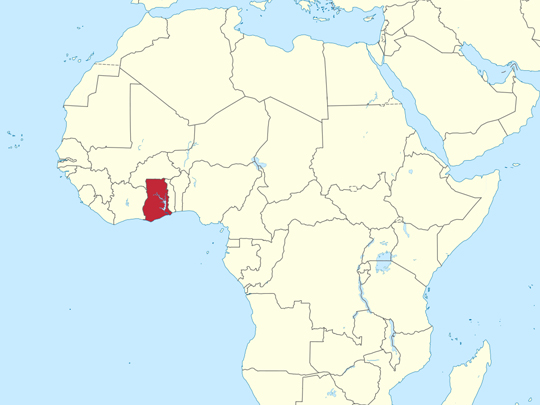
Capital: Accra
Population: 33 million+
Language: English (plus eleven indigenous languages, including Asante Twi, Akuapem Twi, Fante)
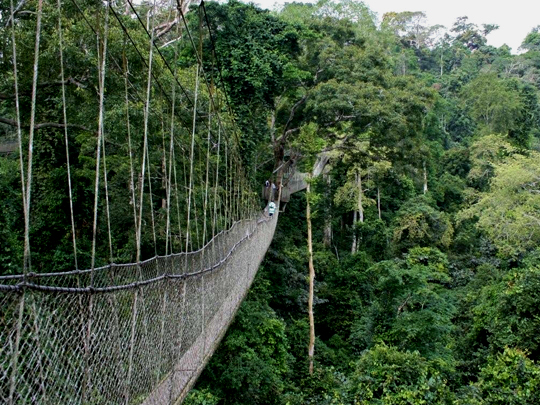
1 – Kakum National Park (above)
Kakum National Park, about 33 km north of Cape Coast, protects a rare patch of tropical rainforest that is home to forest elephants, Diana monkeys and hundreds of bird and butterfly species, though the wildlife stays well hidden beneath the canopy.
The way to experience Kakum is from above, on its celebrated canopy walkway, a chain of seven suspension bridges about 350 m long, strung between giant trees up to 40 m above the forest floor.
When it opened in 1995 the walkway was for years the only one of its kind in Africa, built by Ghana’s wildlife service with Conservation International and US aid funding, and Kakum became one of Ghana’s most visited natural attractions.
2 – Busua
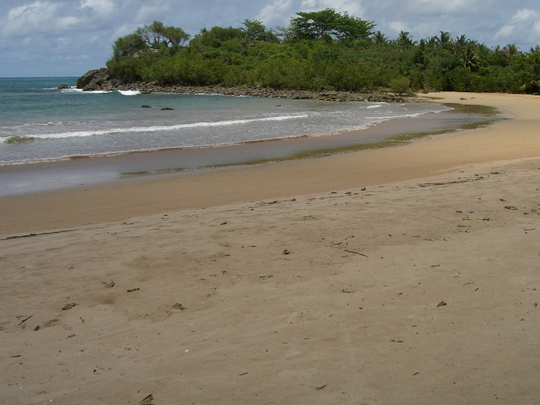
Busua, a fishing village and beach resort in the Ahanta West district of Ghana’s Western Region, about 30 km west of Sekondi-Takoradi, sits on a sheltered golden bay.
Life in Busua runs at beach pace, with surf lessons and boards for hire in one of the centres of Ghana’s surf scene, and a short walk away lie Dixcove, where the British began Fort Metal Cross in 1692, and Butre, guarded by the Dutch Fort Batenstein of 1656.
From 1940 nearby Takoradi was the start of the Takoradi Air Route, where crated British fighters and bombers were assembled and flown some 3,700 miles across Africa to Egypt, more than 4,500 of them by 1943.
3 – Mole National Park
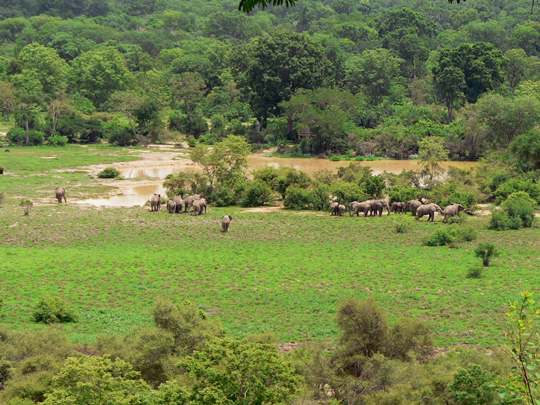
Mole National Park, first protected in 1958 and made a national park in 1971, spreads across some 4,840 km² of Guinea savanna in Ghana’s north, the country’s largest park and home to its most important elephant population.
Guided walking safaris with park rangers lead visitors towards elephants at Mole’s waterholes, while antelope and warthogs roam the surrounding woodland.
Just outside the park stands Larabanga Mosque, a whitewashed mud-and-timber building in the Sudano-Sahelian style, traditionally dated to 1421 and said to be one of the oldest mosques in West Africa, sometimes called the “Mecca of West Africa”.
4 – Elmina Castle
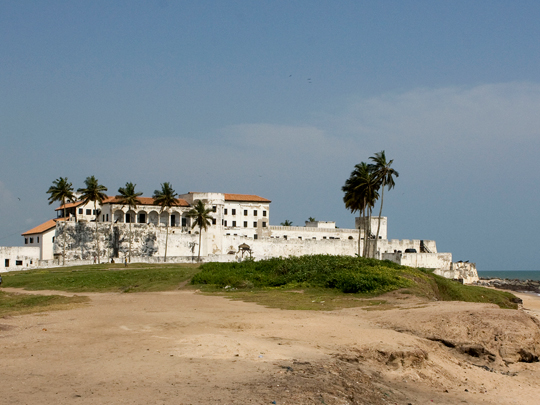
Elmina Castle, on a rocky spit of Ghana’s coast, was built by the Portuguese in 1482 as São Jorge da Mina to control the gold trade, a decade before Columbus crossed the Atlantic, and is the oldest surviving European building in sub-Saharan Africa.
Seized by the Dutch in 1637 and passing to Britain in 1872, Elmina became a major hub of the Atlantic slave trade, and sombre tours lead down into the dungeons where captives were held before passing through the “Door of No Return”.
Elmina is the grandest of a chain of castles and forts along Ghana’s coast, inscribed together by UNESCO in 1979, and in 1883 an Irish nun of the Sisters of Our Lady of Apostles, Sister Ignatius, opened the town’s first girls’ school.
5 – Lake Volta
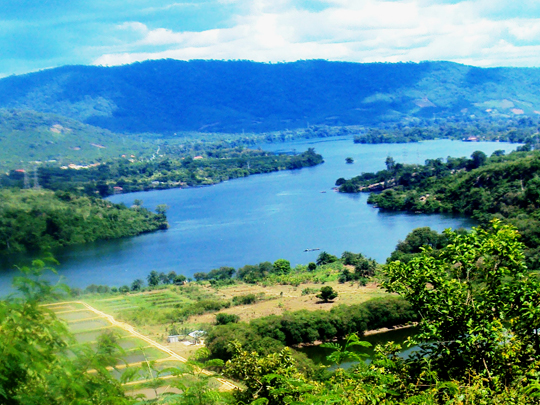
Lake Volta, the world’s largest reservoir by surface area at about 8,500 km², stretches roughly 400 km north from the Akosombo Dam through eastern Ghana.
Ferries cross Lake Volta and fishermen work its waters, while the Akosombo Dam, completed in 1965 as a flagship project of newly independent Ghana, is the country’s largest hydroelectric dam.
The lake began filling in 1964 and took several years to reach its full extent, drowning around 740 villages and moving some 80,000 people to 52 new townships.
6 – Labadi Beach
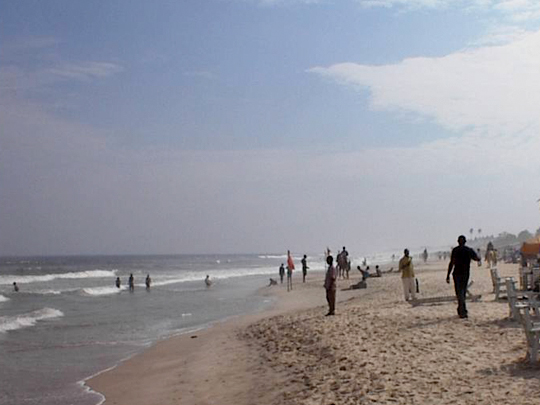
Labadi Beach, formally La Pleasure Beach, is Accra’s most popular beach, a broad sweep of sand on the edge of the capital that is packed at weekends.
Weekends at Labadi bring young horsemen offering rides along the surf line, footballers and swimmers on the sand, and drummers, dancers and DJs at the beach bars.
The soundtrack is pure Ghana, whose music runs from highlife, born in the coastal towns of the Gold Coast in the early 20th century, through hiplife to Afrobeats.
7 – Kumasi
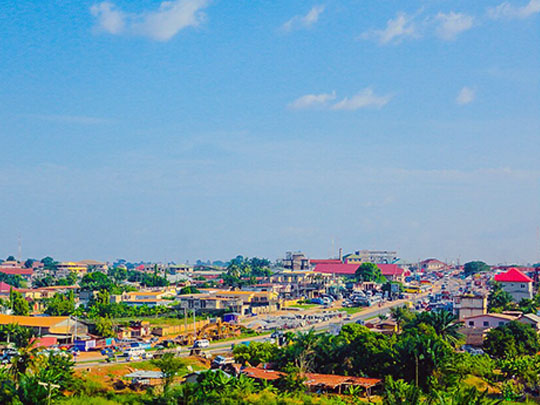
Kumasi, made the Asante capital by Osei Tutu in the late 17th century, is the seat of the Asantehene, whose kingdom grew rich on gold and fought the British through the 19th century, its army killing the Cork-born governor Sir Charles MacCarthy at Nsamankow in 1824.
The old Manhyia Palace, built in 1925 for Prempeh I on his return from exile, is a museum of the dynasty, while Kejetia, often called one of West Africa’s largest markets, sprawls through the city centre and the Asante Traditional Buildings north-east of Kumasi were listed by UNESCO in 1980.
By tradition, the priest Okomfo Anokye called the Golden Stool down from the sky to hold the soul of the Asante nation, and when Governor Frederic Hodgson demanded to sit on it in 1900, Yaa Asantewaa led a rising that ended in her exile to the Seychelles, though the stool stayed hidden for some 20 years.
8 – Nzulezu
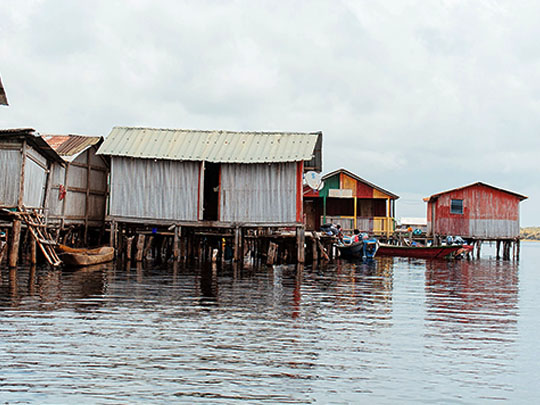
Nzulezu, Nzema for “surface of water”, is a village of several hundred people built on stilts above Lake Tadane in the Amansuri wetland, in Ghana’s far west near Beyin.
A canoe trip of up to an hour from Beyin leads to Nzulezu’s wooden walkways and houses, where school and church are held on the water itself, and Thursday is sacred to the lake, a day of rest from work.
Tradition says the villagers’ ancestors came from Walata in the ancient Ghana Empire, guided by a snail, a story that ties this lake village to the empire whose name the modern country took, and Nzulezu has been on UNESCO’s Tentative List since 2000.
9 – Accra
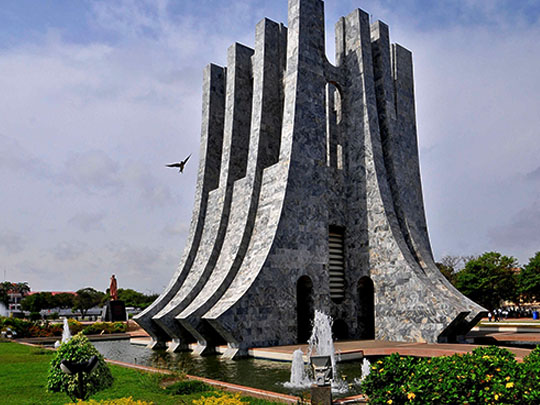

Accra grew from Ga villages around three European forts, Dutch Crèvecoeur, Danish Christiansborg and English James Fort, became capital of the Gold Coast in 1877, and at midnight on 6 March 1957 saw Kwame Nkrumah declare Ghana the first sub-Saharan African colony to win independence from a European power.
Jamestown’s Bukom boxing gyms produced the champion Azumah Nelson, the Kwame Nkrumah Memorial Park stands on the Old Polo Ground where independence was declared, and out at Teshie carpenters have made fantasy coffins in fanciful shapes since Kane Kwei began the craft in 1951.
Independence had its spark at the Christiansborg crossroads, where on 28 February 1948 police fired on Second World War veterans marching to petition the governor over promised pensions, killing three and setting off riots that led to the arrest of Nkrumah and the reforms that brought self-rule.
10 – Cape Coast Castle
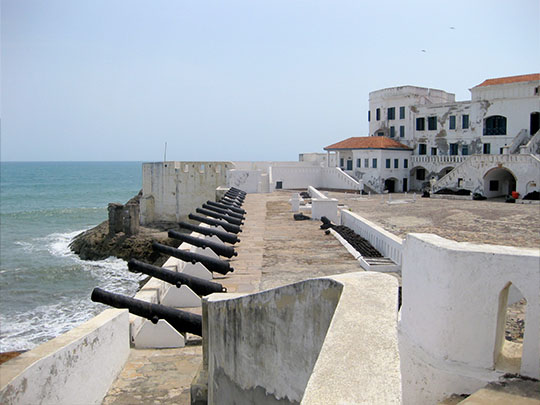

Cape Coast Castle grew from a timber lodge built by the Swedes in the 1650s, passed through Danish and Dutch hands, and from 1664 was English, serving as the headquarters of British rule on the Gold Coast until the government moved to Accra in 1877.
Guided tours lead from the whitewashed ramparts down into the dark, airless dungeons where enslaved Africans were held before shipment across the Atlantic, and the castle, restored after independence, has become a museum of that history.
The last stop for many captives was a gate known as the “Door of No Return”, through which Barack and Michelle Obama walked on their visit in July 2009, and Cape Coast Castle is part of the chain of forts and castles that UNESCO inscribed in 1979.