

Wikimedia Commons / CC-BY-SA-3.0 / GFDL
Capital: Annapolis
Population: 6.2 million+
Language: English (no official language)

1 – Baltimore (also above)

Baltimore, on the Patapsco River where it meets Chesapeake Bay, was founded in 1729 and named after the Calverts, Lords Baltimore, the colony’s proprietors, whose Irish title is generally traced to their estate in County Longford, not the village in County Cork, and Frederick Douglass, who worked as a caulker in Fells Point, escaped slavery from Baltimore in 1838.
Baltimore has the Washington Monument in Mount Vernon, begun in 1815 as the first major monument to George Washington, the old waterfront of Fells Point, the view over the Inner Harbor from Federal Hill and the Irish Railroad Workers Museum, in row houses of 1848 bought by Famine families who worked for the B&O Railroad.
Edgar Allan Poe, whose great-grandfather came from Dring, County Cavan, died in Baltimore in 1849 of causes never explained, and the city’s NFL team, the Ravens, is named after his poem, while Babe Ruth was born here in 1895, and the B&O, chartered in 1827, is usually called the first common-carrier railroad in the US.
2 – Annapolis


Annapolis, on Chesapeake Bay at the mouth of the Severn River, was chosen as Maryland’s capital in 1694 and named after Princess Anne, while its State House, the oldest state capitol in continuous legislative use, was the US capitol in 1783–84, when Washington resigned his commission there and Congress ratified the Treaty of Paris, ending the Revolutionary War.
Annapolis has the State House, its wooden dome held with pegs and iron straps, not nails, the US Naval Academy, founded in 1845, where John Paul Jones lies in a crypt beneath the chapel, and the City Dock memorial where the Lord Ligonier landed enslaved Africans in 1767, the ship Alex Haley named as carrying his ancestor Kunta Kinte, though genealogists dispute the link.
Charles Carroll of Carrollton, born in Annapolis, grandson of an Irish Catholic from County Offaly, was the only Catholic to sign the Declaration of Independence and its last surviving signer, and the Naval Academy has a memorial to John Barry of County Wexford, often called the “father of the American Navy”.
3 – Deep Creek Lake

Deep Creek Lake, in Garrett County on the Appalachian Plateau of far western Maryland, is the state’s largest inland body of water, at about 1,580 ha, created when the Youghiogheny Hydroelectric Company dammed Deep Creek, finishing in 1925, and it lies west of the Eastern Continental Divide, so its water ends up in the Mississippi.
Deep Creek Lake has Deep Creek Lake State Park, for swimming, boating and fishing, the Wisp ski resort and, nearby, the gorge of Swallow Falls State Park, where Muddy Creek Falls, about 16 m, is the highest free-falling waterfall in Maryland.
Henry Ford, Thomas Edison and Harvey Firestone camped at Swallow Falls in July 1921, on one of their celebrated summer road trips, having first camped there in 1918, and Garrett County, Maryland’s last county, formed in 1872, is named after John W. Garrett, president of the B&O Railroad and son of a Lisburn-born Irish immigrant.
4 – Ocean City

Ocean City, on a barrier island on Maryland’s Atlantic coast, grew from a single cottage taking paying guests in 1869 into a resort after the Atlantic Hotel opened on 4 July 1875, and in August 1933 a hurricane cut the inlet that separates the town from Assateague Island.
Ocean City has its boardwalk, more than 3 km long and first laid in 1902, the Herschell-Spillman carousel of 1912 at Trimper’s Rides, one of the oldest in the US, Thrasher’s fries, sold on the boardwalk since 1929 and served with vinegar, and the Life-Saving Station Museum, in a station built in 1891.
Ocean City calls itself the “White Marlin Capital of the World”, with its White Marlin Open first held in 1974, and the wild ponies on neighbouring Assateague are said to descend from a Spanish shipwreck, though the National Park Service thinks it likelier that 17th-century owners grazed them there to dodge fencing laws and taxes.
5 – Fort McHenry

Fort McHenry, a star-shaped fort begun in 1798 on Whetstone Point guarding Baltimore’s harbour, is named after James McHenry, born in Ballymena, County Antrim, who became George Washington’s secretary and secretary of war, and on 13–14 September 1814, its garrison of about 1,000 men withstood some 25 hours of bombardment by the Royal Navy, losing four killed.
Fort McHenry has the ramparts of the star fort and a flag that flies day and night, by a presidential proclamation of 1948, honouring the 9 by 13 m garrison flag sewn in Baltimore by Mary Pickersgill, which was raised only on the morning of 14 September 1814, as a smaller storm flag flew through the night.
Francis Scott Key watched the bombardment of Fort McHenry from an American truce ship, not a British warship, and his poem “Defence of Fort M’Henry”, set to the tune of a London gentlemen’s club song, became the national anthem in 1931, and in 1861 the fort held his grandson, Frank Key Howard, arrested as a Southern sympathiser.
6 – Antietam National Battlefield

Antietam National Battlefield, outside Sharpsburg in western Maryland, keeps the ground of the battle of 17 September 1862, when about 23,000 men were killed, wounded or missing in the bloodiest single-day battle in American history, and Lee’s retreat gave Lincoln the moment to issue the preliminary Emancipation Proclamation.
Antietam has its tour road past the Cornfield, the Dunker Church, the Sunken Road, known ever since as “Bloody Lane”, and Burnside Bridge, and the National Cemetery, while Alexander Gardner’s pictures here, shown in New York as “The Dead of Antietam”, made it the first battlefield photographed before the dead were buried.
The Irish Brigade, led by the Waterford-born Thomas Francis Meagher, charged Bloody Lane after a general absolution from Fr William Corby and lost 540 men, remembered by a monument dedicated in 1997, while the Union had learned Lee’s plans days earlier from a copy of Special Order 191 found near Frederick, wrapped around three cigars.
7 – Catoctin Mountain

Catoctin Mountain, a ridge of the Blue Ridge in Frederick County, north-central Maryland, was mostly worn-out farmland when the federal government bought it in the mid-1930s for a recreation area built by the WPA and later the Civilian Conservation Corps, and since 1954 it has been split between Catoctin Mountain Park and Cunningham Falls State Park.
Catoctin Mountain has Cunningham Falls, a 24 m cascade and the highest waterfall in Maryland, Catoctin Furnace, an ironworks in blast by 1776, built by Thomas Johnson, later Maryland’s first governor, with his brothers, and Blue Blazes, a moonshiners’ site where a deputy sheriff was shot dead in a Prohibition raid in 1929.
Hidden in the woods of Catoctin Mountain Park is the presidential retreat built in 1938–39 as Camp Hi-Catoctin, which Franklin Roosevelt called “Shangri-La” and Eisenhower renamed Camp David in 1953 after his grandson, not his father, as often claimed, and where Carter, Sadat and Begin spent 13 days in 1978 agreeing the Camp David Accords.
8 – Historic St Mary’s City
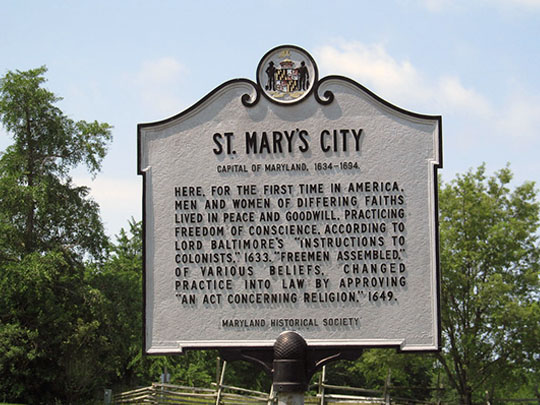
Historic St Mary’s City, on the St Mary’s River near the Potomac, is where the colonists of the Ark and the Dove settled in 1634, in half of a village the Yaocomaco let them occupy, and it was Maryland’s capital until 1694–95, while the colony’s proprietor, Cecil Calvert, never crossed the Atlantic, running Maryland, and an estate at Clohamon, County Wexford, from England.
Historic St Mary’s City has the reconstructed State House of 1676 and Brick Chapel of 1667, described as the first permanent Catholic church in English America, a replica of the Dove, a Woodland Indian hamlet and a 17th-century tobacco plantation.
In 1648, Margaret Brent became the first woman in English America known to demand a vote, and in 1649 the assembly at St Mary’s passed the Act Concerning Religion, a landmark of toleration, though only for Christians who believed in the Trinity, while in 1992 archaeologists opened three lead coffins under the chapel holding Governor Philip Calvert, his first wife and an infant.
9 – Harriet Tubman Underground Railroad National Historical Park

The Harriet Tubman Underground Railroad National Historical Park lies among the marshes of Dorchester County on Maryland’s Eastern Shore, where Tubman was born into slavery as Araminta Ross around 1822, and from where she escaped to Philadelphia in 1849, before coming back about 13 times to lead some 70 people to freedom.
The Harriet Tubman park has its visitor centre near Church Creek, the 201 km Harriet Tubman Byway past the Bucktown Village Store, where an overseer’s 0.9 kg weight hit her head as a young woman and left her with seizures for life, and the marshes of Blackwater National Wildlife Refuge.
The popular claim that Harriet Tubman rescued 300 people in 19 trips comes from an 1869 biography, as her own accounts were far smaller, but in June 1863 she led the Combahee River Raid in South Carolina, often called the first armed expedition led by a woman in US history, which freed more than 700 people, while Cynthia Erivo played her in Harriet (2019).
10 – Frederick Douglass’s birthplace, Talbot County
Frederick Douglass was born in February 1818 near Tuckahoe Creek in Talbot County, on Maryland’s Eastern Shore, recorded only as “Frederick Augustus son of Harriott” in his enslaver Aaron Anthony’s ledger, though he himself thought it was 1817, and he lived in his grandmother’s cabin until he was about six, when he was taken to the Lloyd family’s vast Wye House plantation.
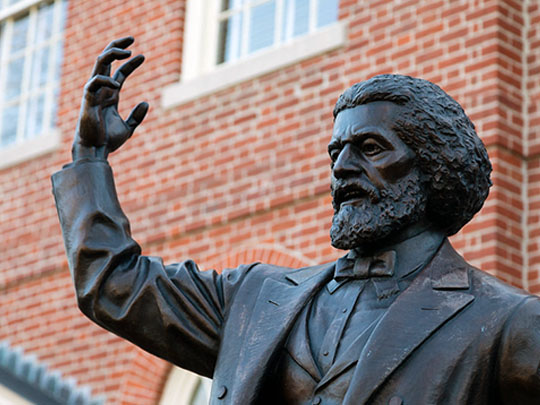
Frederick Douglass’s birthplace is marked by Frederick Douglass Park on the Tuckahoe, opened in 2018 for the bicentenary of his birth, while in Easton, where he was jailed in 1836 after a failed escape plot, his statue on the courthouse lawn shows him giving the lecture he delivered in that courthouse in 1878.
In 1845, Frederick Douglass spent four months in Ireland, where the Dublin Quaker printer Richard Webb published the first Irish edition of his Narrative and he heard Daniel O’Connell speak at Conciliation Hall, writing from Belfast that he had “spent some of the happiest moments of my life since landing in this country”.
11 – Monocacy National Battlefield
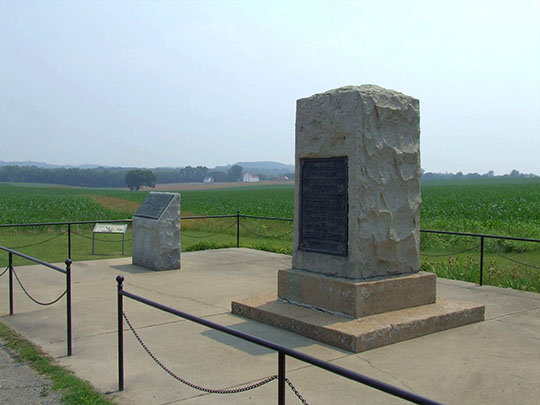
Monocacy National Battlefield, just south of Frederick, keeps the ground where on 9 July 1864 fewer than 7,000 Union troops under Lew Wallace held up some 15,000 Confederates under Jubal Early marching on Washington, and though Wallace lost, the day he bought let Union reinforcements reach the capital first, so it’s known as “the battle that saved Washington”.
Monocacy National Battlefield has the Thomas, Worthington and Best farms, where the fighting raged, with monuments to regiments from New Jersey, Pennsylvania and Vermont and a Confederate memorial, while Ulysses S. Grant wrote that Wallace’s defeat gave the cause “a greater benefit” than many a commander wins by a victory.
Lew Wallace went on to write Ben-Hur (1880), and in the 1959 film, which won 11 Oscars, Messala was played by Stephen Boyd, born in Whitehouse, County Antrim, while on the day of the battle, Early made Frederick hand over a ransom of $200,000, which the town finished repaying in 1951.