

Wikimedia Commons / CC-BY-SA-3.0 / GFDL
Capital: Augusta
Population: 1.4 million+
Language: English

1 – Acadia National Park (also above)

Acadia National Park covers much of Mount Desert Island, the Schoodic Peninsula and part of Isle au Haut, protected from 1916 on land given by wealthy summer residents, and it’s the oldest surviving national park east of the Mississippi, as Michigan’s Mackinac came first, in 1875, but was handed to the state in 1895.
Acadia National Park has the Park Loop Road, 72 km of carriage roads built by John Rockefeller Jr from 1913 to 1940, with stone-faced bridges and granite edging stones nicknamed “Rockefeller’s teeth”, Cadillac Mountain, at 466 m, and popovers at Jordan Pond House, a tradition dating back to the 1890s.
Cadillac Mountain is famous as the first place in the US to see the sunrise, though only from October to early March, bar a few weeks around midwinter, and it is named after Antoine de la Mothe Cadillac, granted the island in 1688, who invented his own noble title, founded Detroit and gave his name to a car.
2 – Portland


Portland, on Casco Bay, Maine’s largest city, has burned four times, in 1676 during King Philip’s War, in 1690 by French and Wabanaki forces, in 1775 when the Royal Navy shelled it, spurring Congress to build up the new Continental Navy, and in the Great Fire of 4 July 1866, so its motto is Resurgam, “I will rise again”.
Portland has the Victorian streets of the Old Port, rebuilt after 1866, the Portland Observatory of 1807, the only surviving maritime signal station in the US, the house where the poet Henry Wadsworth Longfellow grew up and, in neighbouring Cape Elizabeth, Portland Head Light, first lit in 1791, the oldest lighthouse in Maine.
The film director John Ford was born in Cape Elizabeth in 1894 as John Feeney, the son of Irish-born parents from County Galway, and his statue sits in a director’s chair at Gorham’s Corner, Portland’s old Irish neighbourhood, while in 1875 James Healy, whose father was from County Roscommon, became Bishop of Portland, the first African American Catholic bishop.
3 – Bar Harbor

Bar Harbor, on Frenchman Bay on the east side of Mount Desert Island, was incorporated as Eden in 1796, taking its present name in 1918, and after painters such as Thomas Cole and Frederic Church made the island famous in the 1850s it became a Gilded Age resort to rival Newport, where Pulitzers and Vanderbilts built summer “cottages”.
Bar Harbor has the sandbar to Bar Island, walkable for about an hour and a half either side of low tide, the Abbe Museum of Wabanaki culture, lobster on the waterfront and Acadia National Park on its doorstep.
In October 1947, a fire burned about 6,960 ha of the island, destroying 67 estates on “Millionaires’ Row”, 170 homes and five hotels, ending the age of the great cottages, while the conifers that burned grew back as broadleaf trees such as birch and aspen, which is why the autumn colours are so bright.
4 – Katahdin

Katahdin, in Baxter State Park in the forests of north-central Maine, is the state’s highest mountain, at about 1,606 m, its Penobscot name meaning “the greatest mountain”, sacred to the Penobscot and other Wabanaki nations, and it marks the northern end of the Appalachian Trail, about 3,500 km from Georgia.
Katahdin can be climbed to its bare summit by several trails, including the narrow ridge of the Knife Edge, in Baxter State Park, more than 81,000 ha of wilderness left as it was.
Percival Baxter, as governor, couldn’t persuade the legislature to protect Katahdin, so he bought the land himself, from 1930 to 1962, and gave it to Maine on condition it be kept “forever wild”, while Henry David Thoreau, turned back by cloud short of the summit in 1846, wrote on the way down: “Contact! Contact! Who are we? Where are we?”
5 – Fort Knox

Fort Knox stands above the Penobscot River at Prospect in mid-coast Maine, built of local granite from 1844 to 1869 to guard the river after British raids up the Penobscot in the War of 1812 and a border dispute with Canada in 1838–39, though it was never fully finished and never fired a shot in anger.
Fort Knox has granite passageways and gun rooms beside the Penobscot Narrows Bridge, whose 128 m tower has an observatory billed as the tallest public bridge observatory in the world, while down the bay at Castine, in 1779, the Penobscot Expedition against a British fort ended with the Americans losing their whole fleet, much of it burned by its own crews.
Fort Knox is named after Henry Knox, the Revolution’s artillery chief, whose Ulster-Scots parents came to Boston from Derry in 1729, his father a founding member of Boston’s Charitable Irish Society, and he hauled about 54 tonnes of cannon some 480 km from Ticonderoga to Boston in the winter of 1775–76, while the Kentucky Fort Knox was named in 1918.
6 – Camden

Camden, on Penobscot Bay in mid-coast Maine, sits where the Camden Hills come down to the harbour, one of only two places on the Atlantic seaboard “where the mountains meet the sea”, as the town puts it, and it’s named after Charles Pratt, 1st Earl Camden, a British Lord Chancellor who sided with the American colonists.
Camden has Mount Battie, in Camden Hills State Park, with its stone tower of 1921, a First World War memorial, and views over the bay and its islands, while its fleet of windjammer schooners began when Captain Frank Swift started cruises from the harbour in 1936.
The poet Edna St Vincent Millay grew up in Camden, and her poem “Renascence” (1912) is traditionally linked to the view from Mount Battie, while reading it aloud at the Whitehall Inn won her a patron, Caroline Dow, who helped send her to Vassar, and the film Peyton Place (1957) was shot here.
7 – Fort Scammel
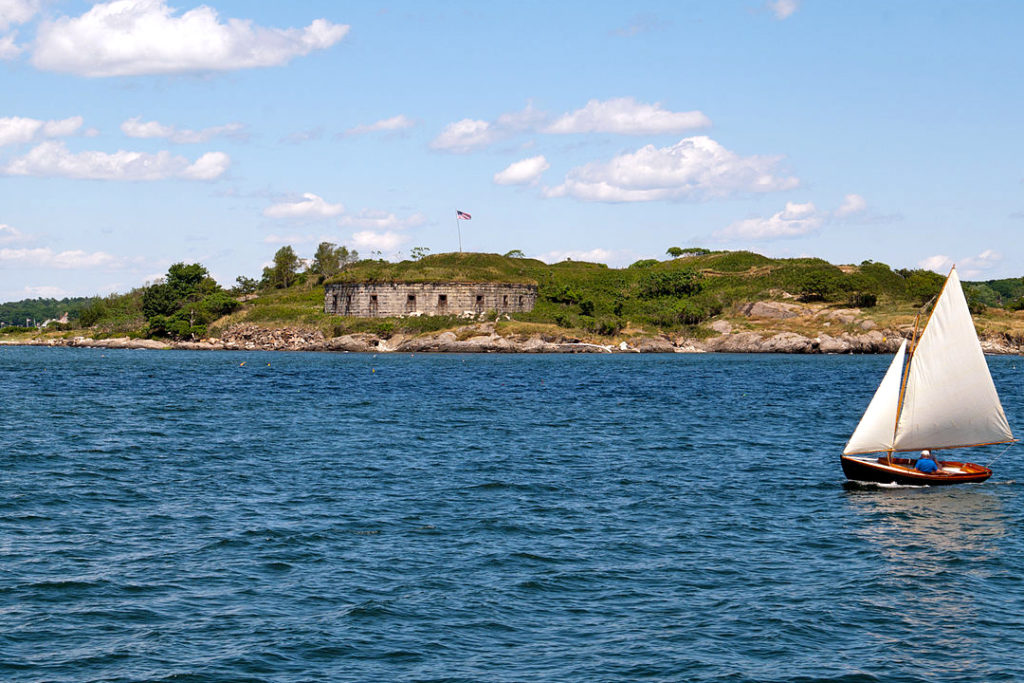
Fort Scammel stands on House Island in Portland Harbor, begun in 1808 and named after Colonel Alexander Scammell, a former adjutant general of the Continental Army, mortally wounded at Yorktown in 1781, and rebuilt from 1862 with stone bastions, though it was never finished.
Fort Scammel’s walls can be seen from the boats that cruise Portland Harbor, as House Island is privately owned, and the island is traditionally said to take its name from a house built in 1623 by the English explorer Christopher Levett, whose ten men left behind vanish from the records.
From 1907 to 1937 House Island was a federal immigration and quarantine station, nicknamed the “Ellis Island of the North”, and in 1948 Fort Scammel was sold for $1,200 to a buyer who planned to sell its granite for a breakwater, though the fort survived.
8 – Mount Desert Island

Mount Desert Island, at about 280 km² the largest island in Maine, was named by Samuel de Champlain, who landed in September 1604 and called it Isle des Monts Déserts for its bare, rocky summits, and in 1613 a French Jesuit mission here was destroyed by Samuel Argall from Virginia, the first English attack on French settlement in Acadia.
Beyond Bar Harbor, Mount Desert Island has the quieter harbour villages of Northeast Harbor, Southwest Harbor and Tremont, and Somes Sound, a long arm of the sea that almost cuts the island in two.
Somes Sound was long called the only fjord on the US East Coast, but geologists call it a “fjard”, and locals argue over whether to say “desert” or “dessert”, while Skylands at Seal Harbor was built in the mid-1920s for Edsel Ford, grandson of a Famine emigrant from County Cork, and was later bought by Martha Stewart.
9 – Battery Steele

Battery Steele stands in the woods of Peaks Island, a short ferry ride from Portland, begun in 1942 to hold two 406 mm guns that could hurl a shell of about 900 kg some 42 km, guarding Casco Bay, a key US Navy anchorage and base for Atlantic Fleet destroyers in the Second World War.
Battery Steele’s long, dark concrete casemates, their walls covered in graffiti, can be walked into, as the battery is part of the Peaks Island Land Preserve, open to visitors on foot or by bike.
Battery Steele, one of only a couple of dozen batteries of its size completed in the US, never fired at an enemy and was disarmed after the war, and the island story that test firing shattered every window on Peaks is exaggerated, though some panes did break.
10 – Popham Colony

The Popham Colony was planted in August 1607 at the mouth of the Kennebec River in Phippsburg by about 100 to 120 men and boys under George Popham and Raleigh Gilbert, the first English colony in New England, 13 years before the Pilgrims, but it was abandoned within about 14 months, after Popham died and Gilbert went home to inherit the family estate.
At the Popham Colony site archaeologists began uncovering Fort St George in 1994, guided by a 1607 plan by the colonist John Hunt, found in Spain’s archive at Simancas in 1888, and nearby are Fort Popham, an unfinished granite fort begun in 1862, and Popham Beach State Park.
The Popham colonists built the Virginia, a pinnace of about 30 tons, thought to be the first ocean-going ship built by English colonists in the Americas, which reached Jamestown in 1609, while their backer, Sir John Popham, the Lord Chief Justice who tried Raleigh and the Gunpowder Plotters, was allotted Mallow, County Cork, in the Munster plantation, but gave it up.
11 – Brunswick

Brunswick, on the Androscoggin River in southern Maine, grew around the Pejepscot Falls, where an English trader settled in the 1620s, and Ulster families from the Bann Valley in County Derry arrived with their minister, James Woodside, in 1718, while Bowdoin College, opened in 1802, counted Longfellow and Hawthorne in its class of 1825.
Brunswick has the house where Harriet Beecher Stowe lived while writing Uncle Tom’s Cabin, pew 23 in First Parish Church, where she said the book came to her in a vision, Joshua Chamberlain’s house museum and Bowdoin’s Peary–MacMillan Arctic Museum, though the story that Lincoln greeted Stowe as “the little woman who wrote the book that started this great war” is probably invented.
Joshua Chamberlain, a Bowdoin professor, led the 20th Maine at Little Round Top at Gettysburg on 2 July 1863 and received the Confederate surrender of arms at Appomattox, his men saluting at “carry arms”, later governing Maine and running Bowdoin, and Jeff Daniels played him in Gettysburg (1993), from Michael Shaara’s Pulitzer-winning novel The Killer Angels.
12 – West Quoddy Head

West Quoddy Head, near Lubec on the Canadian border in Down East Maine, is the easternmost point of the contiguous United States, and a lighthouse has stood here since 1808, authorised by Congress under Thomas Jefferson in 1806.
West Quoddy Head has the candy-striped lighthouse of 1858, with eight red bands, seven white ones and its original Fresnel lens, the clifftop paths of Quoddy Head State Park, with views to Grand Manan, and nearby Campobello Island, where Franklin Roosevelt was struck by paralysis in 1921.
In April 1866, Irish Fenians massed at Eastport hoping to seize Campobello from Britain, a scare that helped push New Brunswick into Canadian Confederation, and in 1897–98 Lubec was the base for a swindle in which the Baptist minister Prescott Jernegan and the diver Charles Fisher raised a fortune to extract gold from seawater, gold that had been planted, before both fled to Europe.
13 – Bath


Bath, on the Kennebec River in mid-coast Maine, has built ships since at least 1743, and by the mid-1800s it was one of the five largest seaports in the US, while Bath Iron Works took its name in 1884 under Thomas W. Hyde, a Civil War officer awarded the Medal of Honor for Antietam.
Bath has the Maine Maritime Museum, on the site of the Percy & Small shipyard, where a steel outline marks the Wyoming, a six-masted schooner launched in 1909, the largest known wooden sailing ship, lost with all hands off Cape Cod in 1924, and Bath Iron Works, which built 82 destroyers in the Second World War, about a quarter of the US total.
On 6 July 1854, a mob stirred up by a street preacher calling himself the “Angel Gabriel”, John Orr, smashed the pews of the Old South Church, bought by Bath’s Irish Catholics, ran an American flag up its belfry, then burned the church, in the anti-immigrant Know-Nothing wave that saw a Swiss Jesuit priest, John Bapst, tarred and feathered in Ellsworth that October.