

Wikimedia Commons / CC-BY-SA-3.0 / GFDL
Capital: Baton Rouge
Population: 4.6 million+
Language: English, French (no official language)

1 – New Orleans (also above)

New Orleans, on a bend of the Mississippi, was founded in 1718 by Bienville and named after the Duke of Orléans, regent of France, and after Spain took over in the 1760s fires in 1788 and 1794 burned most of the town, so the French Quarter was largely rebuilt in Spanish style, while Hurricane Katrina in 2005 left about 80% of the city under water.
New Orleans has Jackson Square, St Louis Cathedral and the Cabildo, where Louisiana was handed to the US in 1803, Bourbon Street, named in 1721 after the French royal house, not the whiskey, the jazz of the city where Louis Armstrong was born on 4 August 1901, and Mardi Gras.
Irish labourers dug the New Basin Canal in the 1830s, and many died of fever, though the famous figure of 10,000 dead seems to date from a 1937 newspaper quoting a song, and in 2014, Ireland held its International Famine Commemoration here, while Alejandro O’Reilly, from County Meath, who crushed the Creole revolt of 1768, is remembered as “Bloody O’Reilly”.
2 – Lafayette

Lafayette, on the Vermilion River in southwest Louisiana, was founded in 1821 as Vermilionville and renamed in 1884 after the Marquis de Lafayette, and it’s the heart of Acadiana, home of the Cajuns, descendants of the French Acadians expelled by the British from Nova Scotia from 1755, about 1,600 of whom sailed to Louisiana from France in seven ships in 1785.
Lafayette has Vermilionville, a living-history village of Acadian and Creole life, Cajun music, zydeco, boudin and crawfish, and in April the free Festival International de Louisiane, which draws hundreds of thousands of people.
The word “Cajun” comes from “Cadien”, a shortened form of “Acadien”, while the zydeco accordionist Clifton Chenier, from near Opelousas, won a Grammy in 1984, and the Acadian heroine Evangeline, whose legend is celebrated in nearby St Martinville, was invented by Longfellow in 1847.
3 – Shreveport

Shreveport, on the Red River in northwest Louisiana, was founded in 1836 and named after Captain Henry Miller Shreve, who from 1833, cleared the Great Raft, a logjam that choked well over 160 km of the river, and it was Louisiana’s Confederate capital from 1863 to 1865, headquarters of the last major Confederate army to surrender.
Shreveport has the Municipal Auditorium, home of the Louisiana Hayride radio show from 1948 to 1960, riverboat casinos on the Red River and Barksdale Air Force Base, where President George W. Bush was flown on 11 September 2001.
Elvis Presley made his Louisiana Hayride debut in Shreveport on 16 October 1954, aged 19, so his parents had to sign his contract, for $18 a show, and on 15 December 1956, at a charity show for the YMCA in the city, the Hayride’s producer, Horace Logan, made famous the line “Elvis has left the building”.
4 – Baton Rouge

Baton Rouge stands on bluffs above the Mississippi, named for the “red stick”, a pole stained red to mark the boundary between the hunting grounds of two Native peoples, that the French explorer Iberville’s party saw in 1699, and it has been Louisiana’s capital since 1850, apart from the Civil War and Reconstruction years.
Baton Rouge has the Louisiana State Capitol, at 137 m the tallest state capitol in the US, finished in 1932, with an observation deck on its 27th floor, and the Old State Capitol, a Gothic castle first used by the legislature in 1850, which Mark Twain called a “little sham castle”.
Huey Long, the former governor who built the new Capitol, was shot in its corridors on 8 September 1935, dying two days later, and is buried in front of it, while officially his assassin was Dr Carl Weiss, riddled with more than 60 bullets by Long’s bodyguards, though a long-running theory holds that their bullets killed Long.
5 – Oak Alley Plantation

Oak Alley Plantation lies on the west bank of the Mississippi at Vacherie, between New Orleans and Baton Rouge, and its 28 live oaks were planted by an unknown settler in the early 1700s, a century before enslaved people built the house in 1837–39 for the sugar planter Jacques Telesphore Roman, with an average of 110 to 120 people enslaved here.
Oak Alley has its 244 m avenue of oaks leading to the Greek Revival house, a slavery exhibit, opened in 2013, with rebuilt cabins and the names of nearly 200 people enslaved here, and it appears in Interview with the Vampire (1994) and Beyoncé’s “Déjà Vu” video.
In the winter of 1846–47 an enslaved gardener at Oak Alley known as Antoine grafted 16 pecan trees, creating the first named variety of paper-shell pecan, which won a diploma at the 1876 Centennial Exposition in Philadelphia and was later known as “Centennial”.
6 – Barataria Preserve

The Barataria Preserve, part of Jean Lafitte National Historical Park and Preserve, protects about 10,500 ha of swamp, bayou and marsh just south of New Orleans, and its name is said to come from Barataria, the island Sancho Panza is given to govern in Don Quixote.
The Barataria Preserve has boardwalks through cypress swamp, with alligators and herons, the Twin Canals Trail and a canoe launch, while Jean Lafitte National Historical Park also takes in Chalmette Battlefield, where Andrew Jackson defeated the British on 8 January 1815, two weeks after peace had been signed at Ghent.
The privateer Jean Lafitte ran his smuggling base on Barataria Bay, and his men helped Jackson defend New Orleans in 1815, earning him a pardon, though the “journal” claiming he lived into the 1850s is thought to be a forgery, while a 2017 USGS study found coastal Louisiana losing land at about an American football field every 100 minutes.
7 – Lake Pontchartrain

Lake Pontchartrain is a shallow, brackish estuary of about 1,630 km² on the northern edge of New Orleans, only about 4 m deep on average, and it was named in 1699 by the French explorer Iberville after the comte de Pontchartrain, Louis XIV’s minister of the navy.
Lake Pontchartrain is crossed by the Causeway, about 38 km long, its first span opened in 1956, from Metairie to Mandeville on the north shore, while the Bonnet Carré Spillway, first used in 1937, diverts Mississippi floodwaters into the lake, and in 2019 it was opened twice in a single year for the first time.
The Lake Pontchartrain Causeway has held the Guinness record for the longest continuous bridge over water since 2011, when Guinness split the title to give China’s Jiaozhou Bay Bridge an aggregate record, and the lake, once badly polluted, came off the state’s list of impaired waters in the mid-2000s, though in Katrina it was the floodwalls of canals running from it that failed.
8 – Whitney Plantation
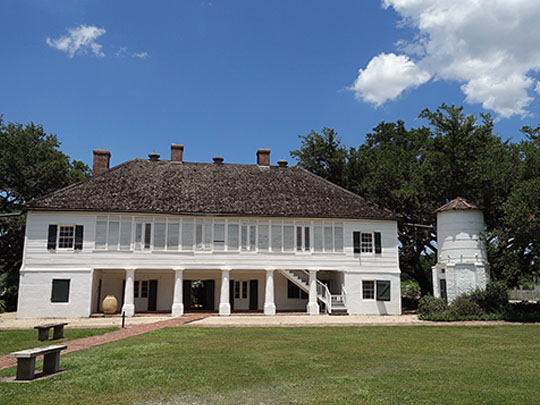

Whitney Plantation, on the River Road at Wallace, above New Orleans, was founded in 1752 by a German immigrant, Ambroise Heidel, and grew indigo and then sugar, while across the river the German Coast Uprising of January 1811, the largest revolt of enslaved people in US history, ended with close to 100 rebels killed and their heads displayed on poles along the levee.
Whitney Plantation, a museum since 2014, tells its story through the eyes of the enslaved, with a Wall of Honor for the 350 people enslaved here, walls carrying 107,000 names of people enslaved in Louisiana before 1820, the Field of Angels for 2,200 enslaved children who died in the parish between 1823 and 1863, and Woodrow Nash’s sculptures of children.
Whitney Plantation was created by a white New Orleans lawyer, John Cummings, who bought it from a chemical company in 1999, spent millions of his own money on it and gave it to a nonprofit in 2019, and though it’s often called America’s first slavery museum, Charleston’s Old Slave Mart Museum opened in 1938.
9 – Poverty Point

Poverty Point, in the farmland of northeast Louisiana, is a vast earthwork built around 1700–1100 BC, six concentric C-shaped ridges facing Bayou Maçon, with great mounds, raised by people who hunted, fished and gathered rather than farmed, and in 2014 it became Louisiana’s first World Heritage Site.
Poverty Point World Heritage Site has a circuit of the ridges, Mound A, 22 m high, and a museum with the baked clay “Poverty Point objects” heated for cooking in earth ovens, along with soapstone from the Appalachian foothills and other stone brought hundreds of kilometres by trade.
Poverty Point’s Mound A, built of about eight million basketloads of soil, is the second-largest earthen mound in North America, and researchers concluded in 2013 that it was raised in under 90 days, while the site takes its name from a 19th-century cotton plantation, and it isn’t the oldest mound site in Louisiana, as Watson Brake is nearly 2,000 years older.
10 – Natchitoches


Natchitoches, pronounced “NAK-a-tish”, on Cane River Lake in northwest-central Louisiana, was founded in 1714 by the French officer Louis Juchereau de St Denis as a trading post, and it’s often called the oldest permanent European settlement in the Louisiana Purchase, though its river was left behind when the Red River shifted east in the 19th century.
Natchitoches has Front Street’s brick shopfronts along the lake, the rebuilt French fort of St Jean Baptiste, its meat pies, the Christmas Festival of Lights, with hundreds of thousands of lights, and the Creole plantations of the Cane River, including Melrose, where the folk artist Clementine Hunter painted.
Steel Magnolias (1989) was filmed in Natchitoches, and Clementine Hunter, who began painting at about 50 and made more than 5,000 works, became the first African American artist with a solo show at New Orleans’ Delgado Museum in 1955, while Melrose was founded not by the freed woman Marie Thérèse Coincoin, as legend says, but by her son Louis Metoyer.
11 – Laura Plantation
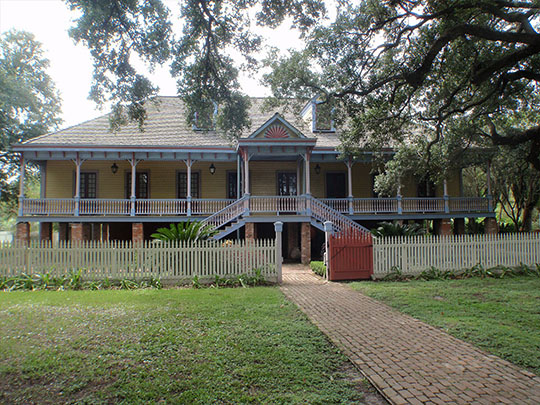
Laura Plantation, on the west bank of the Mississippi at Vacherie, was founded as a Creole sugar plantation in 1805 by Guillaume Duparc and Nanette Prud’homme, and women ran it for nearly a century, the last of them Laura Locoul Gore, who sold it in 1891 on condition it kept her name.
Laura Plantation has its brightly painted raised Creole house, restored after an electrical fire in 2004 destroyed about 80% of it, and six surviving cabins of the enslaved, lived in by farm workers until 1977, while its tours draw on Laura’s own memoir, found in St Louis in 1993 and published in 2000.
The folklorist Alcée Fortier collected stories of Compair Lapin, the Louisiana Br’er Rabbit, from enslaved people’s descendants at Laura Plantation in the 1870s, publishing them in 1895, though Joel Chandler Harris’s Uncle Remus came out first, in 1880.