

Wikimedia Commons / CC-BY-SA-3.0 / GFDL
Capital: Frankfort
Population: 4.6 million+
Language: English

1 – Louisville (also above)

Louisville stands on the Ohio River at the Falls of the Ohio, where George Rogers Clark founded it on Corn Island in 1778, and it’s named after Louis XVI, France’s king, for his help in the American Revolution — today it’s Kentucky’s largest city, with about 640,000 people.
In Louisville you can see the 120-foot steel bat outside the Louisville Slugger Museum and Factory, cruise the Ohio on the Belle of Louisville, built in 1914 and the oldest river steamboat still running, and visit the Muhammad Ali Center, in the city where Ali was born in 1942 and took up boxing at 12 after reporting his stolen bike to a policeman who coached boxing.
On election day, 6 August 1855, anti-Catholic “Know-Nothing” mobs attacked Louisville’s Irish and German neighbourhoods, burning the Irish homes of Quinn’s Row and killing about 22 people in what became known as “Bloody Monday” — and Ali’s famous story of throwing his Olympic gold medal into the Ohio was, according to his book’s editor, Toni Morrison, one he denied himself.
2 – Red River Gorge

Red River Gorge is a sandstone canyon in the Daniel Boone National Forest in eastern Kentucky, with more than 100 natural arches, and its rock shelters hold evidence that people here were among the first in North America to grow crops such as sunflower and squash, thousands of years ago.
In Red River Gorge you can hike to the Sky Bridge arch, drive through the Nada Tunnel, a single-lane logging tunnel of 1910–12, try some of the best rock climbing in the eastern US, and see the arch at Natural Bridge State Resort Park next door.
In the 1960s the Army Corps of Engineers planned to dam and flood Red River Gorge, until Supreme Court Justice William O. Douglas joined a protest hike in November 1967 and the money ran out, and in 1993 the river became Kentucky’s only National Wild and Scenic River — while Sky Bridge appears in Burt Lancaster’s The Kentuckian (1955).
3 – Cumberland Falls

Cumberland Falls drops about 68 feet across a 125-foot-wide ledge on the Cumberland River in southeast Kentucky, earning it the name “Niagara of the South”, and in 1930 the legislature overrode the governor, who wanted a hydroelectric plant, to accept T. Coleman du Pont’s offer to buy the falls for a state park, opened in 1931.
At Cumberland Falls State Resort Park you can watch from the overlooks, walk to Eagle Falls, stay at the DuPont Lodge, built by Depression-era work crews, and come back on a clear night around the full moon to see the moonbow.
The Cumberland Falls moonbow, a rainbow lit by moonlight in the spray, is often billed as the only one in the Western Hemisphere, but Yosemite Falls has them too — it’s one of very few waterfalls where a moonbow can be reliably predicted.
4 – Lexington

Lexington, at the heart of the Bluegrass region of central Kentucky, takes its name, by tradition, from a party of frontiersmen camped here in June 1775 who heard the news of the Battle of Lexington in Massachusetts, and Transylvania University, chartered in 1780, calls itself the oldest university west of the Alleghenies.
Around Lexington you can drive past the white-fenced horse farms, visit the Kentucky Horse Park, with the grave and statue of the racehorse Man o’ War, and watch the races or the yearling sales at Keeneland, opened in 1936, where Seabiscuit was filmed.
In 1985 the Irish horsemen John Magnier, Vincent O’Brien and Robert Sangster paid a record $13.1 million at Keeneland for a yearling, Seattle Dancer, and their Coolmore operation, based in Fethard, Co. Tipperary, owns Ashford Stud outside Lexington, home of the 2018 Triple Crown winner, Justify.
5 – Churchill Downs

Churchill Downs, in Louisville, opened on 17 May 1875, founded by Meriwether Lewis Clark Jr., grandson of the explorer William Clark, on land leased from his uncles John and Henry Churchill, and the first Kentucky Derby was won by Aristides, ridden by Oliver Lewis, one of 13 Black jockeys in the field of 15.
At Churchill Downs you can see the Twin Spires of 1895 and the Kentucky Derby Museum, and on the first Saturday in May join the crowds for the “Run for the Roses”, with mint juleps, big hats, a garland of more than 400 roses for the winner, and “My Old Kentucky Home” sung before the race.
Black jockeys won 15 of the first 28 Kentucky Derbies, until 1902, and in 2026 Golden Tempo made Cherie DeVaux the first woman to train a Derby winner — while the Clare-born breeder Gerry Dilger co-bred the 2017 winner, Always Dreaming, with Mike Ryan, who grew up on a stud in Co. Meath.
6 – Sanders Cafe

The Harland Sanders Café stands on the old US 25 at Corbin, in southeast Kentucky, where Harland Sanders, born in Indiana in 1890, began feeding travellers at a filling station in 1930, became an honorary Kentucky Colonel in 1935 and reopened his café and motel in 1940 after a fire.
At the Harland Sanders Café and Museum you can see the kitchen where he worked out his pressure-fried chicken and its 11 herbs and spices, his office and a model motel room, and a modern KFC next door still serves the chicken.
In 1931 a feud with a rival over an advertising sign ended in a shootout in which the rival, Matt Stewart, killed a Shell manager, and when the new I-75 bypassed Corbin, Colonel Sanders sold up at 65 and took to the road, franchising his recipe — the first KFC was in Utah in 1952, and he sold the company in 1964 for $2 million.
7 – Mary Todd Lincoln House

The Mary Todd Lincoln House, on West Main Street in Lexington, was built around 1803–06 as an inn and became the home of Robert Todd in 1832, when his daughter Mary was 13, and she lived here until 1839, when she left for Springfield, Illinois, where she would marry Abraham Lincoln.
The Mary Todd Lincoln House opened in 1977 as the first house museum in the US to honour a First Lady, and Abraham Lincoln stayed here for about three weeks in 1847 with Mary and their sons, when he is said to have heard his hero Henry Clay speak in town.
The Civil War split the Todds: four of Mary’s brothers fought for the Confederacy, two of them dying, and her brother-in-law General Ben Hardin Helm was killed at Chickamauga in 1863, after which his widow, Emilie, stayed at the White House with the Lincolns.
8 – Frankfort

Frankfort, in the valley of the Kentucky River, has been Kentucky’s capital since 1792, chosen because its backer, Andrew Holmes, offered more land, money and building materials than rival towns, and its name is said to come from Frank’s Ford, where a settler, Stephen Frank, was killed around 1780.
In Frankfort you can tour the State Capitol of 1909–10 and its Floral Clock, 34 feet across, see the Old State Capitol of 1827–30, with its self-supporting stone staircase, visit the Buffalo Trace Distillery, which kept making whiskey through Prohibition for “medicinal” use, and see Daniel Boone’s grave in Frankfort Cemetery.
In January 1900 Governor William Goebel was shot outside the Old State Capitol and sworn in on his deathbed, the only sitting US state governor ever assassinated, and Daniel Boone’s grave may not hold Boone at all — his remains were dug up in Missouri in 1845, perhaps from the wrong grave, and Missouri still claims him.
9 – Abraham Lincoln Birthplace National Historical Park

The Abraham Lincoln Birthplace National Historical Park, near Hodgenville in central Kentucky, marks Sinking Spring Farm, where Lincoln was born on 12 February 1809, and nearby Knob Creek Farm, where his family lived until he was seven.
At the Lincoln Birthplace you can climb the 56 steps, one for each year of his life, to the Memorial Building, designed by John Russell Pope, its cornerstone laid by Theodore Roosevelt on the 1909 centenary, see the spring that gave the farm its name and visit Knob Creek, where a neighbour’s boy once saved young Lincoln from drowning.
The log cabin inside the memorial is only “symbolic” — tree-ring dating in 2004 put its logs at around 1848, and in its touring days it was exhibited beside a supposed birth cabin of Jefferson Davis, whose logs got mixed up with Lincoln’s at Coney Island.
10 – Mammoth Cave National Park

Mammoth Cave National Park, in the hills of south-central Kentucky, protects the longest known cave system in the world, with more than 426 miles mapped, and the cave was mined for saltpetre to make gunpowder in the War of 1812, by enslaved workers.
At Mammoth Cave you can take ranger-led tours through vast chambers and narrow passages, from short walks to crawling expeditions, and cross the Green River on its little ferry, reopened in March 2026, while the early guide Stephen Bishop, an enslaved teenager who mapped much of the cave and was freed in 1856, is buried nearby.
In 1842–43 the cave’s owner, Dr John Croghan, son of a Dublin-born Revolutionary officer, ran a tuberculosis hospital inside it, where several patients died, and in 1972 Patricia Crowther squeezed through the “Tight Spot” to link it to the Flint Ridge caves — her husband, Will, went on to write Colossal Cave Adventure, the first text adventure game, based on Mammoth Cave.
11 – Cumberland Gap
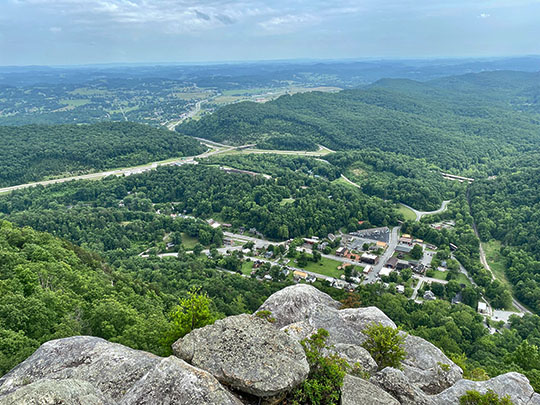

Cumberland Gap is a notch in the Cumberland Mountains where Kentucky, Virginia and Tennessee meet, used for centuries by bison and Native Americans, and in 1775 Daniel Boone and a party of axemen cut the Wilderness Road through it — an estimated 200,000 to 300,000 settlers followed by 1810, the Scots-Irish prominent among them.
At Cumberland Gap National Historical Park you can walk the Wilderness Road through the pass, drive up to the Pinnacle Overlook, at 2,505 feet, for views over three states, and tour the Hensley Settlement, a mountain community farmed from 1903 until its last resident left in 1951.
Cumberland Gap takes its name, via the Cumberland River, from the Duke of Cumberland, victor over the Jacobites at Culloden in 1746, and in 1996 twin tunnels took the highway under the mountain so the road through the pass could be torn up and the gap restored to how it looked in 1780–1810 — in the Civil War a Union general called it the strongest position he’d seen, “except Gibraltar”.
12 – Bourbon Trail
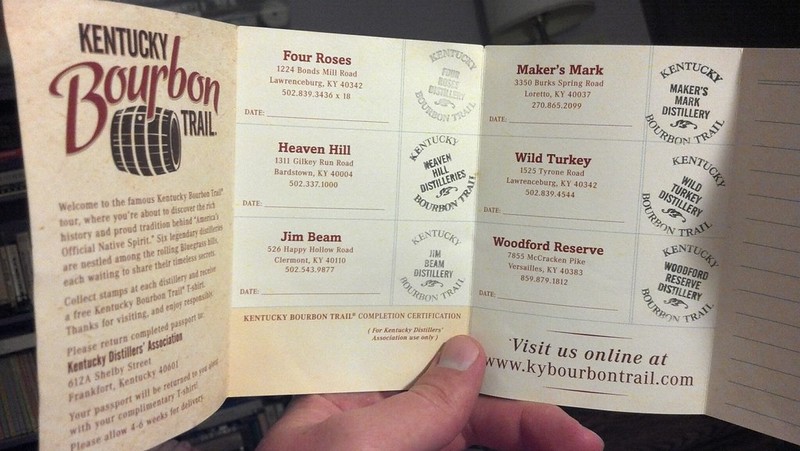
The Kentucky Bourbon Trail, launched by the Kentucky Distillers’ Association in 1999, links the distilleries of central Kentucky, which had 2.7 million visits in 2024, and the state now has more than 16 million barrels of bourbon ageing — more than three for every Kentuckian.
On the Bourbon Trail you can tour the rickhouses and stillrooms of distilleries old and new, and at Maker’s Mark in Loretto watch bottles still being hand-dipped in red wax, a seal devised by Margie Samuels in the 1950s and protected in court in 2012, when Cuervo lost a case over a tequila with a similar drip.
Bourbon is usually said to be named after Bourbon County, though the historian Michael Veach argues it came from New Orleans’ Bourbon Street, and the story that the preacher Elijah Craig invented it is a legend — and since bourbon must age in new charred oak, the used Kentucky barrels go overseas to age Irish whiskey, Jameson among them.
13 – Perryville Battlefield
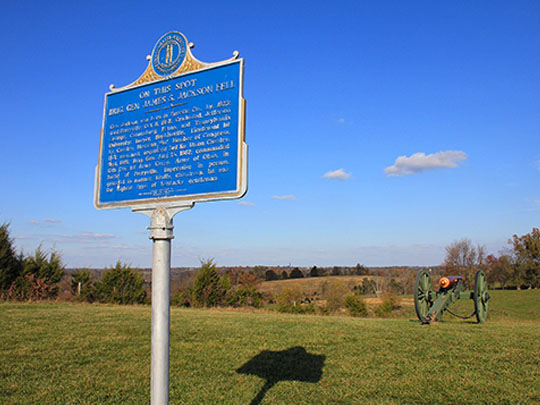
Perryville, in the rolling farmland of central Kentucky, was the scene on 8 October 1862 of the state’s largest Civil War battle, when a Confederate army invading Kentucky fought Union troops over scarce water in a drought, with about 7,600 killed, wounded or missing — the Confederates then withdrew, and Kentucky stayed in the Union — Lincoln had written in 1861 that “to lose Kentucky is nearly the same as to lose the whole game”.
Perryville Battlefield State Historic Site protects more than 1,000 acres of fields and ridges, with walking trails and monuments, and holds a commemoration each October, with living history and artillery firings.
The Union commander, Don Carlos Buell, barely heard the battle from his headquarters nearby, because of an “acoustic shadow”, while the Cork-born Confederate general Patrick Cleburne, born on St Patrick’s Day 1828, had his horse killed under him by a cannonball and fought on wounded — and across the field the mostly Irish 10th Ohio, the “Bloody Tenth”, fought for the Union.