
Wikimedia Commons / CC-BY-SA-3.0 / GFDL
Capital: London
Population: 58.8 million+
Language: English

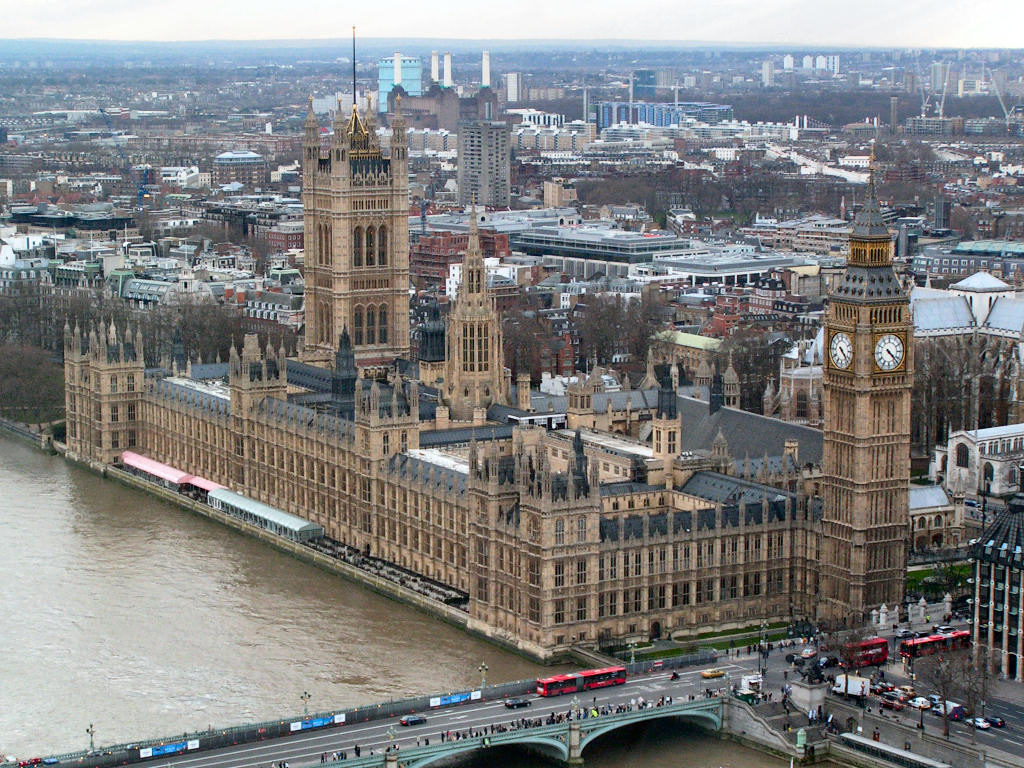
1 – London (also above)
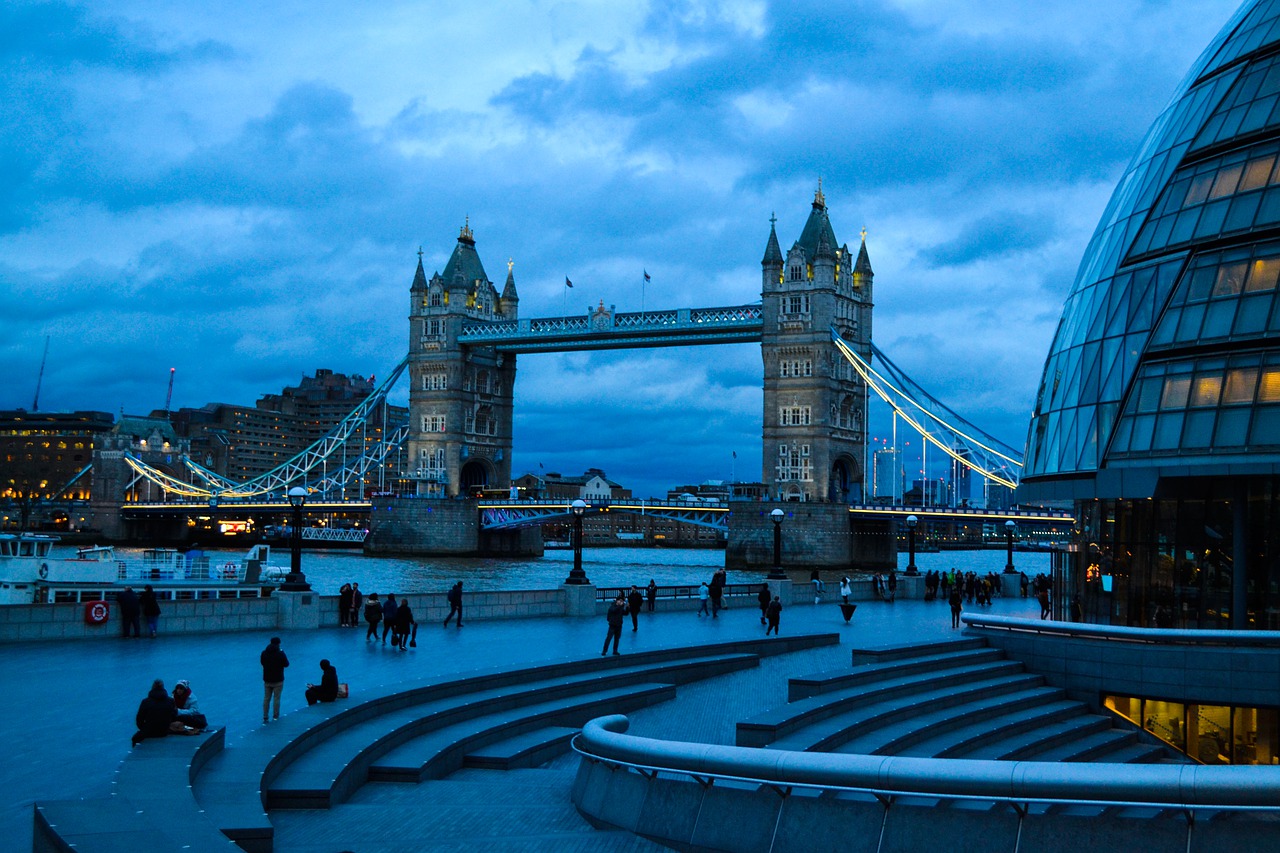
London began as the Roman town of Londinium on the Thames around AD 47–50, was burned in Boudica’s revolt in AD 60 or 61, and after the Great Fire of 1666 got a new St Paul’s Cathedral by Christopher Wren, built between 1675–1710.
See the Crown Jewels in the Tower of London, begun by William the Conqueror, cross Tower Bridge, opened in 1894, then visit Westminster Abbey, the Palace of Westminster and the British Museum.
Michael Collins worked in London from 1906 to 1916 and was sworn into the Irish Republican Brotherhood there by Sam Maguire, both men were heavily involved in the London GAA, before Collins returned home to become a military mastermind in the Irish War of Independence, while Maguire served as his chief intelligence agent in London.
2 – White Cliffs of Dover
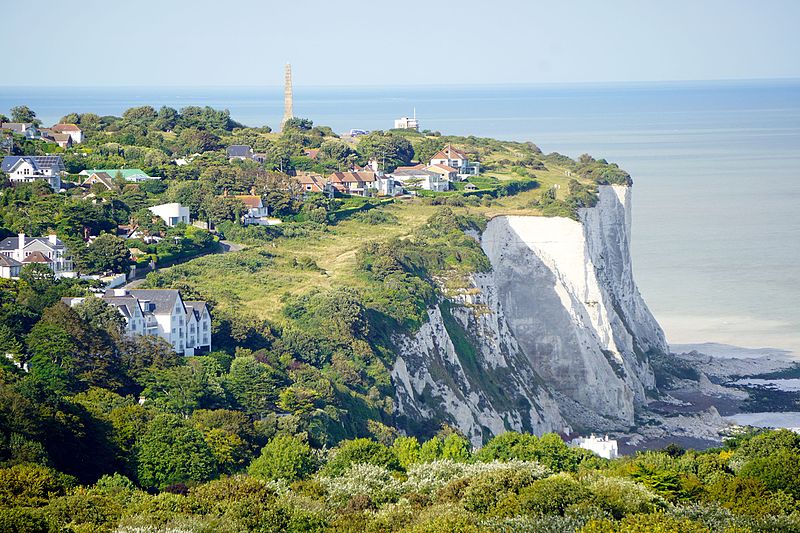
The White Cliffs of Dover, chalk from the Late Cretaceous, rise to about 110 m over the Strait of Dover, with France about 33 km away, and are watched over by Dover Castle, the “key to England”, begun in its present form by Henry II from 1179.
Walk the clifftop path from the White Cliffs of Dover to South Foreland Lighthouse and St Margaret’s Bay, and see the Roman lighthouse inside Dover Castle, England’s most complete standing Roman building.
Marconi’s first international radio message was picked up at South Foreland from France in 1899, and below the White Cliffs of Dover at St Margaret’s Bay, a beach house was home first to Noël Coward and then to Ian Fleming.
3 – Stonehenge
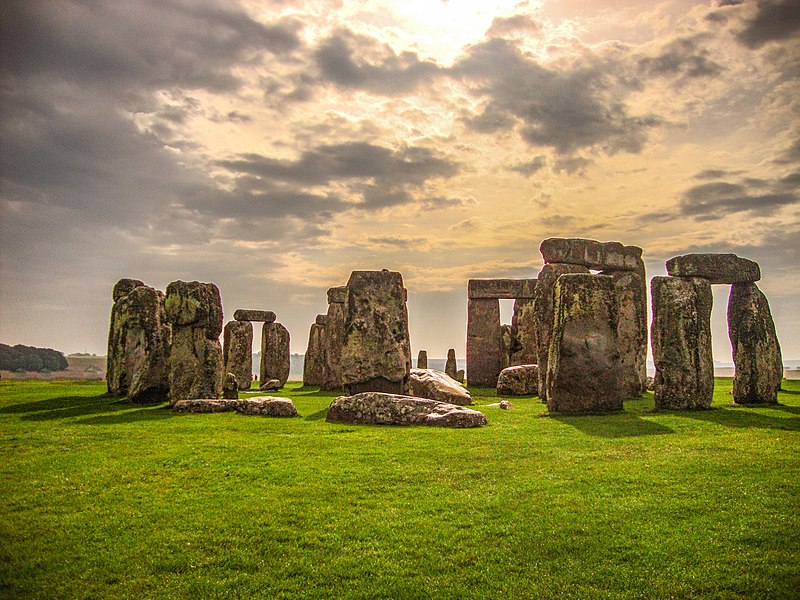
Stonehenge, on Salisbury Plain in Wiltshire, was built in stages from about 3000 BC, with sarsens from about 25 km away, bluestones from the Preseli Hills in Wales and an Altar Stone shown in 2024 to come from north-east Scotland, and UNESCO listed it with Avebury in 1986.
Walk around Stonehenge’s circle, see where the midsummer sun rises behind the Heel Stone, follow the line of the Avenue towards the River Avon, then visit the exhibition at the visitor centre.
Geoffrey of Monmouth claimed around 1136 that Merlin brought Stonehenge’s stones from Ireland, and the Druids didn’t build it either, but it really was sold at auction in 1915, to Cecil Chubb for £6,600, and he gave it to the nation three years later.
4 – Cambridge
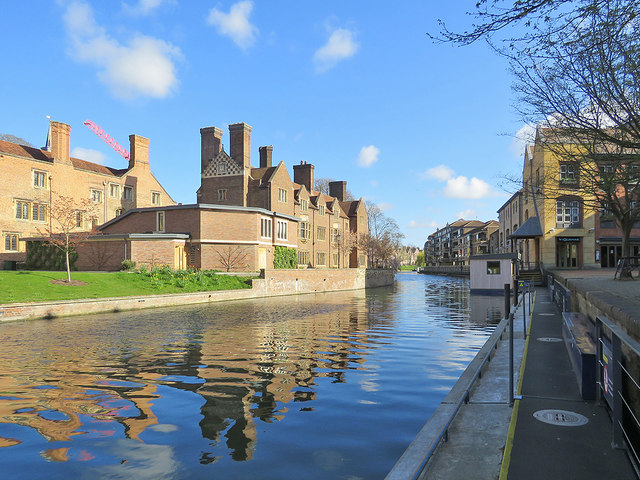
Cambridge, on the River Cam, became a university town around 1209, when scholars left Oxford after two of them were hanged by the town authorities, and Peterhouse, the first college, followed in 1284.
Punt along the Backs behind Cambridge’s colleges, look up at the fan vault of King’s College Chapel, often called the largest in the world, see Wren’s library at Trinity, and watch the grasshopper on the Corpus Clock eat time.
Cambridge’s Mathematical Bridge was not built by Isaac Newton, who died 22 years before it, but at the Cavendish Laboratory in 1932 Ernest Walton from Dungarvan and John Cockcroft split the atomic nucleus by artificial means, and Walton became Ireland’s first Nobel laureate in science.
5 – Liverpool
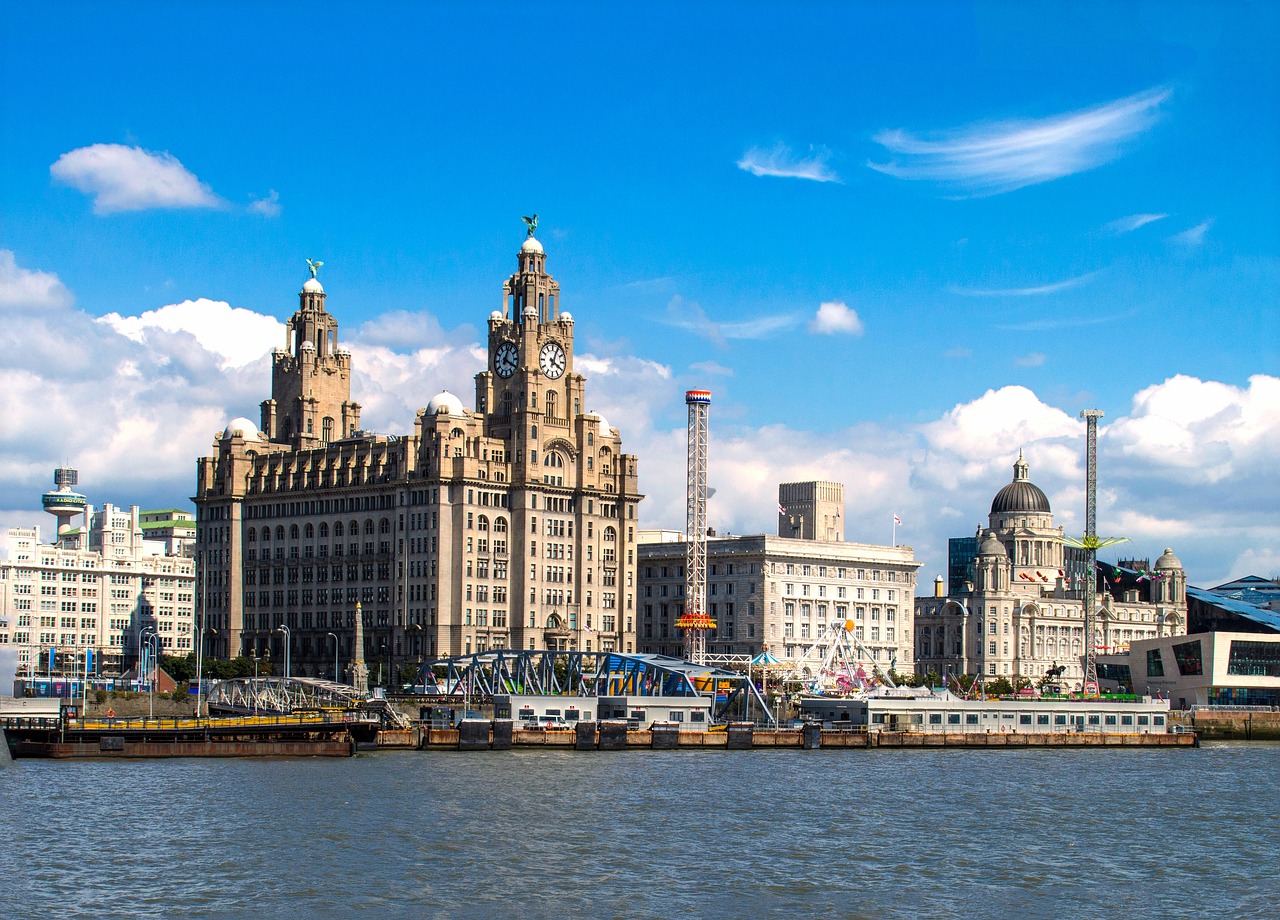
Liverpool, on the Mersey estuary, was made a free borough by King John in 1207 and grew into a great Atlantic port, whose ships carried more than 1.5 million enslaved Africans, more than any other European port, according to National Museums Liverpool.
See Liverpool’s waterfront, the International Slavery Museum, the Anglican cathedral, the largest in Britain, and the Cavern Club, rebuilt in 1984 on the site of the cellar where the Beatles played 292 times.
About 1.3 million Irish people landed at Liverpool’s Clarence Dock during the Great Famine, many heading on to America, and all four Beatles had Irish roots.
6 – Manchester
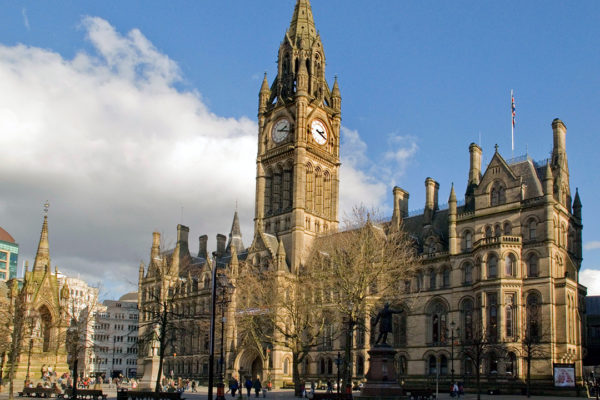
Manchester grew from the Roman fort of Mamucium, founded around AD 79, into one of the world’s first industrial cities, and in 1819 a reform meeting of about 60,000 people at Peterloo ended with at least 15 killed and hundreds injured.
Visit Manchester’s Science and Industry Museum, in the world’s oldest surviving passenger station, built for the Liverpool and Manchester Railway in 1830, and the Pankhurst Centre, where the suffragettes’ Women’s Social and Political Union was founded in 1903.
Manchester ran the first program stored in a computer’s memory, on the “Baby” in 1948, and in 1867 three Fenians, Allen, Larkin and O’Brien, were hanged in Salford for a police sergeant’s killing during a prison-van rescue, their cry of “God Save Ireland” becoming a song long sung as Ireland’s unofficial anthem.
7 – Oxford
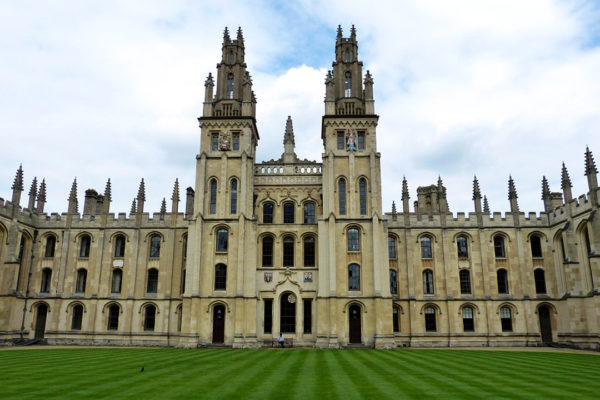
Oxford, where the Cherwell meets the Thames, had teaching in some form by 1096, making its university the oldest in the English-speaking world, and the poet Matthew Arnold called it “that sweet City with her dreaming spires”.
See Oxford’s Radcliffe Camera and the Bodleian Library, the Ashmolean, opened in 1683 as the world’s first university museum, and Christ Church, founded by Henry VIII, whose staircase appears in the first Harry Potter film.
Oxford’s Christ Church is where the mathematics don Charles Dodgson, rowing on the river in 1862, told the Dean’s daughter Alice Liddell the story that became Alice’s Adventures in Wonderland, and its bell, Great Tom, rings 101 times at 9.05 pm, which is 9 pm “Oxford time”.
8 – Bath
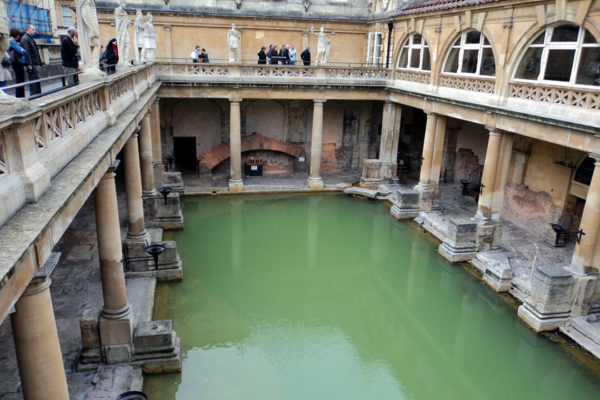
Bath, in Somerset, grew around hot springs as the Roman town of Aquae Sulis, then boomed as a Georgian spa, and UNESCO listed the whole city in 1987.
Visit Bath’s Roman Baths, the abbey, whose west front shows angels climbing ladders after a bishop’s dream, the Royal Crescent and Pulteney Bridge, one of only four bridges in the world lined with shops across its full span.
Dublin-born playwright Richard Brinsley Sheridan fought two duels near Bath in 1772 over the singer Elizabeth Linley, with whom he had fled to France, and he set his comedy The Rivals here, the play that gave English the word “malapropism”.
9 – Land’s End
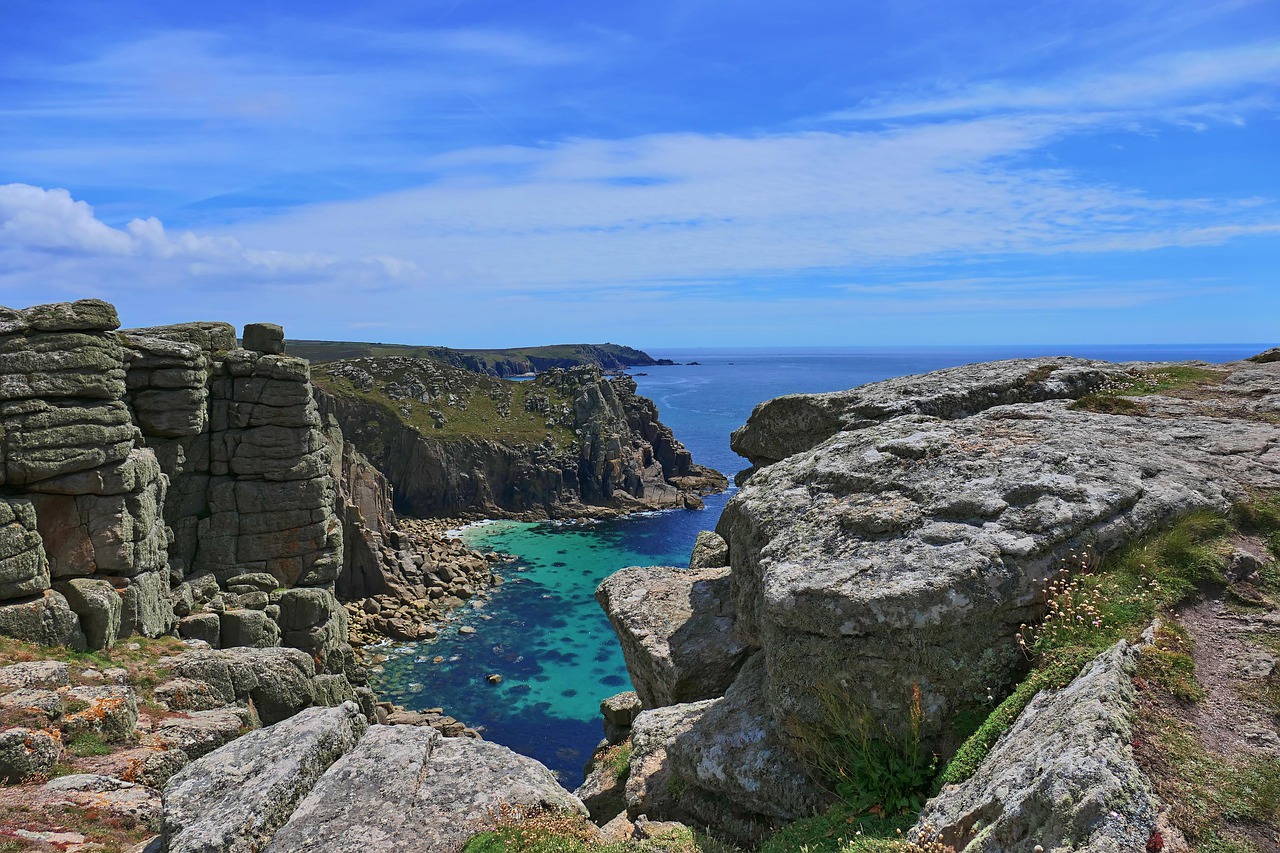
Land’s End, in Cornwall, is the westernmost point of mainland England, a granite headland looking out to the Longships lighthouse, first lit in 1795.
Walk the cliffs at Land’s End, stop by the famous signpost, then head along the coast to the Minack Theatre at Porthcurno, the open-air cliffside stage built by Rowena Cade, which first staged The Tempest in 1932.
Land’s End is the traditional start of the 874-mile journey to John o’ Groats, though the shortest road route is nearer 838 miles, and legend says the drowned land of Lyonesse lay between here and the Isles of Scilly.
10 – Lake District
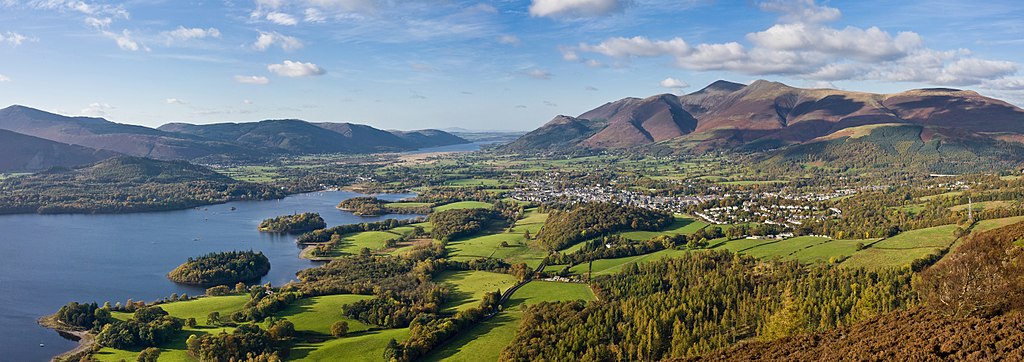
The Lake District, in Cumbria, became a national park in 1951 and is England’s largest, with Scafell Pike, England’s highest mountain at 978 m, and Windermere, its largest lake, and UNESCO listed it in 2017.
Explore the Lake District from Keswick and Derwentwater, see the Castlerigg stone circle, Wordsworth’s Dove Cottage in Grasmere, Beatrix Potter’s Hill Top and Ruskin’s home, Brantwood, on Coniston Water.
Wordsworth’s famous daffodils grew not by Windermere but at Glencoyne Bay on Ullswater, seen on a walk in 1802, while Beatrix Potter left more than 4,000 acres of the Lake District to the National Trust.
11 – York
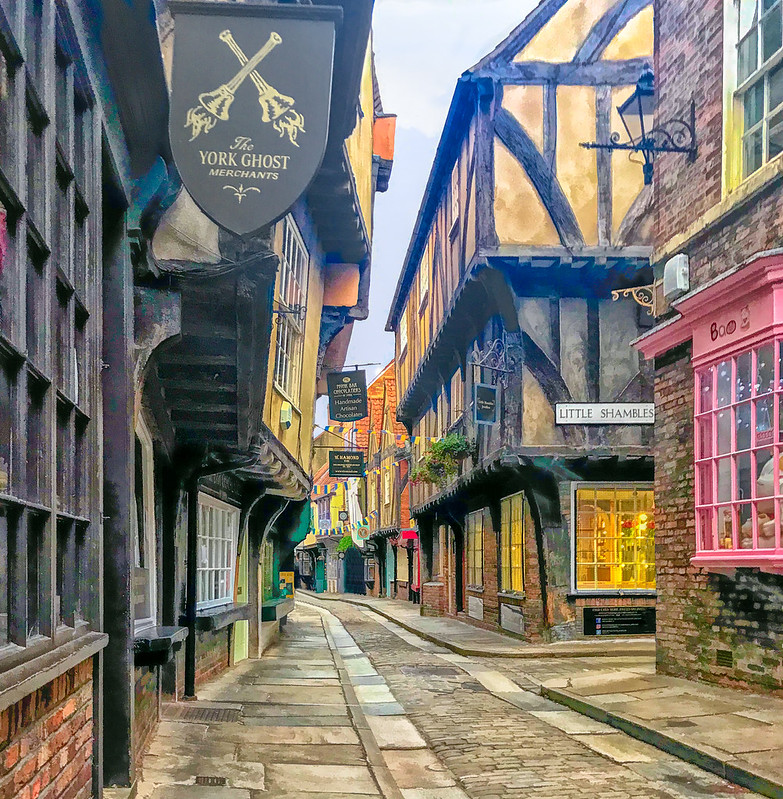
York was founded by the Romans as Eboracum in AD 71, saw Constantine proclaimed emperor here in 306, and fell to the Vikings in 866, becoming the Norse kingdom of Jorvik until 954.
Walk York’s city walls, the longest medieval town walls in England, see the Minster’s Great East Window, which the Minster calls the country’s largest expanse of medieval stained glass, then wander the Shambles and visit the National Railway Museum.
York was the birthplace of Guy Fawkes in 1570, and its Clifford’s Tower stands where, in 1190, about 150 of the city’s Jews died in the castle keep, most by their own hand, rather than face a mob or forced baptism.
12 – Canterbury
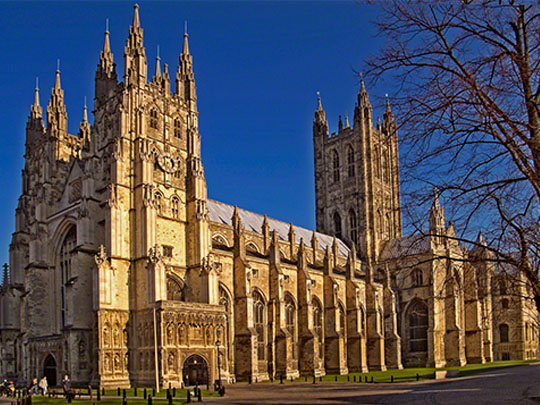

Canterbury, in Kent, is where St Augustine arrived in 597 to convert the English, and where Archbishop Thomas Becket was murdered in his cathedral by four knights on 29 December 1170, being made a saint in 1173.
Visit Canterbury Cathedral, the spot where Becket fell and the Black Prince’s tomb with its gilt-bronze effigy, then St Augustine’s Abbey and St Martin’s Church, widely described as the oldest church in the English-speaking world in continuous use, all three UNESCO-listed in 1988.
Henry II’s famous outburst, “Will no one rid me of this turbulent priest?”, can only be traced to the 1700s, and Canterbury’s pilgrims, made famous by Chaucer, flocked to Becket’s shrine until Henry VIII’s men destroyed it in 1538.
13 – Hadrian’s Wall
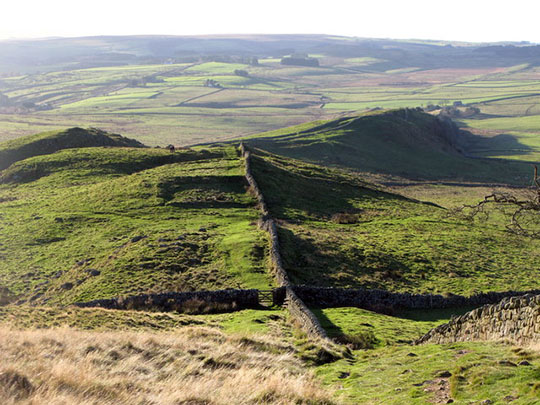
Hadrian’s Wall was begun in AD 122 under the emperor Hadrian and runs 73 miles from Wallsend on the Tyne to Bowness-on-Solway, and UNESCO listed it in 1987, later as part of the Frontiers of the Roman Empire.
Walk Hadrian’s Wall past its forts and milecastles, explore Housesteads and Chesters, the best-preserved forts, and see where the writing tablets were found at Vindolanda.
Hadrian’s Wall was never the border with Scotland, lying wholly in England, while a Vindolanda tablet, Claudia Severa’s birthday-party invitation from around AD 100, is almost certainly the earliest known Latin written by a woman, and a visit in 1981 inspired George R.R. Martin’s Wall in Game of Thrones.
14 – Hastings
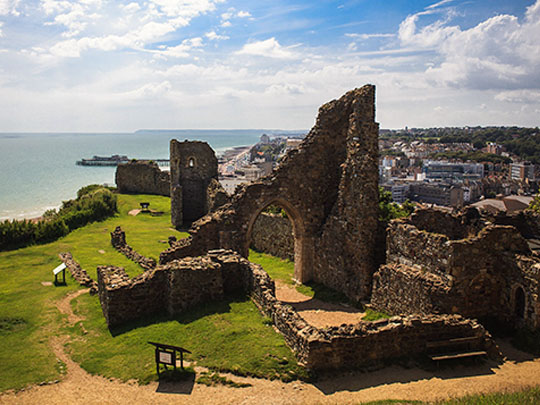
The Battle of Hastings was fought on 14 October 1066 not at Hastings itself but on Senlac Hill, about 6–7 miles away, where William of Normandy defeated King Harold, and the town that grew there is called Battle.
Visit Battle Abbey, built as penance, whose high altar was said to mark where Harold fell, walk the battlefield, then in Hastings see the Norman castle ruins, the tall tarred net huts on the Stade and the East Hill Cliff Railway, the steepest funicular in the UK.
Harold had wintered in Ireland as an exile in 1051–52, and after Hastings his sons fled to Ireland and raided England from Dublin, while the arrow in his eye may be a later addition, as the earliest accounts don’t mention it.
15 – Durham
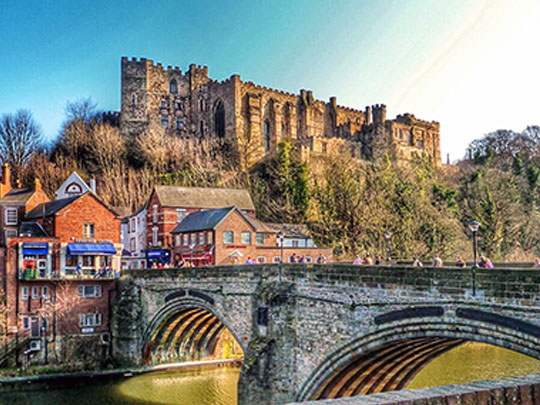
Durham was ruled for centuries by prince-bishops from its castle, and its Norman cathedral, begun in 1093 to hold the relics of St Cuthbert, was UNESCO-listed with the castle in 1986.
See Durham Cathedral’s rib-vaulted nave, among the earliest rib vaults in Europe, St Cuthbert’s shrine, the Venerable Bede’s tomb in the Galilee Chapel, and the sanctuary knocker on the north door.
Durham Cathedral’s cloisters appear in the first Harry Potter films, fugitives who reached its sanctuary knocker got 37 days’ protection, and monks reported finding St Cuthbert’s body uncorrupted when they moved it to the new shrine in 1104.
16 – Runnymede and Salisbury
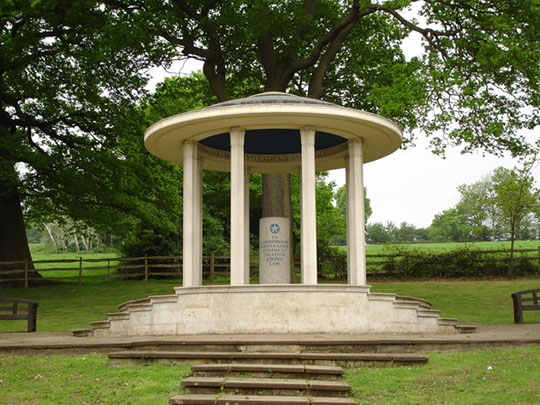
At Runnymede, a meadow beside the Thames in Surrey, King John sealed Magna Carta on 15 June 1215, and Salisbury Cathedral, built in 1220–58 after the move from Old Sarum, keeps the best-preserved of the four surviving 1215 originals.
See Runnymede’s memorials to Magna Carta and John F. Kennedy, whose acre of land was given to the USA, and Writ in Water, then Salisbury Cathedral’s 123 m spire, the tallest in the UK, its Chapter House and Britain’s largest cathedral close.
Magna Carta was sealed, not signed, and the Pope annulled it within about ten weeks, yet three of its clauses have never been repealed in England and Wales, and a Great Charter of Ireland followed in 1216, its only known copy destroyed at the Four Courts in 1922.
17 – Stratford-upon-Avon
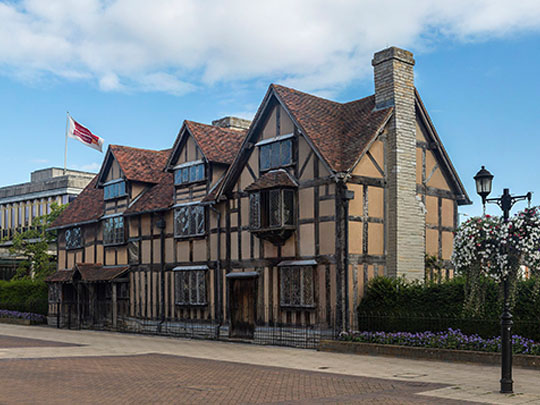
Stratford-upon-Avon, a Warwickshire market town on the River Avon, is where William Shakespeare was baptised on 26 April 1564 and buried in Holy Trinity Church in 1616.
Visit Shakespeare’s Birthplace on Henley Street, Anne Hathaway’s Cottage at Shottery, Mary Arden’s Farm, the site of his last home at New Place, and the Royal Shakespeare Theatre.
Shakespeare’s 23 April birthday is a tradition rather than a record, his grave in Stratford-upon-Avon warns “curst be he that moves my bones”, and a 2016 radar scan suggested his skull may be missing, while his will left his wife his “second best bed”.
18 – Windsor Castle
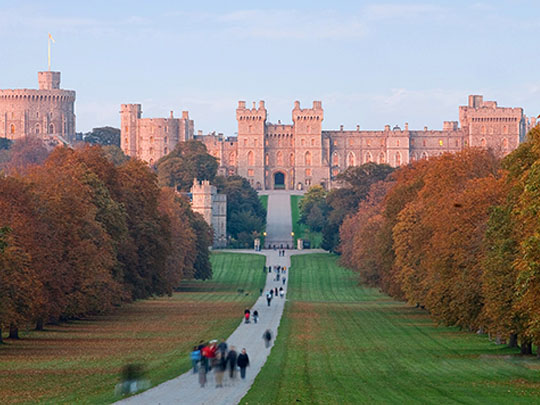
Windsor Castle, on a chalk bluff above the Thames in Berkshire, was begun by William the Conqueror in the years after 1066 and has been a royal home for more than 900 years.
Tour Windsor Castle’s State Apartments, St George’s Chapel, home of the Order of the Garter and burial place of Henry VIII, Charles I and Elizabeth II, and Queen Mary’s Dolls’ House, designed by Lutyens and finished in 1924, with electricity, running water and working lifts.
Windsor gave the royal family its name in 1917, when George V dropped Saxe-Coburg and Gotha, and in 2014 Windsor Castle hosted Michael D. Higgins on the first state visit to Britain by an Irish president.
19 – Lindisfarne
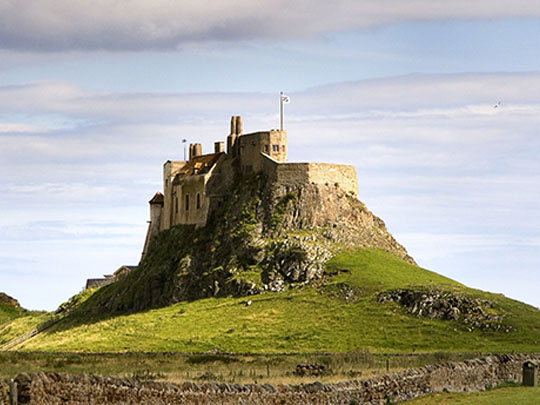
Lindisfarne, or Holy Island, is a tidal island off Northumberland where Aidan, an Irish monk from Iona, founded a monastery in 635 at the invitation of King Oswald, who had learned his Christianity in exile among the Irish.
Cross the causeway to Lindisfarne at low tide, explore the ruins of the medieval priory, then Lindisfarne Castle, a Tudor fort remodelled by Lutyens, with a garden by Gertrude Jekyll.
Lindisfarne’s monks made the Lindisfarne Gospels around 715–720, in the same Insular style as the later Book of Kells, and the Viking raid here in 793, often seen as the start of the Viking Age, led the scholar Alcuin to write that “never before has such terror appeared in Britain”.
20 – Bamburgh Castle
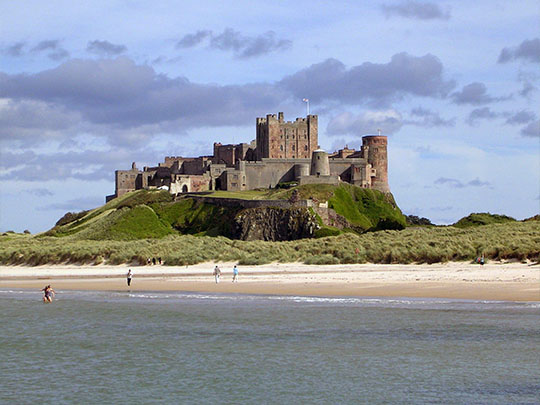
Bamburgh Castle stands on a rock on the Northumberland coast, the royal seat of the kings of Bernicia and Northumbria from 547, and its name comes from Bebba, a 7th-century queen.
Explore Bamburgh Castle, restored by the industrialist Lord Armstrong, who bought it in 1894, and its aviation museum, then visit the village’s museum to Grace Darling, who rowed out with her father to rescue nine shipwreck survivors in 1838.
Bamburgh is the Bebbanburg of The Last Kingdom, the castle has starred in Polanski’s Macbeth and Elizabeth, and in 1464 it became the first castle in England to fall to artillery.