
Wikimedia Commons / CC-BY-SA-3.0 / GFDL
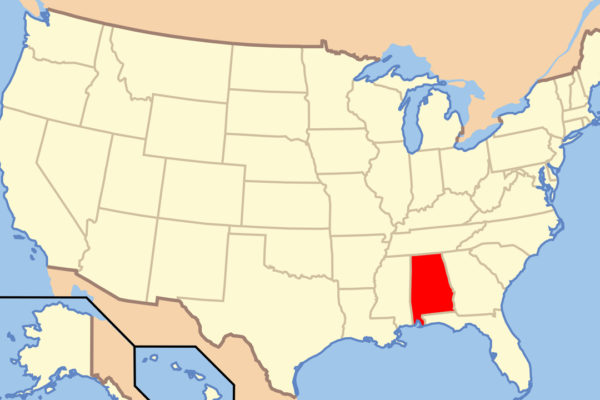
Capital: Montgomery
Population: 5.15 million+
Language: English
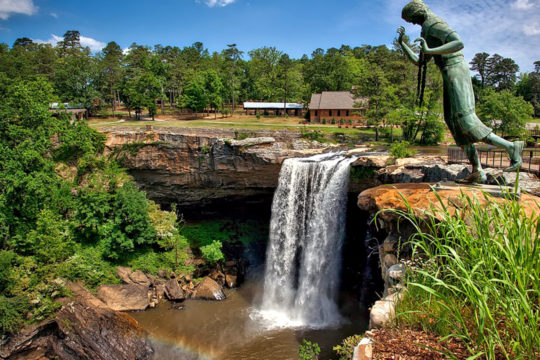
1 – Noccalula Falls (above)
Noccalula Falls drops about 90 feet (27 m) off the edge of Lookout Mountain into the Black Creek gorge at Gadsden, in Alabama’s northeast corner, and the city has been developing it as a public park since 1950.
Beyond the overlook there’s the 1.7-mile Black Creek Trail and the gorge paths below the falls, where Civil War-era names are carved into the rock, plus a pioneer village, an 1899 covered bridge, botanical gardens planted with some 25,000 azaleas and a miniature train.
The legend everyone tells — a Cherokee chief’s daughter leaping to her death rather than marry the man her father chose — traces back to an 1895 poem by local writer Anne Bilbro rather than to any recorded Cherokee tradition, so the park’s 1969 marker claiming rock carvings “confirm” the leap is best read as civic enthusiasm, and the 9-foot bronze of Noccalula on the lip of the falls is really a monument to a Victorian ballad.
2 – Pulpit Rock
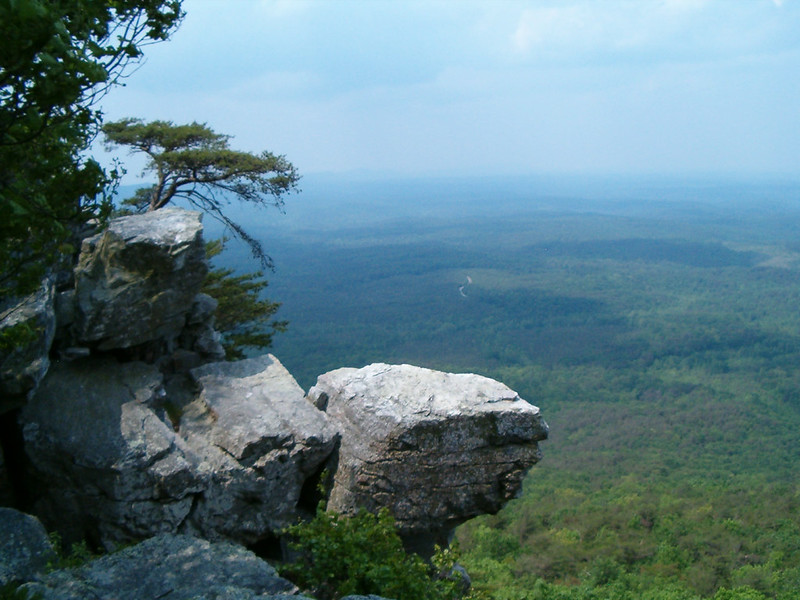
Pulpit Rock is a quartzite ledge just below the summit of Cheaha Mountain in Cheaha State Park, inside Talladega National Forest, and at roughly 2,400 feet (730 m) Cheaha is the highest point in Alabama — its name comes from a Muskogean word meaning “high”.
The short, rocky Pulpit Rock Trail ends on an open slab with the Talladega ridges falling away beneath you — popular with climbers and sunset-watchers — and up top are the stone Bunker Observation Tower, the Bald Rock boardwalk and the cabins, lodge and lake that the Civilian Conservation Corps built by hand in the 1930s.
Cheaha opened in 1933 as Alabama’s first state park, and it’s also a waypoint on the 335-mile Pinhoti Trail, which runs northeast into Georgia to join the Benton MacKaye Trail and, through it, the Appalachian Trail — so with enough socks you could walk from Pulpit Rock to Maine.
3 – Fort Gaines

Fort Gaines guards the eastern tip of Dauphin Island at the mouth of Mobile Bay, on an island the French named Île du Massacre in 1699 after finding a heap of around 60 skeletons — almost certainly a Native burial mound broken open by a hurricane rather than the scene of any massacre.
Begun in 1821, abandoned when its foundations flooded and finished by the Confederates around 1862, Fort Gaines lets you walk the brick bastions, tunnels and kitchens, watch the working blacksmith shop and see an anchor from USS Hartford, Farragut’s flagship at the Battle of Mobile Bay on 5 August 1864, three days before the fort surrendered.
Farragut’s “Damn the torpedoes! Full speed ahead!” was never printed in that form at the time — the earliest account has him shouting bell signals to the engine room, the famous version surfaces in 1878 and naval historians say nobody knows what he really said — but the Irish thread is solid: some fourteen Irish-born sailors, from Dublin to Derry, won the Medal of Honor in that battle.
4 – Little River Falls

Little River Falls is the 45-foot (14 m) drop at the head of Little River Canyon, near Fort Payne — a town named for an 1838 stockade where Cherokee were held before removal on the Trail of Tears — and the canyon, up to 600 feet deep and the deepest in Alabama, has been a National Preserve since 1992.
The 23-mile Canyon Rim Drive strings together overlooks along the gorge, including the one for Grace’s High Falls, at 133 feet the tallest above-ground waterfall in the state, and on summer weekends the swimming holes at Little River Falls and Blue Hole fill so quickly that the car parks close.
The Park Service describes the Little River as forming on and flowing almost its whole length along the top of Lookout Mountain, which is why the canyon feels so improbable — and drowning is the preserve’s leading cause of death, so stay off the rock lip above Little River Falls however many people you see standing on it.
5 – Gulf Shores
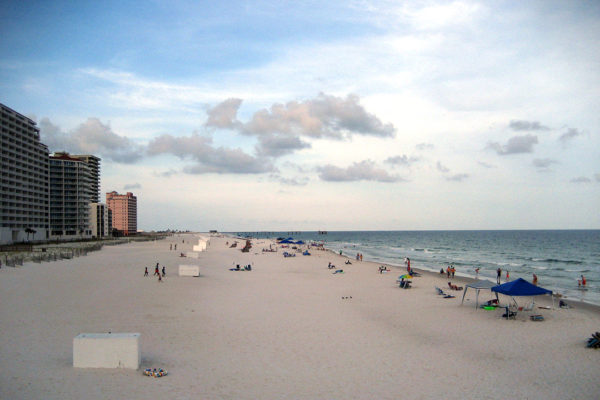
Gulf Shores is the main beach town on Alabama’s short stretch of Gulf coast, a resort that keeps getting rebuilt: Hurricane Frederic flattened most of it in 1979, Ivan came ashore here on 16 September 2004 and Sally on 16 September 2020, sixteen years to the day later.
Gulf Shores’ big draws are the white beaches themselves, Gulf State Park — dunes, lakes, cycling trails and a 1,540-foot fishing pier rebuilt after Ivan — and Bon Secour National Wildlife Refuge, home of the endangered Alabama beach mouse, with turtle-friendly amber lighting along the shore from May to October.
East along the coast, the Flora-Bama bar opened in 1964 and, despite its name, sits entirely in Florida, about six feet from the line — handy for its Interstate Mullet Toss, held every April since the mid-1980s, in which contestants hurl dead fish from Florida into Alabama.
6 – Fort Morgan
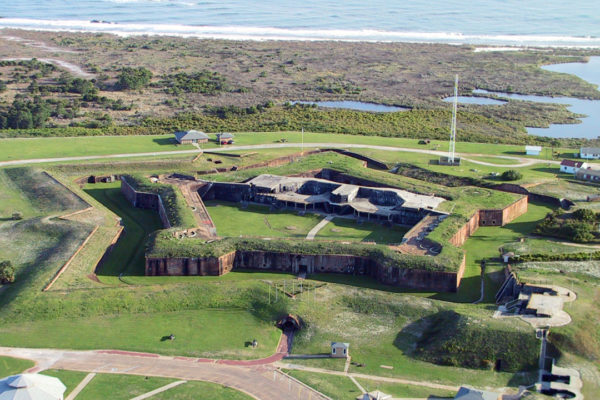
Fort Morgan stands at the end of Mobile Point, facing Dauphin Island across the mouth of Mobile Bay, and was built between 1819 and 1834 to a design by Simon Bernard, Napoleon’s former military engineer, with much of the brickwork laid by enslaved masons.
Inside the star-shaped walls of Fort Morgan you can wander the vaulted casemates and the museum, then the concrete gun batteries added from 1895, because the fort served in four wars — from the 1864 siege that ended in surrender on 23 August to the watch for German U-boats in World War II.
Before it there was Fort Bowyer, an earthwork on the same point, which surrendered to about 1,300 British troops on 12 February 1815 — seven weeks after the Treaty of Ghent was signed, with news of the peace arriving the next day — making it the last land battle between the United States and Britain, while just offshore the monitor USS Tecumseh, sunk by a mine in 1864 with about 94 men, still lies upside down as a protected war grave.
7 – Selma
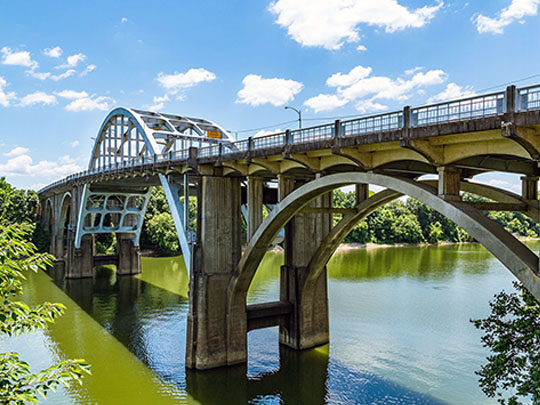
The Edmund Pettus Bridge carries US Highway 80 over the Alabama River at Selma, and on 7 March 1965 about 600 voting-rights marchers led by John Lewis and Hosea Williams were beaten at its far end by state troopers and Sheriff Jim Clark’s mounted posse — Bloody Sunday, which helped force the Voting Rights Act into law that August.
You can walk across the Edmund Pettus Bridge from downtown Selma, visit the National Voting Rights Museum at its foot, and follow the Selma to Montgomery National Historic Trail along the 54-mile route of the third march, which set out on 21 March 1965 and arrived four days later with some 25,000 people at the Capitol.
The steel arch opened in 1940 and still carries the name of a Confederate general and US senator reputed to have led the state’s Klan, which is part of its power: Selma (2014) was filmed on the bridge itself, and in July 2020 John Lewis made a last crossing over it, his coffin carried on a horse-drawn caisson.
8 – Mobile
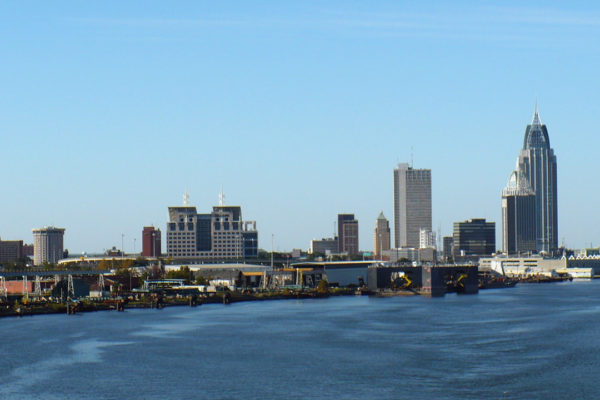
Mobile is Alabama’s oldest city and only deep-water seaport, founded by the French in 1702 at Twenty-seven Mile Bluff and moved to its present site in 1711, and it was the capital of French Louisiana until 1720 before passing to Britain, Spain and, in 1813, the United States.
In Mobile you can see the partial four-fifths-scale reconstruction of Fort Condé built in 1976 over the excavated original, the Cathedral Basilica of the Immaculate Conception — whose bishop for 24 years from 1859 was John Quinlan of Cloyne, Co. Cork — and, a short drive north, Africatown, founded by survivors of the Clotilda, the last known slave ship to reach the United States.
Mobile claims America’s first Mardi Gras in 1703, fifteen years before New Orleans was founded, though the evidence for that first celebration is thin, and its parades have their own signature throw: since the 1970s, riders have been showering crowds with MoonPies.
9 – Rocket Park

Rocket Park is the outdoor collection of the U.S. Space & Rocket Center in Huntsville, the city where Wernher von Braun’s German engineers — the men who built the V-2 for Nazi Germany — arrived at Redstone Arsenal in 1950, and where NASA’s Marshall Space Flight Center developed the Saturn V moon rocket from 1960.
Rocket Park runs from a V-1 and V-2 through the Redstone, Jupiter and Mercury-Redstone rockets to the Saturn family, with a 363-foot Saturn V standing over everything, while next door in the Davidson Center a genuine Saturn V hangs in separated stages — SA-500D, a National Historic Landmark since 1987.
The vertical Saturn V outside is a full-size replica put up in 1999 for Apollo 11’s 30th anniversary, and the real one indoors never flew, but Huntsville’s most famous export may be Space Camp, launched here in 1982 on an idea of von Braun’s and fictionalised in the 1986 film SpaceCamp, which opened four months after the Challenger disaster, flopped and gave Joaquin Phoenix, then credited as Leaf, his first feature role.
10 – Statue of Vulcan
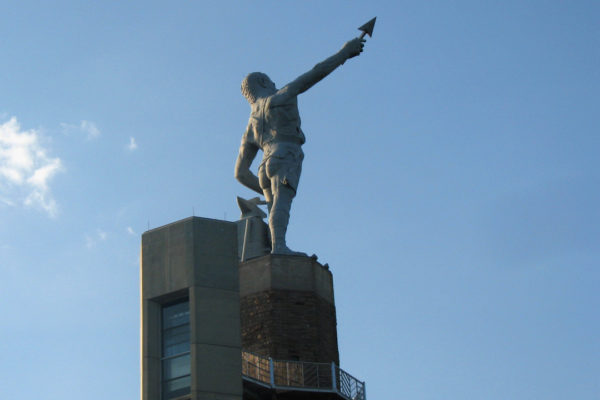
The Statue of Vulcan stands on Red Mountain above Birmingham, the iron-ore ridge that built the city, and shows the Roman god of the forge, cast in 1904 from local pig iron to Giuseppe Moretti’s design for the St Louis World’s Fair, where it won a grand prize.
At Vulcan Park and Museum you climb 159 steps or take the lift to the balcony atop a pedestal of over 120 feet for the best view across Birmingham, with a museum below and the 56-foot, roughly 50-ton statue — billed by its keepers as the largest cast-iron statue in the world — directly overhead.
Vulcan’s afterlife was undignified: he lay in pieces beside the railway because nobody paid the freight bill, then spent three decades at the fairgrounds advertising Coca-Cola, Heinz pickles and ice-cream cones, and from 1946 to 1999 held a neon torch that glowed red for a day after every traffic death — and as he faces downtown, his bare backside has pointed at the suburb of Homewood since 1939, inspiring a local song called “Moon over Homewood”.
11 – USS Alabama – Mobile
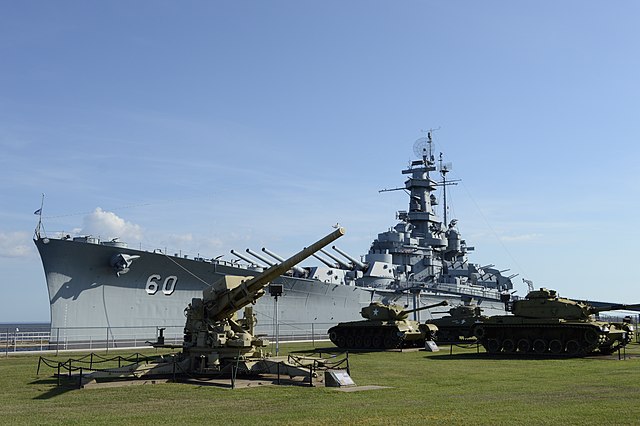
USS Alabama is a South Dakota-class battleship commissioned on 16 August 1942 that served with the British Home Fleet at Scapa Flow in 1943, earned nine battle stars in the Pacific and led the US fleet into Tokyo Bay on 5 September 1945, and she has been moored on Mobile Bay at Battleship Memorial Park since 1964.
Aboard USS Alabama you can roam from the engine rooms to the 16-inch gun turrets and crew quarters on self-guided routes, then cross to the submarine USS Drum, hauled onto dry land in 2001, and the park’s aircraft pavilion.
To save her from scrap, Alabama’s schoolchildren gave about $100,000 in nickels and dimes to a 1964 campaign that towed the ship 5,600 miles from Bremerton, Washington, through the Panama Canal, and “Lucky A” lost no one to enemy fire — though five men died in 1944 when one of her own five-inch mounts fired into another — and she played the USS Missouri in Under Siege (1992), whose villains include Dublin’s Colm Meaney.
12 – Birmingham
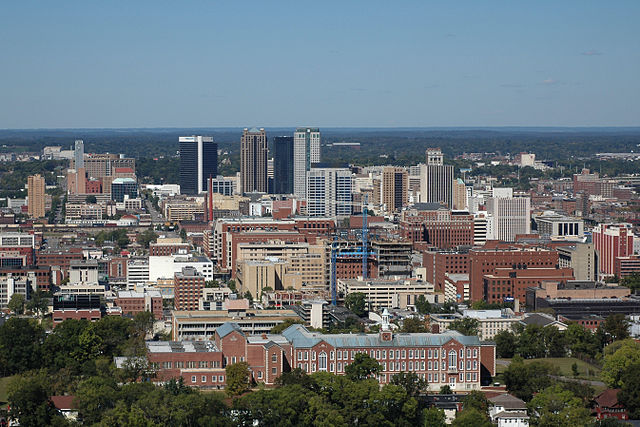
Birmingham was founded in 1871 where two railroads crossed, and it grew so quickly on a rare piece of geological luck — iron ore, coal and limestone, everything you need to make iron, all within a few miles — that it was nicknamed the Magic City.
Sloss Furnaces, a blast-furnace plant that ran from 1882 to 1971 and is now a museum, shows industrial Birmingham, while the Civil Rights District shows the other city: the Birmingham Civil Rights Institute, Kelly Ingram Park, where police turned dogs and fire hoses on marching children in May 1963, and the 16th Street Baptist Church, where a Klan bomb killed Addie Mae Collins, Cynthia Wesley, Carole Robertson and Denise McNair on 15 September 1963.
Birmingham’s most famous document was written in its jail — Martin Luther King Jr’s Letter from Birmingham Jail of 16 April 1963, begun, by his own account, in the margins of a newspaper — and the district has been a national monument since 2017, the 16th Street Baptist Church on America’s World Heritage tentative list since 2008.
13 – Tuskegee
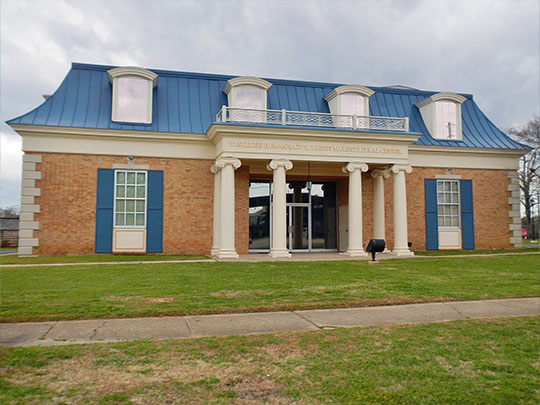
Tuskegee, a small town east of Montgomery, is where Booker T. Washington, aged about 25, opened Tuskegee Normal School on 4 July 1881 in a church and a shanty, and its campus is the only university in the US that is also a National Historic Site.
At Tuskegee you can visit The Oaks, Washington’s house, and the George Washington Carver Museum — both men are buried on campus — then Hangar One at Moton Field, where the Tuskegee Airmen trained, and the Tuskegee History Center, which also tells the story of the US Public Health Service’s Untreated Syphilis Study at Tuskegee, which left about 400 Black men with syphilis untreated from 1932 to 1972.
Washington’s students made the bricks in their own kiln and built most of the campus themselves, and the 992 pilots trained at Tuskegee carry their own myth: they’re often said never to have lost a bomber they escorted, when in fact they lost at least 27 — still well under the 46 averaged by the other escort groups they flew alongside.
14 – Montgomery
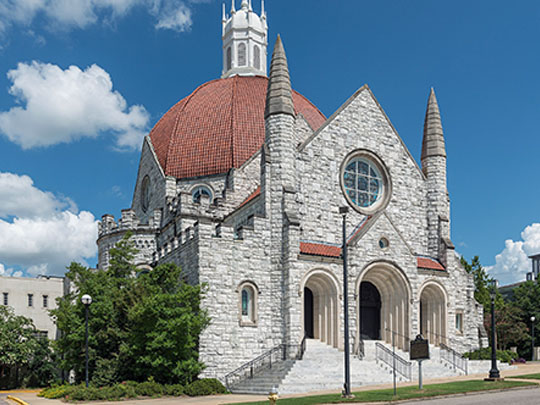
Montgomery, Alabama’s capital since 1846, is named for Richard Montgomery, the American general born at Feltrim near Swords, Co. Dublin, who died attacking Quebec in 1775, and in 1861 it was the Confederacy’s first capital — Jefferson Davis was sworn in on the State Capitol’s portico and the telegram authorising the attack on Fort Sumter went out from the Winter Building.
In Montgomery you can see the Rosa Parks Museum, where she boarded the bus on 1 December 1955, Dexter Avenue King Memorial Baptist Church, King’s pulpit during the year-long boycott, Maya Lin’s Civil Rights Memorial, and the Legacy Museum and National Memorial for Peace and Justice, whose 805 steel monuments, one per county, record around 4,400 lynchings.
Montgomery packs it all into a few blocks: the Court Square fountain marks where enslaved people were auctioned — by 1859 the city had as many slave depots as hotels — and Dexter Avenue runs a short walk uphill past King’s church to the Capitol steps where Davis took his oath and the Selma marchers finished in 1965.