

Wikimedia Commons / CC-BY-SA-3.0 / GFDL
Capital: Riga
Population: 1.8 million+
Language: Latvian

1 – Riga (also above)

Riga, near the mouth of the Daugava on the Gulf of Riga, was founded in 1201 by Bishop Albert and grew into a leading Hanseatic port, and in the 18th century the Limerick-born Wild Goose Peter Lacy governed Livonia from here for Russia.
Riga’s UNESCO-listed centre packs in the House of the Blackheads, bombed in 1941 and rebuilt in 1999, St Peter’s Church, the Freedom Monument of 1935, paid for by public donations, a Central Market housed in the frames of WWI Zeppelin hangars, and art nouveau streets that UNESCO rates the finest in Europe.
At least 25,000 Jews from the Riga ghetto were shot in Rumbula forest in November and December 1941, according to the USHMM, while the Riga dockworker Žanis Lipke hid dozens of Jews and is honoured by Yad Vashem as Righteous Among the Nations.
2 – Ventspils

Ventspils, where the Venta river meets the Baltic, became a Hanseatic town and in the 17th century was the main port of Duke Jacob of Courland, whose shipyard here built dozens of ships that sailed to the duchy’s colonies in Gambia and Tobago.
Ventspils’s late 13th-century Livonian Order castle is one of the best-preserved the Order built, serving as a prison until 1959 before becoming a museum, and colourful cow sculptures, left over from the city’s Cow Parade, turn up all over town.
About 30 kilometres north of Ventspils, the Irbene radio telescope was part of a secret Soviet military town whose 32-metre dish was reportedly used to listen in on the West, until the Soviet army left in 1994.
3 – Liepāja

Liepāja, on Latvia’s south-west coast, is nicknamed the city where the wind is born, and its Karosta district was built from 1890 as a naval port for Tsar Alexander III and stayed a closed Soviet military zone until 1994, while in WWII it was one of the last ports Germany held in the Courland Pocket until May 1945.
Liepāja’s Karosta has the golden-domed St Nicholas Naval Cathedral and a military prison used until 1997 where you can spend the night as a prisoner, while Holy Trinity Cathedral holds the largest mechanical organ in the world never to have been rebuilt.
In December 1941 German police and local collaborators shot 2,749 Jews on the beach at Šķēde outside Liepāja, according to the USHMM, and the photographs taken there, copied in secret by the Jewish electrician David Zivcon, became evidence at Nuremberg.
4 – Cēsis

Cēsis, in the Gauja valley north-east of Riga, grew up around Wenden Castle, begun around 1209 and later the main residence of the master of the Livonian Order, and in June 1919 Estonian and Latvian troops defeated the Baltische Landeswehr nearby in the Battle of Cēsis, which Estonia marks as Victory Day.
Cēsis Castle’s ruins are explored by lantern, climbing the Western Tower to the master’s star-vaulted room, while in town the Victory Monument of 1924 was blown up under Soviet rule in 1951 and rebuilt in 1998.
Latvia’s red-white-red flag traces back to Cēsis, as the medieval Livonian Rhymed Chronicle describes a force from Cēsis carrying a red flag with a white stripe in about 1279, and legend adds that it was a sheet stained by a wounded chieftain’s blood.
5 – Jūrmala

Jūrmala strings 33 kilometres of sandy beach along the Gulf of Riga just west of the capital, and it grew from a string of spa villages into a single resort city in 1959.
Jūrmala is lined with thousands of wooden villas among the pines, and at its western end Ķemeri grew around sulphur springs from 1838, crowned by the white Hotel Ķemeri of 1936.
Jūrmala was a favourite holiday spot of Soviet leaders, including Khrushchev and Brezhnev.
6 – Daugavpils

Daugavpils, Latvia’s second-largest city, lies in Latgale near the Lithuanian and Belarusian borders, and after German forces arrived in June 1941 most of its large Jewish community was confined in a ghetto and murdered in 1941–42, many in the Pogulianka forest.
Daugavpils Fortress, built from 1810 to 1878, held off Napoleon’s army in 1812 and is the only early 19th-century fortification of its type in northern Europe preserved without major alterations, and in WWII it held the German prisoner-of-war camp Stalag 340, while across town Church Hill gathers four denominations’ churches together.
The painter Mark Rothko was born in Daugavpils in 1903 as Marcus Rothkowitz, and the Mark Rothko Art Centre in the fortress’s old arsenal shows original works lent by his children.
7 – Gauja National Park

Gauja National Park, created in 1973 as Latvia’s first national park, follows the Gauja river valley between red Devonian sandstone cliffs, and Turaida Castle there was begun in 1214 for Bishop Albert of Riga on the site of a Livonian wooden fort.
Gauja National Park centres on Sigulda, with its castle ruins and a cable car crossing the valley to Krimulda, along with Turaida’s red-brick tower and the sandstone Gūtmaņa Cave, carved with inscriptions going back to the 17th century.
Gauja National Park’s best-known story is the Rose of Turaida, a legend based on 1620 court records in which a young woman named Maija was killed at Gūtmaņa Cave after refusing a suitor, and newlyweds leave flowers at her grave under a linden at Turaida.
8 – Rundāle Palace

Rundāle Palace, near Bauska in Zemgale, was begun in 1736 to designs by Rastrelli, later architect of St Petersburg’s Winter Palace, as a summer residence for Ernst Johann von Biron, Duke of Courland and favourite of Empress Anna, and it was left unfinished when Biron fell in 1740 and was completed only after he returned from exile.
Rundāle Palace’s Gold Hall and White Hall ballroom glitter with Johann Michael Graff’s stucco, and behind the palace stretches a French Baroque garden laid out to Rastrelli’s plan, with more than 2,000 rose varieties.
Rundāle Palace stood in for the Winter Palace in the 2019 series Catherine the Great with Helen Mirren and hosted ballroom scenes for the BBC’s War & Peace in 2016.
9 – Kuldīga
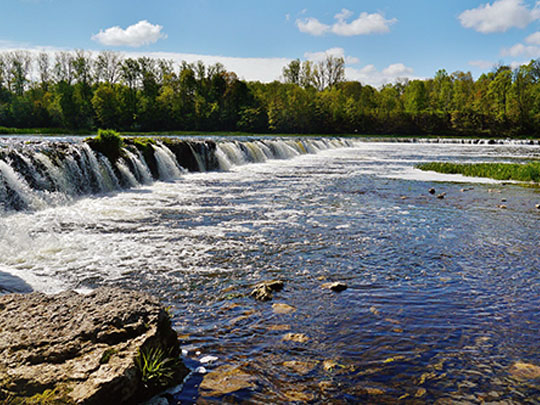
Kuldīga, the German Goldingen, grew up where the Alekšupīte stream meets the Venta river in western Latvia’s Kurzeme region, and it was the main residence of the first Duke of Courland and the birthplace of Duke Jacob in 1610.
Kuldīga’s old town of timber and stone houses became a UNESCO World Heritage Site in 2023, and beside it the Venta Rapid, billed as Europe’s widest waterfall at about 249 metres across but only around two metres high, is crossed by a seven-arched red-brick bridge built in 1874.
Kuldīga is the town where fish fly, as every spring they leap the Venta Rapid on their way upstream to spawn, and around 1640 Duke Jacob had wicker baskets set along the falls to catch them in mid-air.
10 – Rumbula memorial
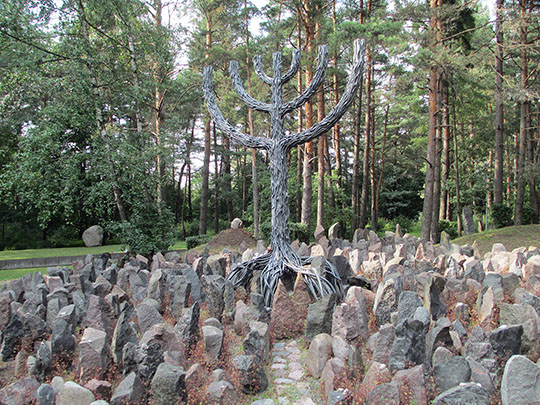
The Rumbula Memorial stands in pine forest beside Rumbula station, about 10 to 12 kilometres south-east of central Riga, where German SS and police units with Latvian auxiliaries shot at least 25,000 Jews from the Riga ghetto on 30 November and 8–9 December 1941, according to the USHMM, along with a transport of about 1,000 Jews deported from Berlin.
The Rumbula Memorial, opened in 2002 to a design by the architect Sergejs Rižs, has a menorah at its centre above paving shaped like a Star of David, surrounded by rough stones carved with victims’ names, stones bearing the names of the ghetto’s streets, and the marked mass graves.
Rumbula’s best-known survivor, Frida Michelson, lived by lying motionless as if dead while the victims’ shoes were piled on top of her, and she later told her story in the memoir I Survived Rumbuli.