
Wikimedia Commons / CC-BY-SA-3.0 / GFDL
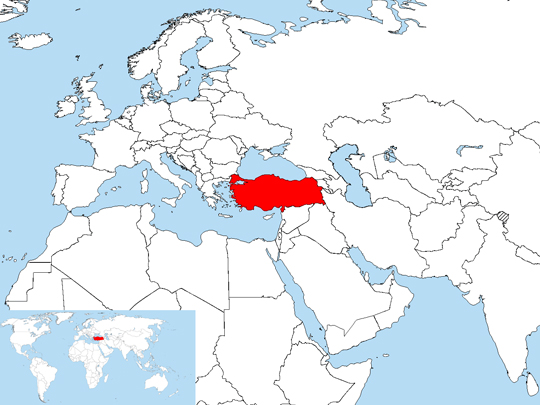
Capital: Ankara
Population: 86.1 million+
Language: Turkish/Kurdish
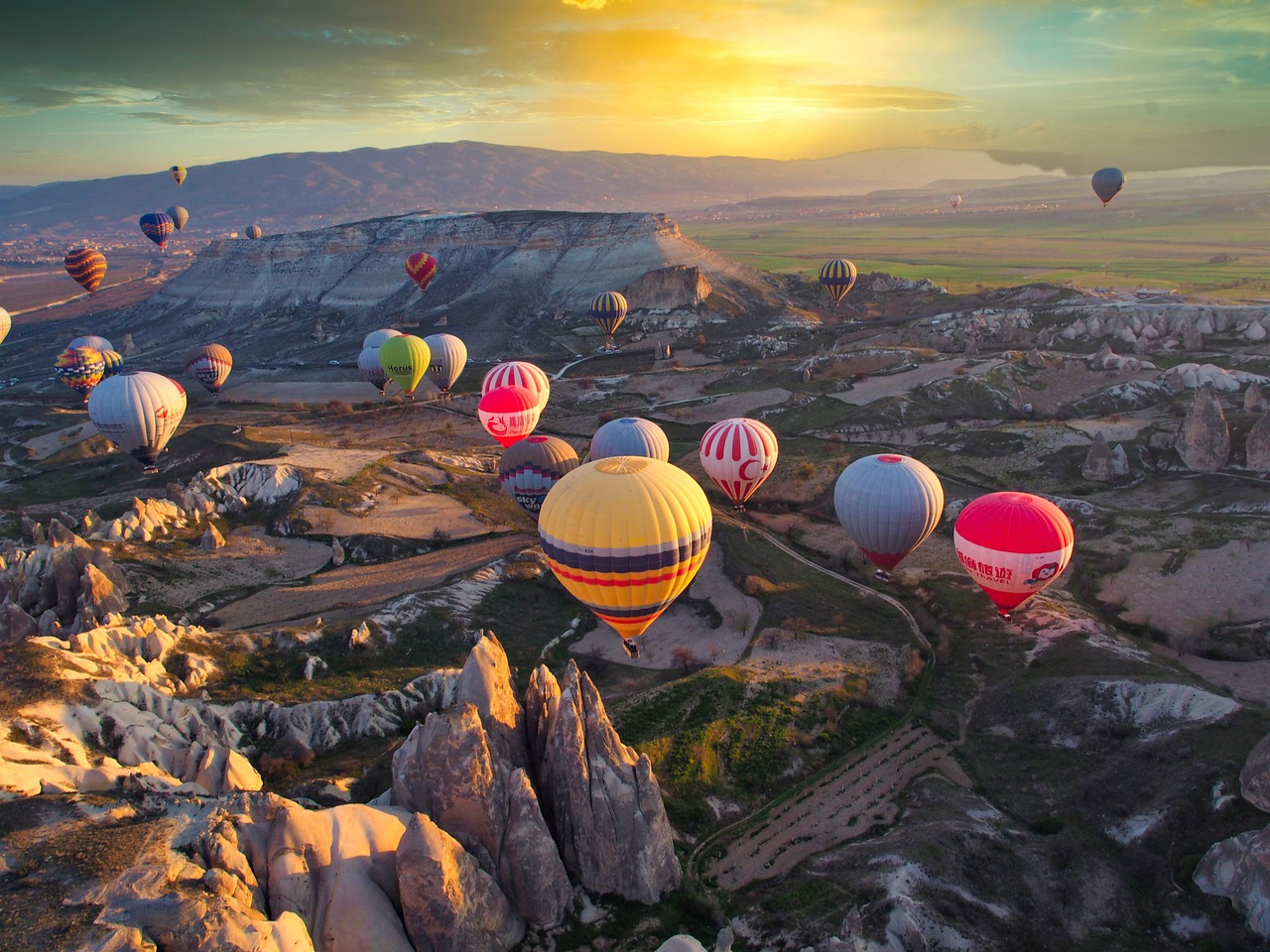
1 – Cappadocia (also above)

Cappadocia, in the high plateau of central Turkey, is a landscape of soft volcanic tuff laid down by eruptions some ten million years ago and carved by wind and water into cones, chimneys and valleys — and from the 4th century monks and villagers carved homes, monasteries and churches into it; UNESCO listed Göreme and the rock sites in 1985.
In Cappadocia the Göreme Open-Air Museum holds rock-cut churches painted from the 10th century on, the Dark Church’s frescoes preserved because pigeons roosted in it and covered the walls, and underground cities like Derinkuyu run some 85 metres down — at dawn, well over a hundred hot-air balloons go up at once.
Cappadocia’s underground cities are usually said to be where early Christians hid from the Romans, but the best evidence dates their great expansion to the Byzantine-Arab wars of the 8th to 11th centuries — they were refuges for days or weeks under raids, and Cappadocian Greeks still used them until 1923.
2 – Pamukkale
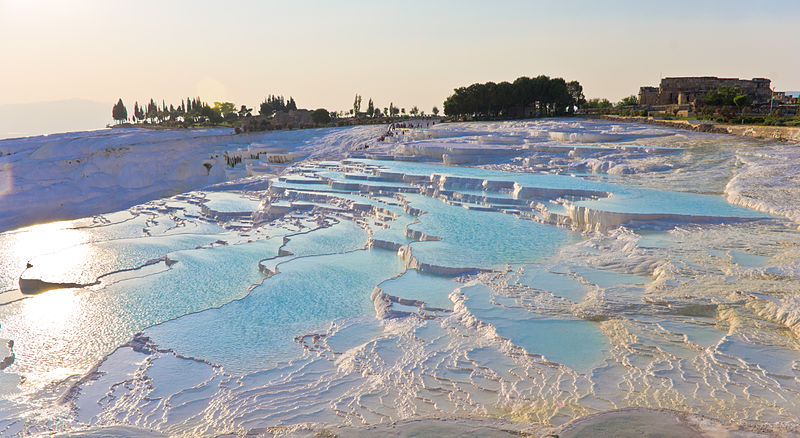
Pamukkale, “cotton castle,” in south-west Turkey near Denizli, is a hillside of white travertine terraces laid down over thousands of years by calcium-rich hot springs, with the Greco-Roman spa city of Hierapolis on top; UNESCO listed the two together in 1988.
At Pamukkale you take your shoes off to walk up the terraces, then explore Hierapolis — its theatre, its necropolis, and the Plutonium, a “gate to hell” whose cave breathes out carbon dioxide strong enough to kill birds, which the ancients put down to the god of the underworld.
Pamukkale nearly didn’t survive tourism: hotels built on top drained the springs and turned the travertine grey, and the last two weren’t demolished until 2001 — today the water is rationed between pools in rotation, and the pools most visitors wade in beside the old road are man-made; and nobody has any evidence Cleopatra ever swam in “Cleopatra’s Pool.”
3 – Göbekli Tepe
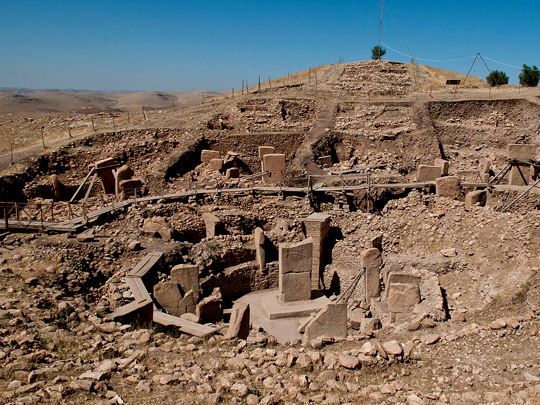
Göbekli Tepe stands on a hilltop near Şanlıurfa in south-east Turkey, a set of stone enclosures built around 11,500 years ago — some six thousand years before the first earthworks at Stonehenge — by people who hadn’t yet invented farming or pottery; UNESCO listed it in 2018.
At Göbekli Tepe a roof and walkways look down into circular enclosures ringed by T-shaped limestone pillars up to five and a half metres high, carved with foxes, boars, snakes and vultures, and in the quarry nearby lies an unfinished pillar seven metres long.
Göbekli Tepe was famous as the world’s oldest temple — built before people settled — but its excavators now describe it as a settlement with a strong ritual side, with houses, hearths, workshops and a rock-cut cistern; and the claims that it was deliberately buried, or was the Garden of Eden, have both been dropped.
4 – Amasra
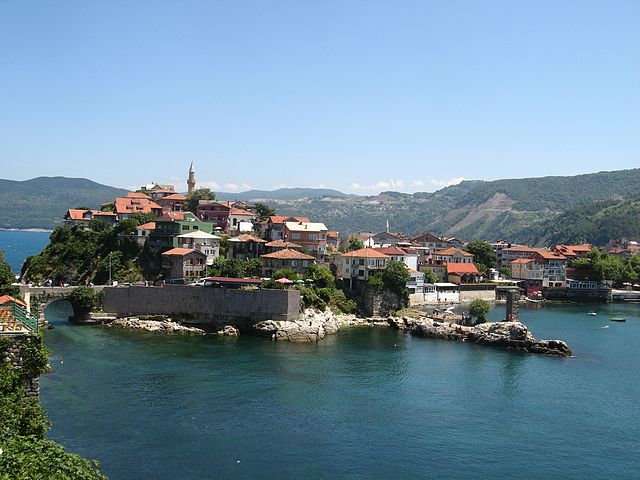
Amasra is a small port on Turkey’s Black Sea coast, in Bartın province, the ancient Amastris, named after a Persian princess who around 300 BC merged four towns to found it — and whose own sons later drowned her — then Byzantine, then Genoese, until it surrendered without a fight to Mehmed the Conqueror in 1460.
Amasra sits on a headland with two harbours and a castle whose walls still carry Genoese coats of arms, connected to an island by the Byzantine Kemere bridge, and its lane of wood-turners’ shops sells walnut bowls and spoons for the local salad.
Amasra is said to be where Mehmed the Conqueror called the town the “eye of the world,” but the phrase is older — a Byzantine writer of the 9th or 10th century already called it the eye of Paphlagonia, and of the whole world.
5 – Bodrum Castle
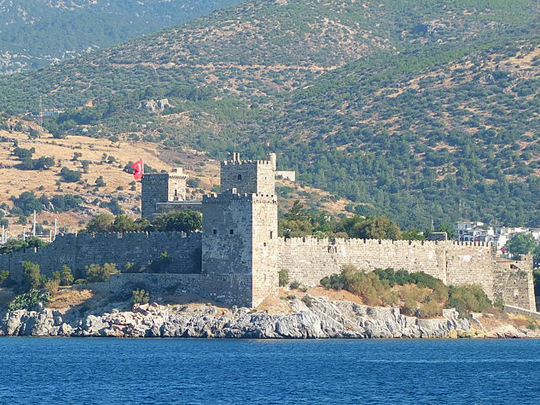
Bodrum Castle, the Castle of St Peter, stands on the harbour of Bodrum in south-west Turkey, built by the Knights Hospitaller from about 1404 on the site of ancient Halicarnassus, and finished by the end of the 15th century — partly from the stones of the Mausoleum, one of the Seven Wonders of the ancient world.
Bodrum Castle’s towers hold the Museum of Underwater Archaeology, whose centrepiece is the Uluburun wreck, a merchant ship that sank around 1320 BC carrying ten tons of copper and a gold scarab bearing Nefertiti’s name; the English Tower still carries the arms of King Henry IV of England.
Bodrum Castle is where the Mausoleum went: the knights took its blocks for their walls, and by 1522 almost all of it had gone — so the Wonder whose name gave us the word “mausoleum” survives largely as building stone, with its finest sculpture now in the British Museum.
6 – Galata Tower – Istanbul
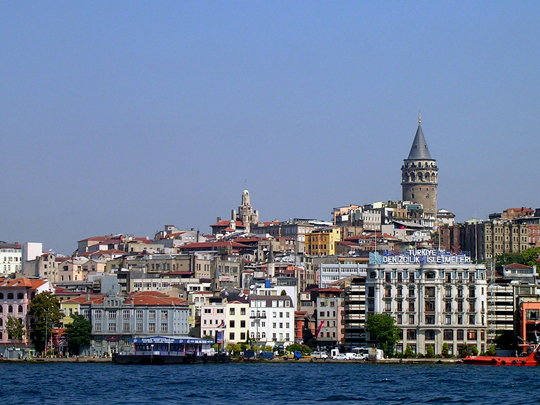
Galata Tower rises above the Golden Horn in Istanbul, built by the Genoese in 1348 for their trading colony across the water from Constantinople, and later used by the Ottomans as a fire lookout; it reopened as a state museum in 2020.
Galata Tower is about 63 metres to its gallery, 67 to the tip of its cone, with a balcony running right round the top looking over the Bosphorus, the old city and the Asian shore — it’s open late into the evening, and the queues are worst on weekend afternoons.
Galata Tower’s best story — that in the 1630s Hezârfen Ahmed Çelebi strapped on wings, jumped from the top and glided across the Bosphorus to Asia — comes from a single writer, the traveller Evliya Çelebi, and the glide ratio it would have needed is roughly double what a modern hang glider manages.
7 – Mount Nemrut
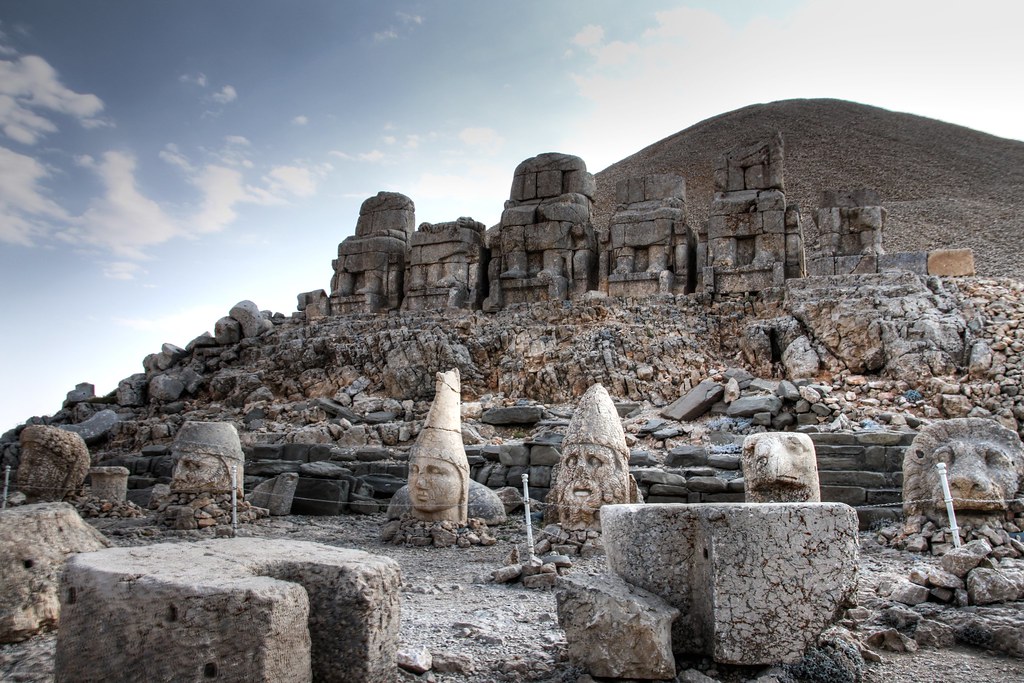
Mount Nemrut rises to about 2,150 metres in south-east Turkey, and on its summit King Antiochus I of Commagene built a tomb sanctuary in the 1st century BC — a cone of loose stones fifty metres high, flanked by terraces of giant statues; UNESCO listed it in 1987.
On Mount Nemrut the statues of gods and kings, eight or nine metres tall, blend Greek and Persian deities like Zeus-Oromasdes and Apollo-Mithras, and their heads, about two metres each, have tumbled to the ground in front of them — most people go up for sunrise on the east terrace.
Nobody has ever found Antiochus’s tomb inside Mount Nemrut, though the American archaeologist Theresa Goell tried in the 1950s and 60s, even with dynamite — and the site’s carved lion, marked with stars and planets, is one of the oldest horoscope reliefs known.
8 – Tortum Lake & Waterfall
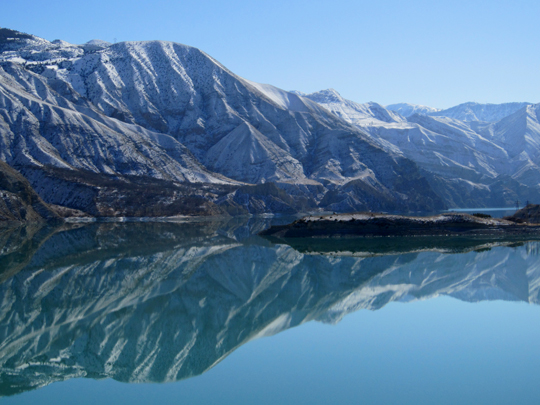
Tortum Lake fills a valley in the mountains north of Erzurum, in north-eastern Turkey, created when a landslide dammed the Tortum river — geologists disagree over when — and it now stretches for about eight kilometres, up to a hundred metres deep.
Tortum Lake spills over the landslide dam as the Tortum Waterfall, some 48 metres high and one of the tallest in Turkey, and the valley around it is quiet, green and rarely visited, deep in the old Georgian borderlands.
Tortum Waterfall is mostly switched off: a hydroelectric plant built in the 1950s takes the lake’s water, so the fall runs at full strength mainly in May and June, when the lake is high — and the local government’s claim that it’s the third-highest waterfall in the world isn’t close.
9 – Manavgat Falls
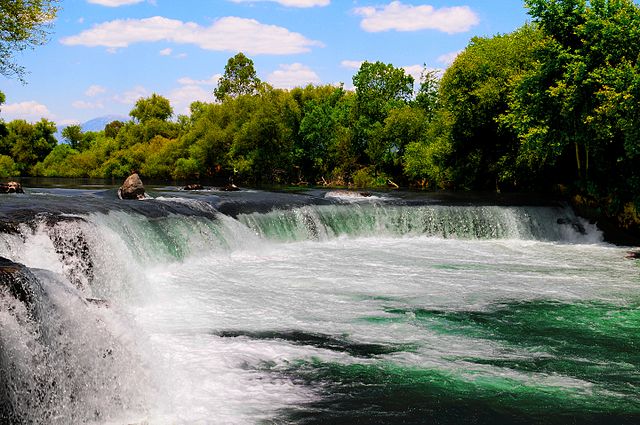
Manavgat Falls lie on the Manavgat river just north of the town of Manavgat, east of Antalya on Turkey’s Mediterranean coast, a broad, low waterfall where the river — the ancient Melas — spills over a ledge about two metres high and forty wide.
Manavgat Falls are an easy stop with tea gardens on the bank, and boats run down the river to the sea and the ancient city of Side, whose Temple of Apollo stands on the shore.
Manavgat Falls were famous enough to go on the back of the Turkish five-lira note from 1968 to 1983 — and in the 2000s Turkey planned to sell the Manavgat river’s water by tanker to Israel, Malta and Cyprus, plans that had been shelved by 2006.
10 – The Ishak Paşa Palace
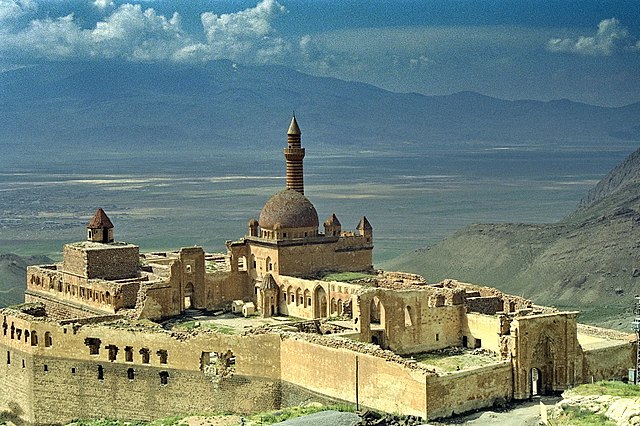
The Ishak Paşa Palace stands on a ledge above Doğubayazıt in far eastern Turkey, close to the Iranian border, begun in 1685 and finished in 1784 by a family of local Ottoman governors, and it looks across the plain to Mount Ararat.
The Ishak Paşa Palace mixes Ottoman, Persian, Seljuk and Armenian styles in carved stone — a harem, a mosque, a courtyard and a hammam — and is said to have 366 rooms, one for each day of a leap year; since 2009 much of it has sat under a glass and wood roof that many architects objected to.
The Ishak Paşa Palace had hot water piped from the hammam furnace and flues in the walls — often called the world’s first central heating, which it wasn’t — and local tradition says Russian troops carried off its gilded doors in the 19th century, though where they ended up has never been established.
11 – Hadrian’s Gate – Antalya
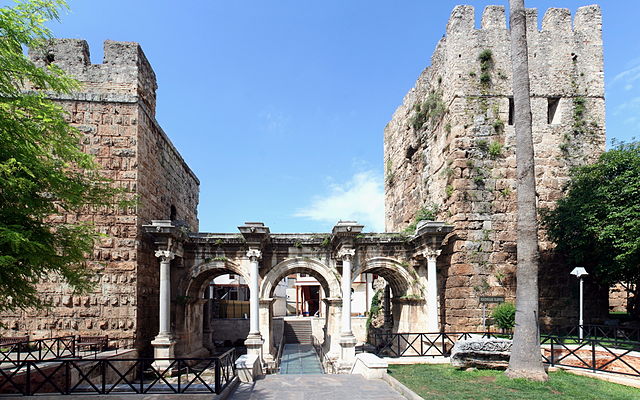
Hadrian’s Gate in Antalya was built to mark the emperor Hadrian’s visit around AD 130, a triple arch of white marble on the walls of Attaleia, the city founded by Attalos II of Pergamon in the 2nd century BC.
Hadrian’s Gate leads into Kaleiçi, Antalya’s old town, and you walk through on a glass walkway above the wheel ruts worn into the Roman paving, between two towers — the south one Roman, the north one topped by the Seljuks in the 13th century.
Hadrian’s Gate was never actually lost: the Irish hydrographer Francis Beaufort — he of the Beaufort wind scale — recorded it in 1817 while charting the coast, its lower part was dug out in 1882, and when the walls around it came down in the 1950s it was restored and stood free.
12 – Ölüdeniz Beach – Fethiye
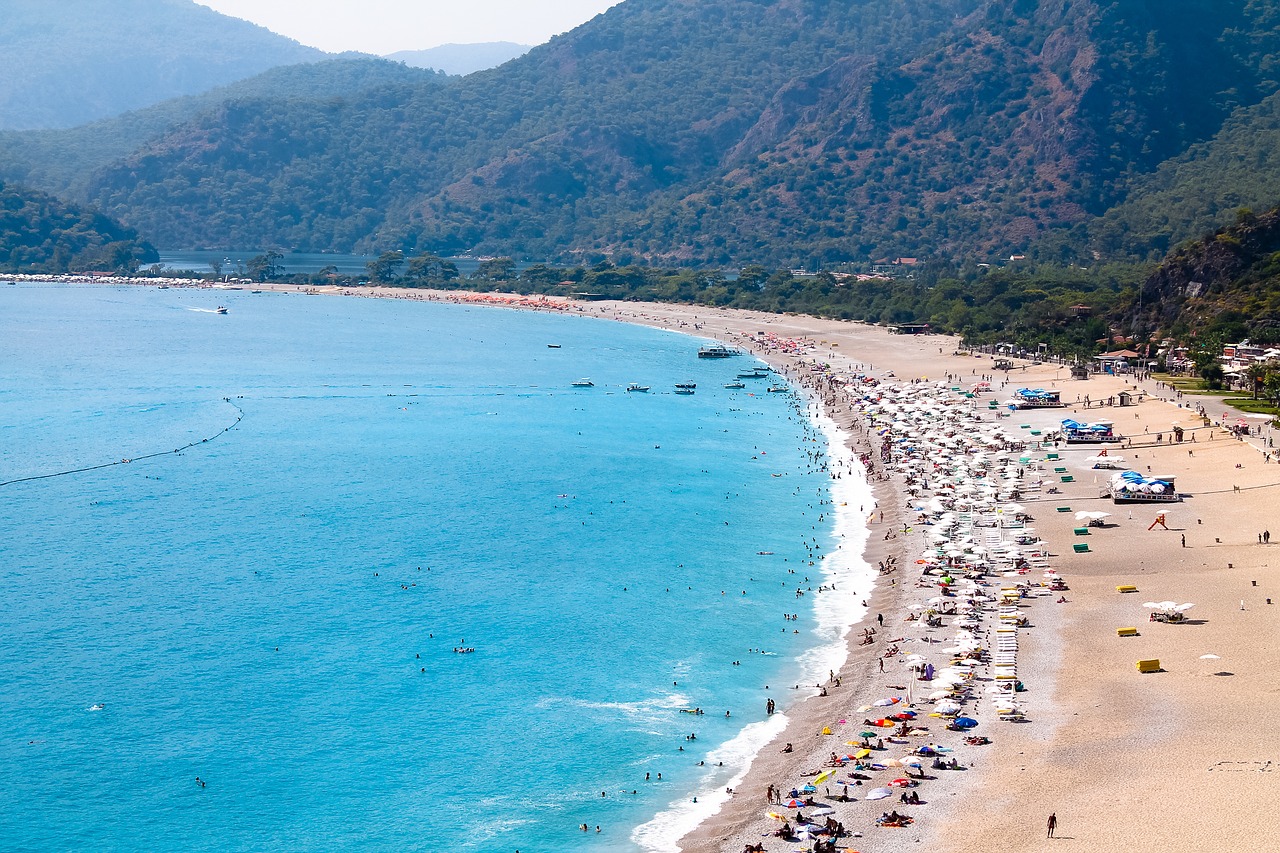
Ölüdeniz, near Fethiye on Turkey’s south-west coast, is a sheltered lagoon behind a sand spit — the name means “dead sea” because the water stays calm even in storms — protected as a nature park since 1983.
Ölüdeniz is best seen from above: paragliders launch from Babadağ, nearly 2,000 metres up and less than five kilometres from the sea, and land on the beach, and the Lycian Way, the long-distance footpath along the coast, starts just above it.
Over the hill from Ölüdeniz is Kayaköy, a ghost town of stone houses that was the Greek village of Levissi until its people were deported and finally expelled in the 1923 population exchange — the setting of Louis de Bernières’s novel Birds Without Wings.
13 – Temple of Apollo – Didyma
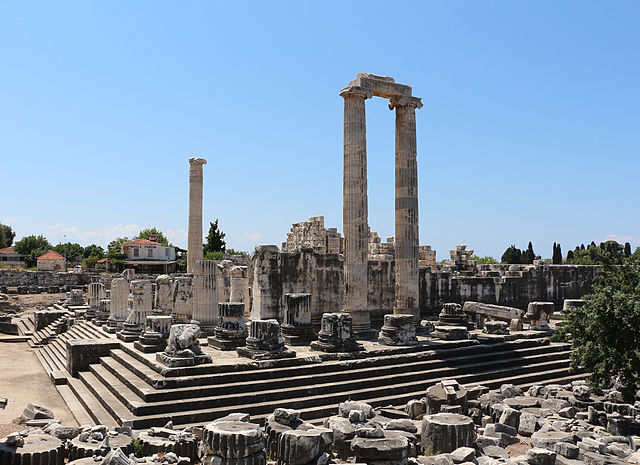
The Temple of Apollo at Didyma, on Turkey’s Aegean coast south of Miletus, was one of the great oracles of the Greek world, linked to Miletus by a sacred way; the Persians burned the first temple in 494 BC, and work on its vast replacement began around 300 BC.
The Temple of Apollo at Didyma was never finished, though building went on for some six hundred years: its columns, almost twenty metres tall, stand on a platform over a hundred metres long, and the carved Medusa heads from its frieze are now the most photographed things on the site.
In 1979 the archaeologist Lothar Haselberger spotted faint lines on the walls of the Temple of Apollo at Didyma — full-size construction drawings, scratched into the stone, including the subtle swelling of the columns — which survived only because the temple was never finished and the walls were never polished smooth.
14 – Sultan Ahmed Mosque

The Sultan Ahmed Mosque stands on the old Hippodrome in Istanbul, facing Hagia Sophia, built between 1609 and 1617 by the architect Sedefkâr Mehmed Ağa for Sultan Ahmed I, who died at 27 just after it was finished.
The Sultan Ahmed Mosque is known as the Blue Mosque for the more than 20,000 Iznik tiles and the blue-painted domes inside, reopened in 2023 after a long restoration; it’s free to enter outside prayer times, with headscarves lent at the door.
The Sultan Ahmed Mosque’s six minarets come with two stories — that the architect misheard “gold” (altın) as “six” (altı), and that the sultan paid for a seventh minaret at Mecca to settle the outrage — but the first is folklore, and the seventh minaret in Mecca wasn’t his.
15 – Aspendos Theatre
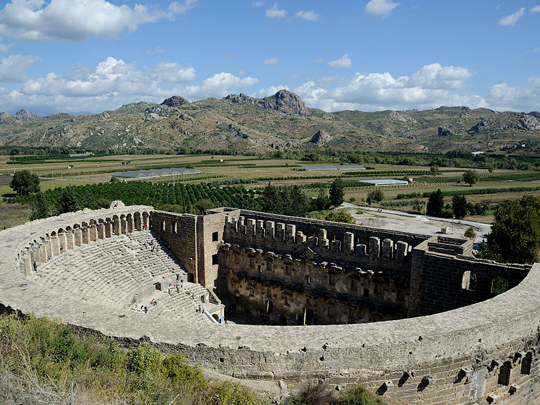
Aspendos Theatre stands near the Köprüçay river east of Antalya, built around AD 160–180 by the architect Zenon for the city of Aspendos, and it is often called the best-preserved Roman theatre anywhere, a claim made in Turkey’s own World Heritage submission.
Aspendos Theatre seats some 7,000 people in its curve of stone rows, behind a stage wall that still stands to its full height, and it’s still used — the Aspendos Opera and Ballet Festival is held inside it every September.
Aspendos Theatre survived because it stopped being a theatre: in the 13th century the Seljuk sultan Alaeddin Keykubad turned the stage building into a palace and travellers’ lodging, and you can still see the red zigzag paint his builders put on the walls.
16 – Fortress of Corycus
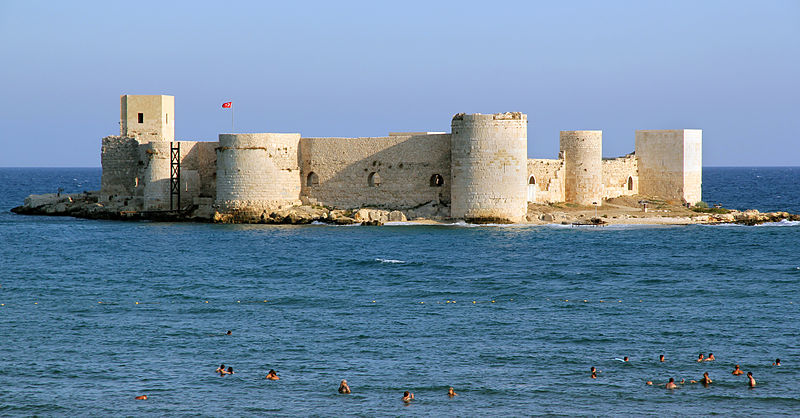
The Fortress of Corycus stands at Kızkalesi on Turkey’s southern coast in Mersin province, a land castle on the shore and a second, the “Maiden’s Castle,” on an islet a few hundred metres out, rebuilt by a Byzantine admiral around 1101 and later held by crusaders from Cyprus.
From Corycus you can swim, paddle or take a boat out to the sea castle in summer, and nearby are the Heaven and Hell sinkholes, Cennet and Cehennem — one 70 metres deep with a Byzantine chapel at the bottom, the other where the monster Typhon was said to have been chained.
The sea castle at Corycus is named for a legend: a king was told his daughter would die of a snakebite, so he walled her up on the island — and a snake reached her anyway, hidden in a basket of grapes.
17 – Hagia Sophia – Istanbul
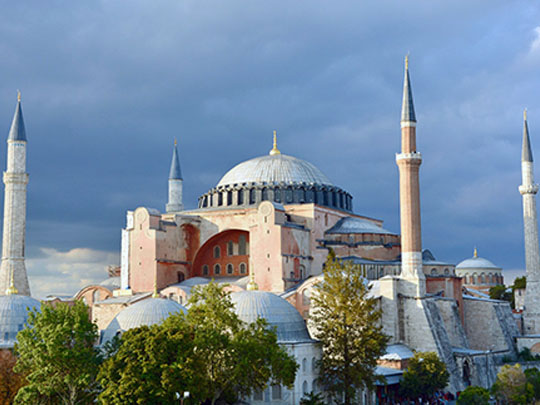
Hagia Sophia stands at the heart of old Istanbul, built in under six years, between 532 and 537, for the emperor Justinian, and for nearly a thousand years it was the largest cathedral in the world — then a mosque from 1453, a museum from 1935, and a mosque again since 2020.
Hagia Sophia’s dome, about 32 metres across and 55 high, seems to float on a ring of windows — it collapsed in an earthquake in 558 and was rebuilt higher — and since January 2024 foreign visitors pay €25 and follow a route through the upper galleries, where the gold Byzantine mosaics are.
Carved into a marble parapet in Hagia Sophia’s south gallery are Norse runes, most likely the name Halfdan, scratched by a Viking — probably one of the Varangian Guard who served the Byzantine emperors — between the 9th and 11th centuries, and found only in 1964.
18 – Gallipoli
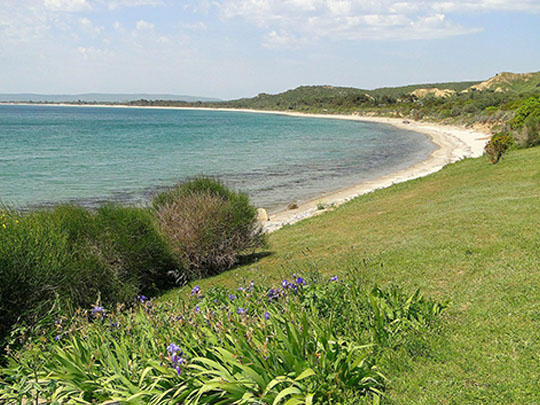
Gallipoli is the peninsula on the European shore of the Dardanelles, where in 1915 British, French, Australian, New Zealand and Indian troops landed to force the straits and knock the Ottoman Empire out of the war — and failed, after eight months that killed over 44,000 Allied and about 87,000 Ottoman soldiers; it is now a national historical park.
Gallipoli’s battlefields run from the landing beaches at Helles and Anzac Cove to the ridges of Lone Pine and Chunuk Bair, where Mustafa Kemal, later Atatürk, made his name, lined with war cemeteries; the words of reconciliation carved at Anzac Cove and credited to Atatürk have no record before 1953.
Gallipoli has an Irish story: at V Beach on 25 April 1915, of about a thousand Royal Dublin Fusiliers, one officer and 374 men reached the shore, and in August the 10th (Irish) Division landed at Suvla and lost nearly half its 17,000 men in two months — some 3,000 to 4,000 Irish died in the campaign.
19 – Ephesus
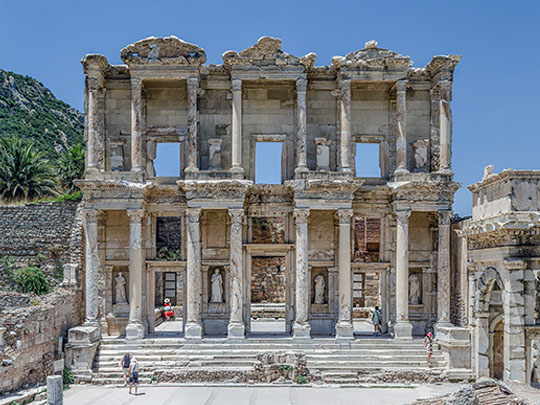
Ephesus, near Selçuk on Turkey’s Aegean coast, was one of the great cities of the Roman East, capital of the province of Asia and home to the Temple of Artemis, one of the Seven Wonders — St Paul lived here, and the silversmiths rioted against him in its theatre; UNESCO listed it in 2015.
At Ephesus you walk down marble streets to the two-storey facade of the Library of Celsus, built in the 110s as a library and a tomb for its founder’s father, and the theatre that seated about 25,000, while the Terrace Houses, under a roof, hold the wall paintings and mosaics of the richest homes, on a separate ticket.
Ephesus was a port, and the sea is now some five kilometres away: the Küçük Menderes river silted up the harbour, the city moved more than once to follow the coast, and in the end silt, not war, finished it — and of the Wonder, a single column has been put back up from the pieces.
20 – Troy
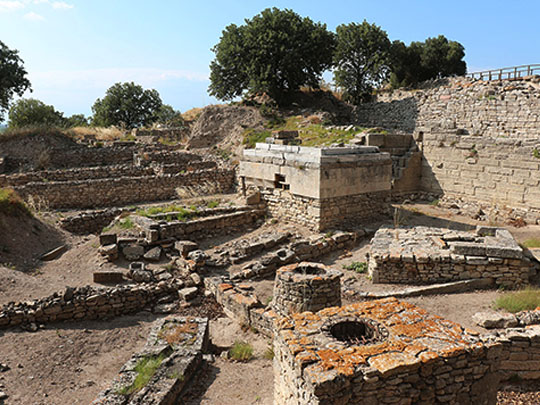

Troy lies on the mound of Hisarlık near the Dardanelles in north-west Turkey, nine cities stacked one on another from the early Bronze Age to Roman times, and the strongest candidate for Homer’s Troy is the level called Troy VI or VIIa, from the late Bronze Age; UNESCO listed it in 1998.
At Troy a trail leads through the walls, ramps and houses of the different cities, including the great trench Heinrich Schliemann cut through the mound in the 1870s, and down the road is the Troy Museum, opened in 2018 — the wooden horse at the site dates from 1975, and the one on the Çanakkale waterfront is the prop from the 2004 film.
Troy’s “Priam’s Treasure,” the gold Schliemann found in 1873, is a thousand years too old for Homer’s Priam, and the story of his wife carrying it out in her shawl was one he admitted inventing — the treasure went to Berlin, vanished in 1945, and resurfaced in Moscow’s Pushkin Museum in the 1990s, where it still is.