
Wikimedia Commons / CC-BY-SA-3.0 / GFDL
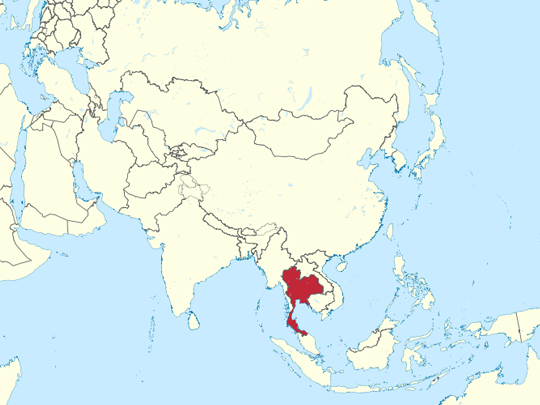
Capital: Bangkok
Population: 65.8 million+
Language: Thai
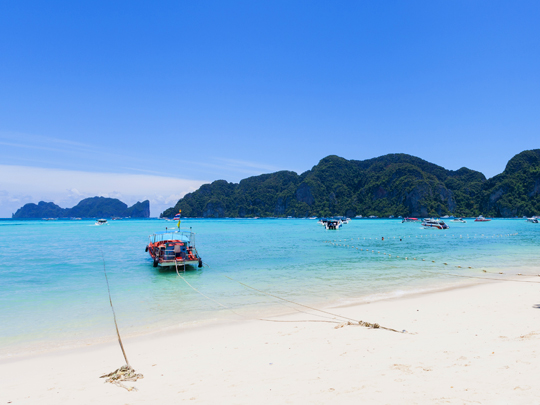
1 – Koh Phi Phi Island (above)
Koh Phi Phi is a small group of limestone islands in the Andaman Sea off Krabi, in southern Thailand, where Phi Phi Don’s village sits on a narrow sandy isthmus between two bays — which is why, when the 2004 tsunami came through, it was hit from both sides and more than a thousand people were killed or went missing there.
Koh Phi Phi’s day trips run from Phi Phi Don to the uninhabited Phi Phi Leh, with its cliffs, lagoons and the Viking Cave, where swiftlets’ nests are harvested, and to Maya Bay, reopened in 2022 after nearly four years closed for its reefs to recover — boats moor at the back of the island, visitors walk in, and swimming is banned.
Maya Bay on Koh Phi Phi is where The Beach was filmed in 1999, and the crew bulldozed dunes and planted coconut palms to make it look more like a beach — local conservationists sued that year, and the case was only settled by Thailand’s Supreme Court in 2022, twenty-three years later.
2 – The Sanctuary of Truth – Pattaya
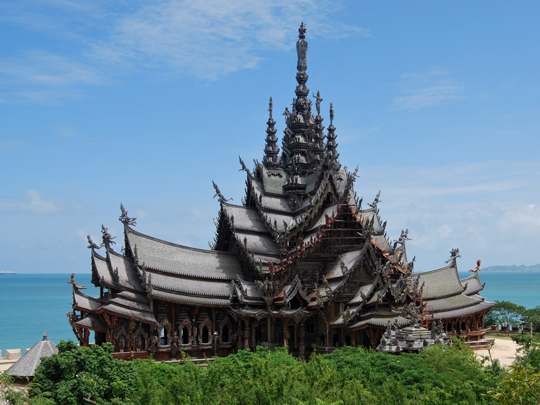
The Sanctuary of Truth stands on the seafront at Pattaya on Thailand’s eastern Gulf coast, a wooden temple-like building 105 metres tall begun in 1981 by the businessman Lek Viriyaphant, as a museum of philosophy rather than a working temple.
Every surface of the Sanctuary of Truth is hand-carved — gods, spirits and figures from Buddhist and Hindu tradition in teak and other woods — and visitors are handed hard hats because carvers are still at work on it.
The Sanctuary of Truth was supposed to be finished around 2025, according to the tourism authority, and it wasn’t — it has become a building people visit precisely because it’s still being built, and the often-repeated claim that there’s not a single nail in it is best taken as referring to the main wooden structure.
3 – James Bond Island – Phang Nga Bay
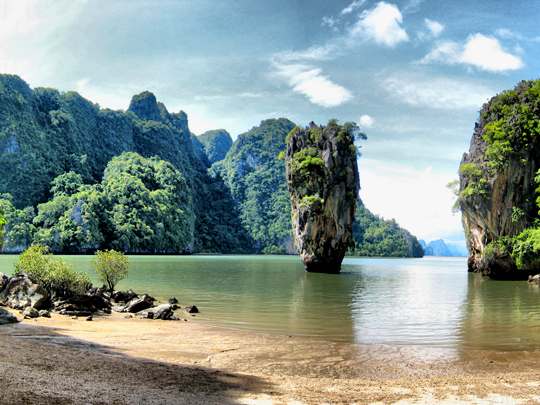
James Bond Island is Khao Phing Kan, a pair of leaning limestone hills in Phang Nga Bay, north-east of Phuket, and its fame comes from 1974, when it played the villain Scaramanga’s hideout in The Man with the Golden Gun.
The shot everyone wants at James Bond Island is Ko Tapu, “nail island,” a 20-metre spike of rock standing in the water, wider at the top than at the waterline, which boats have been kept away from since the late 1990s to slow its erosion; the bay around it has been a national park since 1981.
In the same bay, the stilt village of Koh Panyee was so short of flat land that in 1986 its children built a floating football pitch out of scraps of wood — and their team went on to win youth tournaments on the mainland, a story that went viral decades later.
4 – Grand Palace – Bangkok
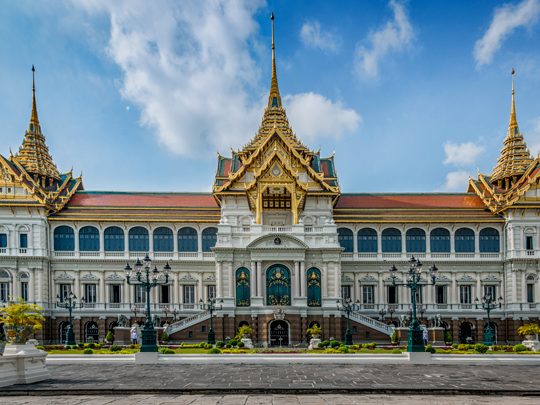
The Grand Palace stands on the east bank of the Chao Phraya in Bangkok, begun in 1782 by King Rama I when he moved the capital across the river from Thonburi, and it was the kings’ main residence until the early 20th century; it is still used for royal ceremonies today.
The Grand Palace is a walled compound of over 200,000 square metres of throne halls, pavilions and courtyards, with the Temple of the Emerald Buddha inside the same walls, and the dress code is strict — no shorts, sleeveless tops or tight trousers — and ticket sales stop at 3.30pm.
The Grand Palace’s Chakri Maha Prasat throne hall, built for Rama V between 1876 and 1882 by a British architect from Singapore, was designed with a European dome, until a senior minister persuaded the king to give it Thai roofs instead — which is why Thais have long called it a Westerner wearing a Thai hat.
5 – Chiang Mai
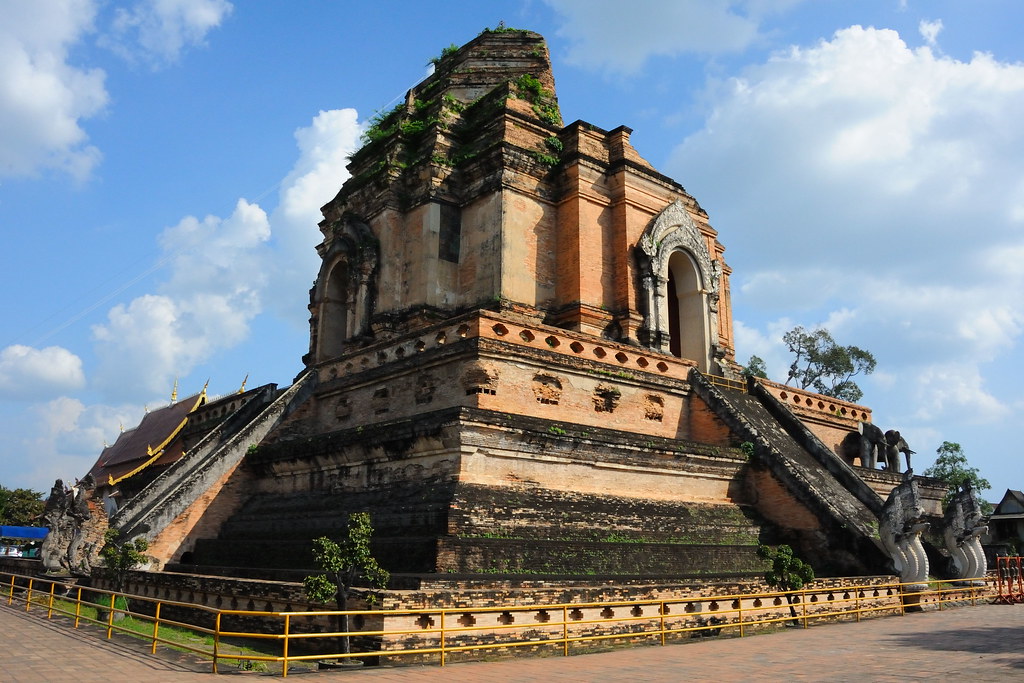
Chiang Mai, the “new city,” was founded in 1296 by King Mangrai as the capital of the northern Lanna kingdom, spent more than two centuries under Burmese rule from 1558 until 1775, and was then nearly abandoned before being rebuilt as the north’s capital.
Chiang Mai’s old city is a moated square about a mile and a half a side with fragments of its brick walls, packed with temples, and above it on Doi Suthep, up a long naga staircase of around 300 steps, is the gold chedi of Wat Phra That Doi Suthep, founded, so the story goes, where a white elephant carrying a relic of the Buddha climbed the mountain and died.
Chiang Mai’s Wat Chedi Luang was the tallest building in Lanna until an earthquake in 1545 brought down its upper thirty metres — geologists have since found evidence that the ground liquefied beneath it — and it has stood as a broken giant ever since; the city is now bidding for World Heritage status, with a decision due in 2027.
6 – Khao Yai National Park
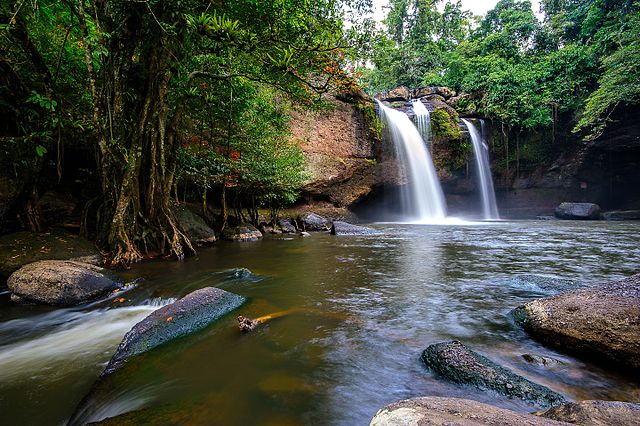
Khao Yai National Park, north-east of Bangkok, became Thailand’s first national park in 1962, and its 2,166 square kilometres of forest are part of the Dong Phayayen–Khao Yai Forest Complex World Heritage Site, listed in 2005.
Khao Yai is one of the easiest places in Thailand to see wild elephants, about 300 of them, along with gibbons and four species of hornbill, and its waterfalls include Haew Suwat, where Leonardo DiCaprio jumps in The Beach — swimming there is now banned.
In October 2019 a calf slipped over Haew Narok falls in Khao Yai, and eleven elephants died trying to reach it — six found at the foot of the falls and five more by drone downstream — and eight had died at the same waterfall in 1992.
7 – Wat Arun Temple
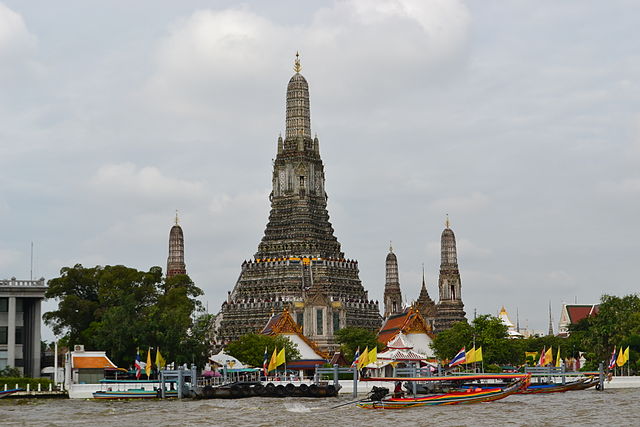
Wat Arun, the Temple of Dawn, stands on the Thonburi bank of the Chao Phraya opposite the Grand Palace, the temple King Taksin adopted when he made Thonburi his capital after Ayutthaya fell in 1767 — and where the Emerald Buddha was kept before it crossed the river.
Wat Arun’s central prang rises about 80 metres (published figures vary) and was raised to that height under Rama III, finished in 1851, its steep stairs and terraces encrusted with pieces of coloured Chinese porcelain; it faces west, so it’s at its best at sunset, seen from across the river.
A restoration of Wat Arun between 2013 and 2017 replaced about 120,000 of its 300,000 or so pieces of porcelain and refinished the plaster, and when the scaffolding came down many Thais complained it had turned too white — the Fine Arts Department said the original designs had been kept.
8 – Similan Islands
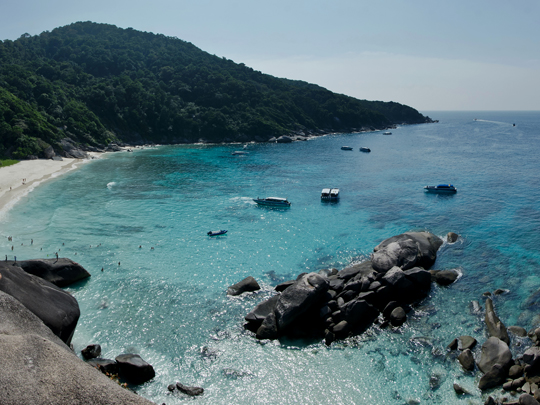
The Similan Islands lie in the Andaman Sea off Phang Nga province, a national park since 1982, and their name comes from the Malay sembilan, nine — though there are now eleven, since two more islands, Ko Bon and Ko Tachai, were added to the park in 1998.
The Similan Islands are for diving and snorkelling over granite boulders and coral, and they open only from 15 October to 15 May, with a cap of 3,850 visitors a day, including 525 divers — before the caps, up to 7,000 a day came in high season.
One of the Similan Islands has been closed to everyone since 2016: Ko Tachai, shut to let its reef and turtle beaches recover, and still closed in 2026, after the park’s advisory panel recommended against a proposed reopening.
9 – Doi Inthanon National Park
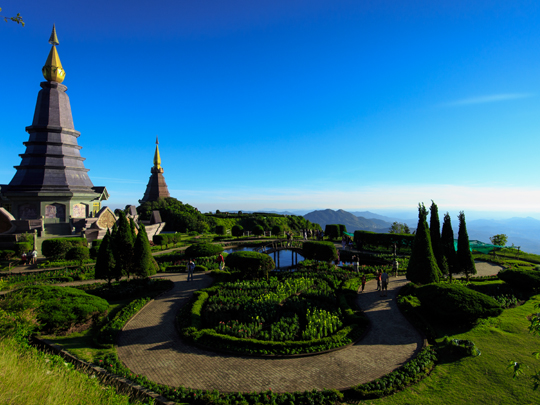
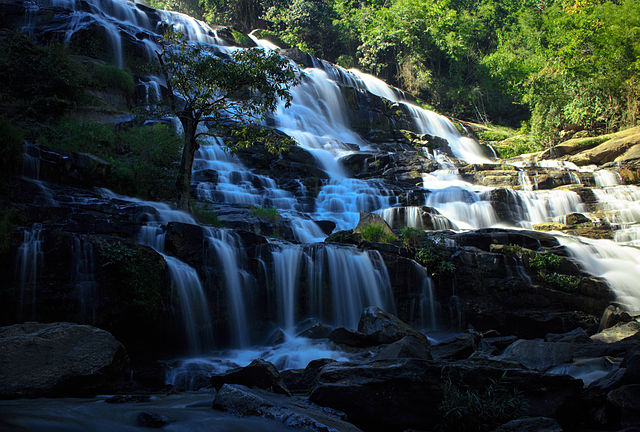
Doi Inthanon is Thailand’s highest mountain at 2,565 metres, south-west of Chiang Mai, and it takes its name from Inthawichayanon, ruler of Chiang Mai from 1870, who asked for his remains to be kept on the summit when he died in 1897.
A road runs almost to the top of Doi Inthanon past the Wachirathan and Mae Ya waterfalls, Karen and Hmong villages and terraced fields, to a boardwalk through mossy cloud forest and a pair of chedis built for the King and Queen’s sixtieth birthdays in 1987 and 1992.
Doi Inthanon is regularly said to hold Thailand’s coldest temperature, −5°C in December 2017, but that reading at the observatory was never made official — the Thai Meteorological Department’s record is −1.4°C, in the north-east in 1974.
10 – Khao Sok National Park
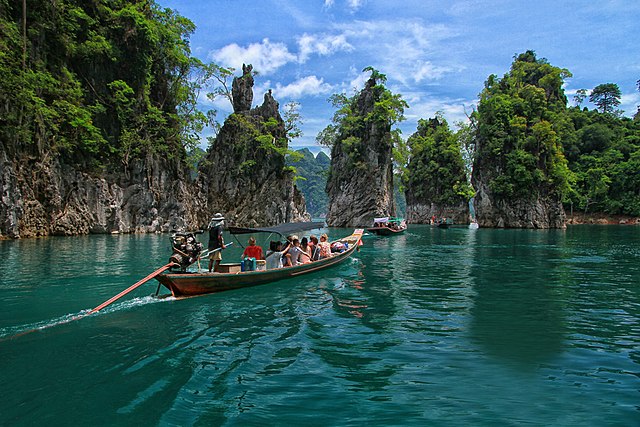
Khao Sok National Park covers 739 square kilometres of limestone mountains and rainforest in Surat Thani province in southern Thailand, created in 1980, and it’s regularly described as older than the Amazon, 160 million years old — a claim that really only means the land has sat near the equator that long.
Khao Sok’s centrepiece is Cheow Lan, a reservoir of limestone islands formed when the Ratchaprapha dam was finished in 1987, where you stay in floating raft houses; in the forest, with luck and in season, you might see Rafflesia kerrii, the largest flower in Thailand, up to a metre across, which smells of rotting meat.
Cheow Lan lake at Khao Sok drowned a valley: 385 families from the village of Ban Chiew Lan were moved out, and as the water rose a rescue team led by the conservationist Seub Nakhasathien saved more than 1,300 animals of over a hundred species from the shrinking islands.
11 – Ayutthaya
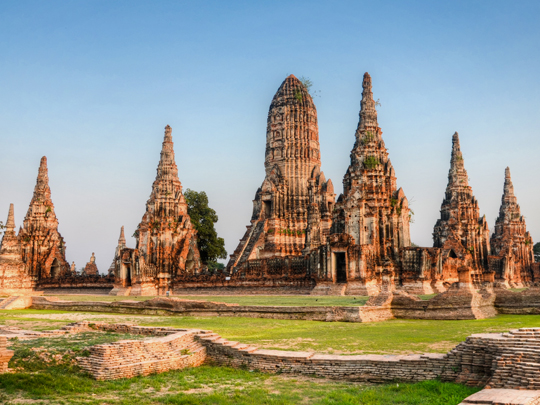
Ayutthaya, on an island where three rivers meet north of Bangkok, was founded around 1350 and was the capital of Siam for over four centuries, one of the great trading cities of Asia, until a Burmese army took and burned it in April 1767 after a fourteen-month siege; UNESCO listed it in 1991.
Ayutthaya’s ruins are best seen by bicycle: the three chedis of Wat Phra Si Sanphet, where a sixteen-metre standing Buddha covered in gold was melted down by the Burmese, the riverside towers of Wat Chaiwatthanaram, and at Wat Mahathat a stone Buddha’s head wrapped in the roots of a fig tree — nobody knows how it got there.
Ayutthaya around 1700 is often said to have had a million people, the largest city in the world, but no one ever counted — the historian Anthony Reid, working from maps and European visitors’ accounts, put it at 150,000 to 200,000, still a very big city for its time.
12 – Wat Phra Kaew
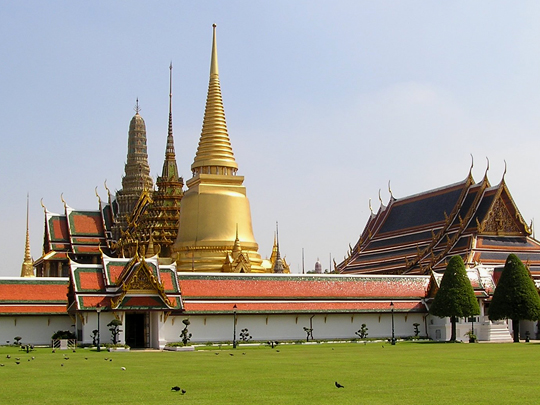
Wat Phra Kaew, the Temple of the Emerald Buddha, stands inside the Grand Palace in Bangkok and is the most sacred temple in Thailand, home to a meditating Buddha about 66 centimetres high carved from green jade or jasper — not emerald — which has been here since the 1780s.
The Emerald Buddha of Wat Phra Kaew sits high on a gilded altar, and the galleries around the temple carry 178 painted scenes of the Ramakien, the Thai Ramayana — though what you see is a repainting under Rama III and later restorations, not the original.
The Emerald Buddha’s story at Wat Phra Kaew starts in 1434, when lightning struck a chedi in Chiang Rai and flakes of stucco fell away to reveal green stone; it travelled through Lampang, Chiang Mai, Luang Prabang and Vientiane before reaching Bangkok, and three times a year the King changes its robes for the hot, rainy and cool seasons.
13 – Sukhothai
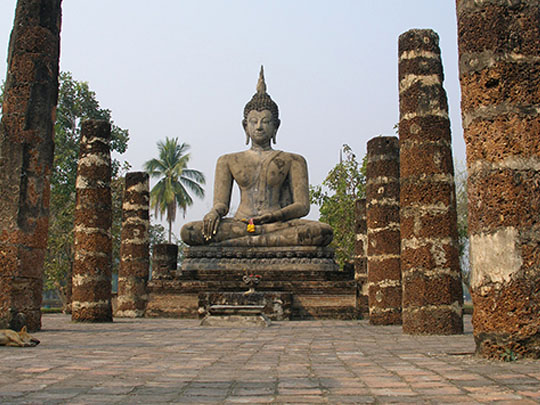
Sukhothai, in the plains of north-central Thailand, was the capital of the first great Thai kingdom, traditionally founded around 1238 — the name means roughly “dawn of happiness” — until Ayutthaya made it a vassal and in 1438 installed its own ruler; UNESCO listed it in 1991 together with Si Satchanalai and Kamphaeng Phet.
Sukhothai Historical Park spreads over some 70 square kilometres and is best seen by bicycle, hired at the gate: Wat Mahathat with its lotus-bud chedi and rows of stucco disciples, Wat Sa Si on an island in a lotus pond, and at Wat Si Chum a 15-metre seated Buddha squeezed into a roofless hall — plus the walking Buddha, a pose Sukhothai’s sculptors made their own.
Sukhothai’s most famous object is the Ramkhamhaeng Inscription of 1292, Thailand’s founding text, which credits the king with inventing the Thai alphabet — found in 1833 by the future King Mongkut, and argued over for decades as his possible forgery; most scholars now accept it as genuine, though the script was adapted from Old Khmer rather than invented from nothing.
14 – The Death Railway and the Bridge at Kanchanaburi
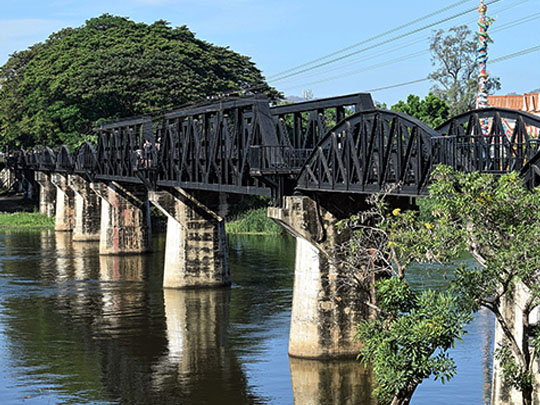
The Death Railway, the Thai–Burma Railway, ran some 415 kilometres from Ban Pong in Thailand to Thanbyuzayat in Burma, built by Japan between 1942 and October 1943 with some 60,000 Allied prisoners of war and 200,000 or more Asian labourers — an estimated 12,000 to 13,000 of the prisoners died, and 80,000 to 100,000 of the labourers.
At Kanchanaburi the steel bridge still carries trains, its curved spans brought from Java by the Japanese and its two straight middle spans replacements for those bombed in 1945; Kanchanaburi War Cemetery holds 6,982 graves, and up the line the Australian-run museum at Hellfire Pass leads through a cutting dug largely by hand.
The Bridge on the River Kwai of 1957 was shot in Sri Lanka from a novel by Pierre Boulle, who was never on the railway, and the river at Kanchanaburi was the Mae Klong until Thailand renamed it Khwae Yai for tourists — while the real senior British officer, Lt Col Philip Toosey, never collaborated but bargained for food and medicine.