

Wikimedia Commons / CC-BY-SA-3.0 / GFDL
Capital: Jackson
Population: 2.9 million+
Language: English

1 – Biloxi (also above)

Biloxi stretches along the Mississippi Gulf Coast, takes its name from the Biloxi people, and was briefly the capital of French Louisiana until the seat of government moved to New Orleans in 1722, while Iberville’s Fort Maurepas of 1699, Mississippi’s first European settlement, stood across the bay on the site of Ocean Springs.
Biloxi mixes seafood-town heritage with the casinos that arrived after Mississippi legalised dockside gambling in 1990, while Frank Gehry’s Ohr-O’Keefe Museum of Art celebrates George Ohr, the self-styled “Mad Potter of Biloxi”, and is co-named for Annette O’Keefe, whose husband, the Biloxi mayor Jerry O’Keefe, descended from an Irish emigrant.
Legend says the 1848 Biloxi Lighthouse was painted black to mourn Abraham Lincoln, but the black was really a coat of coal tar to stop rust, and it went back to white in 1868, while Maria Younghans kept the light for more than 50 years, from 1866 to 1918, before her daughter Miranda took over.
2 – B.B. King Museum, Indianola

The B.B. King Museum and Delta Interpretive Center sits in Indianola in the Mississippi Delta, built around the restored brick cotton gin where Riley King, born in 1925 near Itta Bena, worked in the 1940s before music took him to Memphis.
The B.B. King Museum traces his life alongside the history of the Delta, and King himself is buried on the museum grounds, while nearby Club Ebony, a classic stop on the blues circuit, was later bought by King and donated to the museum.
BB stood for “Beale Street Blues Boy”, from his radio days in Memphis, and by his own account his guitar Lucille was named after a 1949 dance-hall fire in Twist, Arkansas, started when two men fighting over a woman called Lucille knocked over a kerosene fire, as a reminder never to run back into a blaze for a guitar again.
3 – Jackson

Jackson, Mississippi’s capital, was picked in 1821 at LeFleur’s Bluff on the Pearl River, named for Andrew Jackson, and burned so thoroughly by Union troops in 1863 that it picked up the nickname “Chimneyville”.
Jackson has the Old Capitol, where Mississippi voted 84 to 15 to secede in 1861, the Mississippi Civil Rights Museum and the Museum of Mississippi History, which opened together in 2017 for the state’s bicentennial, the Medgar and Myrlie Evers Home, where the civil rights leader was shot in his driveway in 1963, and Eudora Welty’s house.
The Help (2011) is set in 1960s Jackson, but the film was shot largely in Greenwood, up in the Delta, whose streets were comparatively unchanged, with only a few scenes filmed in Jackson, including the Fondren district.
4 – Elvis Presley Birthplace, Tupelo

The Elvis Presley Birthplace and Museum in Tupelo centres on the two-room house that Vernon Presley built in 1934 with his father and brother, where Elvis was born on 8 January 1935 and his twin brother, Jesse Garon, was stillborn.
The Elvis Presley Birthplace site, bought by the city of Tupelo in 1957, includes the house, a museum, the Assembly of God church where young Elvis was first influenced by gospel music, moved onto the grounds, and a bronze statue of Elvis at 13.
Elvis Presley got his first guitar at Tupelo Hardware around his 11th birthday, though the story comes in several versions, as he wanted a rifle, or some say a bicycle, and left with a guitar costing $7.75.
5 – Vicksburg

Vicksburg sits on high bluffs above the Mississippi, and its 47-day siege ended on 4 July 1863 when John Pemberton surrendered some 29,500 Confederate troops to Ulysses S. Grant, a prize Lincoln called “the key”, as Admiral David Dixon Porter later recalled.
Vicksburg National Military Park holds the trenches, monuments and the ironclad USS Cairo, sunk by a Confederate mine in 1862 and raised in 1964, while downtown the Biedenharn Coca-Cola Museum marks where Joseph Biedenharn first bottled Coca-Cola in 1894.
Vicksburg is said to have skipped the Fourth of July for 81 years after the surrender, but historians call this a myth, as Black residents kept marking the day during Reconstruction while many white residents ignored it, though the first citywide celebration came only in 1945.
6 – Tupelo

Tupelo grew up on former Chickasaw land in northeast Mississippi beside the new Mobile & Ohio Railroad around 1859–60, first called Gum Pond after its tupelo trees, and saw the Battle of Tupelo in July 1864, when Union troops beat off repeated attacks by Nathan Bedford Forrest and Stephen Lee, then withdrew to Memphis.
Tupelo has the 0.4 ha Tupelo National Battlefield, the headquarters and visitor centre of the Natchez Trace Parkway, and Brices Cross Roads battlefield about 24 km north, where Forrest won in June 1864.
Tupelo became the first city to get power from the Tennessee Valley Authority in 1934, billing itself the “First TVA City”, and Belfast-born Van Morrison’s “Tupelo Honey” isn’t about Tupelo, as it’s named after honey from tupelo trees in the swamps of Florida and the Southeast.
7 – Greenwood
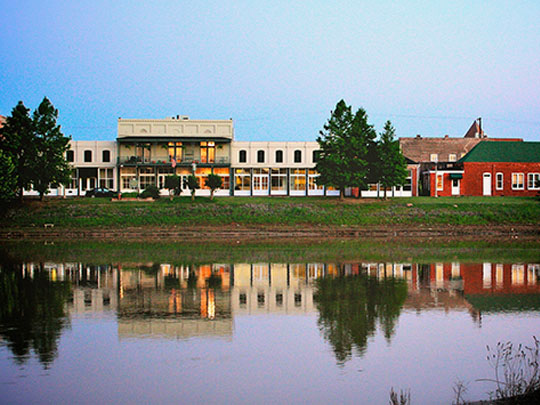

Greenwood sits in the Mississippi Delta where the Tallahatchie and Yalobusha rivers meet to form the Yazoo, grew from a trading post founded in the 1830s, and was incorporated in 1844 under the name of the Choctaw chief Greenwood LeFlore.
Greenwood has Cotton Row, the stretch of Front Street along the Yazoo lined with old cotton offices, Grand Boulevard, an oak-shaded avenue once named one of America’s ten most beautiful streets, the Museum of the Mississippi Delta, and Broad Street Park, where Stokely Carmichael rallied the crowd with the cry “We want Black Power” in June 1966.
Robert Johnson died near Greenwood in 1938, his death certificate gives no cause despite the famous poisoned-whiskey story, and nobody knows where he’s buried, so three nearby churchyards have markers, one placed in 1990 by an Atlanta rock band, an obelisk paid for by Columbia Records in 1991, and a 2002 headstone at Little Zion, the site usually judged the likeliest.
8 – Natchez
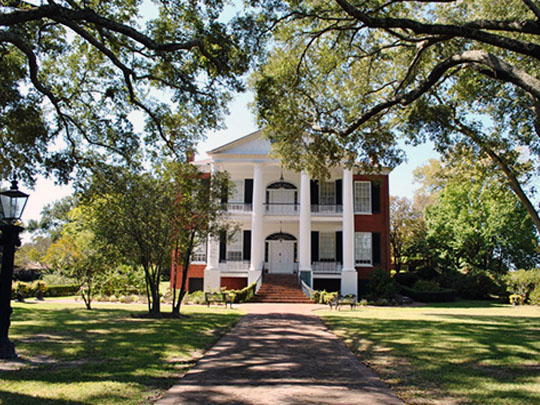
Natchez sits on bluffs above the Mississippi and takes its name from the Natchez people, who rose against the French at Fort Rosalie, founded in 1716, and killed about 230 colonists in 1729, before the town became the first capital of the Mississippi Territory in 1798 and surrendered to the Union without a fight in 1862.
Natchez is packed with mansions, from the octagonal Longwood, left unfinished when its Northern workmen went home in 1861, to Melrose, part of Natchez National Historical Park, alongside the house of William Johnson, a formerly enslaved barber whose 16-year diary chronicles the town, and the Forks of the Road, called by the Park Service the second-largest domestic slave market in the Deep South.
Natchez’s grandest mansion, Stanton Hall, was built in the late 1850s by the Irish-born cotton broker Frederick Stanton, who originally called it “Belfast” and died months after it was finished, while in 1787, under Spanish rule, Irish priests trained at Salamanca came to serve the Natchez district.
9 – The Emmett Till sites
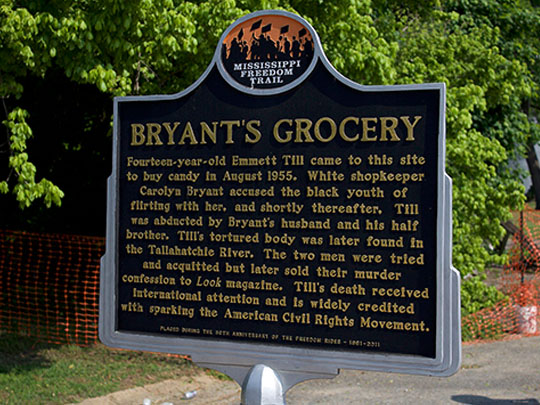
In August 1955 Emmett Till, a 14-year-old from Chicago visiting relatives near Money, Mississippi, was abducted and murdered by Roy Bryant and J.W. Milam after an encounter with Bryant’s wife Carolyn at the family’s grocery store, and his body was pulled from the Tallahatchie River three days later.
The Emmett Till sites make up the Emmett Till and Mamie Till-Mobley National Monument of 2023, linking Graball Landing, believed to be where his body was recovered, the courthouse in Sumner, restored to its 1955 look, where an all-white jury acquitted both men after 67 minutes, and Roberts Temple Church of God in Christ in Chicago, scene of the open-casket funeral.
The first Emmett Till marker at Graball Landing, put up in 2008, was stolen within months, reportedly thrown into the river, and later replacements were shot up, one of them hit 317 times and later taken in by the Smithsonian, until a bulletproof steel sign went up in 2019.
10 – Port Gibson and Windsor Ruins

Port Gibson, the county seat of Claiborne County, saw Grant’s army win the Battle of Port Gibson on 1 May 1863, just after crossing the Mississippi at Bruinsburg in what the National Park Service calls the largest US amphibious operation before Normandy, with Michael Lawler, born in County Kildare, leading a Union brigade, in a campaign that ended at Vicksburg.
Port Gibson and Windsor Ruins have the First Presbyterian Church, topped by a golden hand pointing to heaven, copying its pastor Zebulon Butler’s preaching gesture, Temple Gemiluth Chessed (1892), billed as Mississippi’s oldest standing synagogue, and the 23 surviving columns of Windsor, a mansion built with enslaved labour in 1859–61, which burned in 1890, said to be from a guest’s cigarette or cigar.
Port Gibson’s famous claim that Grant called it “too beautiful to burn” is described by architectural historians as a legend the town leaned on to attract tourists in 1939, while the only known picture of Windsor is a sketch by the Union officer Henry Otis Dwight, found in the early 1990s among his papers.