

Wikimedia Commons / CC-BY-SA-3.0 / GFDL
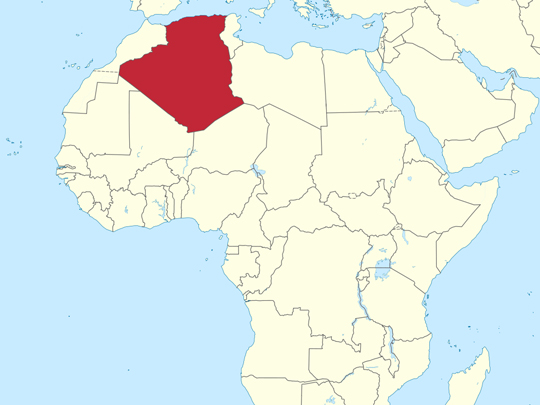
Capital: Algiers
Population: 47 million+
Language: Arabic & Tamazight
1 – Tipaza (above)
A Mediterranean coastal town about 70km west of Algiers, where Phoenician, Roman, early Christian and Byzantine ruins tumble right down to the sea — a UNESCO World Heritage Site since 1982.
Wander the seafront Roman remains — forum, theatre, thermal baths, basilicas and necropolises — then head inland to the great circular Royal Mausoleum of Mauretania, tomb of a Numidian-Mauretanian royal line.
Nobel-winning writer Albert Camus spent childhood summers here and immortalised the ruins in his 1938 essay “Noces à Tipasa” (“Nuptials at Tipasa”) — a memorial stone to him still stands among the columns.
2 – Casbah of Algiers
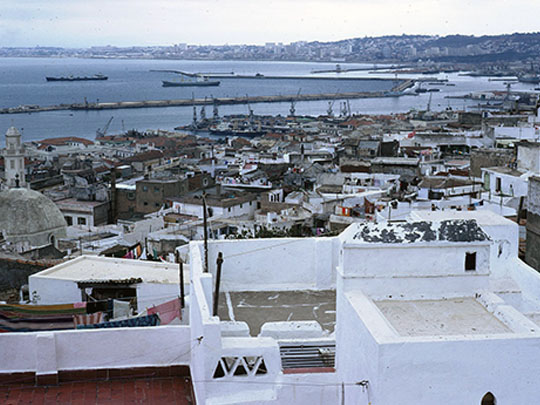
The old town of Algiers, tumbling down a steep hillside above the bay, was founded in 944 by the Berber Zirid dynasty and walled in the 16th century as the seat of the Regency of Algiers — the Ottoman corsair state that made this one of the great powers of the Mediterranean; UNESCO-listed since 1992.
Climb the stepped lanes past the remains of the citadel and the Palace of the Dey at the top, the Ketchaoua Mosque near the bottom, and the Palais des Raïs (Bastion 23), a run of Ottoman palaces and fishermen’s houses begun in 1576 and now a museum.
Gillo Pontecorvo shot The Battle of Algiers (1966) in these actual alleys using mostly non-professional actors — among them the former FLN commander Saadi Yacef, playing a version of himself — and the film was banned for years in France before the Pentagon screened it privately in 2003 for officers dealing with Iraq.
3 – M’Zab Valley
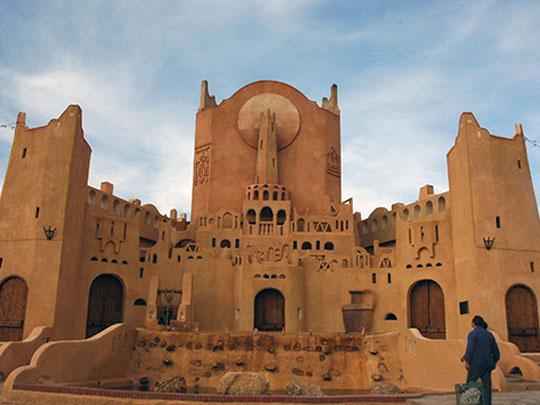
Six hundred kilometres south of Algiers in the northern Sahara, five fortified hilltop towns — Ghardaïa, Beni Isguen, Melika, Bou Noura and El Atteuf — were built from the early 11th century by the Ibadi Mozabites, an Amazigh Muslim community who came south to escape persecution in the north; UNESCO-listed since 1982.
Each town is a spiral of pale houses winding up to a fortress-mosque whose minaret doubled as watchtower and grain store, with palm groves below kept alive by an ingenious system of hand-dug wells and flood channels.
The valley’s austere, rigorously egalitarian planning became a touchstone for twentieth-century modernism — UNESCO credits its influence on Le Corbusier, Fernand Pouillon and André Ravéreau, meaning a thousand-year-old Saharan oasis helped shape the look of postwar European housing.
4 – Constantine
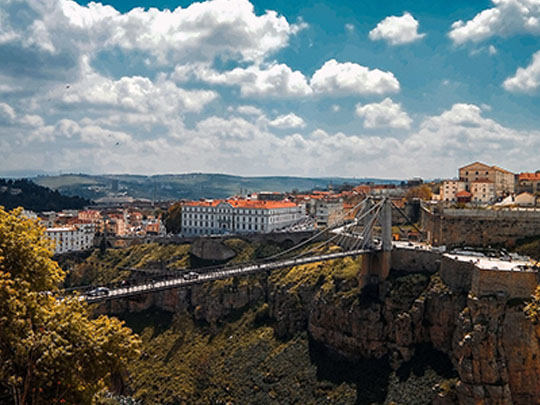

Perched in eastern Algeria on a limestone plateau split by the deep gorge of the Rhumel, the city began as a Phoenician trading post and became Cirta, capital of Numidia under the Berber king Massinissa from around 203 BC, before a fourth-century civil war levelled it and the Emperor Constantine rebuilt it under his own name.
Cross the bridges that give the “city of bridges” its nickname — the Sidi M’Cid suspension bridge of 1912, El Kantara on Roman foundations, the great stone arches of Sidi Rached — then take in Ahmed Bey’s Ottoman palace, the Numidian and Roman collections of the Cirta museum, and the modern Emir Abdelkader Mosque.
Constantine is the home of malouf, the local branch of Arab-Andalusian classical music, and its greatest master was Cheikh Raymond Leyris, a Jewish singer revered by Muslims and Jews alike; his shooting in the city’s souk in June 1961 sent his young guitarist and son-in-law into exile in France, where he became the singer Enrico Macias.
5 – Gouraya National Park

A coastal park rising steeply above the city of Béjaïa in the Kabylie region, where the forested foothills of the Atlas plunge straight into the Mediterranean; a UNESCO Biosphere Reserve since 2004.
Hike up to the fort and shrine of Yemma Gouraya for sweeping views over the Gulf of Béjaïa, take in the Pic des Singes (“Monkey Peak”) and the Cap Carbon lighthouse, and cool off at the Aiguades beaches below.
The park is one of the last refuges of the endangered Barbary macaque — the only wild monkey native to Africa north of the Sahara, and the same species as the famous “apes” of Gibraltar.
6 – Tassili
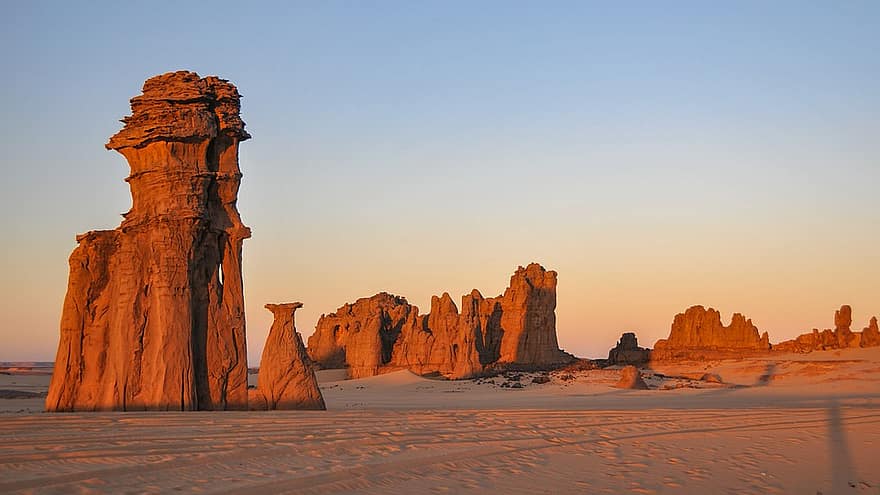
A vast sandstone plateau in the deep Sahara of southeastern Algeria, near the borders of Libya and Niger; a UNESCO World Heritage Site whose name means “plateau of rivers.”
Explore one of the world’s greatest open-air galleries of prehistoric art — over 15,000 paintings and engravings, some up to 12,000 years old, at sites like Sefar and Jabbaren — amid wind-carved “forests of stone” and hundreds of natural arches, with the oasis of Djanet as the gateway.
The art is a record of a “Green Sahara”: it shows giraffes, elephants and hippos, and herders driving cattle across land that is now pure desert — a few of the stranger horned figures were even nicknamed “Martians” by the archaeologists who found them.
7 – Jardin d’Essai du Hamma
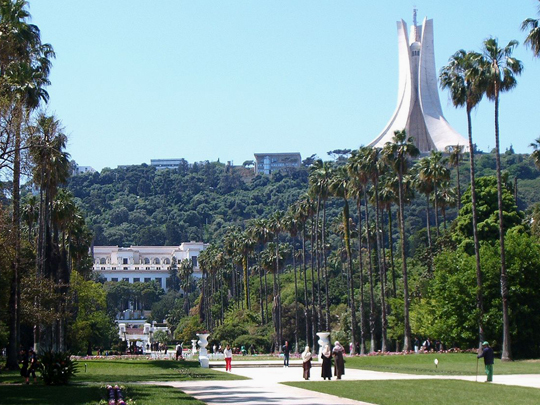
A grand botanical garden laid out in 1832 on drained marshland in the heart of Algiers, facing the bay — today one of the country’s most visited attractions.
Stroll the showpiece 600-metre avenue of towering Washingtonia palms, wander shaded alleys of dragon trees, ficus and bamboo across its formal French and landscaped English gardens, and visit the historic on-site zoo.
The garden’s giant, vine-draped ficus is known locally as the “Tarzan tree” — long said to have featured in the 1932 Hollywood film Tarzan the Ape Man starring Johnny Weissmuller.
8 – Timgad
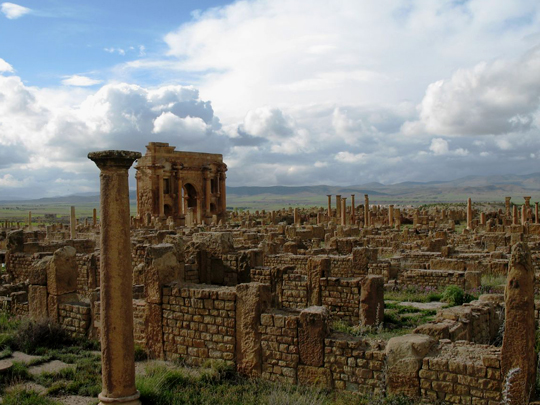
A remarkably complete Roman city on the northern slopes of the Aurès Mountains, founded from scratch by the Emperor Trajan around AD 100 as a colony for army veterans; UNESCO-listed since 1982.
Walk the original grid of paved streets past the 12-metre Arch of Trajan, the forum, a 3,500-seat theatre, temples, bath-houses and even a rare public library.
Nicknamed the “Pompeii of North Africa,” Timgad was buried and preserved by desert sand for roughly a thousand years after Rome’s fall before being rediscovered largely intact.
9 – Beni Hammad
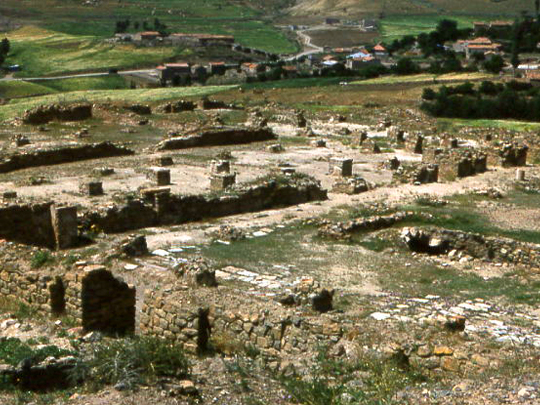
The ruined first capital of the Berber Hammadid dynasty, set dramatically in the Hodna Mountains about 225km southeast of Algiers; founded in 1007 and abandoned less than a century later, it was Algeria’s first UNESCO World Heritage Site (1980).
Trace some 7km of fortified walls enclosing palaces, gardens and one of Algeria’s largest medieval mosques, whose lone square minaret still stands around 25 metres tall.
Though short-lived, the city was a refined cultural capital whose art and architecture rippled out across the medieval Islamic world — its surviving minaret is often likened to the later Giralda of Seville.
10 – Fort Santa Cruz, Oran
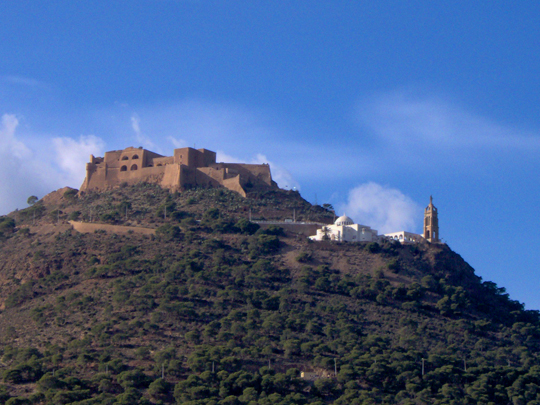
A hilltop Spanish fortress built between 1577 and 1604 atop Mount Murdjadjo, some 400m above Oran — Algeria’s second city and great western port — and part of a trio of forts once linked by tunnels.
Climb up for the fort’s thick ramparts and bastions and knockout views over the bay, then visit the neighbouring Chapel of Santa Cruz, crowned by a statue of the Virgin Mary modelled on the one above Marseille.
That chapel was raised in thanks after a 19th-century cholera epidemic lifted following prayers for rain — locals still make an annual pilgrimage up the mountain to mark it.
11 – Atlas Mountains
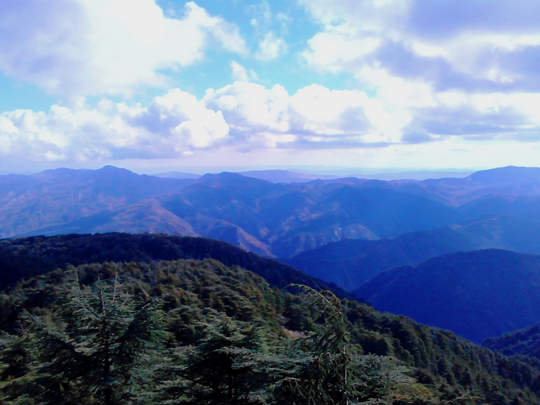
The great mountain barrier that walls Algeria’s fertile Mediterranean north off from the Sahara, split into two roughly parallel chains — the coastal Tell Atlas and the inland Saharan Atlas — running for well over 1,000km.
Hike the Djurdjura National Park in Kabylie, crowned by Lalla Khedidja (2,308m, the Tell Atlas’s highest point), explore the rugged Aurès massif, or wander the cedar forests of Chréa above Blida.
These ranges are the ancestral homeland of the indigenous Amazigh (Berber) peoples — the Kabyle of the Djurdjura and the Chaoui of the Aurès — and the wild Aurès became the cradle of the 1954 revolt that launched Algeria’s war of independence.