
Wikimedia Commons / CC-BY-SA-3.0 / GFDL
Capital: Phoenix
Population: 7.6 million+
Language: English

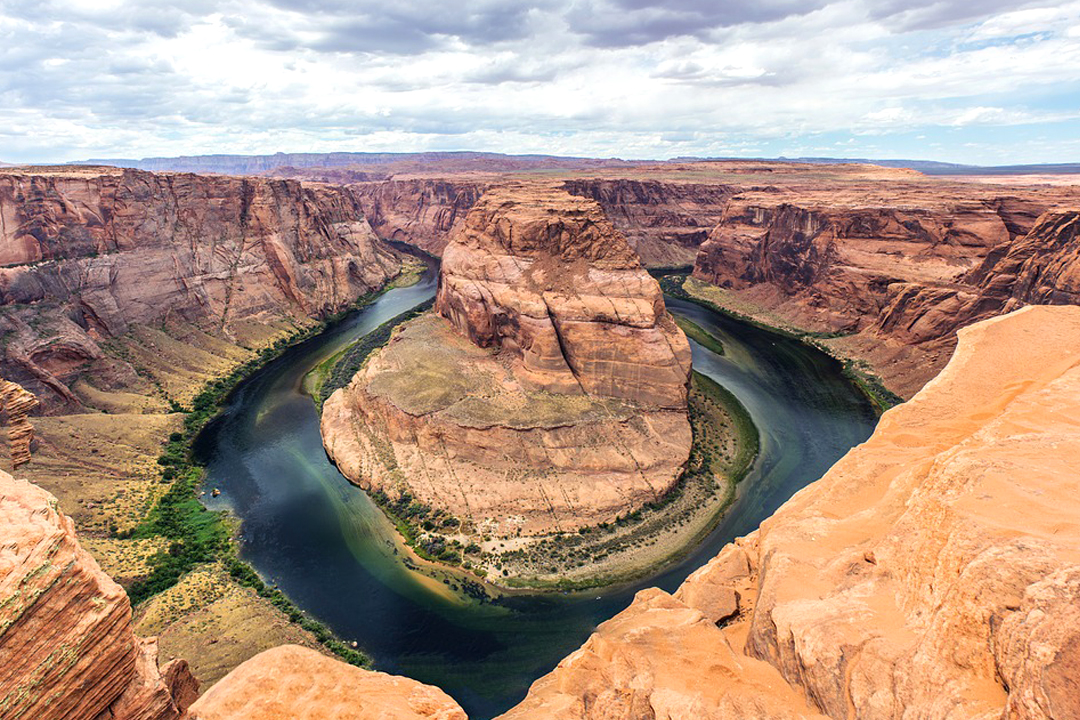
1 – Horseshoe Bend (also above)
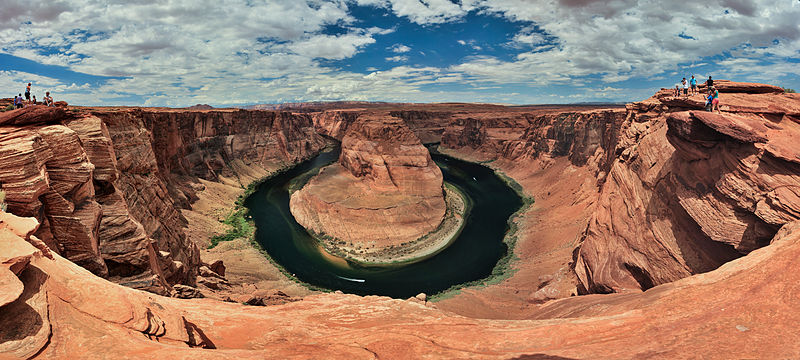
Horseshoe Bend is a tight loop of the Colorado River near Page, in northern Arizona, where the water turns almost full circle around a sandstone spur about 300 m below the overlook, some 8 km downstream from Glen Canyon Dam, whose Lake Powell took 17 years to fill, from 1963 to 1980.
The path to Horseshoe Bend runs about 1.2 km each way from a car park run by the City of Page, and a railed viewing platform opened in 2018, though most of the rim has no railing and people have died falling from it.
Horseshoe Bend was a quiet local viewpoint until social media made it famous in the 2010s, when visitor numbers rose from a few thousand a year to more than 2 million by the Park Service’s estimate, which is why the platform and car park were built.
2 – Grand Canyon
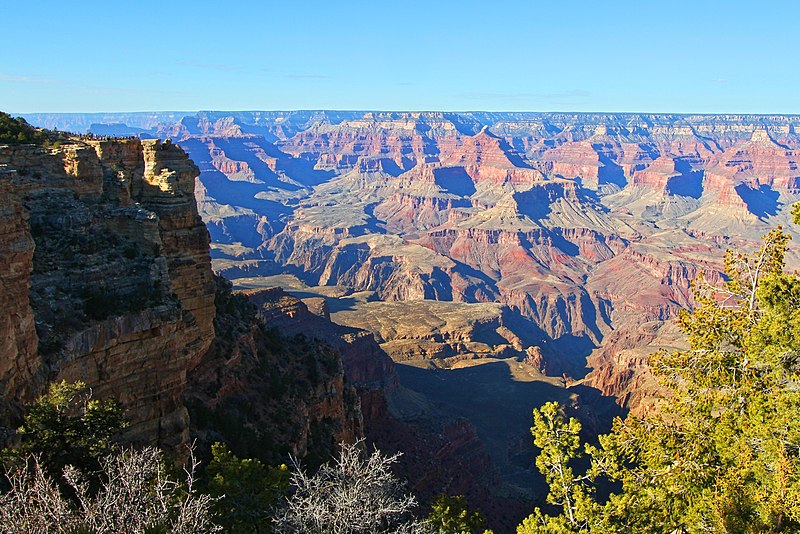
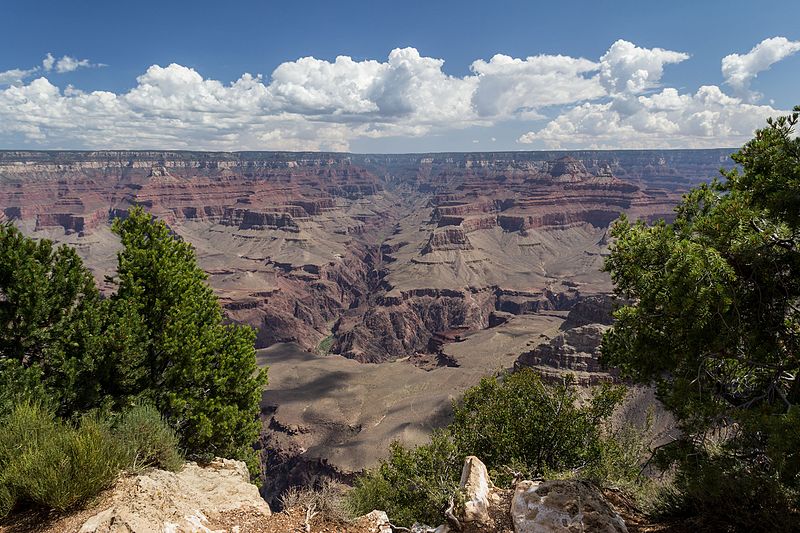
The first Europeans at the Grand Canyon were a Spanish party under García López de Cárdenas, guided by Hopi in 1540, three of whose men tried and failed to reach the river, and the first known trip through it was John Wesley Powell’s in 1869, led by a man who had lost his right arm at Shiloh.
On the South Rim are El Tovar, the grand hotel of 1905, and the Buckey O’Neill Cabin at Bright Angel Lodge, the rim’s oldest surviving building, built in the 1890s by the son of an Irish immigrant who served in the Irish Brigade, and O’Neill was later killed at the foot of Kettle Hill with the Rough Riders in 1898.
Two days before Powell finished, three of his men climbed out at Separation Canyon and were never seen again, and whether they were killed by Shivwits Paiute or by local Mormons is argued over, while at Supai, deep in the canyon, the Havasupai village’s post comes by what the US Postal Service calls the last mail-by-mule route in the country.
3 – Monument Valley
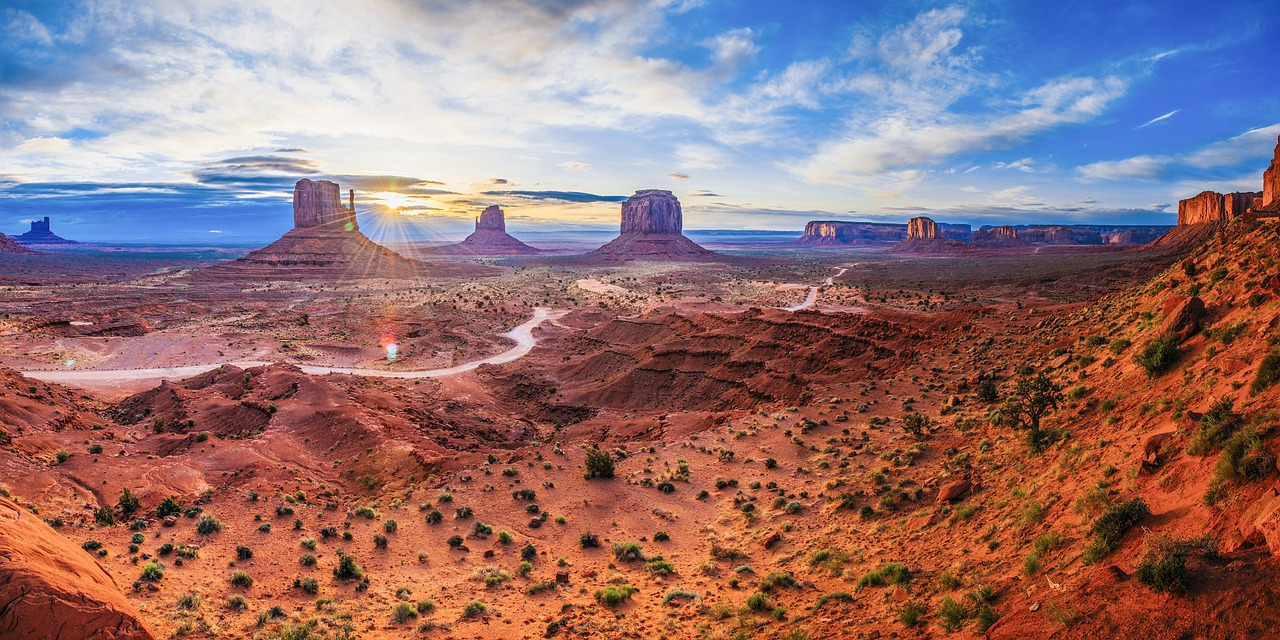
Monument Valley straddles the Arizona–Utah border on the Navajo Nation, and its buttes are layer cakes of rock, with red De Chelly sandstone cliffs rising from a base of Organ Rock shale under a cap of harder Shinarump conglomerate that has kept them from wearing away, standing up to about 300 m above the valley floor.
Monument Valley is a Navajo Tribal Park, with a self-drive loop through the valley and guided tours to sites off it, in a lived-in landscape where Navajo families make their homes, some hauling water many kilometres.
John Ford, who made the valley the shorthand for the American West, was born John Martin Feeney to parents from County Galway, his father from Spiddal, and Stanley Kubrick used tinted aerial footage of Monument Valley as an alien world in the stargate sequence of 2001: A Space Odyssey (1968).
4 – Meteor Crater
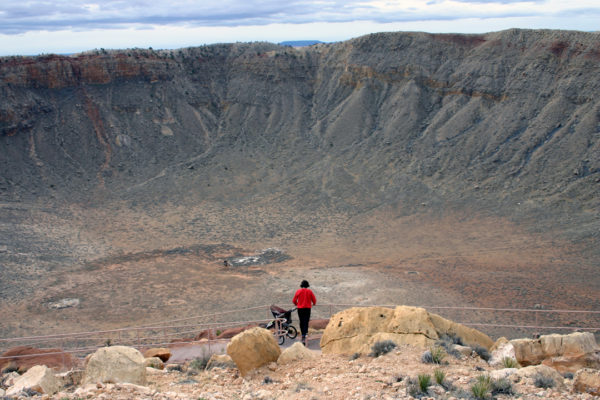
Meteor Crater, also called Barringer Crater, is a hole about 1.2 km wide and 170 m deep in the desert east of Flagstaff near Winslow, made around 50,000 years ago by an iron-nickel asteroid perhaps 50 m across.
Meteor Crater is privately owned by the Barringer family’s company and is a National Natural Landmark rather than a national park, with rim-top viewpoints, a museum on impacts and space, and the ground where Apollo astronauts trained in geology from 1963.
Mining engineer Daniel Barringer spent more than a quarter of a century, with most of a fortune, drilling for the huge iron mass he was sure lay under the crater floor, when the impactor had in fact largely vaporised, and in 1960 Eugene Shoemaker and Edward Chao proved the impact with coesite, a mineral formed only by intense shock and never before found in nature.
5 – Papago Park
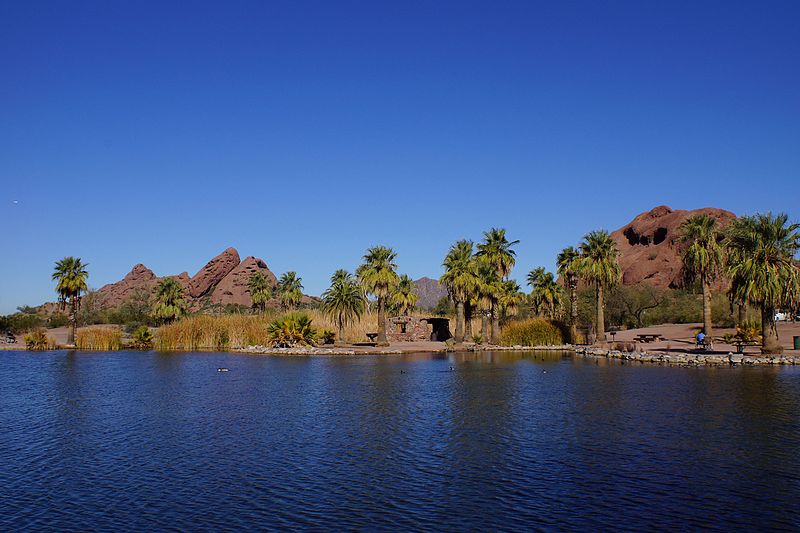
Papago Park is a desert park of red sandstone buttes on the Phoenix–Tempe line, known for Hole-in-the-Rock, a hollow butte that some believe the Hohokam used to track the sun through the seasons, and its name is an old term for the Tohono O’odham people, which they have long rejected.
Papago Park holds the Phoenix Zoo, the Desert Botanical Garden, trails up Hole-in-the-Rock and the buttes, and the small white pyramid built in 1931 by Arizona’s first governor, George Hunt, as the tomb for his wife Helen and later himself.
During World War II Papago Park held a prisoner-of-war camp, and on 23 December 1944, 25 Germans, many of them U-boat men, tunnelled 54 m out, planning to float down the Salt River to Mexico in a homemade boat, but found it nearly dry, and their leader, U-162 captain Jürgen Wattenberg, was caught on 28 January 1945 after asking a Phoenix street foreman the way.
6 – Phoenix
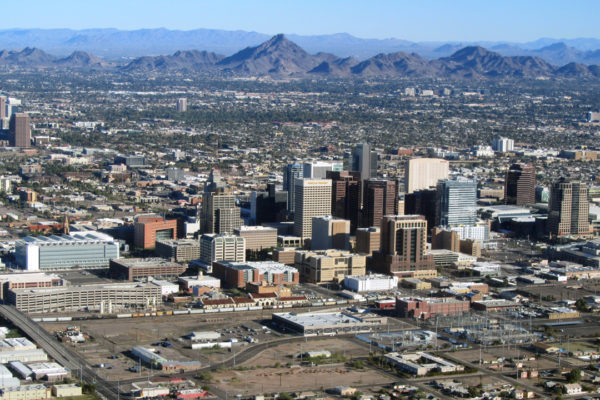
Phoenix sits on the Salt River in the Sonoran Desert, where the Hohokam dug hundreds of kilometres of irrigation canals, often called the largest prehistoric irrigation network in North America, abandoning them by about 1450, and tradition credits the settler Darrell Duppa with the name, for a town rising from the ruins of an older civilisation.
Phoenix has the S’edav Va’aki Museum on a Hohokam platform mound, the Heard Museum’s Native art, Frank Lloyd Wright’s Taliesin West in neighbouring Scottsdale, part of a World Heritage Site since 2019, and the Irish Cultural Center’s castle-style McClelland Library with its An Gorta Mór Famine memorial.
Phoenix’s modern canals largely follow the Hohokam lines, which is how a city of this size survives in the desert, and the territorial capital moved from Prescott to Tucson, back to Prescott and finally to Phoenix in 1889.
7 – Montezuma Castle

Montezuma Castle is a five-storey, roughly 20-room cliff dwelling built by the Sinagua people in the early 1100s, high in a limestone cliff above Beaver Creek near Camp Verde, and on 8 December 1906 Theodore Roosevelt made it one of the first four national monuments.
Visitors climbed ladders into Montezuma Castle until 1951, when damage closed it, and the trail below gives a clear view, while 18 km away Montezuma Well is a spring-fed sinkhole taking in some 5.7 million litres of water a day, with no fish but its own leeches, amphipods and other species found nowhere else on Earth.
The name is wrong twice over: early American settlers assumed it was Aztec, but the Sinagua had moved on by about 1400, decades before Moctezuma II was born in 1466, and it was never a castle, while Hopi, Zuni, Yavapai and Apache peoples all have ties to the site.
8 – San Xavier del Bac

San Xavier del Bac is a Spanish mission church about 14 km south of downtown Tucson on the Tohono O’odham Nation, founded by the Jesuit Eusebio Kino in 1692, with the present white church built by Franciscans in 1783–97, largely by O’odham labour, the oldest intact European building in Arizona.
Inside San Xavier del Bac, the walls and altarpiece glitter with gilded statues amid painted murals, often called one of the finest Spanish colonial interiors in the US, while the façade carries a carved cat and mouse, and the story goes that the world will end when the cat catches the mouse.
The church is nicknamed the “White Dove of the Desert”, its east tower was never finished, most likely because money ran out, despite a tale of a builder falling to his death that has no record behind it, and from 1992 an international team of mostly Italian conservators restored the interior, training four members of the Tohono O’odham Nation.
9 – Oak Creek Canyon

Oak Creek Canyon runs about 19 km between Flagstaff and Sedona, cut along the Oak Creek Fault up to 610 m deep, and its first non-Native settler was the Irish-born J. J. Thompson, baptised at First Derry Presbyterian Church, who arrived in 1876 and farmed at Indian Gardens.
State Route 89A follows Oak Creek Canyon past the West Fork Trail and Slide Rock State Park, where a natural rock chute on Frank Pendley’s old apple-orchard homestead makes a water slide, and in Sedona stands the Chapel of the Holy Cross, built into the red rock in 1956.
Sedona’s famous energy “vortexes” are a modern idea, given that meaning around 1980 by the psychic Page Bryant and popularised by the 1987 Harmonic Convergence, though no unusual energy has been measured, and the canyon was the setting for Zane Grey’s The Call of the Canyon, filmed here in 1923 and long thought lost until a copy turned up in a Russian film archive.
10 – Petrified Forest National Park
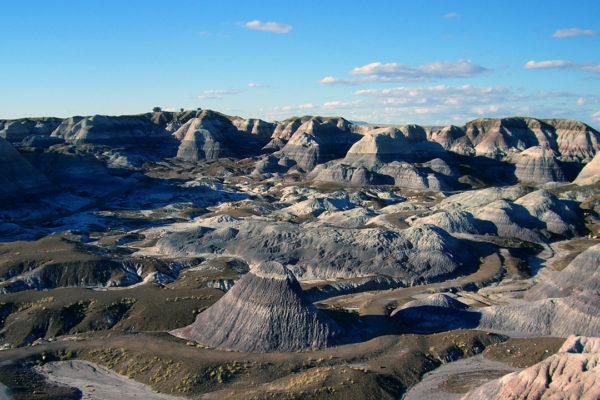
Petrified Forest National Park, in northeast Arizona, preserves fallen trees some 225 to 208 million years old, from the Late Triassic, whose wood was turned to colourful quartz by silica-rich groundwater, and it became a national monument in 1906 and a national park in 1962.
Highlights of Petrified Forest include the log-strewn Crystal Forest and Blue Mesa, the Painted Desert Inn with murals by the Hopi artist Fred Kabotie, Puerco Pueblo, with more than 100 rooms, and the petroglyphs of Newspaper Rock, and it is the only park in the National Park System with a stretch of old Route 66.
For decades the park claimed visitors stole about a tonne of petrified wood a month, but when staff retook about 200 historic photographs, they found the logs barely disturbed, and the park has received more than 1,200 “conscience letters” returning stolen pieces and blaming them for bad luck.
11 – Old Tucson Studios

Old Tucson Studios is a Western film set in the Tucson Mountains west of Tucson, a city whose Spanish presidio was founded on 20 August 1775 by the Dublin-born officer Hugo O’Conor, and the set itself was built by Columbia Pictures in 1939 for the film Arizona.
Old Tucson’s dusty main street of saloons has appeared in some 400 films, TV shows and adverts, including Gunfight at the OK Corral, Rio Bravo and El Dorado.
A fire on 24 April 1995 destroyed about 25 buildings and the soundstage, and the set reopened in January 1997 with 15 new buildings, while John Wayne made four films at Old Tucson, among them Rio Lobo and McLintock! (1963).
12 – Canyon de Chelly
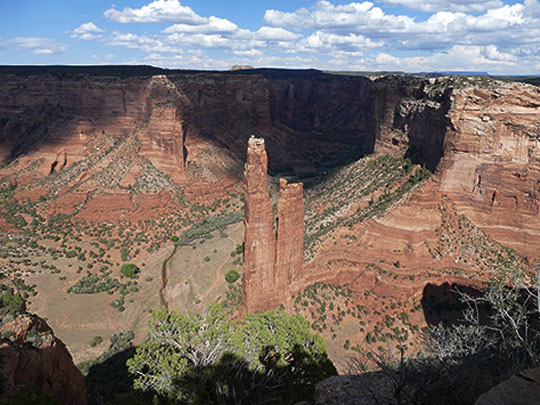

Canyon de Chelly, in the far northeast of Arizona, is a national monument on Navajo Nation land, where about 40 Navajo families live and farm on the canyon floor, and its name is a Spanish rendering of the Navajo Tséyi’, “within the rock”, pronounced “d’SHAY”.
The North and South Rim Drives at Canyon de Chelly look down on the spire of Spider Rock, about 240 m high, where Navajo tradition says Spider Woman lives, and on the ruins of White House, an Ancestral Puebloan village of about 1060–1275 reached by the only trail open to visitors without a Navajo guide.
In 1805, a Spanish force killed about 115 people at Massacre Cave, by its commander’s count, while in 1864 US troops felled thousands of the canyon’s peach trees as Kit Carson’s campaign forced the Navajo onto the Long Walk to Bosque Redondo, where thousands died until the Treaty of 1868, considered the only treaty to reverse a removal, let them return.
13 – Tombstone
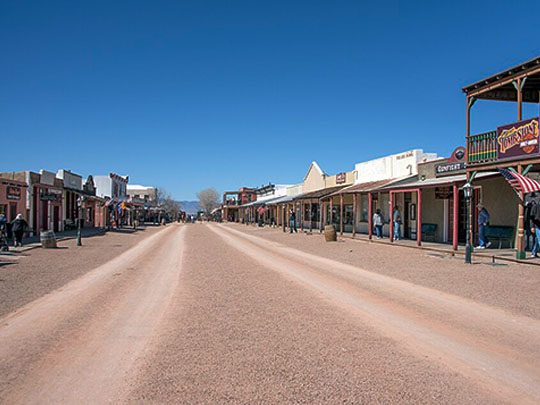
Tombstone, in southeast Arizona, takes its name from prospector Ed Schieffelin, who was warned that the only rock he would find out there was his own tombstone and named his 1877 silver claim accordingly, and by the early 1880s it had several thousand people, before the mines flooded and the boom faded.
In Tombstone are the 1881 Bird Cage Theatre, the Courthouse, a state historic park, the Boothill Graveyard and the site of the gunfight of 26 October 1881, when the Earps with Doc Holliday killed Billy Clanton, Frank McLaury and Tom McLaury in a vacant lot six doors from the OK Corral, which gave the fight its name only decades later.
Tombstone’s most loved resident was Nellie Cashman of County Cork, who ran the Russ House restaurant, raised money for the town’s Catholic church and nursed miners, earning the name “the Angel of Tombstone”, while Boothill’s famous “Here lies Lester Moore, four slugs from a .44” is on a replacement marker for a man who may never have existed.
14 – Hoover Dam
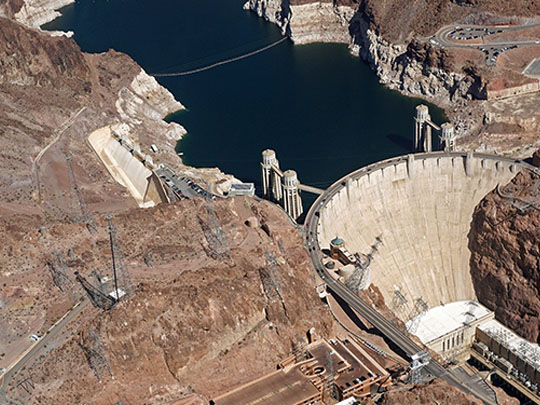
Hoover Dam blocks the Colorado River in Black Canyon on the Arizona–Nevada border, a concrete arch-gravity dam 221 m high built in 1931–36, about two years ahead of schedule, at the cost of 96 official deaths, and it holds back Lake Mead, the largest reservoir in the US by capacity when full.
Across the crest of Hoover Dam stand Oskar Hansen’s 9 m bronze Winged Figures of the Republic beside a star map fixing the sky on the day Franklin Roosevelt dedicated the dam in 1935, and the 2010 bypass bridge looks down on it.
The two intake towers carry two clocks, one for each state, which show the same time in summer and differ by an hour in winter because Nevada uses daylight saving and Arizona does not, and the story that workers are buried in the concrete is a myth, as it was poured in 1.5 m lifts that made that practically impossible.
15 – Hopi Mesas and Old Oraibi
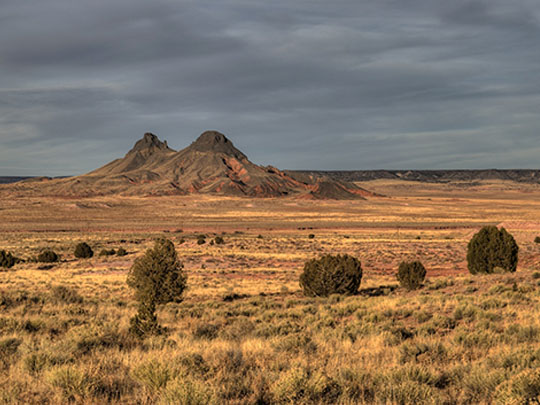
The Hopi Mesas and Old Oraibi lie in northeast Arizona on a Hopi reservation entirely surrounded by the Navajo Nation, where First, Second and Third Mesa reach out as three fingers of high ground, and Old Oraibi, on Third Mesa, lived in since about 1100, is among the oldest continuously inhabited towns in the US.
On First Mesa, Walpi, a stone village on a narrow ridge with no electricity or running water, is visited only on tours led by Hopi guides, while the Hopi Cultural Center on Second Mesa has a museum, and photography, sketching and recording are banned in the villages.
In September 1906, Old Oraibi split between traditionalists and those willing to work with the US government, and the quarrel was settled by a pushing contest that sent the losers off to found Hotevilla, while the Hopi keep their own time, staying on standard time all year as the surrounding Navajo Nation changes its clocks.