
Wikimedia Commons / CC-BY-SA-3.0 / GFDL
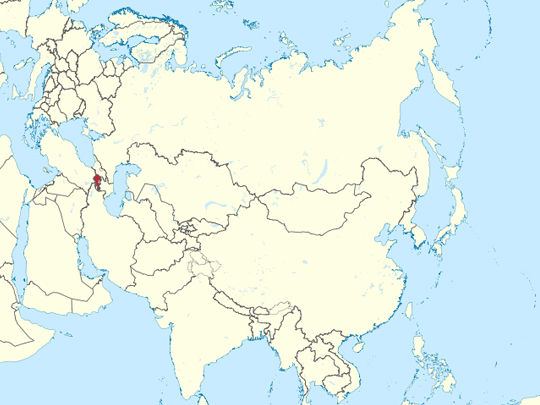
Capital: Yerevan
Population: 3.1 million+
Language: Armenian
1 – Tatev monastery (also above)
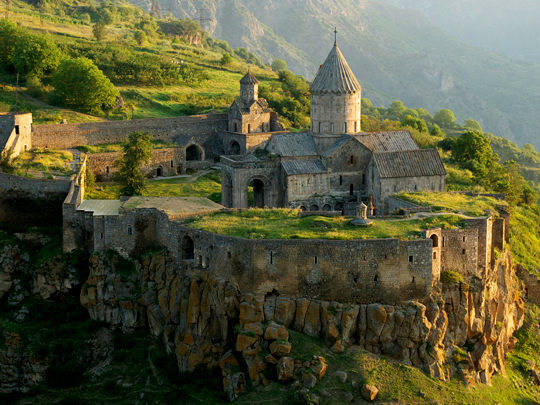
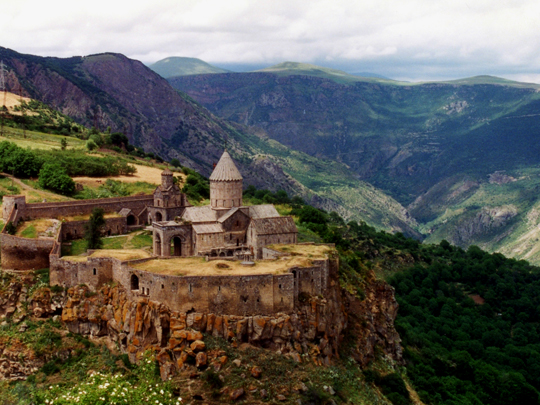
Tatev Monastery stands on a basalt plateau at the edge of the Vorotan gorge in Syunik, southern Armenia, became the seat of the bishops of Syunik in the 9th century, and in the late 14th and early 15th centuries ran a university led by the scholar Gregory of Tatev, who is buried there.
Look for the Church of Sts Paul and Peter (895–906), the 8 m gavazan, a stone column topped by a cross-stone that rocks on a hinged base, the Great Hermitage of Tatevi Anapat on the riverbank below, and Satan’s Bridge, a natural travertine arch over the Vorotan.
Most visitors reach Tatev on the Wings of Tatev, a 5.75 km cable car that set a Guinness record in October 2010 as the longest non-stop double-track cable car, floating up to about 320 m above the gorge.
2 – Khor Virap Monastery
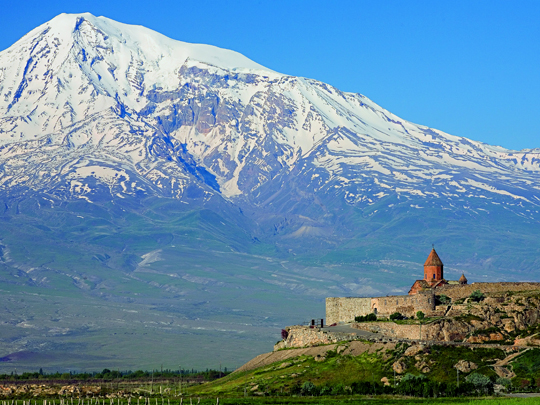
Khor Virap sits on a hill in the Ararat plain beside the Turkish border, where tradition says Gregory the Illuminator spent about 13 years in a pit before curing King Trdat III, whose conversion made Armenia traditionally the first state to adopt Christianity in 301, though many historians prefer around 314.
Climb down the steep iron ladder into the pit beneath the chapel of St Gevorg, see the 17th-century church, and take in the classic view of Mount Ararat, which has been in Turkey since 1921 but appears on Armenia’s coat of arms.
Khor Virap’s hill rises among the ruins of Artaxata, Armenia’s ancient capital, and both Strabo and Plutarch claimed Hannibal helped plan the city, a story historians treat with real doubt.
3 – Geghard Monastery
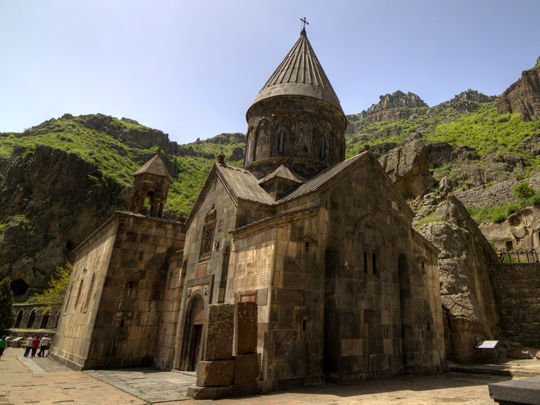
Geghard Monastery sits in the Upper Azat gorge east of Yerevan, where tradition says Gregory the Illuminator founded it at a sacred cave spring in the 4th century, and its main church was finished in 1215, with UNESCO listing the monastery and valley in 2000.
The Proshyan princes had churches and tombs cut entirely out of the cliff in the 13th century, so expect rock-hewn chambers, cross-stones carved into the walls, the cave spring, and acoustics that make any singing ring out.
Geghard means “spear”, after the Holy Lance said to have pierced Christ and to have been kept at Geghard for centuries, though the relic has been at Etchmiadzin since the early 19th century, and rival lances, including one in Vienna, claim the same honour.
4 – The Cascade
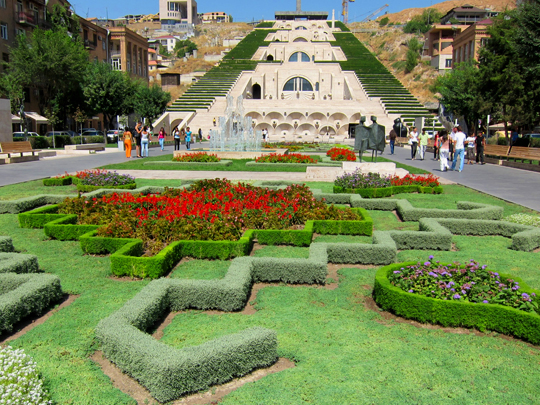
The Cascade is a giant stairway in central Yerevan, climbing the slope Alexander Tamanyan’s 1920s city plan earmarked for terraces and waterfalls, built from the 1970s by architects Jim Torosyan, Aslan Mkhitaryan and Sargis Gurzadyan until the 1988 earthquake and the Soviet collapse halted work.
Climb the 572 steps or ride the indoor escalators past the Cafesjian Center for the Arts, funded by Armenian-American collector Gerard Cafesjian and opened in 2009, and a sculpture garden featuring Fernando Botero’s Cat and Roman Warrior and Barry Flanagan’s hares.
Yerevan itself began as the Urartian fortress of Erebuni, founded by King Argishti I in 782 BC according to cuneiform inscriptions found in 1950, which makes the city behind the Cascade older than Rome’s traditional founding date.
5 – Temple of Garni
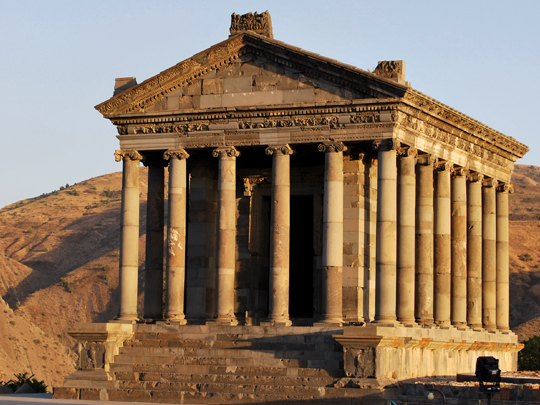
The Temple of Garni stands on a promontory above the Azat gorge, usually dated to around 77 AD under King Tiridates I, and is often described as the only standing Greco-Roman colonnaded building in the former Soviet Union.
See the temple’s 24 Ionic basalt columns, the Roman bathhouse whose sea-god mosaic carries a Greek inscription reading “we worked without receiving anything”, and the Symphony of Stones, a wall of natural basalt columns in the gorge below.
Garni collapsed in an earthquake in 1679 and was rebuilt in 1969–75 from its original stones, and scholars debate whether it was a temple at all, as some argue it was a royal tomb.
6 – Zorats Karer
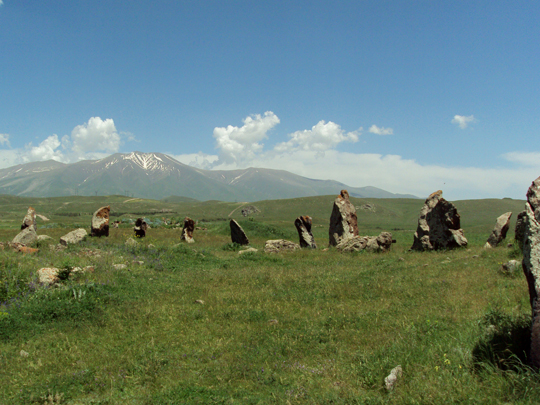
Zorats Karer, also called Karahunj, is a field of 223 numbered standing stones near Sisian in Syunik, about 80 of them pierced with holes, and a 2000 study by LMU Munich found it was mainly a burial ground from the Middle Bronze Age to the Iron Age.
Wander among the basalt stones, many leaning or fallen, and peer through the holes that some claim line up with the sun and stars.
Karahunj is no “7,500-year-old observatory”: that was the theory of radiophysicist Paris Herouni, archaeologists reject it, the site is no older than about 2000 BC, younger than Stonehenge, and the supposed link between “Karahunj” and “Stonehenge” doesn’t hold up either.
7 – Goshavank
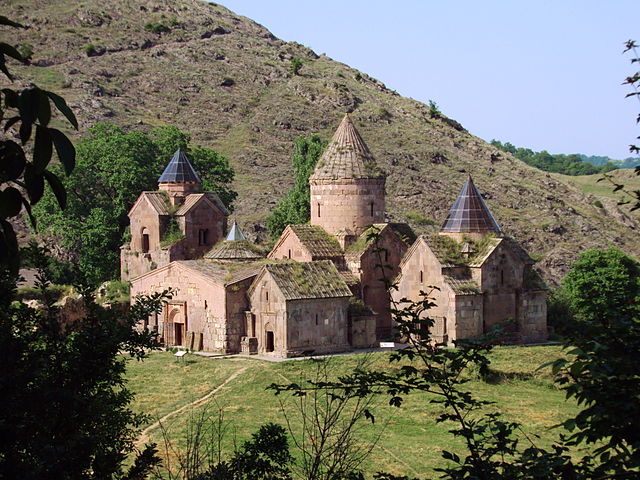
Goshavank stands in the village of Gosh in Tavush province, about 15 km east of Dilijan, built from 1188 to replace the earthquake-ruined Getik monastery and renamed after the scholar Mkhitar Gosh, who died in 1213.
See the church of St Astvatsatsin (1191–96), the scriptorium and book depository with its belfry, built in stages up to 1291, and one of the two lace-like cross-stones carved by master Poghos in 1291, with Gosh Lake on the walking trail.
Mkhitar Gosh’s law code, written around 1184, travelled a long way: it became the main source for the statute of the Armenian community in Lviv, approved by Poland’s King Sigismund I in 1519.
8 – Areni-1 Cave
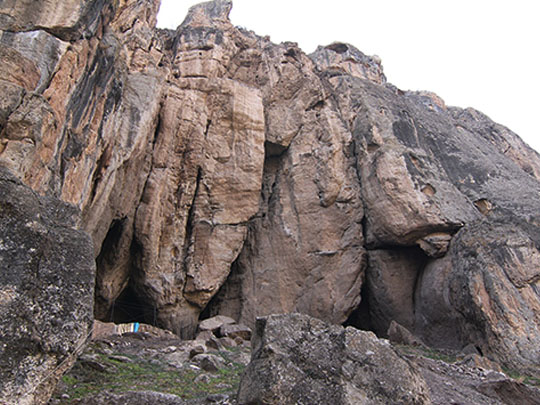
Areni-1 Cave has three limestone chambers in the cliffs above the Arpa river in Vayots Dzor, near the village of Areni, where a cool and unusually stable microclimate preserved leather, rope, textile and plant matter that would have rotted to nothing almost anywhere else — and where excavations from 2007 uncovered the oldest complete winemaking installation known anywhere, dated to around 4100 BC.
You can walk in and see the works in place: a shallow clay pressing basin about a metre across, a fermentation vat sunk into the floor, storage jars and the drainage channel running between them, with grape seeds, dried vines and pressed skins found all around — and because the whole setup sits in a part of the cave used for burials, the best guess is that the wine was made for funerals.
The same cave gave up a 5,500-year-old cowhide shoe, found upside down beneath a broken bowl with grass still packed inside it, and archaeologists remain unable to agree whether the grass was insulation or simply there to hold the shape.
9 – Tsitsernakaberd
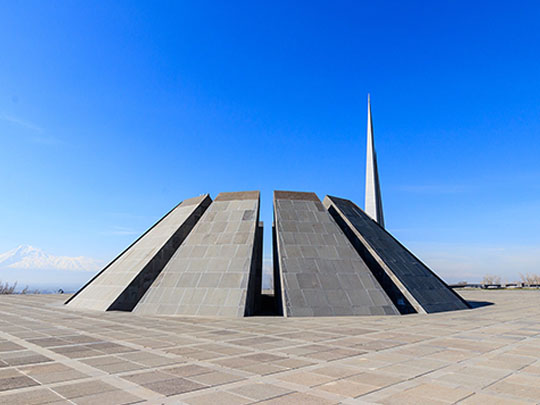
Tsitsernakaberd, the “Swallow’s Fortress” hill above the Hrazdan gorge in Yerevan, is Armenia’s memorial to the victims of the Armenian Genocide that began in 1915, built in 1967 after huge crowds marked the 50th anniversary in Yerevan in 1965.
Walk through the 12 tilted basalt slabs circling the eternal flame, past the 44 m spire, to the museum added in 1995, or come on Remembrance Day, 24 April, when crowds lay flowers around the flame.
Armenia and most genocide scholars put the dead at about 1.5 million, with other estimates starting around 600,000, and in 2015 Christ Church Cathedral in Dublin dedicated a memorial khachkar to them, blending Celtic and Armenian crosses with shamrocks and grapes.
10 – Etchmiadzin Cathedral
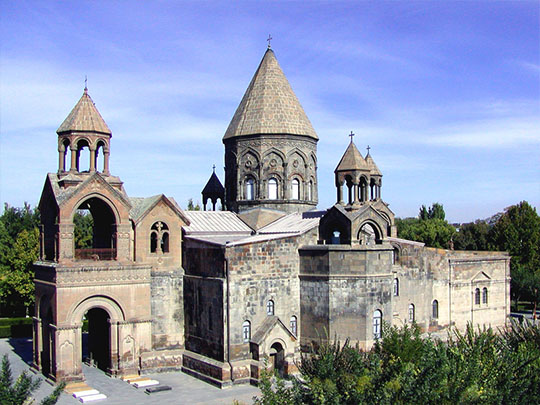

Vagharshapat, twenty kilometres west of Yerevan, was the Armenian capital when Gregory the Illuminator founded a church here in 301–303 on ground already occupied by a pagan temple, and the site has been the Mother See of the Armenian Apostolic Church ever since it was permanently re-established here in 1441 — Etchmiadzin Cathedral is widely reckoned the oldest cathedral in the world.
What stands is layered: the south and west walls are fourth-century, the cruciform domed plan comes from a rebuild in 484, the dome from 1627 and the bell tower from 1658, while the treasury museum holds the hand of Gregory the Illuminator and a fragment of wood said to have come off Noah’s Ark, and the churches of St Hripsime and St Gayane and the ruins of Zvartnots all belong to the same UNESCO listing.
The name means “the descent of the Only-Begotten”, after the story the historian Agathangelos set down in the fifth century: Gregory saw Christ descend and strike the ground with a golden hammer to mark the spot, which is about as precise as building instructions get.
Interesting extra – The Snake Castle (in Turkey)
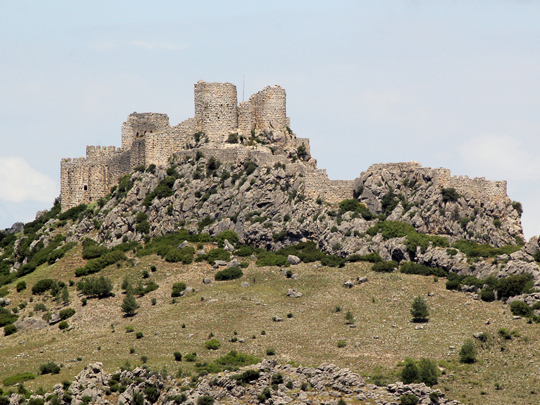
Yılankale, the Snake Castle, is a fortress of the Armenian Kingdom of Cilicia built in the late twelfth or thirteenth century on a limestone ridge above the Ceyhan river to watch the road between Adana and Ceyhan — it stands in modern Turkey, roughly seven hundred kilometres west of Yerevan, and it is the reminder that for two centuries the Armenian state was a Mediterranean power rather than a Caucasian one.
Eight towers and three walled sections climb the ridge, with a twin-towered gatehouse, a cistern, storerooms and the outline of a chapel still legible inside, and from the walls you can pick out the castles of Anavarza, Tumlu and Kozan across the Cilician plain, which is exactly what they were built to do.
A relief of an uncrowned lion above the gate is why historians read it as a prince’s castle rather than a king’s, and the Turkish name attaches to Shahmaran, the half-woman, half-serpent queen of snakes from Persian legend, said to have lived in caves beneath the rock.