
Wikimedia Commons / CC-BY-SA-3.0 / GFDL
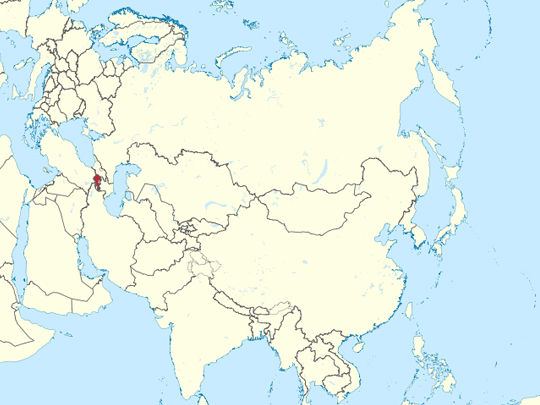
Capital: Yerevan
Population: 3 million+
Language: Armenian/Russian
1 – Tatev monastery (also above)
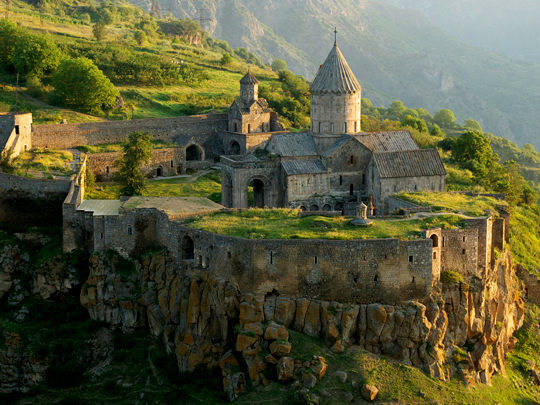
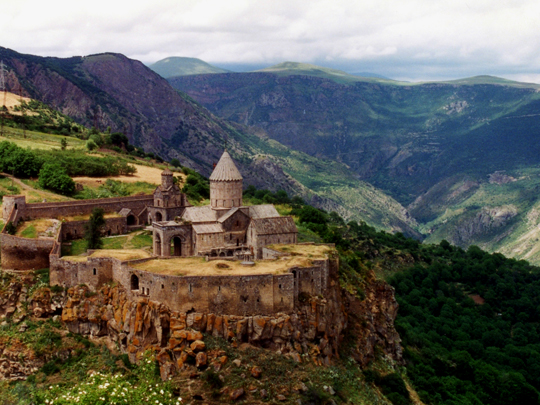
Tatev monastery was founded in the 9th century on a basalt spur that falls some seven hundred metres into the Vorotan gorge in Syunik, Tatev was a fortified monastery that owned hundreds of surrounding villages, and from roughly 1390 to 1435 it ran the most important university in medieval Armenia, teaching philosophy, theology, music and manuscript illumination under Hovhan Vorotnetsi and then Grigor Tatevatsi, who is buried beside the main church.
Three churches stand inside the walls, with Saints Peter and Paul, consecrated in 906, as the anchor, alongside a refectory, a restored library and the monks’ cells; most visitors now arrive on the Wings of Tatev, a 5.7-kilometre cable car that Guinness lists as the longest reversible ropeway built in a single section, crossing the gorge in about twelve minutes some three hundred metres above the river.
In the courtyard stands the Gavazan, an eight-metre octagonal column raised in 906 on a hinged base so that it sways instead of snapping — a working earthquake detector roughly nine centuries before the seismograph, and still upright.
2 – Khor Virap Monastery
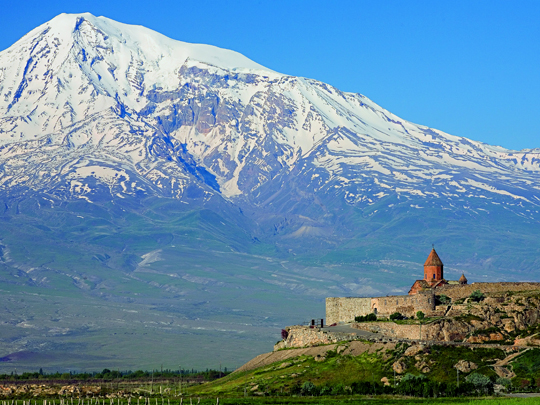
Khor Virap Monastery is on a low hill on the Ararat plain about thirty kilometres south of Yerevan, hard against the closed Turkish border, holding what was once the dungeon of Artashat, the old Armenian capital — and specifically the pit into which King Tiridates III threw Gregory the Illuminator for refusing to sacrifice to the goddess Anahit.
You climb down a near-vertical iron ladder into the pit itself, roughly six metres deep, beneath the 17th-century church of Surp Astvatsatsin; the compound is small and takes an hour, but the reason a couple of hundred thousand people come every year is the view across the border to Mount Ararat, the mountain on every Armenian coat of arms and inside Turkey since 1920.
Gregory survived thirteen years down there — fed, so the story goes, by a widow who dropped bread through the opening — and on being hauled out he cured the king, who then made Armenia the first state anywhere to adopt Christianity, in 301.
3 – Geghard Monastery
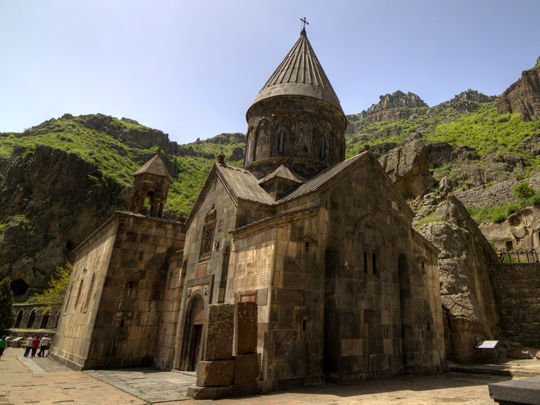
Geghard monastery sits at the mouth of the Azat gorge about thirty kilometres east of Yerevan with cliffs closing in on three sides, and what makes it a UNESCO site is that half of it was never built at all: the main church dates from 1215, but the chapels and tombs beside it were cut directly into the living rock in the 13th century, columns and vaulted ceilings and all.
Go into the upper rock-cut chambers for the acoustics, which hold a note for several seconds and are the reason Armenian choirs sing in them; then look for the Proshian family mausoleum of 1283, the lion-and-ox relief over the door, the spring running out of the rock inside the Avazan chapel, and the khachkars cut into the cliffs outside.
The name means “the spear”, after the lance said to have pierced Christ’s side at the crucifixion, which the monastery held for centuries and which now sits in a gilded silver case in the treasury at Etchmiadzin, never carbon-dated and never metallurgically tested.
4 – The Cascade
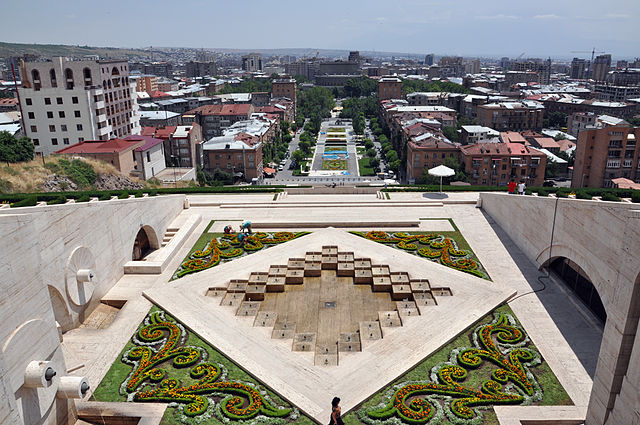
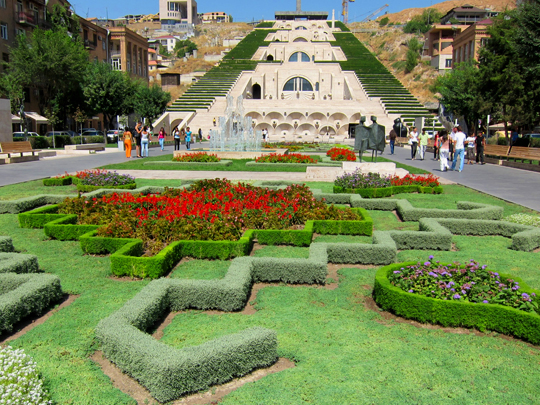
Alexander Tamanyan drew a monumental stairway on this hillside in his 1924 master plan for Yerevan, but nothing was built until 1980, and the 572 steps climbing roughly three hundred metres from Tamanyan Street towards Victory Park were still unfinished when the 1988 Spitak earthquake, the collapse of the Soviet Union and the Karabakh war stopped work altogether.
The Armenian-American philanthropist Gerard Cafesjian funded The Cascade’s completion between 2002 and 2009, turning the inside into the Cafesjian Center for the Arts, with galleries reached by escalators running up within the steps, while the garden at the bottom fills with sculpture: Botero’s Cat and Roman Warrior, Lynn Chadwick’s faceless figures, Barry Flanagan’s bronze hares.
The money came from the diaspora, which is the quiet fact underneath a great deal of modern Armenia — considerably more Armenians live outside the country than in it, and Tatev’s restoration was paid for the same way — and the steps themselves are now where half of Yerevan spends a summer evening.
5 – Temple of Garni
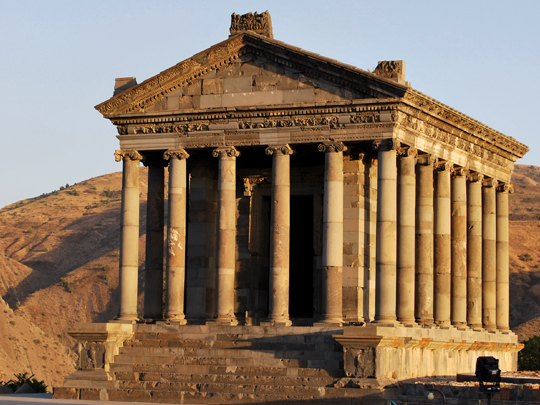
The Temple of Garni is a Greek-style temple stands on a basalt promontory above the Azat gorge some twenty-eight kilometres east of Yerevan, generally dated to the first century AD and credited to King Tiridates I, though a minority of scholars read it instead as a second-century tomb; dedicated to Mihr, the sun god, it is the only classical colonnaded building left standing anywhere in the South Caucasus.
Twenty-four Ionic columns in local grey-black basalt, jointed with iron cramps and lead rather than mortar, rise from a high podium reached by a steep flight of steps, with a Roman-style bathhouse and its mosaic floor alongside and a footpath dropping into the gorge to the Symphony of Stones, a fan of hexagonal basalt columns hanging over the river.
When Armenia went Christian in 301 and the pagan temples came down, Garni survived because it had stopped being a temple and become a royal summer residence — it stood until an earthquake flattened it in 1679, after which the stones lay scattered on the hillside for nearly three centuries until Soviet-Armenian architects reassembled them between 1969 and 1975.
6 – Karahunj Observatory
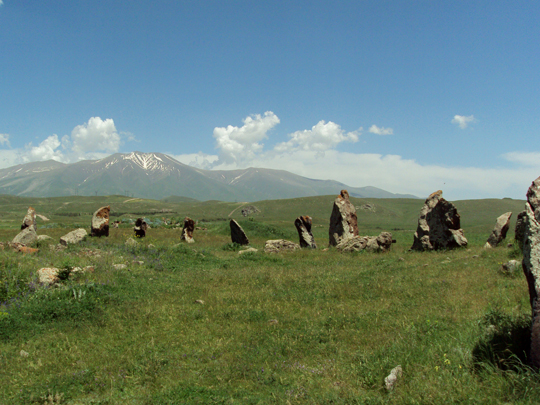
Karahunj Observatory sits on a windswept plateau at 1,770 metres near Sisian in Syunik stand 223 upright basalt stones, some three metres tall and weighing up to ten tonnes, more than eighty of them drilled through with neat holes about five centimetres across — a prehistoric site whose purpose has been argued over for ninety years and is still not settled.
You wander freely among them: a central ring, two long arms running north and south, a chord cutting across the circle, and outlying menhirs, with Bronze Age and Iron Age burial cists scattered through the site and the finds from the excavations held in a small museum in Sisian.
The “Armenian Stonehenge” tag and the claim that this is the world’s oldest observatory both trace back to a 1990s survey by the radiophysicist Paris Herouni, who also promoted the name Karahunj partly because its second syllable sounds like “henge”; German archaeologists who surveyed the site in 2000 read it instead as a Bronze Age necropolis, and Armenia’s parliament declared it an observatory by decree anyway in 2004.
7 – Goshavank
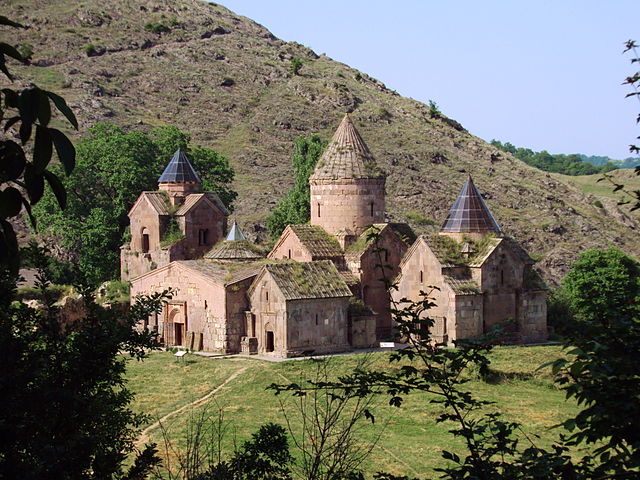
Goshavank stands in the village of Gosh in the forested Tavush hills beyond Dilijan, begun in the 1190s after an earthquake destroyed the older monastery at Getik, and named for its founder Mkhitar Gosh — jurist, fabulist and theologian, who wrote the first Armenian law code and taught here until his death in 1213.
The complex is compact and largely intact: the church of St Astvatsatsin from 1196, two churches dedicated to St Gregory, a double chapel, and a two-storey building with the book depository below and the bell tower above — and the school here was the first in Armenia to teach law as a subject in its own right.
Beside the door of St Gregory the Illuminator stands a khachkar carved by a mason named Poghos in 1291, so finely layered that Armenians call these stones aseghnagorts, “needle-work”, and Gosh’s law code outlived his monastery by centuries, governing the Armenian communities of Lviv and Kamianets-Podilskyi under Polish royal decree from 1519 until 1772.
8 – Areni-1 Cave
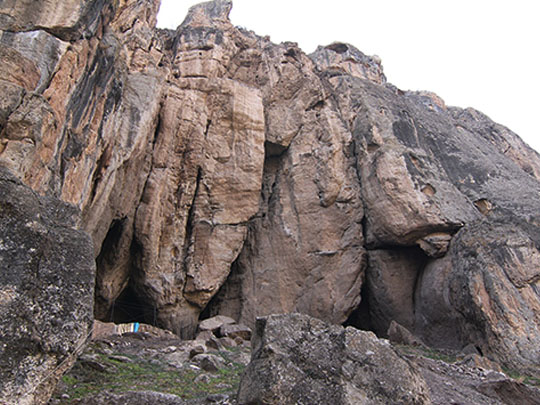
Areni-1 Cave has three limestone chambers in the cliffs above the Arpa river in Vayots Dzor, near the village of Areni, where a cool and unusually stable microclimate preserved leather, rope, textile and plant matter that would have rotted to nothing almost anywhere else — and where excavations from 2007 uncovered the oldest complete winemaking installation known anywhere, dated to around 4100 BC.
You can walk in and see the works in place: a shallow clay pressing basin about a metre across, a fermentation vat sunk into the floor, storage jars and the drainage channel running between them, with grape seeds, dried vines and pressed skins found all around — and because the whole setup sits in a part of the cave used for burials, the best guess is that the wine was made for funerals.
The same cave gave up a 5,500-year-old cowhide shoe, found upside down beneath a broken bowl with grass still packed inside it, and archaeologists remain unable to agree whether the grass was insulation or simply there to hold the shape.
9 – Tsitsernakaberd
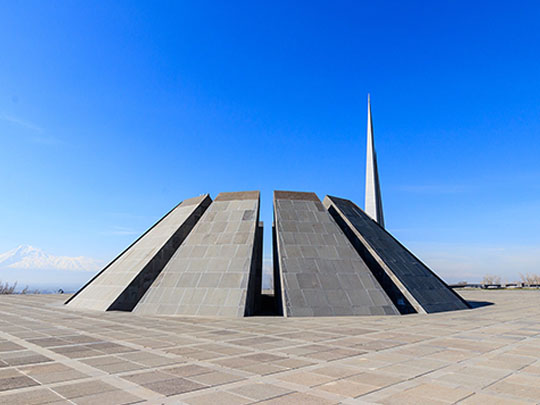
On Swallow’s Fortress hill above the Hrazdan gorge in Yerevan, Tsitsernakaberd is Armenia’s memorial to the roughly 1.5 million Armenians killed in the deportations and massacres carried out in the Ottoman Empire from 1915 — an event the Soviet authorities forbade any public marking of until a hundred thousand people filled Yerevan for a day and a night on the fiftieth anniversary in 1965 and forced the decision.
Twelve basalt slabs lean inward around an eternal flame sunk below ground level, a 44-metre stele stands split down its length, and a hundred-metre wall carries the names of the towns and villages where the killings happened, with the names of those who sheltered Armenians cut into the back of it; the museum, added in 1995, is built into the hillside so as not to compete with the monument above.
Everyone reads the twelve slabs as the lost provinces of Western Armenia, though the architects said the number came out of the geometry and there were in fact six Ottoman vilayets plus Adana — a small illustration of how a memorial acquires meanings its designers never put in it.
10 – Etchmiadzin Cathedral
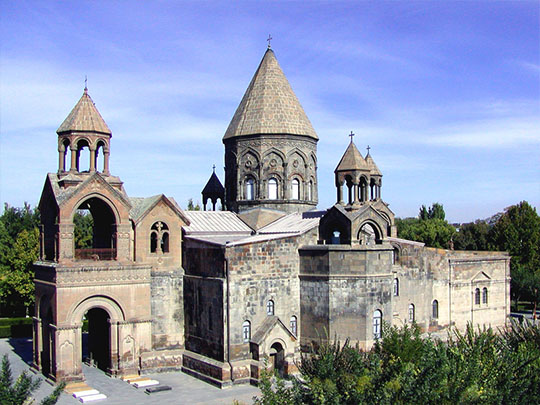

Vagharshapat, twenty kilometres west of Yerevan, was the Armenian capital when Gregory the Illuminator founded a church here in 301–303 on ground already occupied by a pagan temple, and the site has been the Mother See of the Armenian Apostolic Church ever since it was permanently re-established here in 1441 — Etchmiadzin Cathedral is widely reckoned the oldest cathedral in the world.
What stands is layered: the south and west walls are fourth-century, the cruciform domed plan comes from a rebuild in 484, the dome from 1627 and the bell tower from 1658, while the treasury museum holds the hand of Gregory the Illuminator and a fragment of wood said to have come off Noah’s Ark, and the churches of St Hripsime and St Gayane and the ruins of Zvartnots all belong to the same UNESCO listing.
The name means “the descent of the Only-Begotten”, after the story the historian Agathangelos set down in the fifth century: Gregory saw Christ descend and strike the ground with a golden hammer to mark the spot, which is about as precise as building instructions get.
11 – The Snake Castle (in Turkey)
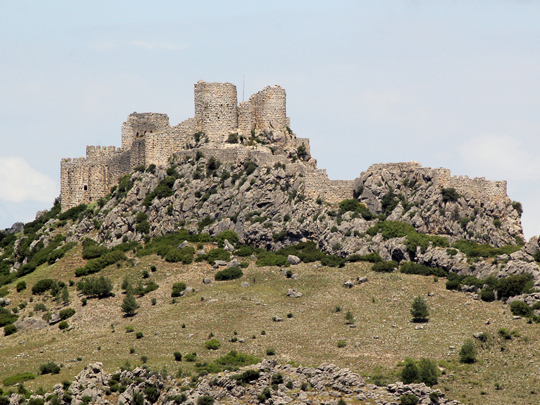
Yılankale, the Snake Castle, is a fortress of the Armenian Kingdom of Cilicia built in the late twelfth or thirteenth century on a limestone ridge above the Ceyhan river to watch the road between Adana and Ceyhan — it stands in modern Turkey, roughly seven hundred kilometres west of Yerevan, and it is the reminder that for two centuries the Armenian state was a Mediterranean power rather than a Caucasian one.
Eight towers and three walled sections climb the ridge, with a twin-towered gatehouse, a cistern, storerooms and the outline of a chapel still legible inside, and from the walls you can pick out the castles of Anavarza, Tumlu and Kozan across the Cilician plain, which is exactly what they were built to do.
A relief of an uncrowned lion above the gate is why historians read it as a prince’s castle rather than a king’s, and the Turkish name attaches to Shahmaran, the half-woman, half-serpent queen of snakes from Persian legend, said to have lived in caves beneath the rock.