

Central Intelligence Agency / Wikimedia Commons / CC-BY-SA-3.0 / GFDL
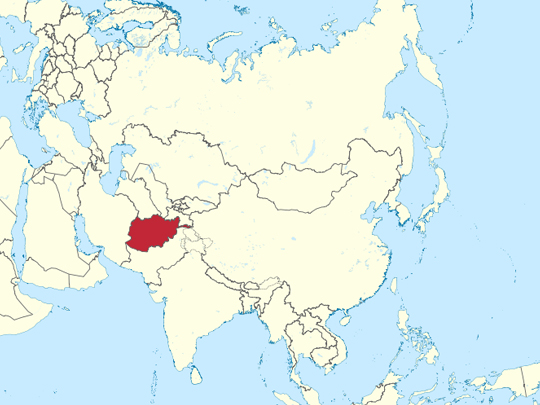
Capital: Kabul
Population: 36.5 million+ (no census since 1979).
Language: Dari & Pashto. Also Uzbek, Turkmen, Balochi, Pashayi, Nuristani and Pamiri.
1 – Band-e Amir National Park (also above)

Band-e Amir National Park, where six lakes sit at around 2,900 metres in the central highlands of Bamyan Province, held back not by anything anyone built but by walls of travertine that mineral-rich water has been depositing, layer on layer, for thousands of years — a formation so rare that Afghanistan made it the country’s first national park in 2009, having first proposed it in the 1970s and then lost four decades to war.
Band-e Haibat, the Dam of Awe, is the largest and deepest and the one with the infinity-pool edge; Band-e Zulfiqar is the first you see on the way in; Band-e Pudina is shallow and warm enough to wade in; Band-e Gholaman has dried up entirely; and the whole chain is walkable in a day along the cliff paths, with swan-shaped pedal boats for hire at the main lake.
The name means the Amir’s Dam, and the Amir is Ali — the story everyone tells is that he built the dams through a sequence of miracles while disguised as a slave, which is why a good share of the visitors are pilgrims who come for the water rather than the view.
2 – Bamiyan Valley
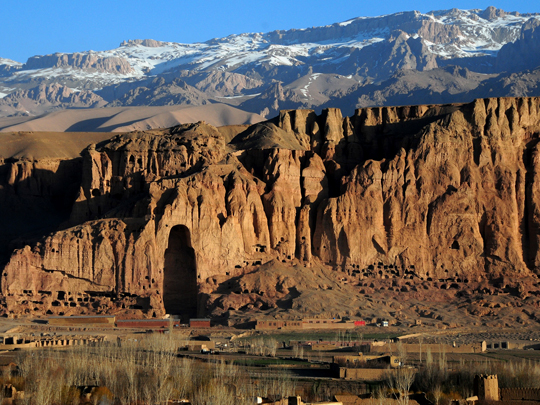
Bamiyan valley is 130 km northwest of Kabul at 2,500 metres, sitting on the Silk Road where Greek, Persian, Indian and Chinese ideas collided, and the place where Buddhist monks carved two colossal standing Buddhas — 55 metres and 38 metres — into the sandstone cliff in the sixth or seventh century, where they stood for roughly fourteen hundred years until the Taliban spent most of March 2001 destroying them with artillery, then explosives, then a rocket for the face that wouldn’t fall.
The two empty niches are still the centrepiece, flanked by a honeycomb of monks’ caves; Shahr-e Zohak, the Red City, guards the valley mouth on a cliff of rust-coloured rock; and Shahr-e Gholghola — the City of Screams — is the citadel Genghis Khan levelled in 1221 after an arrow from the valley’s defences killed his favourite grandson.
The caves behind the Buddhas turned out to hold the oldest oil paintings known anywhere: mid-seventh-century murals bound with walnut and poppy-seed oil, roughly five hundred years before anyone in Europe tried the technique.
3 – Panjshir Valley
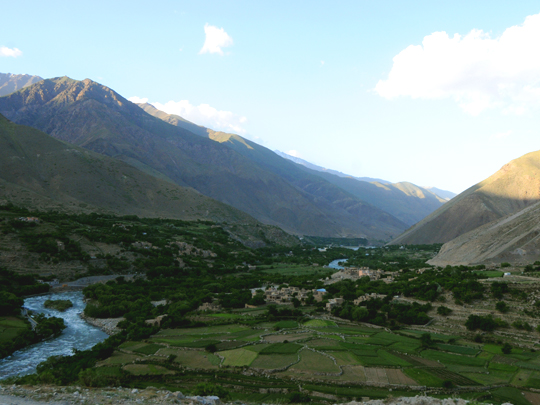
Panjshir Valley is a long, narrow gorge about 150 km north of Kabul with essentially one way in, which is the whole story of the place: Ahmad Shah Massoud, the Lion of Panjshir, used that bottleneck to let Soviet columns in and then cut them off from the high ground, holding the valley through at least nine major Soviet offensives between 1980 and 1985 and again against the Taliban right through the 1990s.
Massoud’s mausoleum stands on a rise above the river, built so the sun falls on the tomb; Soviet tanks and armoured vehicles still lie rusting in the riverbed where they were ambushed; and the valley’s emerald mines were already famous enough in the first century AD for Pliny the Elder to write about the stones coming out of here.
Massoud was killed on 9 September 2001 by two al-Qaeda operatives posing as journalists, who detonated a bomb hidden in their camera — two days before the attacks in New York that made his warnings about bin Laden look, in retrospect, like the most ignored briefing of the decade.
4 – Herat Citadel
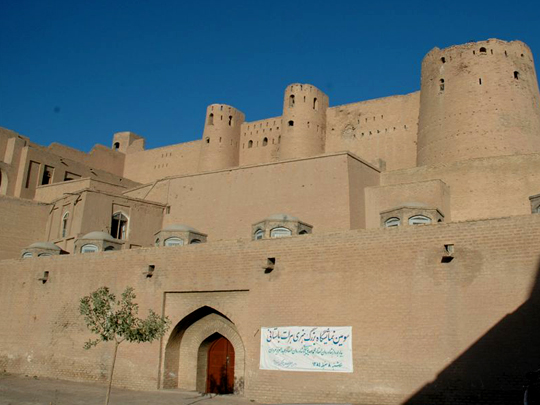
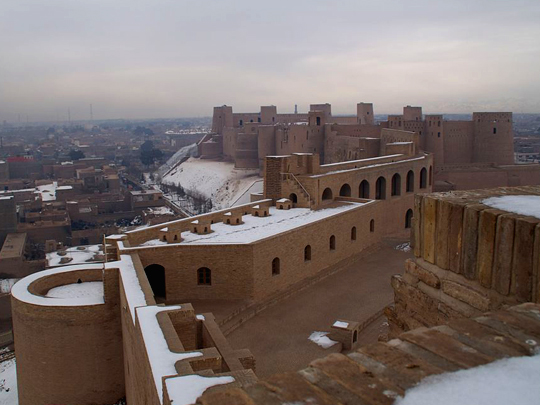
Qala Ikhtyaruddin rises from a mound in the middle of Herat, a Silk Road city near the Iranian border, and a fort is thought to have first gone up on this spot after Alexander the Great took the place — then called Artacoana — in 330 BC; it has been flattened and rebuilt more or less continuously ever since, by Genghis Khan in 1222, the Kartids in 1245, Timur in 1381, and finally by Timur’s son Shah Rukh, whose reconstruction after 1415 is essentially what you see today.
Herat Citadel’s eighteen brick towers stand along walls two metres thick and sixteen metres high over a footprint 250 metres long, restored between 2006 and 2011 by the Aga Khan Trust for Culture and now holding the national archive, a small museum and an open-air amphitheatre.
A short walk away lean the five surviving minarets of the Musalla complex — all that’s left of some twenty, after Anglo-Afghan forces demolished the finest Timurid building group in Asia in 1885 to clear a field of fire for a Russian invasion that never arrived.
5 – Minaret of Jam
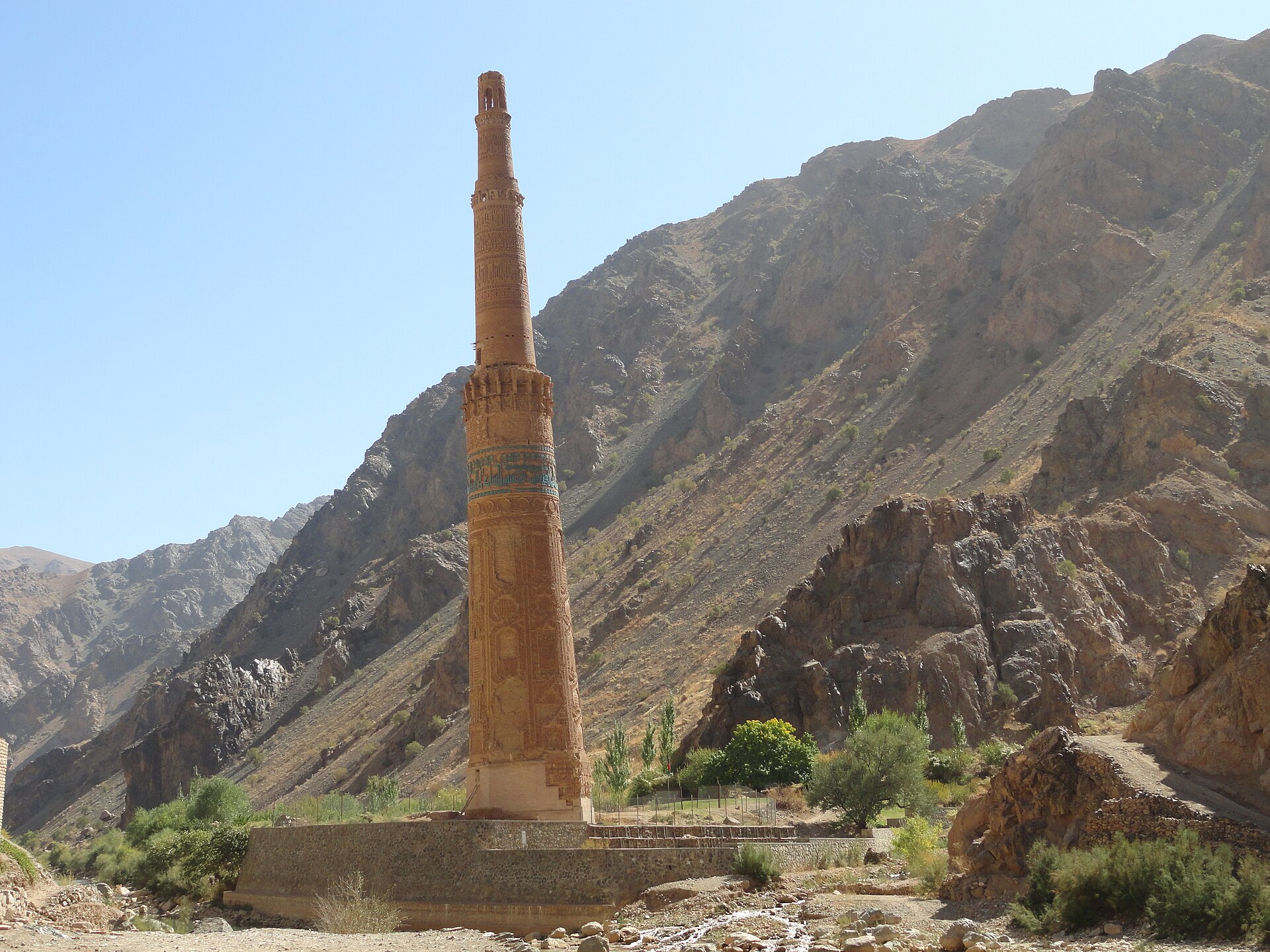

Minaret of Jam is sixty-five metres of patterned brick stand alone at the bottom of a gorge in Ghor province, 1,900 metres up where the Jam river meets the Hari Rud and about 215 km east of Herat, built around 1190 by the Ghurid sultan Ghiyath al-Din as a tower of victory and probably marking the site of Firuzkuh, the lost summer capital of an empire that once reached from eastern Iran to the Ganges plain.
Four tapering shafts rise from an octagonal base, every surface worked into interlocking geometric brickwork with a turquoise-tiled inscription near the top carrying the Quranic chapter of Maryam, and a double staircase spirals up inside; scattered around it in the valley are the remains of a palace, fortifications, a pottery kiln and a Jewish cemetery whose Hebrew gravestones date from the eleventh and twelfth centuries.
It was the tallest minaret in the world when it went up and stayed second only to Delhi’s Qutb Minar — built by the same dynasty — until the twentieth century, and it became Afghanistan’s first UNESCO World Heritage site in 2002, going onto the Danger list the same day.
6 – The Blue Mosque – Mazar-i-Sharif
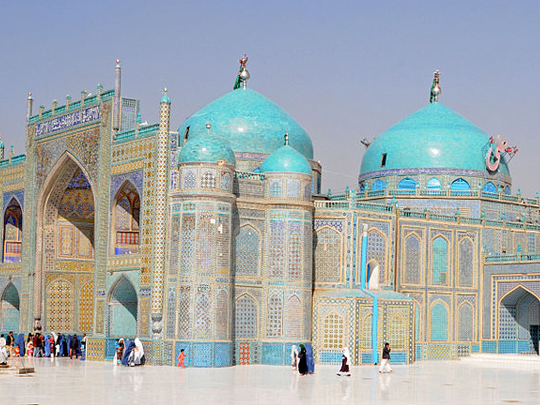
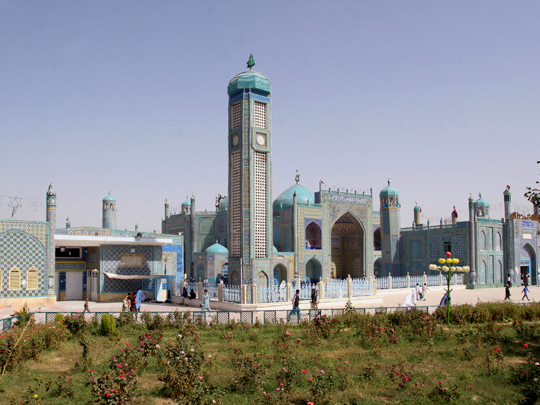
The city is named after the shrine rather than the other way round — Mazar-i-Sharif means tomb of the exalted — and the tradition holds that after Ali, the Prophet’s cousin and son-in-law, was killed in 661, his followers smuggled his body east on a white camel to keep it from being desecrated, burying him where the animal finally dropped; most of the Muslim world maintains he lies in Najaf in Iraq, and Afghans have never much minded.
The twin blue domes and sheets of cobalt mosaic belong to the complex Sultan Husayn Bayqara raised in the 1480s, after Genghis Khan flattened the twelfth-century shrine that a Seljuk sultan had built when a local mullah dreamed the grave’s location; non-Muslims can’t enter the shrine itself, but the rose-planted park around it works as the city’s living room.
Thousands of white pigeons live in the arches and are never harmed, and the story everyone tells is that a grey bird joining the flock turns white within forty days.
7 – Balkh
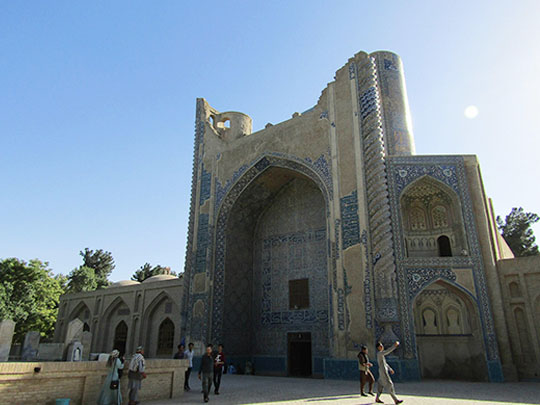

Balkh is named after the shrine rather than the other way round — Mazar-i-Sharif means tomb of the exalted — and the tradition holds that after Ali, the Prophet’s cousin and son-in-law, was killed in 661, his followers smuggled his body east on a white camel to keep it from being desecrated, burying him where the animal finally dropped; most of the Muslim world maintains he lies in Najaf in Iraq, and Afghans have never much minded.
The twin blue domes and sheets of cobalt mosaic belong to the complex Sultan Husayn Bayqara raised in the 1480s, after Genghis Khan flattened the twelfth-century shrine that a Seljuk sultan had built when a local mullah dreamed the grave’s location; non-Muslims can’t enter the shrine itself, but the rose-planted park around it works as the city’s living room.
Thousands of white pigeons live in the arches and are never harmed, and the story everyone tells is that a grey bird joining the flock turns white within forty days.