
Wikimedia Commons / CC-BY-SA-3.0 / GFDL
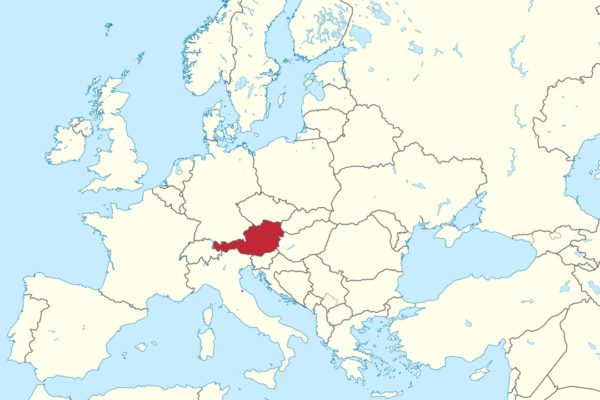
Capital: Vienna
Population: 9.2 million+
Language: German
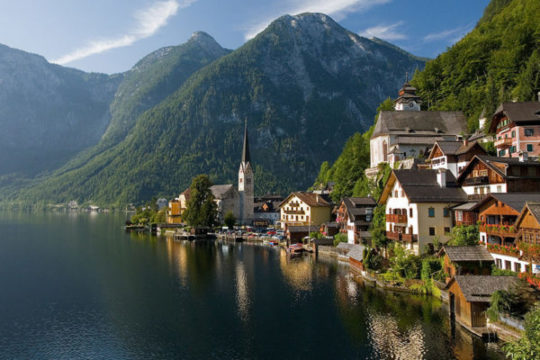
1 – Hallstatt (also above)
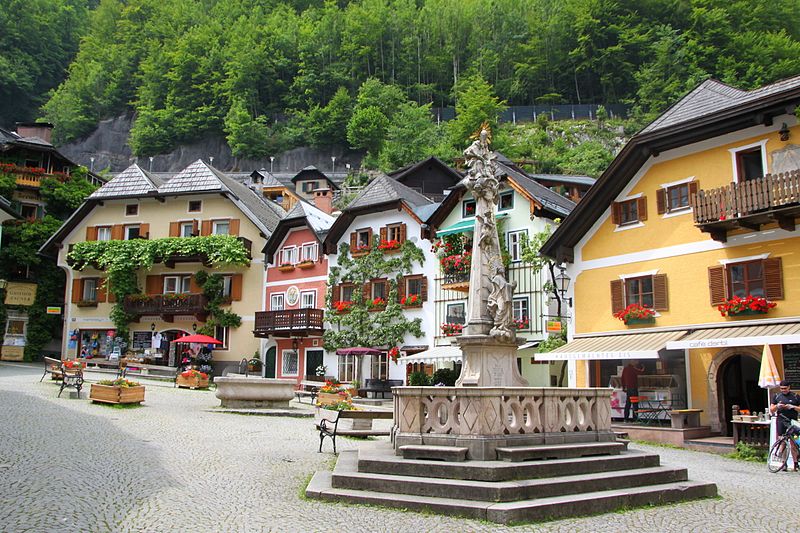
Hallstatt clings to the shore of Lake Hallstatt in the Salzkammergut, where salt has been mined since the Bronze Age, and the prehistoric cemetery above the village gave its name to the whole Hallstatt culture of the Late Bronze and Early Iron Age.
Ride up to the salt mine, often described as the world’s oldest known, see the Bone House, where around 1,200 skulls are stacked and some 600 painted, and walk the brine pipeline trail, laid from 1595 and often called the world’s oldest pipeline, through a landscape UNESCO listed in 1997.
Hallstatt didn’t inspire Disney’s Frozen, whose makers looked to Norway, but China did build a full-size copy of Hallstatt in Guangdong province, which opened in 2012.
2 – Hohenwerfen
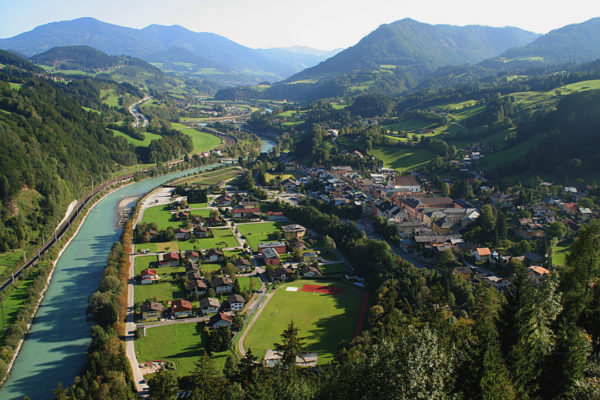
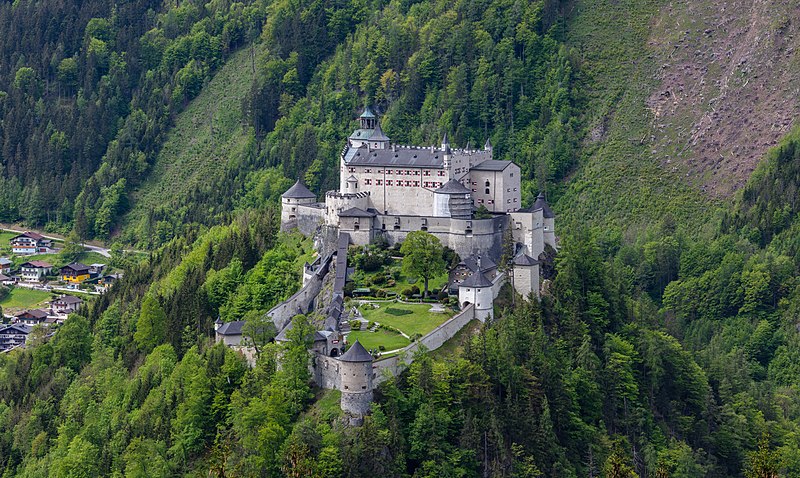
Hohenwerfen Castle sits on a rock high above Werfen in the Salzach valley, begun in 1077 by Archbishop Gebhard of Salzburg during the Investiture Controversy and used mainly as a prison in the 17th and 18th centuries.
Come for the falconry centre’s bird-of-prey flight displays, then look up at Hohenwerfen from the Gschwandtanger meadow above Werfen, where The Sound of Music‘s “Do-Re-Mi” picnic was filmed with the castle in the background.
Hohenwerfen played Schloss Adler, the Alpine Nazi fortress, in Where Eagles Dare (1968) with Richard Burton and Clint Eastwood, though the famous cable-car scenes were shot at Ebensee.
3 – Bregenz
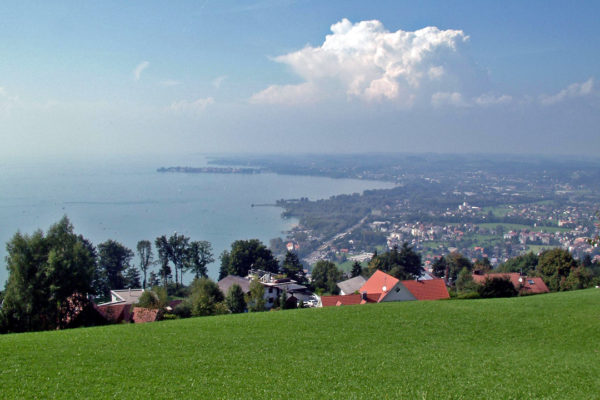
Bregenz, Vorarlberg’s capital on the south-east shore of Lake Constance, began as Celtic Brigantion and Roman Brigantium, and around 610 the Irish monk Columbanus and his companion Gall preached here, smashing pagan idols and reconsecrating a church, which is why Bregenz is twinned with Bangor, Co. Down, the monastery Columbanus set out from.
See the Bregenz Festival’s lake stage, seating about 7,000, Peter Zumthor’s glass-skinned Kunsthaus (1997), and the Martinsturm, whose onion dome is said to be the largest in Central Europe.
Bregenz’s lake stage appears in the Bond film Quantum of Solace (2008), and the lake beyond it has no agreed borders, as Switzerland says the line runs down the middle while Austria treats the water as shared by all the shore states.
4 – Vienna
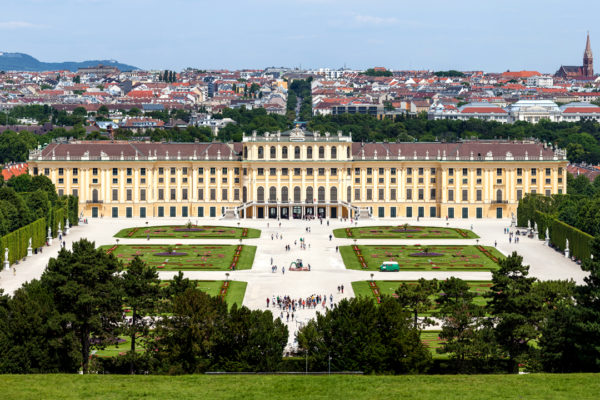
Vienna, on the Danube, was the Habsburg seat from 1278 to 1918, held out against Ottoman sieges in 1529 and 1683, hosted the Congress of Vienna in 1814–15, and replaced its old walls with the Ringstrasse, opened in 1865.
Take in the Hofburg, Schönbrunn Palace with the world’s oldest continuously operating zoo (1752), Klimt’s The Kiss at the Belvedere, the Spanish Riding School, the Riesenrad wheel of The Third Man, and the Schottenstift, founded around 1155 for Irish Benedictine monks — “Scoti” then meant Irish — which is why Vienna has a Schottentor and Schottenring.
Vienna’s favourite origin stories don’t hold up: no source from 1683 links the croissant to the siege, and the tale of Kolschitzky opening the first coffee house was largely invented in 1783, as historians credit an Armenian, Johannes Diodato, with opening the first in 1685.
5 – Innsbruck
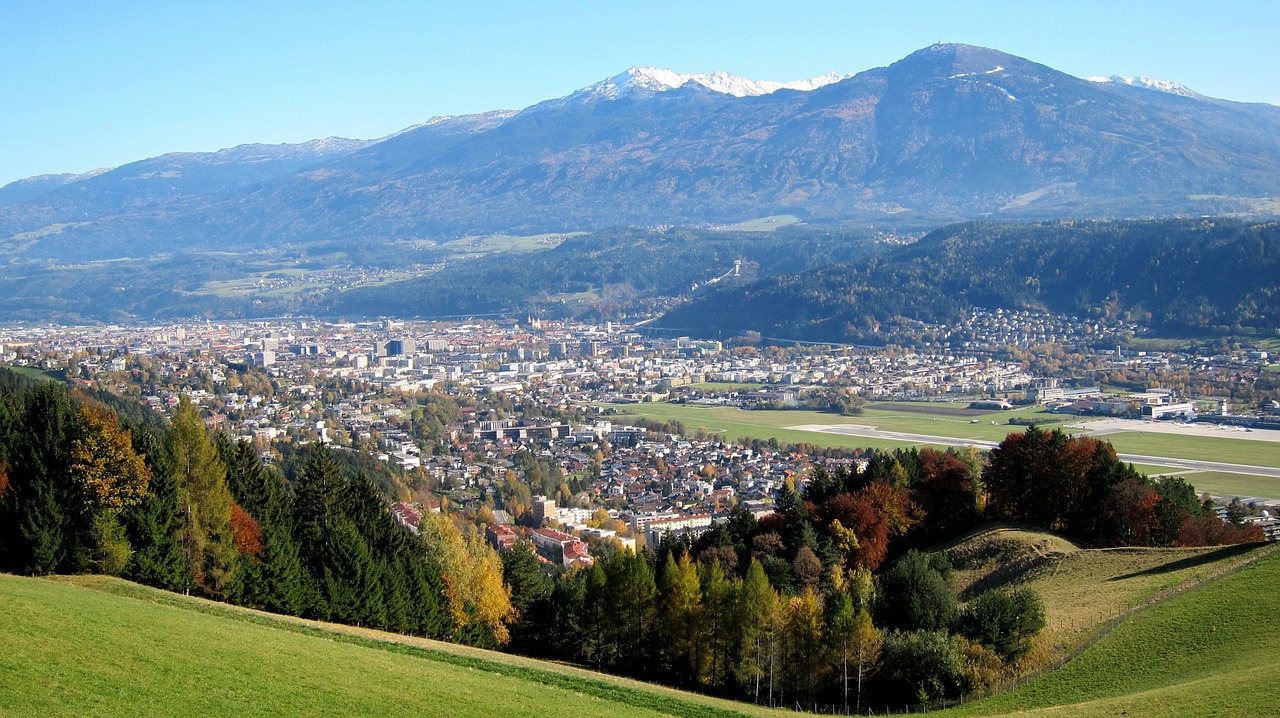
Innsbruck, Tyrol’s capital, takes its name from the bridge over the Inn, became capital of Tyrol in 1429 and was home to Emperor Maximilian I in the 1490s.
Look up at the Golden Roof, 2,657 fire-gilded copper tiles finished in 1500 as a royal box for watching tournaments, then visit Schloss Ambras and its Renaissance cabinet of curiosities, and Zaha Hadid’s Bergisel ski jump in a city that hosted the Winter Olympics in 1964 and 1976.
Innsbruck’s Hofkirche holds Maximilian’s grand tomb, guarded by 28 bronze “Black Men”, including a King Arthur cast in 1513 to a design by Dürer, but the tomb is empty, as the emperor is buried in Wiener Neustadt.
6 – Zell am See

Zell am See lies on Lake Zell in the Pinzgau region of Salzburg state, and takes its name from the “cella”, or monastic cell, founded here in the 8th century.
Stroll the lakeside old town around the Romanesque-Gothic church of St Hippolyte, ride up the Schmittenhöhe (1,965 m) for lake and mountain views, and head to the Kitzsteinhorn glacier above Kaprun next door.
Zell am See’s Schmittenhöhe cable car, opened at the end of 1927, is billed by its operator as the first cable car in the state of Salzburg.
7 – Graz
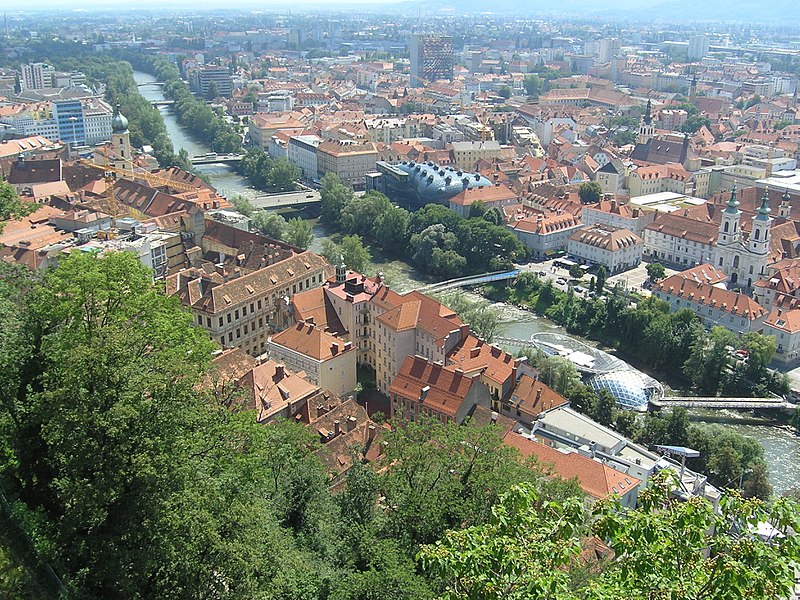
Graz, Austria’s second city and capital of Styria, was the seat of the Inner Austrian Habsburgs from the 14th century, and its old town and Schloss Eggenberg are UNESCO-listed (1999 and 2010).
See the Kunsthaus, a blue blob nicknamed the “Friendly Alien”, built for Graz’s year as European Capital of Culture in 2003, the Landeszeughaus, billed as the largest preserved historic armoury in the world with about 32,000 objects, and Arnold Schwarzenegger’s childhood home in nearby Thal.
When Napoleon’s troops demolished the Schlossberg fortress in 1809, the people of Graz paid a ransom to save the clock tower, whose big hand shows the hours so they can be read from afar.
8 – Linz
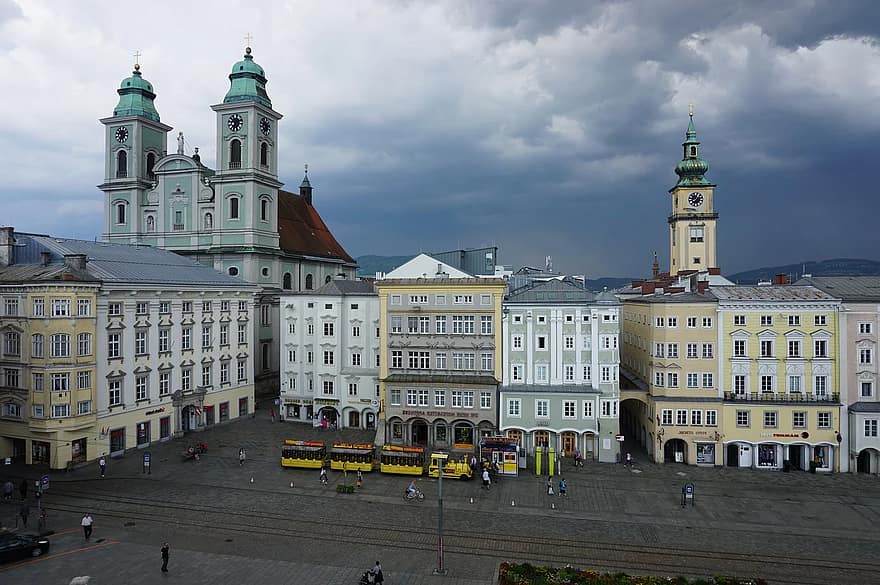
Linz, Upper Austria’s capital on the Danube, began as Roman Lentia and was European Capital of Culture in 2009, shared with Vilnius.
Start at the Hauptplatz and its Trinity Column (1723), then visit the Lentos art museum and Ars Electronica on the riverbank, and ride the Pöstlingbergbahn (1898), one of the steepest adhesion railways in the world.
Mozart wrote his “Linz” Symphony in about four days in 1783, and Johannes Kepler, who lived in Linz, published his Harmonices Mundi, with his third law of planetary motion, here in 1619.
9 – Kufstein
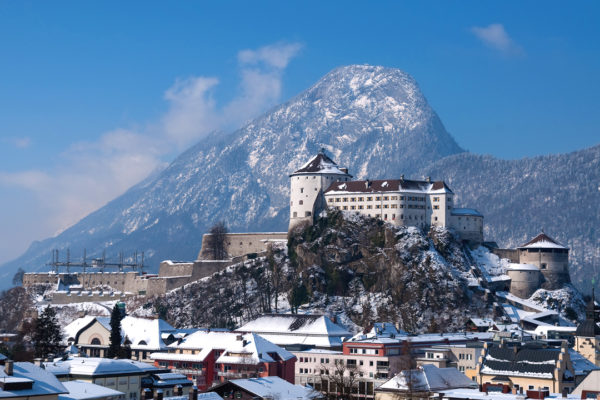
Kufstein guards the Inn on the Bavarian border, and its fortress, first recorded in 1205, passed between Bavaria and Tyrol until Maximilian I stormed it in 1504 with heavy guns named Weckauf and Purlepaus.
Climb to Kufstein Fortress and its Kaiserturm (1518–22), whose cells held Hungarian prisoners including the writer Ferenc Kazinczy and the outlaw Sándor Rózsa, and listen for the Heldenorgel, a 1931 war memorial and one of the largest open-air organs.
The Kufsteinlied, “Perle Tirols”, sounds like an old folk song, but Karl Ganzer wrote it in the late 1940s.
10 – Kitzbühel

Kitzbühel, in the Tyrolean Alps, received town rights in 1271, was Bavarian until 1504 and grew rich on copper and silver mining.
Kitzbühel’s big name is the Hahnenkamm, first raced in 1931, whose Streif downhill runs 3,312 m and drops through the Mausefalle at an 85% gradient, among the toughest in ski racing.
Kitzbühel’s skiing goes back to 1893, when Franz Reisch, inspired by Fridtjof Nansen’s book on crossing Greenland, skied the Kitzbüheler Horn, and local hero Toni Sailer became the first skier to win all three alpine golds at one Olympics, in 1956.
11 – Salzburg
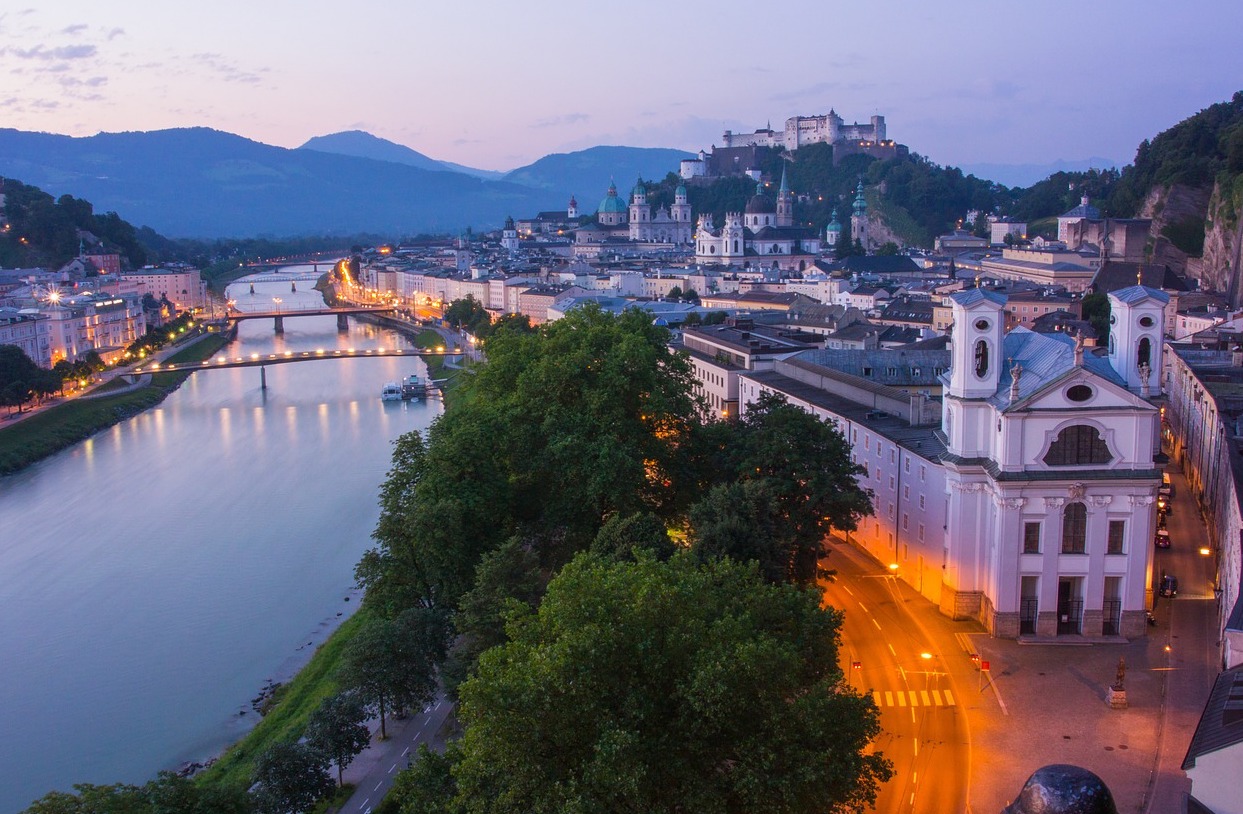
Salzburg grew from Roman Iuvavum, revived by St Rupert around 696, and was ruled by its prince-archbishops until 1803, leaving a baroque old town that UNESCO listed in 1996.
See Mozart’s Birthplace at Getreidegasse 9, where he was born in 1756, the cathedral where he was baptised, Hohensalzburg Fortress, begun in 1077 and one of the largest medieval castles in Europe, and the Mirabell Gardens of the “Do-Re-Mi” scene.
Salzburg’s co-patron is St Virgil, an Irishman who was probably abbot of Aghaboe in Co. Laois before becoming bishop of Salzburg and building its first cathedral in 774, and whose belief in people living on the far side of the earth drew complaints from St Boniface.
12 – Grossglockner High Alpine Road
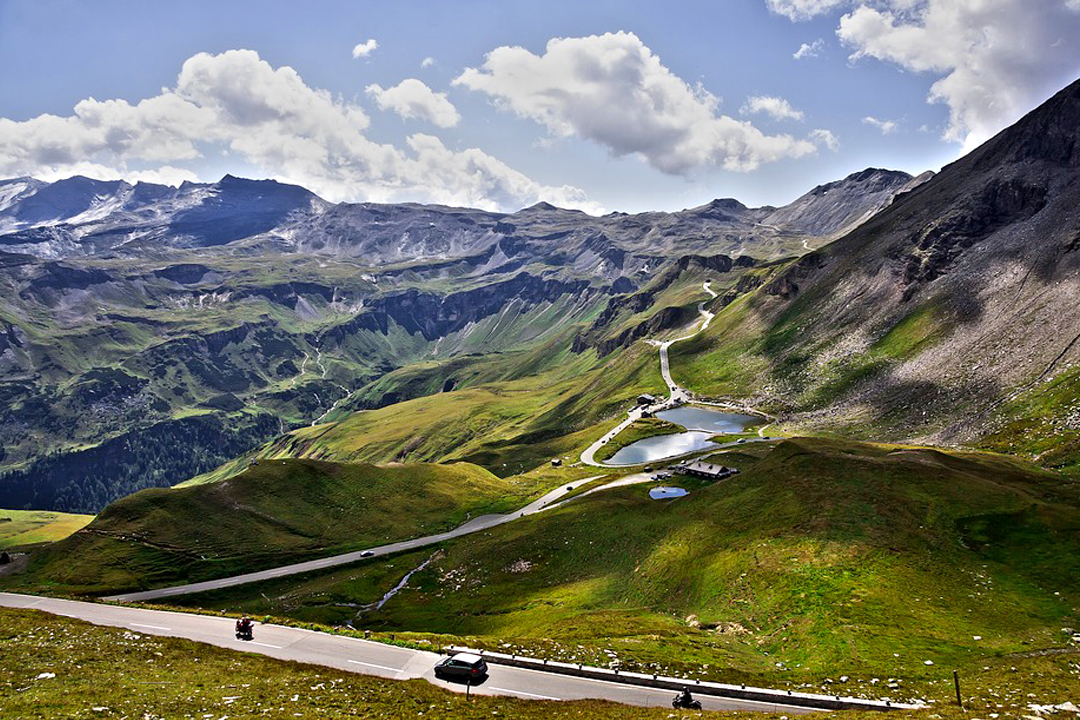
The Grossglockner High Alpine Road was built in 1930–35 as Depression-era job creation for more than 3,000 workers, planned by engineer Franz Wallack and opened on 3 August 1935.
Drive its 48 km and 36 bends over the Hochtor at 2,504 m, detour up to the Edelweissspitze (2,571 m), the highest point you can reach by car, and stop at the Franz-Josefs-Höhe beneath the Grossglockner, Austria’s highest mountain at 3,798 m, and above the Pasterze, Austria’s longest glacier.
The Franz-Josefs-Höhe on the Grossglockner road is named after Emperor Franz Joseph and Empress Sisi’s visit in 1856, when the Pasterze’s ice reached almost up to where the car park sits.
13 – Wörthersee
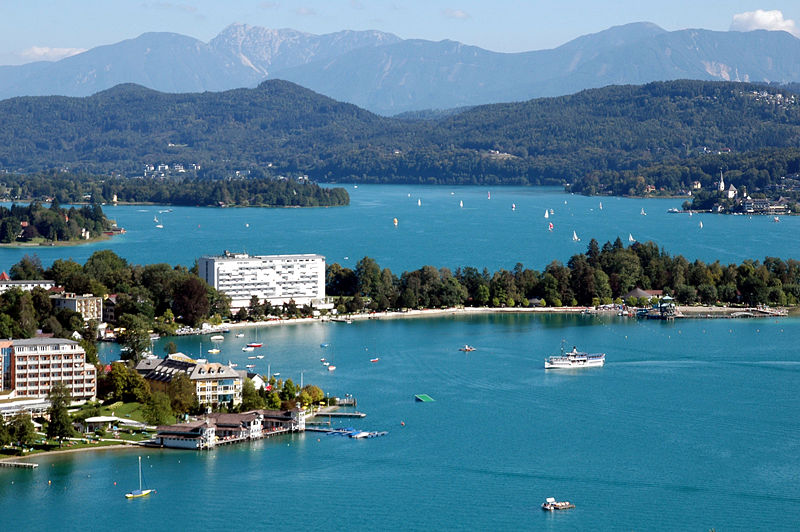
The Wörthersee stretches about 16.5 km across Carinthia from Klagenfurt to Velden, and the church at Maria Wörth, on what was an island until the lake was lowered around 1770, dates back to the 9th century.
Visit Maria Wörth’s two churches, the Renaissance Schloss Velden, and the 100 m Pyramidenkogel, billed as the tallest wooden observation tower in the world, for views over the whole lake.
The Wörthersee is composer country: Brahms wrote his Second Symphony and Violin Concerto in Pörtschach, and Mahler composed his Fifth, Sixth and Seventh Symphonies in his lakeside hut at Maiernigg.
14 – Wachau and Melk Abbey
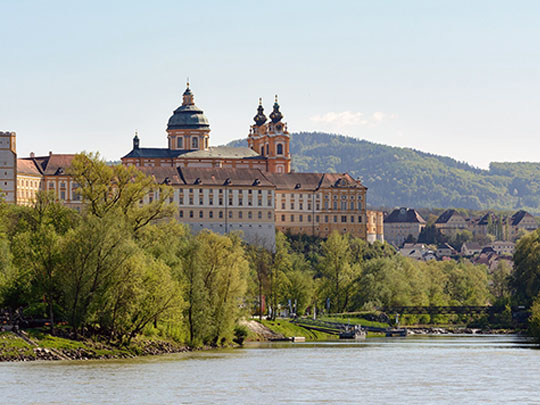
The Wachau is the roughly 35 km stretch of the Danube between Melk and Krems, a landscape of vine terraces and apricot orchards that UNESCO listed in 2000, and its village of Willendorf gave up the Venus of Willendorf, a figurine about 30,000 years old, in 1908.
Melk Abbey has housed Benedictine monks since 1089 on a rock once held by Austria’s Babenberg rulers, and Jakob Prandtauer’s baroque rebuild of 1702–36 gives you the gilded church, Marble Hall and library, while downriver the Aggstein castle ruin and terraces of Grüner Veltliner and Riesling line the Wachau’s banks.
Melk Abbey holds the tomb of St Coloman, an Irish pilgrim hanged as a suspected spy at Stockerau in 1012, whose relics were moved to Melk in 1014 and who was Austria’s patron saint until 1663.
15 – Dürnstein
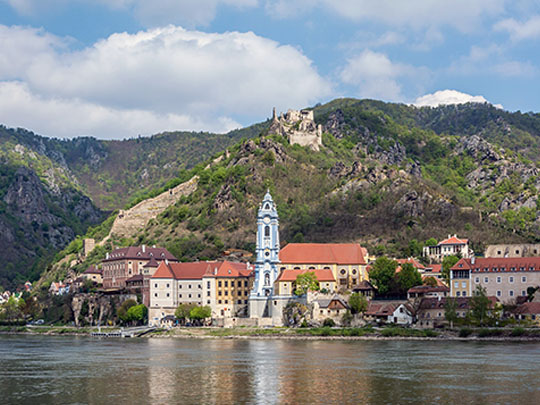
Dürnstein is a small Danube town in the Wachau, below the ruins of a castle built by the Kuenring family around 1140, where Duke Leopold V of Austria held Richard the Lionheart over the winter of 1192–93 after the two fell out at the siege of Acre.
Climb up to Dürnstein’s castle ruin, blown up by Swedish troops in 1645, then visit Stift Dürnstein, whose blue-and-white baroque tower of 1733 is the Wachau’s best-known landmark.
The tale of the minstrel Blondel finding Richard by singing outside his cell is legend, but the 150,000-mark ransom was real, and Leopold’s share helped pay for Vienna’s city walls, its mint and the founding of Wiener Neustadt.