
Wikimedia Commons / CC-BY-SA-3.0 / GFDL
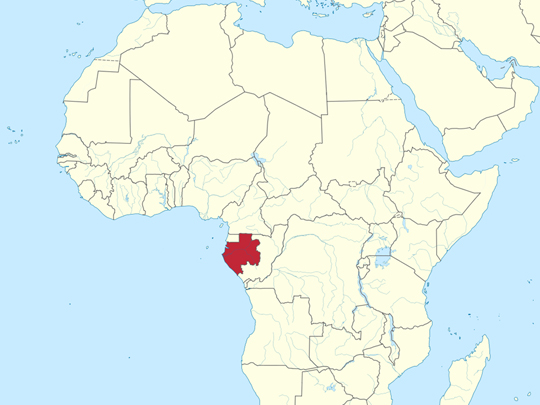
Capital: Libreville
Population: 2.6 million+
Language: French
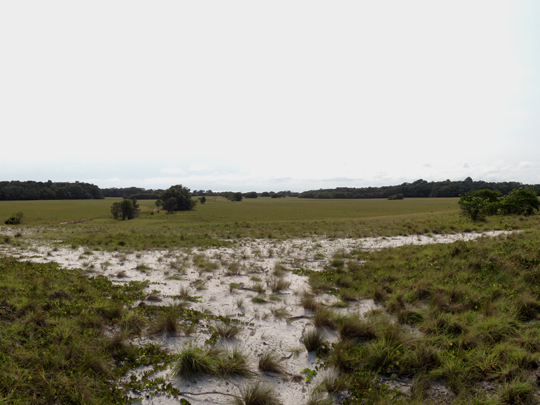
1 – Loango National Park (also above)
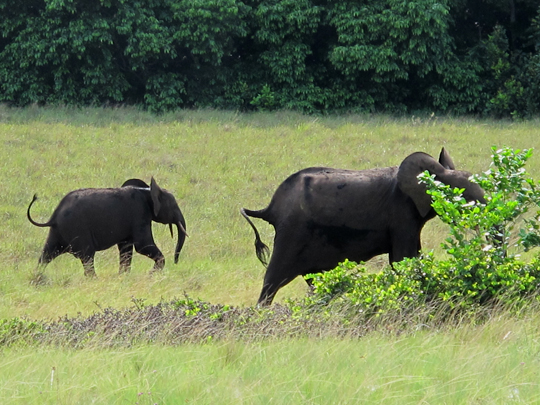
On Gabon’s wild Atlantic coast, Loango National Park is a mosaic of white-sand beaches, lagoons, savanna and rainforest so pristine that the naturalist Mike Fay dubbed it “Africa’s Last Eden.”
It’s one of the only places on Earth where you might watch elephants, buffalo and even lowland gorillas stroll out of the forest onto an ocean beach; offshore, humpback whales and dolphins pass through some of the richest waters in Africa, and leatherback turtles haul up to nest.
Loango is best known as the “Land of Surfing Hippos” — after National Geographic photographers captured its hippos wallowing and bodysurfing in the Atlantic breakers, a sight seen almost nowhere else in the world.
2 – Libreville
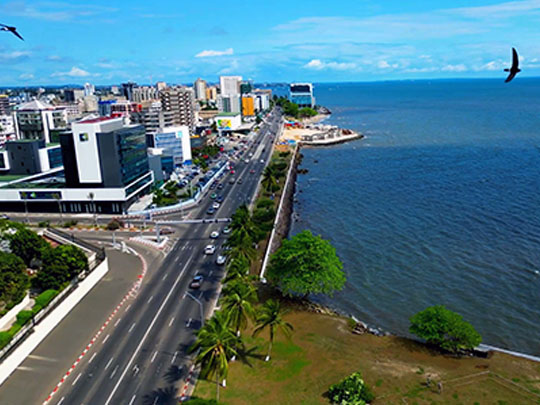

Gabon’s capital stands on the north shore of the estuary, and it began as a refuge: in 1846 the French navy, working the anti-slavery patrol, seized a Brazilian slave ship called L’Elizia, and fifty-two of the people freed from its hold were settled here in 1849 — the place named Libreville, “free town”, in deliberate imitation of Freetown. Within a few years they were holding elections to choose their own leaders.
Climb to the Church of St Michael at Nkembo, where dozens of carved wooden columns by a blind Gabonese sculptor retell Bible stories in Gabonese dress, then the National Museum for its Fang and Kota reliquary figures, the sprawl of Mont-Bouët market, and the corniche along the water.
Those reliquary guardians — sheet-brass faces, blank almond eyes — reached Paris in the early 1900s and hit European art like a hammer: Picasso, Braque and Vlaminck all collected them, and the shock of them runs straight into Cubism and everything after.
3 – Lope National Park

In the heart of Gabon, where the Congo Basin rainforest gives way to rolling grassland, Lopé is a rare mosaic of ancient forest and “relict” savanna left over from the last ice age — a UNESCO World Heritage Site prized for both its wildlife and a human story stretching back hundreds of thousands of years.
Reached by the scenic railway that crosses the country, the park shelters gorillas, chimps and forest elephants at some of the highest densities in Africa, while its rocky outcrops hold around 1,800 ancient rock carvings — one of the greatest collections of prehistoric art in Central Africa.
Lopé is the world capital of the mandrill, the giant, rainbow-faced monkey — its forests hold the largest primate groups ever recorded, super-troops of well over a thousand animals moving through the trees together.
4 – Pointe-Denis Beach
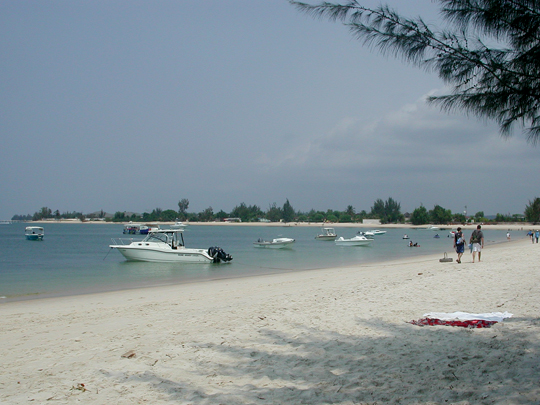
A long ribbon of white sand on the peninsula facing Libreville across the Gabon Estuary, Pointe-Denis is the capital’s favourite beach escape — just a 20-minute boat ride from the city, yet backed by the wild mangroves and forest of Pongara National Park.
Days here are spent swimming, lazing at beach bars and bungalows, and — in season — spotting humpback whales offshore or heading into the park in search of elephants and buffalo, with silky sand and a gentle surf.
Come nesting season, these beaches host one of the world’s most important gatherings of the leatherback — the largest turtle on the planet, which can weigh as much as a small car — as the giant reptiles haul ashore in the dark to lay their eggs.
5 – Lambaréné
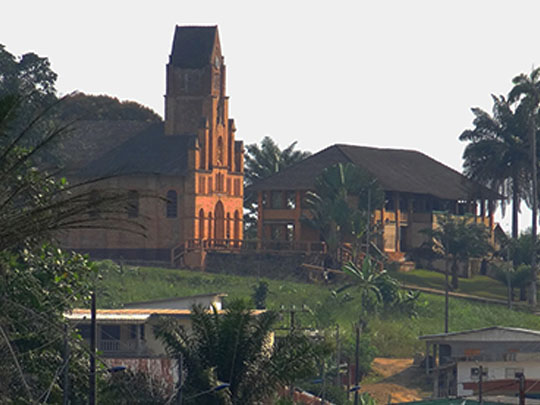

On an island in the wide brown Ogooué some 250km inland, Lambaréné is where Albert Schweitzer — concert organist, theologian, and a qualified doctor only at thirty-eight — built a hospital in 1913 and ran it until his death in 1965, becoming the most famous European in Africa and winning the Nobel Peace Prize in 1952, though his manner with his African patients has been argued over ever since.
The old hospital is kept as a museum: consulting room and pharmacy left as they were, the piano fitted with organ pedals so he could practise in the tropics, and his grave under a plain cross above the river — while a modern hospital carries on the work next door.
The idea he is remembered for came to him on this river: labouring upstream through a herd of hippos in 1915, casting about for an ethic that would cover every living thing, he said the phrase “reverence for life” simply arrived, unsought.
6 – Ivindo National Park
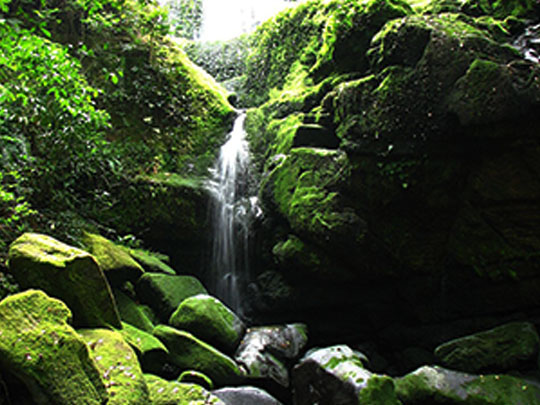
In Gabon’s north-east, wrapped around the Ivindo River, this is some of the least disturbed rainforest left in the Congo Basin — in a country still roughly 85% forest, one of the emptiest and greenest on Earth — and UNESCO listed it in 2021.
Kongou Falls is the showpiece, a broad thundering wall of white water breaking over granite in the middle of the jungle, with Mingouli Falls downstream; deeper in lies Langoué Baï, a marshy clearing reached on a long forest walk, where elephants, gorillas, buffalo and sitatunga step out of the trees to feed on mineral-rich mud.
Nobody outside the local forest communities knew Langoué was there until the naturalist Mike Fay spotted it in 2000, near the end of a 2,000-mile walk across the Congo Basin — and what he brought back helped persuade Gabon’s president to create thirteen national parks in a single stroke in 2002, turning a logging economy into one of the great conservation states almost overnight.