

Bert Kaufmann / Wikimedia Commons / CC-BY-SA-3.0 / GFDL
Capital: Rome
Population: 58.9 million+
Language: Italian

1 – Rome (also above)

Rome rose on its hills beside the Tiber to rule a republic and then an empire, and while legend has Romulus founding it in 753 BC, archaeologists have found people living on the Palatine centuries earlier.
Rome’s headline acts are the Colosseum, opened by Titus in AD 80 with 100 days of games, the Forum and Palatine Hill, the Pantheon, the Spanish Steps and the Trevi Fountain, where Anita Ekberg waded in for Fellini’s La Dolce Vita, and San Pietro in Montorio, where a number of those from the Flight of the Earls, including Hugh O’Neill and Rory O’Donnell are buried.
During the German occupation of 1943–44, when more than 1,000 of the city’s Jews were deported to Auschwitz (USHMM) and 335 men were shot at the Ardeatine Caves, Cork-born priest Hugh O’Flaherty ran an escape network from the Vatican credited with saving around 6,500 people, a story Gregory Peck told in The Scarlet and the Black.
2 – Lake Como

Lake Como is a glacial lake in Lombardy shaped like an upside-down Y, Italy’s third-largest and over 400 metres deep, and it was on its western shore that partisans caught Mussolini at Dongo in April 1945, shooting him the next day at Giulino di Mezzegra, according to the generally accepted account.
Lake Como’s real draw is its villas and waterside towns, from Bellagio and Varenna to Villa del Balbianello at Lenno, Villa Carlotta and the grand Villa d’Este at Cernobbio.
Hollywood can’t get enough of Lake Como: Villa del Balbianello was a location for Star Wars: Episode II and the villa where Bond recovers in Casino Royale, and Ocean’s Twelve filmed on the lake too.
3 – Naples
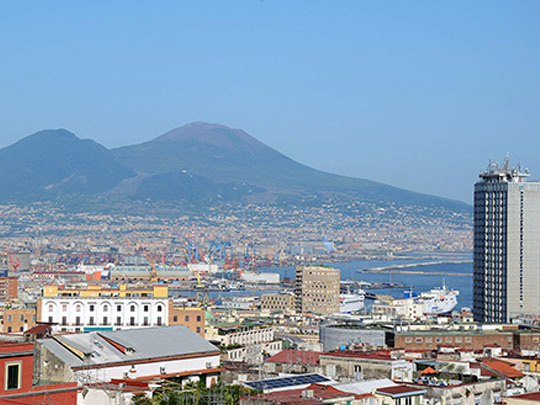
Naples began as the Greek city of Neapolis, the “New City”, whose street plan survives in its UNESCO-listed centre, later ruled as the capital of a Bourbon kingdom, and in the Four Days of Naples, 27–30 September 1943, its people rose against the German occupiers just before the Allies arrived.
Naples piles on the sights, from the Veiled Christ in the Cappella Sansevero, carved with its veil from a single block of marble, to the National Archaeological Museum’s treasures from Pompeii and the Teatro di San Carlo, opened in 1737 and called the oldest continuously active opera house in the world.
Naples gave the world pizza, but the story that a local pizzaiolo created the margherita for Queen Margherita in 1889 is probably a later invention, since no newspaper reported the visit and one historian argues the royal thank-you letter is forged.
4 – Venice

Venice was built across 118 small islands in a lagoon from the 5th century onwards and grew into a maritime republic that dominated trade with the East until Napoleon ended it in 1797.
Venice packs in St Mark’s Basilica, the Doge’s Palace, the Grand Canal and Rialto Bridge, Titian’s altarpieces in the Frari, and the glass and lace islands of Murano and Burano.
The word “ghetto” comes from Venice, where Jews were confined from 1516 to an area named after its old foundry, the geto, and the Holocaust memorial there names the 246 Jews deported from Venice during WWII.
5 – Palermo

Palermo, Sicily’s capital on the north-west coast, passed through Phoenician, Roman, Arab and Norman hands, and Patton’s US troops rolled in on 22 July 1943 after Allied raids had wrecked much of the old centre.
Palermo’s Arab-Norman monuments, UNESCO-listed in 2015, include the Palazzo dei Normanni with its glittering Cappella Palatina and, in the hills above, Monreale Cathedral’s gold mosaics, with the Capuchin Catacombs and their roughly 8,000 bodies for the strong-stomached.
The steps of Palermo’s Teatro Massimo, Italy’s largest opera house, are where The Godfather Part III ends.
6 – Siena

Siena was a powerful medieval republic in the Tuscan hills and Florence’s great rival, whose painters Duccio, Simone Martini and the Lorenzetti brothers helped shape Gothic art, and it came through WWII undamaged when the Germans pulled out and French troops took over on 3 July 1944.
Siena centres on the shell-shaped Piazza del Campo, overlooked by the Torre del Mangia and the Palazzo Pubblico, home to Lorenzetti’s frescoes of Good and Bad Government, with the striped marble Duomo a short climb away.
Twice a year, on 2 July and 16 August, ten of Siena’s 17 neighbourhoods race horses bareback three times round the Campo in the Palio, a roughly 90-second race that a riderless horse can win and that Quantum of Solace opens in the middle of.
7 – Malcesine, Lake Garda

Malcesine sits on the eastern shore of Lake Garda, Italy’s largest lake, beneath Monte Baldo, while across the water Mussolini’s German-backed Salò Republic ran its ministries from lakeside villas in 1943–45.
Malcesine’s lanes wind up to the Scaliger Castle, named after Verona’s medieval della Scala lords, and a cable car with rotating cabins lifts you up Monte Baldo for views down the length of the lake.
In 1786 Goethe was sketching Malcesine’s castle when locals took him for an Austrian spy and tore up his drawing, and he talked his way out and wrote it all up in his Italian Journey.
8 – Belluno

Belluno is a hill town above the Piave river in the Veneto, the birthplace of Pope Gregory XVI and the gateway to the Dolomites, which became a UNESCO site in 2009.
Belluno’s main square, Piazza dei Martiri, is named after four partisans hanged there in 1945, and the town is the jumping-off point for the Dolomiti Bellunesi National Park.
On 9 October 1963 a landslide in Belluno province plunged into the Vajont reservoir and sent a wave over the dam that wiped out the town of Longarone and killed nearly 2,000 people, yet the dam itself survived.
9 – Florence

Florence, on the Arno, was the cradle of the Renaissance, its wealth and art driven by the Medici family in the 15th and 16th centuries, and its historic centre is a UNESCO site.
Florence’s must-sees are the Duomo, whose dome Brunelleschi built from 1420 to 1436 without a wooden supporting frame, the Uffizi, the Palazzo Vecchio, Michelangelo’s David in the Accademia, and the Ponte Vecchio with the Vasari Corridor running over it.
In August 1944 retreating German troops blew up every bridge in Florence except the Ponte Vecchio, for reasons historians debate, and mined the medieval streets at each end of it instead.
10 – Pisa

Pisa was a powerful maritime republic in the Middle Ages, and its Piazza dei Miracoli, a UNESCO site, gathers four medieval masterpieces: the cathedral, the baptistery, the bell tower and the Camposanto cemetery.
Pisa’s Leaning Tower began tilting during construction, and in July 1944 fire during wartime fighting brought down the Camposanto’s roof, but removing its damaged frescoes revealed the artists’ preparatory drawings underneath.
Galileo probably never dropped balls from the Leaning Tower of Pisa, since the story comes from a biography by his pupil, but engineers did pull it about 44 centimetres back towards upright between 1990 and 2001 by removing soil from under its north side.
11 – Riomaggiore

Riomaggiore is the southernmost of the Cinque Terre villages on the Ligurian coast, a medieval fishing and wine village that could only be reached by sea or on foot until the railway arrived in the 1870s, and it’s part of a UNESCO site.
Riomaggiore is all pastel tower-houses stacked above a tiny harbour, with the 14th-century church of San Giovanni Battista, a hilltop castle, and terraced vineyards and coastal paths linking it to the other villages.
The Via dell’Amore cliff path from Riomaggiore to Manarola was cut during railway works around 1920 and took its name from the courting couples who used it to meet.
12 – Bologna

Bologna, capital of Emilia-Romagna, is home to a university traditionally dated to 1088 and often called the oldest in continuous operation, and Polish troops were the first Allied soldiers into the city when it was liberated on 21 April 1945.
Bologna is laced with 62 kilometres of porticoes, a UNESCO site, and its skyline is dominated by the Two Towers, the 97-metre Asinelli and the leaning Garisenda that Dante mentions in the Inferno, with Piazza Maggiore at its heart.
Bologna’s famous ragù is served with fresh tagliatelle, not spaghetti, and the official recipe was registered by the Bologna branch of the Italian Academy of Cuisine in 1982.
13 – Herculaneum

Herculaneum was a wealthy Roman seaside town at the foot of Vesuvius, buried under about 20 metres of volcanic material in AD 79, which carbonised wood, food and even scrolls, and a man digging a well stumbled on it in 1709.
Herculaneum’s houses stand up to two storeys high with wooden fittings intact, and on the ancient shoreline the stone boathouses where about 300 skeletons were found in 1980 show where people sheltered in their last moments.
Herculaneum’s Villa of the Papyri held the only library to survive from the ancient world, and in 2024 researchers used AI and X-ray scans to read more than 2,000 Greek letters from a charred scroll that had never been unrolled.
14 – Lecce

Lecce sits in the Salento, the heel of Italy’s boot in Puglia, and the exuberant Baroque buildings it put up between the 16th and 18th centuries earned it the nickname “the Florence of the South”.
Lecce’s showstopper is the Basilica di Santa Croce, its facade crowded with carved figures, and a Roman amphitheatre lies half-uncovered in Piazza Sant’Oronzo after workers stumbled on it around 1900.
Lecce’s secret is pietra leccese, a soft local limestone that’s easy to carve and hardens with age, which made the city’s elaborately carved facades possible.
15 – Milan

Milan was capital of the Western Roman Empire for over a century before growing into Italy’s financial and fashion capital, and from its Central Station’s hidden Platform 21 trains carried Jews to Auschwitz in 1943–44, a site that has become the city’s Shoah Memorial.
Milan’s Duomo took from 1386 to 1965 to finish, and nearby are La Scala, the Galleria Vittorio Emanuele II, Sforza Castle and the Biblioteca Ambrosiana, whose Milan Glosses are the largest surviving collection of Old Irish writing.
Leonardo’s Last Supper in Milan is tempera on dry plaster rather than a true fresco, which is why it has deteriorated so badly, and it survived an Allied bomb that wrecked the refectory around it in August 1943 thanks to sandbags and scaffolding.
16 – Positano

Positano tumbles down a cliff on the UNESCO-listed Amalfi Coast, a medieval port of the Amalfi Republic that boomed in the 16th and 17th centuries and later lost much of its population to emigration to America.
Positano’s landmark is Santa Maria Assunta, with its majolica-tiled dome and a Byzantine-style Black Madonna that, legend says, told sailors to “set me down” here, while offshore lie the Li Galli islets, said to be home to the Sirens.
John Steinbeck put Positano on the map with a 1953 Harper’s Bazaar essay in which he wrote that the place “bites deep”, and Under the Tuscan Sun later filmed scenes on its beach.
17 – Verona

Verona, on the River Adige, layers Roman, medieval Scaliger and Venetian history into a UNESCO-listed centre, and in January 1944 Mussolini’s puppet republic tried and shot his own son-in-law, Count Ciano, here for voting to topple him.
Verona’s Roman Arena, built around AD 30, has staged opera since 1913, while the Roman Ponte Pietra, blown up by retreating Germans in 1945, was rebuilt with its original stones.
Juliet’s house in Verona belonged to the Cappello family, whose name only sounds like Shakespeare’s Capulets, and its famous balcony was added in the 1930s.
18 – Siracusa

Siracusa was founded by Corinthian Greeks on the island of Ortigia in the 8th century BC and grew into one of the great cities of the Greek world, and British troops took it on the first day of the Allied invasion of Sicily, 10 July 1943.
Siracusa’s old town on Ortigia is a maze of Baroque streets, while the mainland archaeological park has a 5th-century BC Greek theatre, which has staged classical drama almost every year since 1914, and the Ear of Dionysius cave, named by Caravaggio in 1608.
Archimedes was born in Siracusa and killed when the Romans took the city around 212 BC, but the story of him torching Roman ships with giant mirrors first appears some 700 years later.
19 – Pompeii

Pompeii was a busy Roman town south of Naples buried by Vesuvius in AD 79, and the only eyewitness account comes from Pliny the Younger, who watched the eruption from across the bay as a teenager.
Pompeii’s streets, forum, amphitheatre and frescoed villas are haunting enough, but the plaster casts of victims, made since 1863 by filling the hollows their bodies left in the ash, are the real gut-punch, and the site was hit by more than 160 Allied bombs in 1943.
Pompeii’s eruption is traditionally dated to 24 August, but a charcoal scrawl found in 2018 reading 17 October has fuelled a debate over whether it actually happened in autumn.
20 – Turin

Turin, on the Po beneath the Alps, was the capital of the House of Savoy and became the first capital of united Italy in 1861, and in March 1943 its FIAT workers staged the first major strike against Fascism.
Turin has the Museo Egizio, which bills itself as the oldest museum devoted entirely to ancient Egypt, the Mole Antonelliana, planned as a synagogue and home to the National Cinema Museum, and the Shroud of Turin, which carbon dating in 1988 placed in the Middle Ages.
The Mini getaway in The Italian Job (1969) races across the rooftop test track of FIAT’s Lingotto factory in Turin, a car plant later converted by Renzo Piano.
21 – Urbino

Urbino, a hill town in the Marche, became one of Europe’s great Renaissance courts under Federico da Montefeltro, who ruled from 1444 to 1482, and it’s the setting of Castiglione’s The Book of the Courtier.
Urbino’s Ducal Palace houses the National Gallery of the Marche, with Piero della Francesca’s Flagellation, the Ideal City panel and Raphael’s La Muta, and Raphael’s birthplace is a short walk away.
During WWII the art official Pasquale Rotondi hid nearly 10,000 Italian artworks, including Giorgione’s Tempest, at Sassocorvaro and Carpegna near Urbino, and none was lost.
22 – San Gimignano

San Gimignano is a Tuscan hill town that grew rich in the Middle Ages as a stop on the Via Francigena pilgrim route to Rome, and its medieval centre is a UNESCO site.
San Gimignano’s skyline is 14 surviving medieval towers, the tallest being the Torre Grossa, with the frescoed Collegiata and the Piazza della Cisterna at street level.
Rival families in San Gimignano raced to build ever-taller towers as symbols of wealth, around 72 of them at the peak, and the 14 that remain also came through American shelling in 1944 that damaged the Collegiata.
23 – Monte Cassino
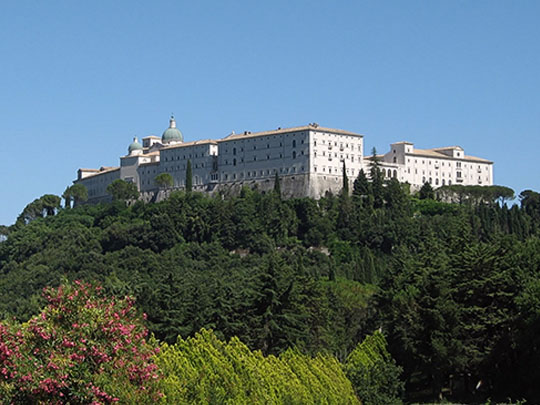
Monte Cassino’s hilltop abbey above the town of Cassino was founded by St Benedict around 529, and it has been destroyed four times, by the Lombards, the Saracens, an earthquake in 1349 and Allied bombers on 15 February 1944, when it stood on Germany’s Gustav Line.
Monte Cassino’s abbey was rebuilt “where it was, as it was” and reconsecrated by Pope Paul VI in 1964, and the slopes below hold the Polish War Cemetery, with over 1,000 graves including General Anders, plus Commonwealth and German cemeteries nearby.
No German troops were inside Monte Cassino’s abbey when it was bombed, but their paratroopers turned the ruins into a fortress that held out until Polish soldiers raised their flag over it on 18 May 1944, with the Irish Brigade fighting in the valley below.
24 – Ravenna
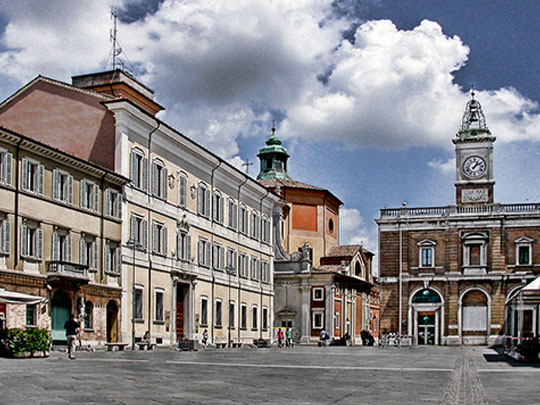

Ravenna, near the Adriatic in Emilia-Romagna, was capital of the Western Roman Empire from 402, then of Theodoric’s Ostrogothic kingdom and Byzantine Italy, and Canadian troops, with Italian partisans, liberated it on 4 December 1944.
Ravenna’s eight UNESCO-listed early Christian monuments include San Vitale, with its glittering mosaics of Emperor Justinian and Empress Theodora, the starry Mausoleum of Galla Placidia, Sant’Apollinare in Classe, and Theodoric’s tomb, roofed with a single block of stone weighing around 230 tonnes.
Dante died in Ravenna in 1321, and when Florence came to claim him the Franciscans hid his bones, which a builder stumbled on in 1865, and Florence sends oil every year for the lamp at his tomb.
25 – Agrigento
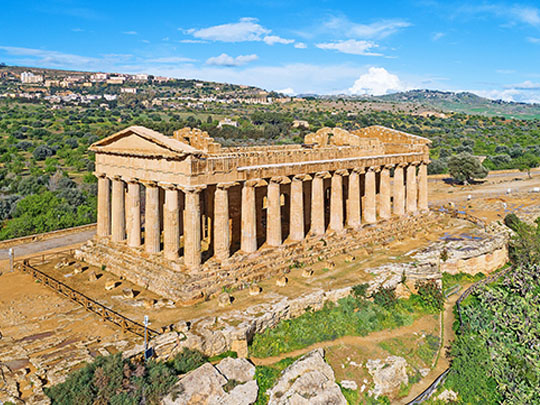
Agrigento grew from the Greek city of Akragas, founded around 580 BC on Sicily’s south coast, and later became Roman Agrigentum, and US troops took it on 16 July 1943 during the Allied invasion of Sicily.
Agrigento’s Valley of the Temples, a UNESCO site, lines up a series of Doric temples, among them the temples of Concordia and Heracles and the vast Temple of Olympian Zeus with its giant stone figures.
Agrigento’s Temple of Concordia is one of the best-preserved Greek temples anywhere because it was turned into a church in the 6th century, though its name comes from an unrelated Latin inscription found nearby.
26 – Paestum
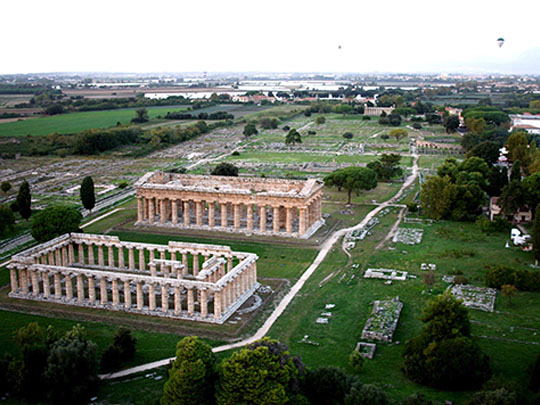

Paestum was founded as the Greek city of Poseidonia around 600 BC on the coast south of Salerno, later became a Roman colony and was abandoned in the Middle Ages, and on 9 September 1943 the US 36th Infantry Division landed on the beaches beside it during the Salerno landings.
Paestum’s three Doric temples are among the best-preserved Greek temples anywhere, and its museum holds the Tomb of the Diver, painted around 470 BC and the only known Greek tomb of its time decorated with human figures.
Paestum’s temples were named by 18th-century visitors, who called the oldest “the Basilica” because they thought it was Roman and the grandest “the Temple of Neptune”, though it was probably dedicated to Hera.
27 – Ostia Antica
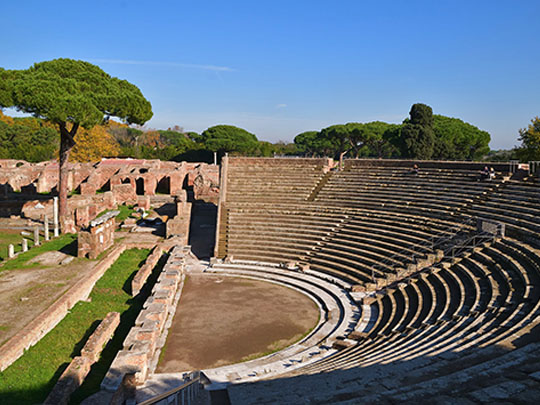

Ostia Antica, at the mouth of the Tiber, takes its name from the Latin ostium, meaning mouth, and was ancient Rome’s naval base and then its grain port, though the silted river has left it about 3 kilometres inland.
Ostia Antica’s highlights are the Decumanus Maximus main street, a theatre seating around 4,000, the Piazzale delle Corporazioni, whose floor mosaics advertised the merchants’ trades, a thermopolium snack bar with its marble counter, and multi-storey apartment blocks.
Much of Ostia Antica was dug out in a rush between 1938 and 1942, when Mussolini wanted it ready for a world’s fair in Rome that the war cancelled, and the site also has the oldest known synagogue in Europe.
28 – Anzio
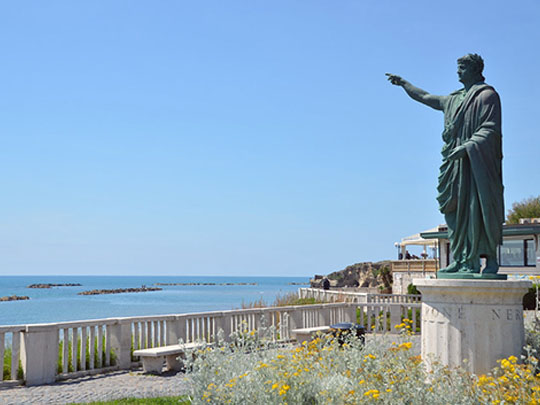
Anzio is ancient Antium, on the coast south of Rome, where Suetonius says both Nero and Caligula were born, and on 22 January 1944 Allied troops landed here almost unopposed, only to be pinned down for four months.
Anzio’s harbour and seafront lead to two Commonwealth war cemeteries, Beach Head and Anzio, while the Sicily–Rome American Cemetery at neighbouring Nettuno holds 7,845 US dead.
The 1st Battalion Irish Guards was cut down to roughly a single company at Anzio, and Roger Waters’ father was killed here too, a loss he sang about in Pink Floyd’s When the Tigers Broke Free.
29 – Bobbio
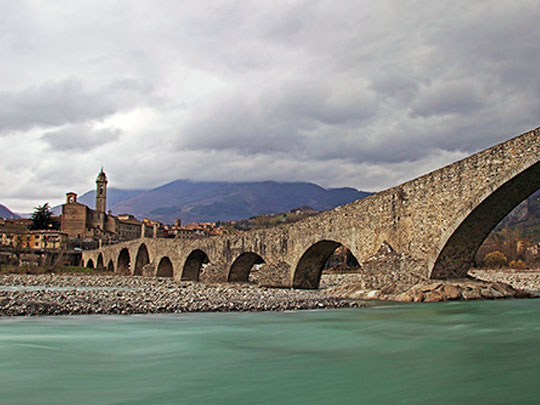

Bobbio sits in the Trebbia valley in Emilia-Romagna, where the Irish monk Columbanus, born in Leinster and trained at Bangor, founded an abbey in 614 that became one of Europe’s great centres of learning, and in summer 1944 partisans briefly made the town the free Republic of Bobbio.
Bobbio’s abbey keeps Columbanus’s tomb in its crypt, its library once held over 600 books, among them the Antiphonary of Bangor that ended up in Milan, and the humpbacked Ponte Gobbo spans the river below the town.
In 1950 Robert Schuman, one of the founding fathers of the European Union, called Columbanus, who lies in Bobbio, the patron saint of everyone trying to build a united Europe.
30 – Lucca
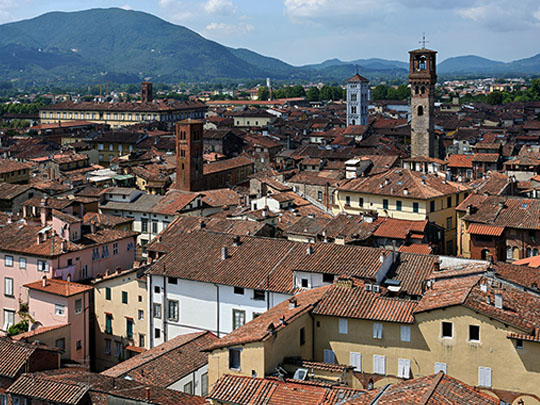
Lucca, in northern Tuscany, was an independent republic until the French arrived in 1799, after which Napoleon gave it to his sister Elisa, and a patrol from the US 92nd Buffalo Soldiers Division entered on 5 September 1944.
Lucca’s 4.2 kilometres of Renaissance walls, never besieged and turned into a tree-lined promenade in the 1820s, circle Piazza dell’Anfiteatro, built on the outline of a Roman amphitheatre, the oak-topped Guinigi Tower, the cathedral’s Volto Santo crucifix and Puccini’s birthplace.
Lucca’s Basilica of San Frediano holds the tomb of Frediano, by tradition an Irish prince who became the city’s bishop and died in 588, and legend says he turned the flooding Serchio river with a rake.