

Wikimedia Commons / CC-BY-SA-3.0 / GFDL
Capital: Carson City
Population: 3.2 million+
Language: English (no official language).

1 – Valley of Fire (also above)

Valley of Fire lies about 80 km northeast of Las Vegas and opened in 1934 as Nevada’s first state park, with stone cabins built by the Civilian Conservation Corps, among red Aztec sandstone formed from desert dunes around 150 million years ago.
Valley of Fire’s sights include Atlatl Rock, covered in petroglyphs more than 2,000 years old, and Mouse’s Tank, a natural rock basin named after “Little Mouse”, a Southern Paiute man said to have hidden there in the 1890s after being accused of killing two prospectors.
Valley of Fire has doubled as another planet more than once, providing nearly all the outdoor Mars scenes in Total Recall (1990) and the spot where Captain Kirk died in Star Trek Generations (1994).
2 – Stella Lake, Great Basin National Park

Stella Lake sits high in Great Basin National Park in east-central Nevada, a park created in 1986 and named for the vast basin whose rivers never reach the sea, and the lake lies on the 4.3 km Alpine Lakes Loop, which starts at about 3,000 m below Wheeler Peak.
Stella Lake reflects Wheeler Peak, at 3,982 m Nevada’s second-highest peak but its tallest independent mountain, while the park also holds the Lehman Caves, a glacier the park calls Nevada’s only one, and skies dark enough to earn International Dark Sky Park status in 2016.
The groves of ancient bristlecone pines above Stella Lake were home to Prometheus, a tree about 4,900 years old, the oldest known tree of its time, which was cut down in 1964 during research by the geographer Donald Currey.
3 – Red Rock Canyon

Red Rock Canyon lies about 24 km west of the Las Vegas Strip, and it was protected as a recreation area in 1967 before becoming a National Conservation Area in 1990.
Red Rock Canyon is best seen from a 21 km one-way scenic loop past the striped Calico Hills, with petroglyphs and agave roasting pits left by early Native peoples along the trails, and its sandstone walls draw rock climbers from around the world.
Red Rock Canyon’s colours come from the Keystone Thrust, a fault that about 65 million years ago shoved grey limestone more than 500 million years old over far younger red and tan sandstone.
4 – Bellagio Fountains, Las Vegas

The Bellagio Fountains front Steve Wynn’s Bellagio, named after a village on Lake Como, which opened on 15 October 1998 on the site of the old Dunes, whose north tower was blown up in 1993 in a show complete with cannon fire from a neighbouring casino’s pirate ship, watched by about 200,000 people.
The Bellagio Fountains fill a lake of more than 3 ha with more than 1,200 nozzles, known as “oarsmen” and “shooters”, that fire water as high as a 40-storey building in shows choreographed to music, designed by the fountain firm WET.
The Bellagio Fountains star near the end of Ocean’s Eleven (2001), when the crew gathers to watch them dance to Debussy’s “Clair de Lune”, and the lake was filled partly with well water that once kept the Dunes golf course green.
5 – Hoover Dam

Hoover Dam blocks the Colorado River in Black Canyon on the Nevada–Arizona border, about 48 km southeast of Las Vegas, rising 221 m, and it was finished in 1936, two years ahead of schedule, after President Franklin Roosevelt had dedicated it in 1935 as Boulder Dam.
Hoover Dam is decorated with Oskar Hansen’s 9 m bronze Winged Figures of the Republic and a terrazzo star map recording the sky on dedication day, while the Mike O’Callaghan–Pat Tillman Memorial Bridge, opened in 2010 about 270 m above the Colorado River, looks straight down on it.
Hoover Dam’s name flipped from Hoover to Boulder in 1933 and back to Hoover by law in 1947, and while 96 workers died in official “industrial fatalities”, nobody is buried in the concrete, and the last recorded death, Patrick Tierney’s in 1935, fell on 20 December, the same date his father, a surveyor, had died on the project years earlier.
6 – Reno

Reno grew up on the Truckee River in northwest Nevada after the Central Pacific Railroad arrived in 1868, named for Union general Jesse Lee Reno, killed in 1862, and in 1931 Nevada cut its divorce residency to six weeks and legalised gambling, turning Reno into the “Divorce Capital of the World”.
Reno’s landmarks include the Reno Arch, whose slogan “The Biggest Little City in the World” won a 1929 naming contest, and the University of Nevada, where a 1908 statue by Mount Rushmore sculptor Gutzon Borglum honours John Mackay, the Dublin-born Comstock silver king.
Arthur Miller sat out his six-week Reno divorce residency in 1956 near Pyramid Lake and met the mustangers who inspired The Misfits (1961), the last finished film for both Marilyn Monroe and Clark Gable, while Johnny Cash wrote “Folsom Prison Blues”, with its line about shooting a man in Reno, after seeing a prison film in the US Air Force.
7 – Las Vegas Strip

The Las Vegas Strip runs about 6.8 km along Las Vegas Boulevard South, mostly outside the city limits in unincorporated Paradise, and it took off after Nevada legalised gambling in 1931, with El Rancho Vegas opening in 1941 as its first resort, built just outside town for cheaper land and lower taxes.
The Las Vegas Strip is a parade of mega-resorts, from the Luxor’s pyramid to the Venetian’s canals, guarded at its southern end by the “Welcome to Fabulous Las Vegas” sign, designed by Betty Willis in 1959, who never copyrighted it and called it her gift to the city.
Bugsy Siegel didn’t start the Flamingo, as legend has it, since Hollywood Reporter founder Billy Wilkerson began it before Siegel took over and opened it in 1946, and despite another legend, the Luxor’s beam isn’t visible from space.
8 – Virginia City, Comstock Lode
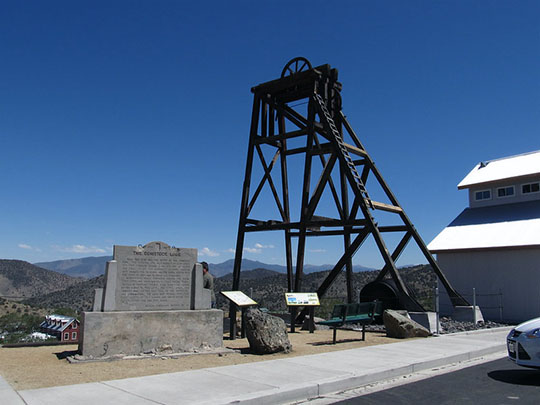
Virginia City grew up on the Comstock Lode in the hills southeast of Reno after Irish prospectors Peter O’Riley and Patrick McLaughlin struck ore in 1859, though the lode is named after Henry Comstock, who claimed they were on his land to talk his way into a share, while its mines went on to yield hundreds of millions of dollars in silver and gold.
Virginia City’s wooden boardwalks lead to Piper’s Opera House, St Mary’s in the Mountains, built for the town’s largely Irish congregation and rebuilt after the Great Fire of 1875, and the offices of the Territorial Enterprise, the paper where Samuel Clemens likely first signed himself “Mark Twain” in 1863.
Virginia City’s richest strike, the 1873 “Big Bonanza”, made fortunes for Dublin-born John Mackay and Tyrone-born James Fair, and Mackay later co-founded the Commercial Cable Company, whose transatlantic cable came ashore at Waterville, County Kerry, and whose cable ship, the Mackay-Bennett, recovered 306 bodies from the Titanic in 1912.
9 – Lake Tahoe
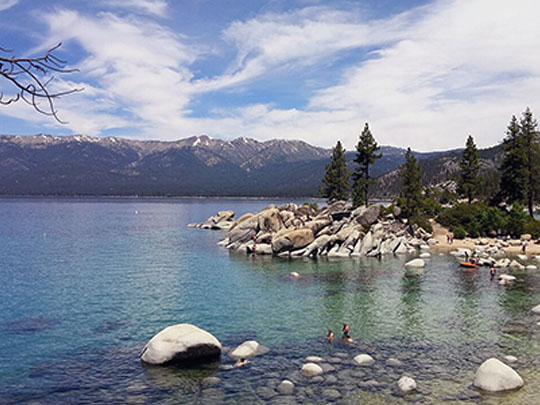
Lake Tahoe straddles the California–Nevada line high in the Sierra Nevada at 1,897 m, plunges to 501 m, making it the second-deepest lake in the US after Crater Lake, and takes its name from the Washoe word for lake, the Washoe having lived around it for thousands of years.
Lake Tahoe’s Nevada shore holds Thunderbird Lodge, millionaire George Whittell Jr’s 1930s stone estate with tunnels to its boathouse, the casinos of Stateline, and the Cal Neva Lodge, which straddles the state line and which Frank Sinatra bought in 1960, only to give up his Nevada gaming licences in 1963 after mobster Sam Giancana stayed there.
Mark Twain called Lake Tahoe “the fairest picture the whole earth affords” in Roughing It, accidentally set a forest fire there in 1861 when his campfire got away from him, and couldn’t stand the name “Tahoe”, which he said sounded “as weak as soup for a sick infant”.
10 – Carson City
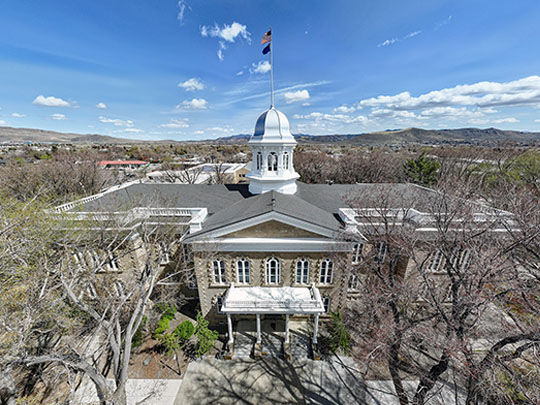
Carson City was laid out in 1858 by Abraham Curry, who set aside a plaza for a capitol that didn’t yet exist, and it became territorial capital in 1861 and state capital in 1864, named after the Carson River, which John C. Frémont’s expedition named for its guide, Kit Carson.
Carson City’s sights include the 1871 State Capitol, built of sandstone quarried at the state prison and topped by a silver-coloured dome, the Carson City Mint, which struck “CC” coins from 1870 to 1893 and houses the Nevada State Museum with its Coin Press No. 1, plus the Nevada State Railroad Museum.
Carson City hosted the Corbett–Fitzsimmons heavyweight title fight on St Patrick’s Day 1897, after Nevada legalised prizefighting to stage it, won by Cornish-born Bob Fitzsimmons with a “solar plexus” punch over James J. Corbett, whose father came from County Mayo, and the film of the fight is often cited as the first feature-length film.
11 – Area 51
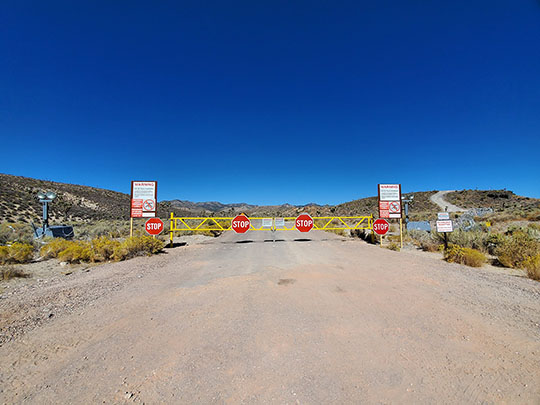
Area 51 sits on the Groom Lake salt flat about 130 km north-northwest of Las Vegas, picked in 1955 by the CIA’s Richard Bissell and Lockheed’s Kelly Johnson as a secret base for testing the U-2 spy plane, with Johnson nicknaming it “Paradise Ranch” to tempt workers out there.
Area 51 is off limits, but visitors can drive the Extraterrestrial Highway, State Route 375, named in 1996 alongside a promotional event for Independence Day, stop at the alien-themed Little A’Le’Inn in tiny Rachel, and see the “Black Mailbox”, which rancher Steve Medlin replaced with a white, bulletproof one after the original was shot up.
Area 51’s secret was spy planes, not aliens, as a CIA history made public in 2013 confirmed the U-2 and A-12 tests, and a 1997 CIA study found over half the UFO reports of the late 1950s and 1960s were these planes, while the 2019 “Storm Area 51” joke drew more than two million online RSVPs but only a few dozen people to the gate.
12 – Lake Mead
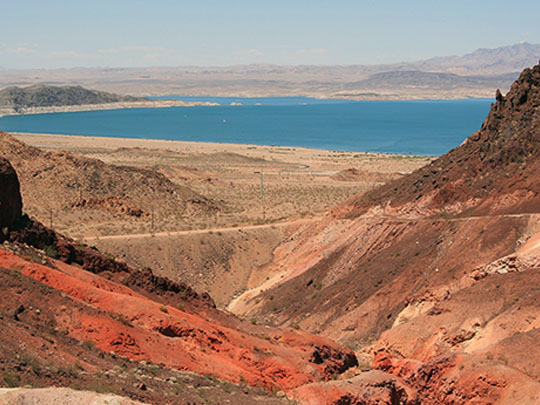
Lake Mead is the reservoir behind Hoover Dam on the Colorado River, along the Nevada–Arizona border, which began filling in 1935, became the largest reservoir in the US by volume when full, and was named in 1936 for Elwood Mead, the Bureau of Reclamation’s commissioner, who died in office that year.
Lake Mead’s shores make up Lake Mead National Recreation Area, which the National Park Service began running in 1936 as America’s first national recreation area, and in dry years the falling water uncovers the ruins of St Thomas, a Mormon settlement founded in 1865 by settlers who thought they were in Utah or Arizona until a survey put them in Nevada.
St Thomas’s last resident, Hugh Lord, left in 1938 by rowing away as Lake Mead’s rising water reached his front door, and on the lake bed lies a B-29 bomber that crashed on a low pass in 1948 while testing a “Sun Tracker” sensor for missile guidance, with all five crew surviving and the wreck not found until 2001.