
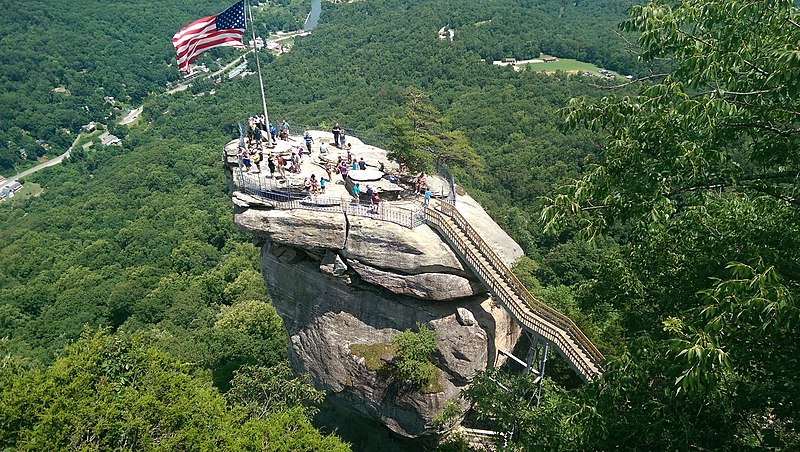
Wikimedia Commons / CC-BY-SA-3.0 / GFDL
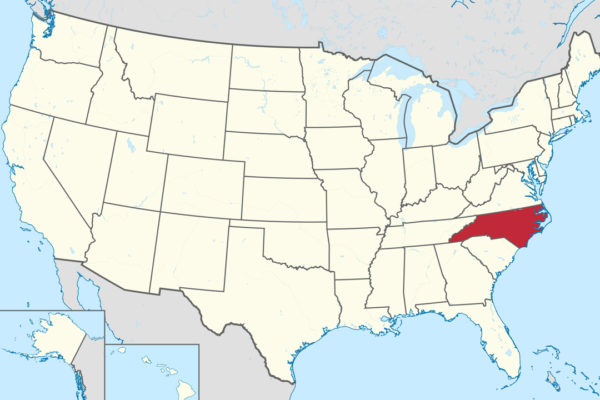
Capital: Raleigh
Population: 11.1 million+
Language: English
1 – Chimney Rock State Park (also above)
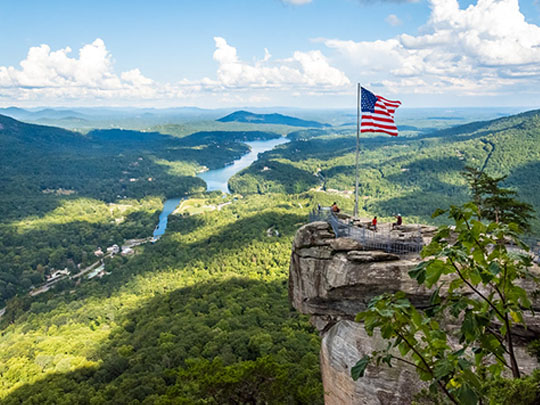
Chimney Rock State Park lies in Hickory Nut Gorge in the mountains of western North Carolina, around a 315-foot rock spire roughly half a billion years old, bought in 1902 by Missouri doctor Lucius Morse, whose family ran it as a private attraction until the state took it over in 2007.
Chimney Rock State Park’s sights include the summit of the Chimney itself, reached by stairs or by a 258-foot elevator shaft blasted inside the rock in 1949 and Hickory Nut Falls, which tumbles down the side of the gorge.
Chimney Rock State Park’s Hickory Nut Falls was the backdrop for the closing scenes of The Last of the Mohicans (1992), starring Daniel Day-Lewis, an Irish citizen since 1993 who lives in County Wicklow, while the Morse family dammed the river below to create Lake Lure, where Dirty Dancing was filmed.
2 – Old Salem
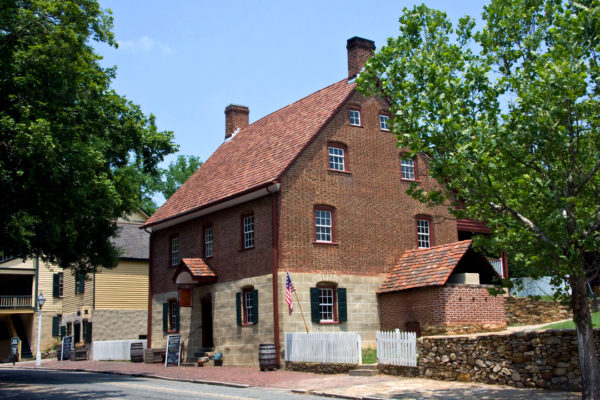
Old Salem is the restored heart of Salem, founded in 1766 by Moravians, German-speaking Protestants, on the Wachovia tract their church had bought in 1753, and in 1913 Salem merged with neighbouring Winston to become Winston-Salem.
Old Salem’s sights include the Single Brothers’ House of 1768–69, where young men lived and learned trades until they married, the Winkler Bakery with its wood-fired oven, and St Philips Moravian Church, regarded as the oldest standing African-American church building in North Carolina, where emancipation was read to the congregation in May 1865.
Old Salem’s graveyard, God’s Acre, buries the dead not in family plots but by sex, age and marital status in order of death, under identical flat stones, and the many-pointed Moravian star, a Christmas favourite, began not in Salem but at a Moravian boys’ school in Germany in the 1830s.
3 – Fort Macon
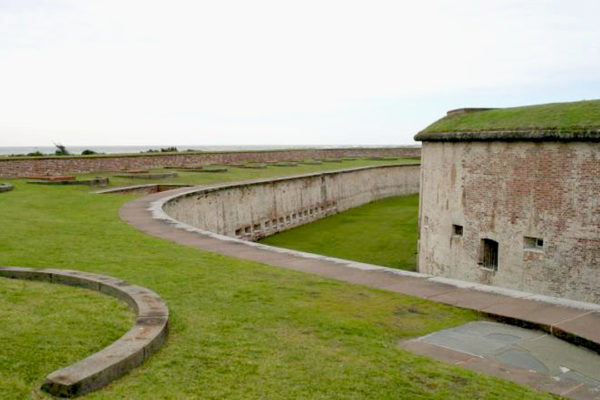
Fort Macon guards Beaufort Inlet from the eastern tip of Bogue Banks on the North Carolina coast, a brick fort built between 1826 and 1834 and named after Senator Nathaniel Macon, which local militia seized for the Confederacy without a shot in April 1861 before Union rifled cannon pounded its walls for 11 hours on 25 April 1862 and forced its surrender.
Fort Macon State Park centres on the restored fort, repaired by the Civilian Conservation Corps in 1934–35 and opened in 1936 as North Carolina’s first working state park, and the fort was garrisoned again by coast artillery troops during the Second World War.
Fort Macon was sold by Congress to North Carolina for just $1 in 1924, and two decades before the Civil War its protective jetties were designed by a young army engineer, Robert E. Lee, later the Confederacy’s most famous general.
4 – Asheville & Biltmore

Asheville sits in the Blue Ridge Mountains of western North Carolina and is home to Biltmore, built in 1889–95 for George Washington Vanderbilt II, designed by Richard Morris Hunt in the style of a French Renaissance château, with grounds by Frederick Law Olmsted, and opened to the public in 1930 at the city’s request to draw Depression-era tourists.
Asheville’s Biltmore House has 250 rooms and about four acres of floor space, widely considered the largest private home in the US, while in town Thomas Wolfe’s mother’s boarding house became “Dixieland” in his 1929 novel Look Homeward, Angel, which the local library banned for years, and the Grove Park Inn opened in 1913.
Asheville’s Biltmore hid paintings by Botticelli, Rembrandt and Raphael from the National Gallery of Art during the Second World War while tourists walked past unaware, and F. Scott Fitzgerald, grandson of an Irish emigrant, lived around Asheville in 1936–37 while his wife Zelda was at Highland Hospital, where she died in a fire in 1948.
5 – Bellamy Mansion – Wilmington
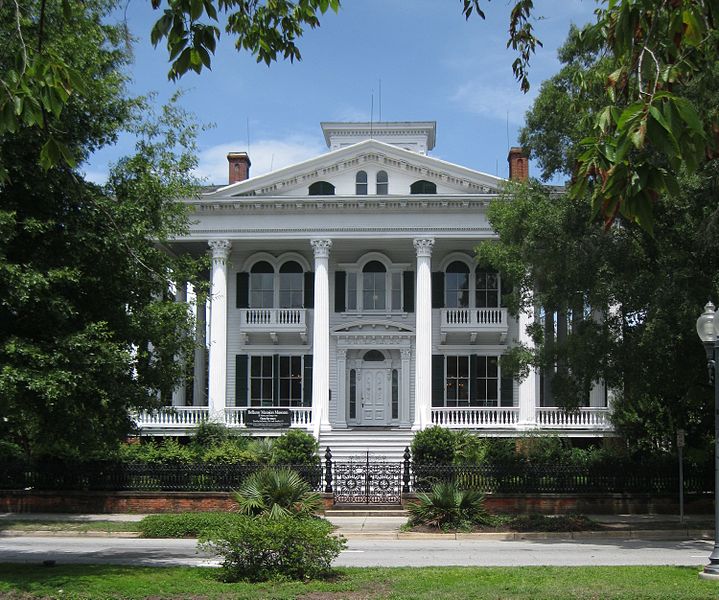
The Bellamy Mansion stands on Market Street in Wilmington, near the Cape Fear River, built in 1859–61 for physician and planter John Dillard Bellamy, a 22-room Greek Revival house with Italianate touches, and Union troops made it their headquarters after Wilmington fell in 1865.
The Bellamy Mansion’s sights include its grand, columned main house, restored after an arson attack in 1972, and its brick slave quarters, among the best-preserved urban slave housing in the US.
The Bellamy Mansion was built largely by enslaved and free Black craftsmen, among them plasterer William B. Gould, who left his initials in the plaster and in 1862 escaped down the Cape Fear River to join the Union Navy, keeping a diary described as the only known Civil War diary by a formerly enslaved sailor.
6 – Charlotte
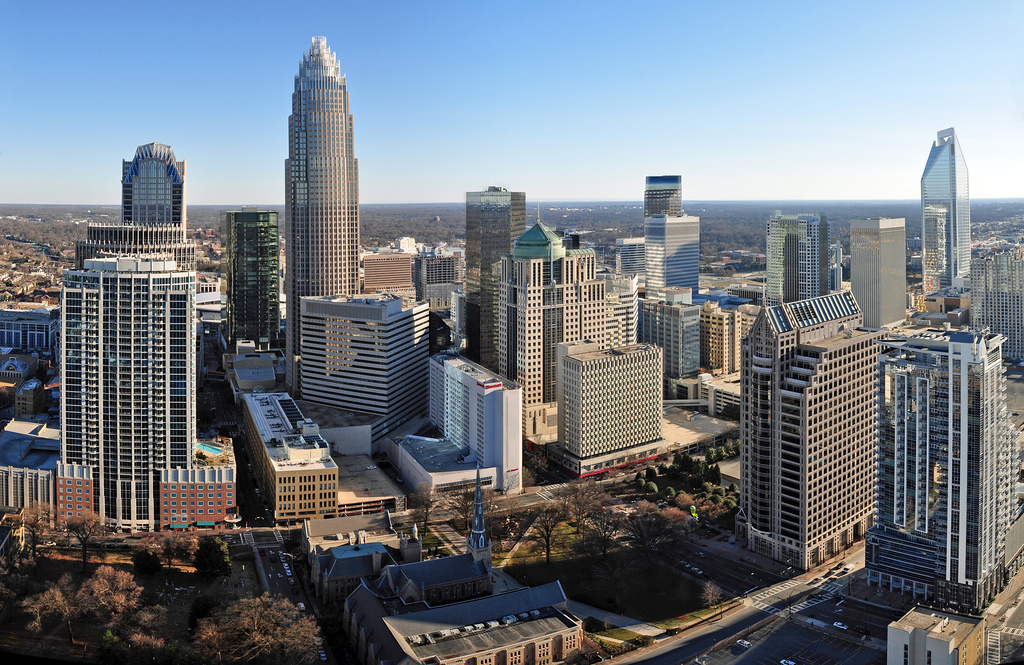
Charlotte, founded in 1768, is named after Queen Charlotte, the German-born wife of George III, hence the nickname “the Queen City”, while its county, Mecklenburg, is named after her home duchy and was settled from the mid-1700s by Scots-Irish Presbyterians from Ulster.
Charlotte’s Fourth Ward became the city’s first historic district in 1976, a Victorian neighbourhood rescued after banks offered cheap loans to “urban pioneers”, and the city’s 1837 branch of the US Mint, which struck only gold coins, was rebuilt in 1936 as the Mint Museum.
Charlotte’s “Mecklenburg Declaration of Independence” of 20 May 1775, a date still on the state flag, is rejected by most historians, since no original survives and the text was first printed in 1819, while two presidents of Ulster stock were born nearby: Andrew Jackson, son of County Antrim emigrants, in the Waxhaws on the border in 1767, and James K. Polk in Pineville in 1795.
7 – Wright Brothers National Memorial
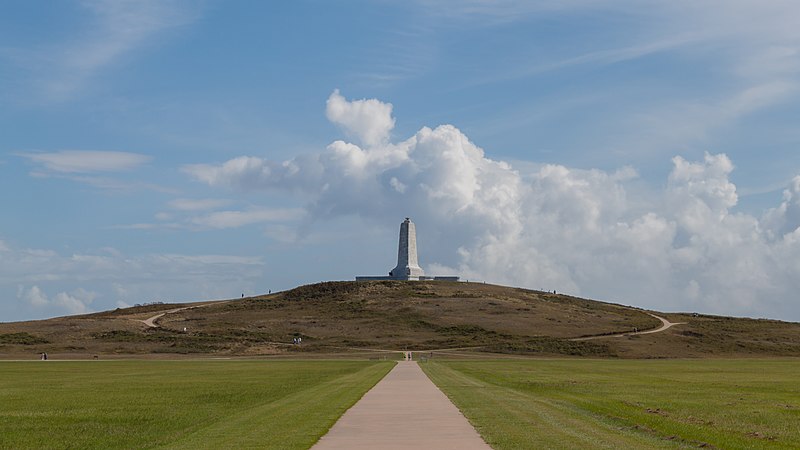
The Wright Brothers National Memorial stands at Kill Devil Hills on North Carolina’s Outer Banks, where on 17 December 1903 Orville Wright made the first powered airplane flight, about 120 feet, one of four flights that day, the longest Wilbur’s 852 feet, after the brothers chose the spot for its steady winds, soft sand and privacy.
The Wright Brothers National Memorial’s sights include the 60-foot granite monument on Big Kill Devil Hill, dedicated in 1932 with Orville present, and a boulder marking the takeoff spot, fixed by surviving witnesses in 1928.
The Wright Brothers’ first flight is usually credited to Kitty Hawk, though Kill Devil Hills is about four miles south, and the famous photo was taken by lifesaving-station surfman John T. Daniels, who had never used a camera, while the original Flyer spent 20 years in London’s Science Museum during Orville’s feud with the Smithsonian, and a scrap of its fabric went to the Moon on Apollo 11.
8 – Roanoke Island
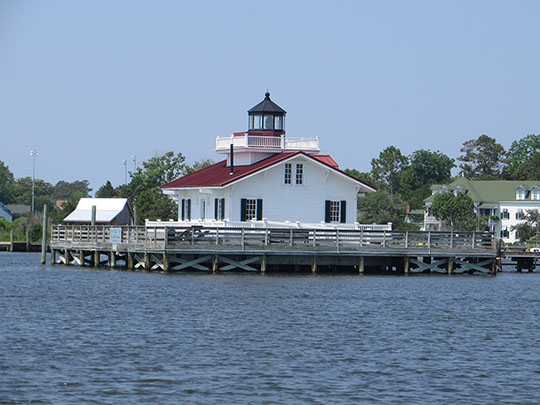
Roanoke Island, tucked between the Outer Banks and the mainland, is where Sir Walter Raleigh’s colonists landed in 1585 and again in 1587, when John White brought about 115 settlers and his granddaughter Virginia Dare became the first child born to English parents in the Americas.
Roanoke Island’s sights include Fort Raleigh National Historic Site, which also remembers the Roanoke Island Freedmen’s Colony, founded in 1862 for formerly enslaved people, and the outdoor drama The Lost Colony, staged since 1937, in which a young Andy Griffith played Sir Walter Raleigh.
Roanoke Island’s colony didn’t vanish without a trace, since White, returning in 1590, found “CROATOAN” carved on a post, pointing to the nearby island of that name, and he later lived on Raleigh’s estates in Munster, writing his last known letter from Ireland in 1593, while Raleigh, who gave his scientist Thomas Harriot Molana Abbey near Youghal, never set foot in North Carolina.
9 – Cape Hatteras Lighthouse
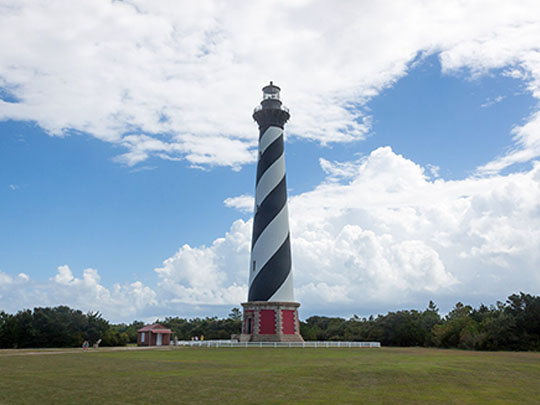
Cape Hatteras Lighthouse stands at Buxton on Hatteras Island, first lit in 1870 to warn ships off Diamond Shoals, where the Gulf Stream meets colder northern currents in the “Graveyard of the Atlantic”, and it’s part of Cape Hatteras National Seashore, established in 1953 as the first national seashore.
Cape Hatteras Lighthouse, about 198 feet tall and billed as the tallest brick lighthouse in the US, wears its famous black-and-white spiral stripes, with 257 steps for visitors to the top.
Cape Hatteras Lighthouse was moved 2,900 feet inland over 23 days in 1999 as the sea crept closer, leaving it about 1,500 feet from the shore, the same distance as when it was built, and in 1923 Billy Mitchell’s army bombers sank two old battleships off the cape to prove the power of air attack.
10 – Great Smoky Mountains
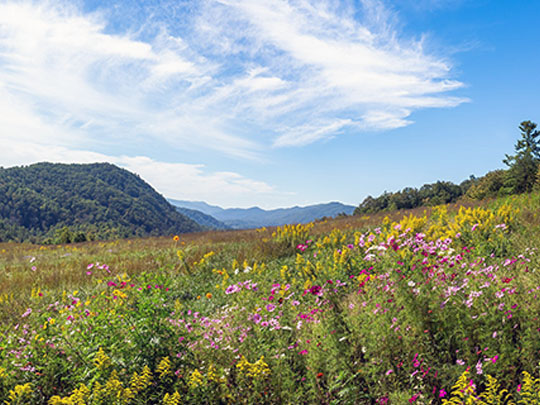
Great Smoky Mountains National Park straddles the North Carolina–Tennessee border, created by buying out about 1,200 landowners and 18 logging companies, with $5 million from a Rockefeller fund matching money raised by the two states and schoolchildren’s pennies, and dedicated by Franklin D. Roosevelt in 1940.
Great Smoky Mountains National Park’s North Carolina side has the Mountain Farm Museum of log buildings at Oconaluftee, the 1886 Mingus Mill, elk brought back in 2001–02 after more than 150 years, and Kuwohi, called Clingmans Dome until 2024, at 6,643 feet the highest point on the Appalachian Trail.
Great Smoky Mountains National Park’s famous haze isn’t smoke but compounds given off by the forest, and the park charges no entrance fee not because of the original land deeds, as often claimed, but because a 1951 Tennessee deed banned tolls on its main roads, while the story of the Cherokee Tsali giving his life so his people could stay is largely legend.
11 – Greensboro
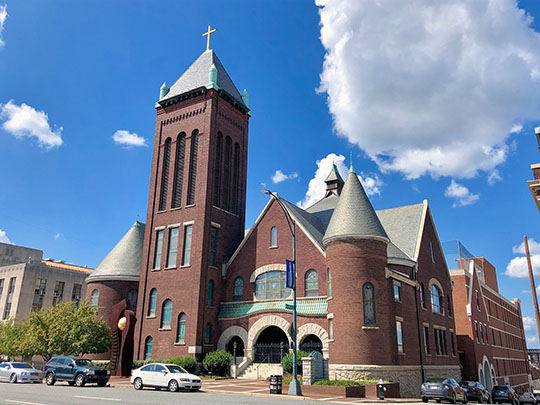
Greensboro, named after Revolutionary War general Nathanael Greene, is where on 15 March 1781 Cornwallis won the Battle of Guilford Courthouse but lost about a quarter of his army, prompting Charles James Fox to tell Parliament “another such victory would ruin the British army”.
Greensboro’s sights include Guilford Courthouse National Military Park, created in 1917 as the first Revolutionary War battlefield protected by the federal government, and the International Civil Rights Center & Museum, in the old Woolworth’s where four Black students from North Carolina A&T sat down at the whites-only lunch counter on 1 February 1960.
Greensboro’s Woolworth’s first served Black diners on 25 July 1960, when three of its own Black kitchen workers changed out of uniform to eat, and a section of the counter is in the Smithsonian, while Greensboro was also the birthplace of writer O. Henry and of Vicks VapoRub, created by pharmacist Lunsford Richardson in the drugstore where O. Henry had trained.
12 – Ocracoke
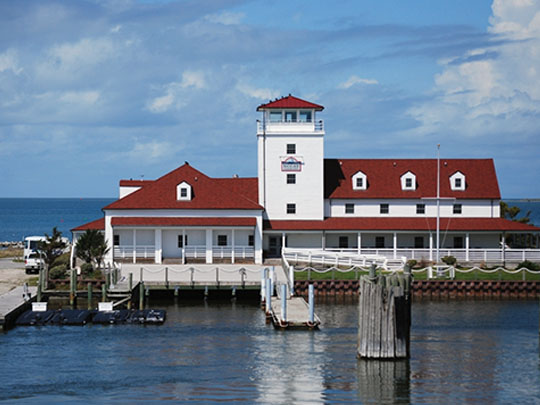
Ocracoke is an island at the southern end of the Outer Banks, reached by ferry, boat or small plane, where the pirate Blackbeard was killed fighting Royal Navy lieutenant Robert Maynard on 22 November 1718, his head then hung from Maynard’s bowsprit.
Ocracoke’s sights include the 1823 Ocracoke Lighthouse, the oldest working light station in North Carolina, the Banker ponies, whose breed has been linked to Colonial Spanish horses, and the British Cemetery, where four sailors from the Royal Navy trawler HMT Bedfordshire, sunk by a German U-boat in May 1942, are buried.
Ocracoke’s islanders speak a distinctive “hoi toide” brogue, often romanticised as surviving Elizabethan English, which linguists call a myth, and Blackbeard’s real name is uncertain, recorded variously as Teach, Thatch or Thack.