
Nils Huenerfuerst / CC-BY-SA-3.0 / GFDL
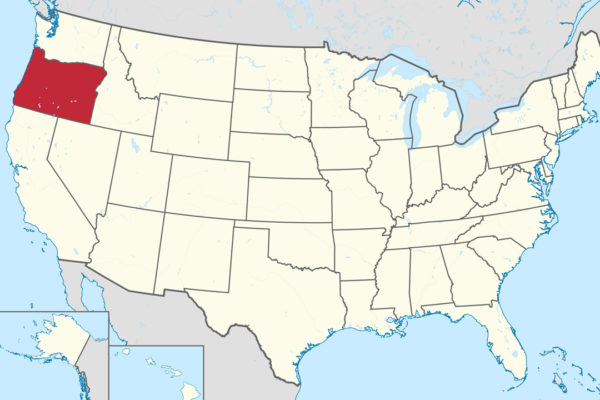
Capital: Salem
Population: 4.25 million+
Language: English (no official language).
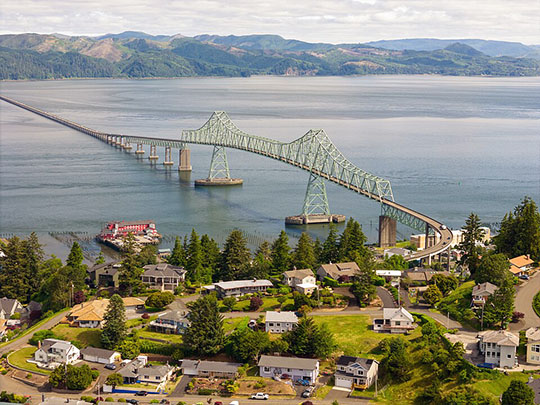
1 – Astoria (above)
Astoria, near the mouth of the Columbia River, began as Fort Astoria, built in 1811 for John Jacob Astor’s Pacific Fur Company and often called the first permanent American settlement west of the Rockies, which makes Astoria Oregon’s oldest city.
Climb the 164 steps of the Astoria Column for views over the Astoria–Megler Bridge, the longest continuous truss bridge in North America, then head to Fort Clatsop, where Lewis and Clark wintered in 1805–06, and the old county jail where The Goonies opens, which houses the Oregon Film Museum.
Astoria’s first chronicler had an Irish accent: Dublin-born clerk Ross Cox reached the fort in 1812, and his memoir Adventures on the Columbia River was one of Washington Irving’s sources for Astoria, before Cox went home to work as a clerk in Dublin’s police office.
2 – Crater Lake National Park
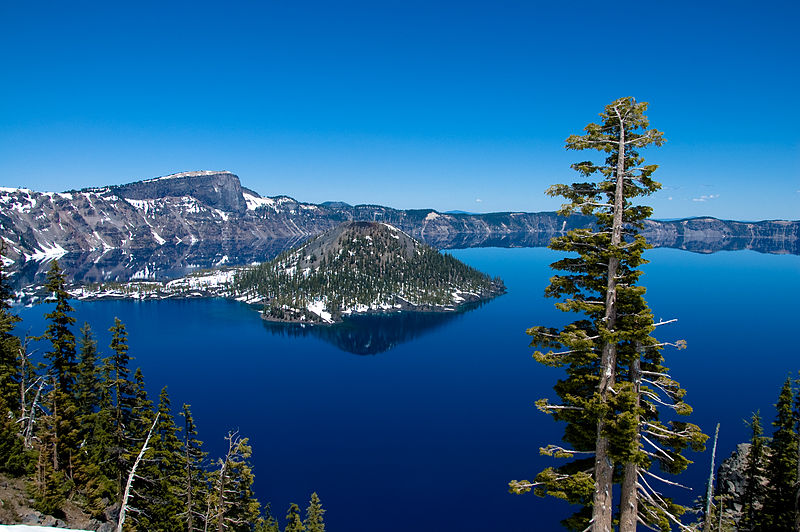
Crater Lake sits on the crest of the Cascades in southern Oregon, filling the caldera left when Mount Mazama collapsed after an eruption about 7,700 years ago, and it became the fifth-oldest national park still in existence in 1902.
Rim Drive loops the caldera past Wizard Island, a cinder cone rising 767 ft out of the water, while Klamath oral tradition, from people who lived here when Mazama blew, tells of Llao of the Below World battling Skell of the Above World.
At 1,943 ft, Crater Lake is the deepest lake in the US and has no rivers flowing in or out, and on it bobs the Old Man of the Lake, a hemlock log over 450 years old that has floated upright since at least 1896.
3 – Portland
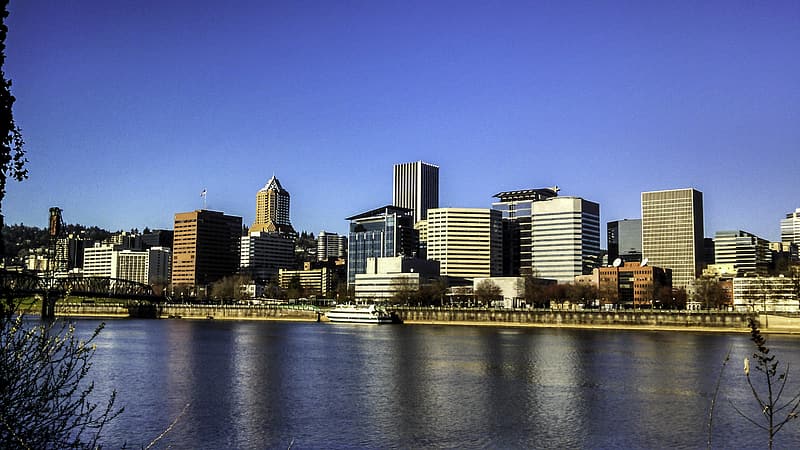
Portland grew up where the Willamette meets the Columbia and got its name from a coin toss in 1845, when Maine man Francis Pettygrove beat Asa Lovejoy, who wanted “Boston”, two tosses out of three, and the actual penny is on display at the Oregon Historical Society.
Portland’s quirks include the Benson Bubbler drinking fountains and Mill Ends Park, a 2-ft circle in a road median that columnist Dick Fagan claimed was home to the only leprechaun colony west of Ireland and which became a city park on St Patrick’s Day 1976.
Simpsons creator Matt Groening grew up in Portland and borrowed Flanders, Lovejoy, Quimby and Kearney from its street signs, but the city’s famous Shanghai tunnels are largely a tall tale, as historians have found virtually no evidence kidnapped sailors were ever moved through them.
4 – Sea Lion Caves
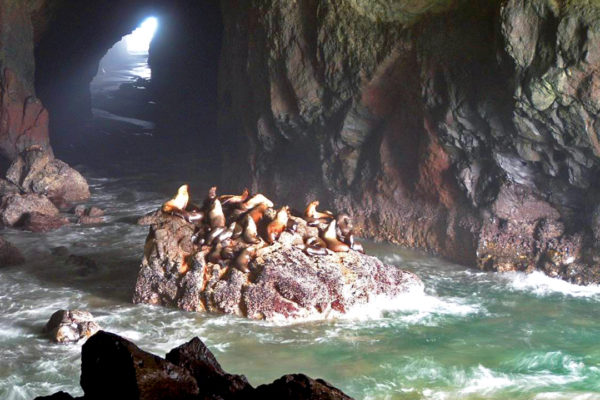
Sea Lion Caves, on the US 101 clifftops north of Florence on the central coast, was found by local seaman Captain William Cox in 1880, opened to visitors in 1932 and is billed as America’s largest sea cave.
A 1961 elevator drops 208 ft into the cavern, where Steller sea lions haul out on the rocks, and a viewpoint inside the cave frames Heceta Head Lighthouse on the headland to the north.
Sea Lion Caves is privately owned yet holds a genuine wildlife distinction: it is the only mainland rookery for Steller sea lions in the lower 48 states.
5 – Multnomah Falls
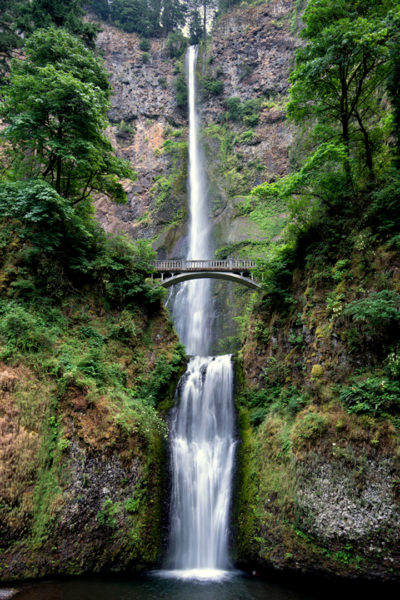
Multnomah Falls tumbles down the Oregon side of the Columbia River Gorge east of Portland, on land given to the city by Norwegian-born lumber baron Simon Benson, who also paid for the footbridge across the falls.
Multnomah Falls drops about 620 ft in two tiers, with the Benson Bridge of 1914 spanning the gap between them and the stone Multnomah Falls Lodge, designed by A. E. Doyle and finished in 1925, at its foot.
The famous claim that Multnomah Falls is the second-tallest year-round waterfall in the US doesn’t hold up: the World Waterfall Database calls it false and ranks the falls far down the national list, and the story of a chief’s daughter leaping to save her people is a legend recorded in the 20th century.
6 – Cape Perpetua
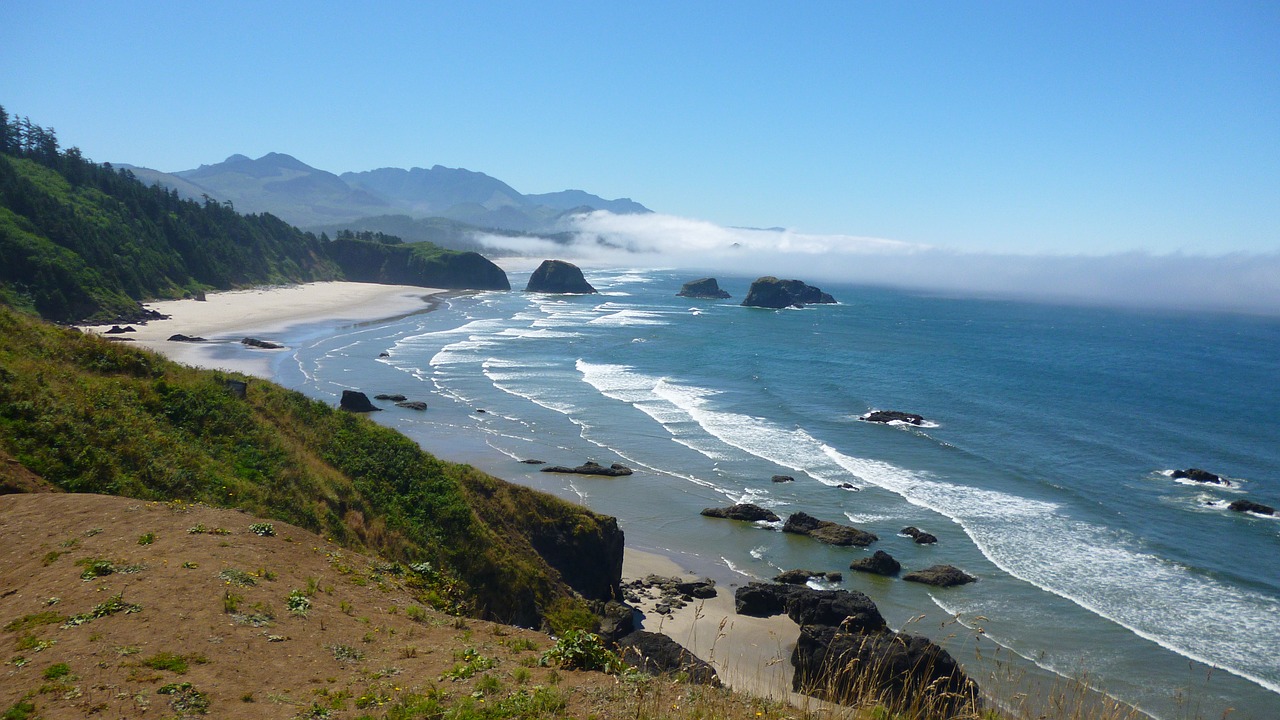
Cape Perpetua, a basalt headland just south of Yachats on the central coast, was named by Captain James Cook in March 1778 for the day he first sighted it, St Perpetua’s feast day.
Cape Perpetua’s shoreline has Thor’s Well, Devil’s Churn and Spouting Horn, where waves explode through cracks in the rock, and an 800-ft overlook topped by a stone shelter built by the Civilian Conservation Corps in 1933 and used as a coastal lookout in World War II.
Despite the photos, Thor’s Well isn’t a bottomless hole draining the Pacific: it’s probably a collapsed sea cave only about 20 ft deep, which fills and empties with every wave.
7 – Portland Japanese Garden
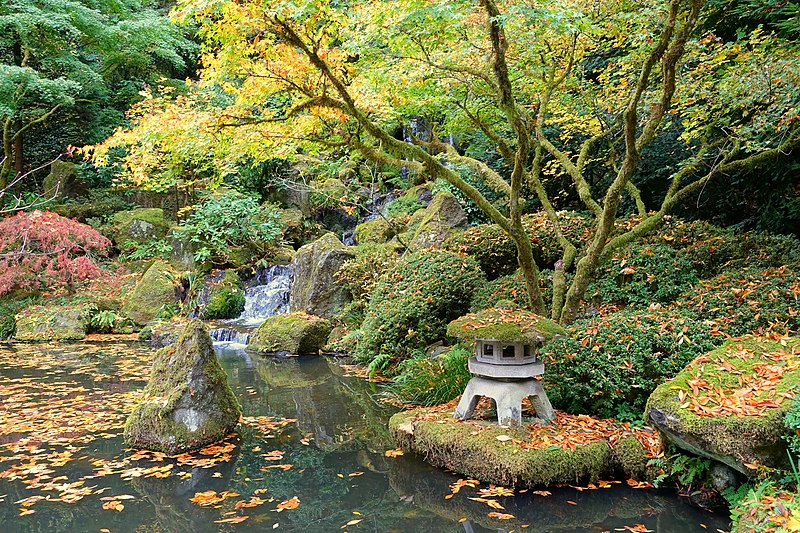
Portland Japanese Garden sits in the hills of Washington Park on the site of the old city zoo, designed by Professor Takuma Tono and opened to the public in 1967.
Portland Japanese Garden takes in five traditional styles, the Flat, Natural, Sand and Stone, Strolling Pond and Tea gardens, plus a Cultural Village by Japanese architect Kengo Kuma that opened in 2017.
Heavenly Falls fills what was once the zoo’s bear cave, and in 1988 Japan’s ambassador to the US, Nobuo Matsunaga, called Portland Japanese Garden “the most beautiful and authentic Japanese garden in the world outside Japan”.
8 – Cannon Beach
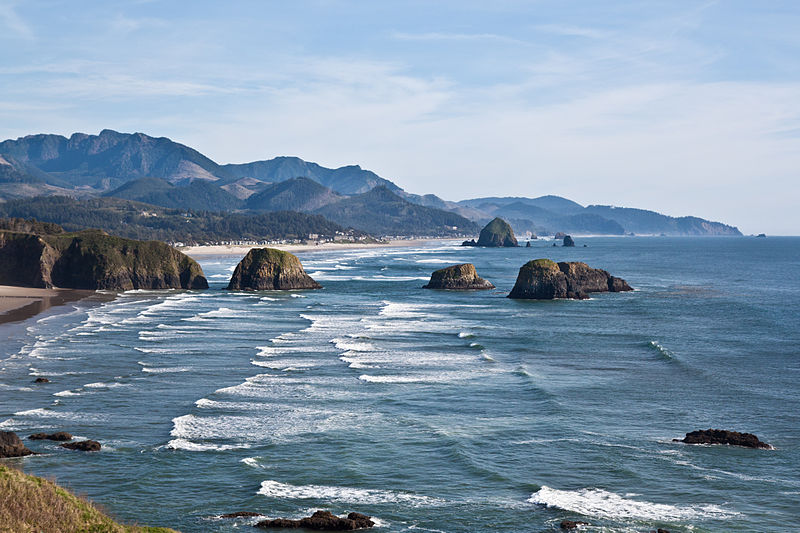
Cannon Beach on the north coast takes its name from the US Navy schooner Shark, wrecked on the Columbia River bar in 1846, whose cannon drifted south to Arch Cape, where one was spotted in 1898 and two more turned up in 2008.
Next door, Ecola State Park takes its name from the Chinook word for whale, as it was here that William Clark’s party bought whale blubber from the Tillamook people in January 1806, and offshore stands “Terrible Tilly”, the Tillamook Rock Lighthouse.
Cannon Beach plays other places on screen: Indian Beach in Ecola stood in for Australia’s Bells Beach in the finale of Point Break and for La Push, Washington, in Twilight.
9 – Lincoln City
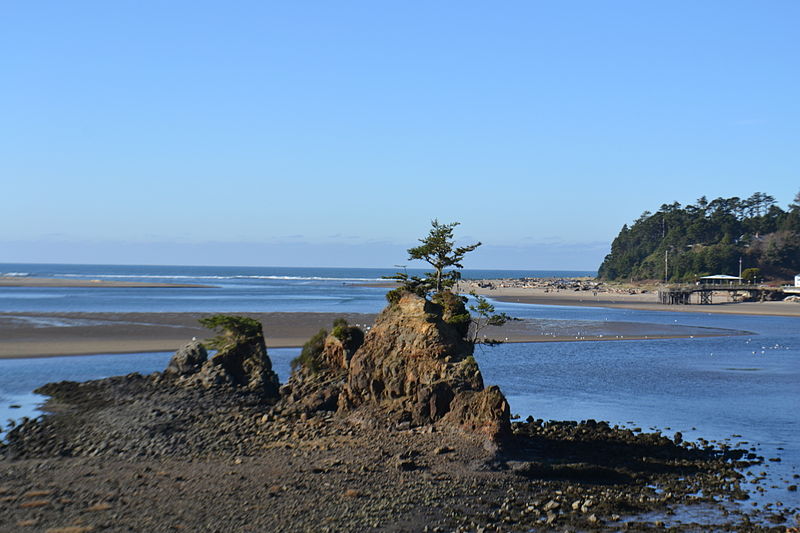
Lincoln City on the central coast was created in 1965 when five communities, Oceanlake, Delake, Taft, Nelscott and Cutler City, merged under a name chosen in a contest among local schoolchildren.
Lincoln City’s beaches host the Finders Keepers glass floats, hand-blown by Pacific Northwest artists and hidden for beachcombers since the millennium, while the D River Wayside hosts kite festivals and Devils Lake sits just inland.
The D River got its one-letter name in a 1940 contest to give the “world’s shortest river” the world’s shortest name, but Guinness gave the title to Montana’s Roe River in 1989 and dropped the category in 2006, so neither river holds the title.
10 – Haystack Rock

Haystack Rock is a 235-ft basalt sea stack on the beach at Cannon Beach, protected as part of the Oregon Islands National Wildlife Refuge and one of Oregon’s Marine Gardens.
At low tide, Haystack Rock’s tide pools fill with sea stars, anemones, crabs and nudibranchs, and tufted puffins nest on its upper slopes in spring and summer.
Haystack Rock is often called the third-tallest coastal monolith in the world, but that was mid-20th-century local promotion with no measurement behind it (Pacific City’s Haystack Rock is about 100 ft taller), though its screen fame is real, as The Goonies‘ Fratellis make their escape on the beach below.
11 – Oregon City
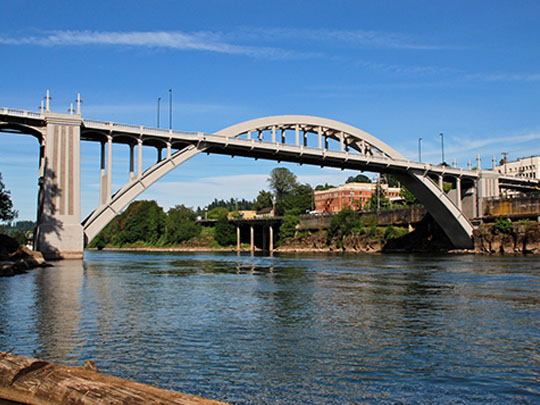
Oregon City, at Willamette Falls just south of Portland, was the end of the Oregon Trail, became the first US city west of the Rockies to be incorporated in 1844 and was capital of Oregon Territory from 1848 until a disputed move to Salem in 1851–52.
Ride the Municipal Elevator, billed as North America’s only “vertical street”, up the bluff to the McLoughlin House, home of Hudson’s Bay Company man John McLoughlin, the “Father of Oregon”, whose Irish Catholic family had roots in Desertegney on Donegal’s Inishowen peninsula, then visit the End of the Oregon Trail Interpretive Center.
Oregon City keeps a quirky gold-rush souvenir: the first official plat of San Francisco was filed at its federal land office in 1850, as it was the nearest one, and Oregon City has held on to it despite San Francisco’s efforts to get it back.
12 – Columbia River Gorge
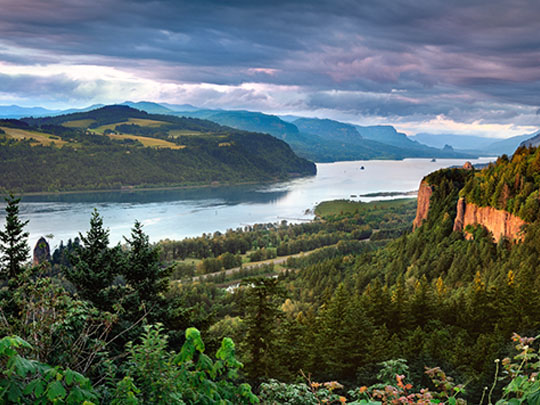
The Columbia River Gorge cuts about 80 miles through the Cascades along the Oregon–Washington border, up to 4,000 ft deep and often called the only near-sea-level route through the range, which made it the way west for Lewis and Clark in 1805.
Drive the Historic Columbia River Highway, built 1913–22 and billed as America’s first planned scenic highway, to Vista House at Crown Point, a domed 1918 rest stop mocked as “the $100,000 outhouse” for its marble restrooms, then cross the Bridge of the Gods, named for a Native legend rooted in a real landslide that dammed the river around 1450.
The Columbia River Gorge was scoured by dozens of Ice Age floods from glacial Lake Missoula, a theory that got geologist J Harlen Bretz ridiculed in the 1920s, until he was finally awarded geology’s Penrose Medal in 1979, aged 96, and joked that all his enemies were dead.
13 – Mount Hood and Timberline Lodge
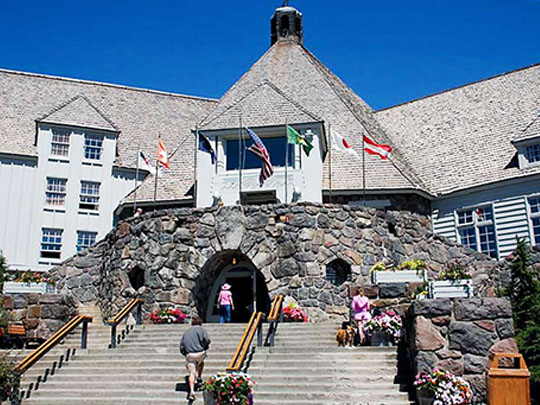
Mount Hood, Oregon’s highest peak at about 11,240 ft, is a volcano whose last major eruptions began around 1781, and it was named in 1792 by Lt William Broughton after Lord Hood, a British admiral who at the time held a barony in the Peerage of Ireland.
Timberline Lodge, built by Depression-era WPA crews on Mount Hood’s south slope and dedicated by Franklin D. Roosevelt in 1937, is a National Historic Landmark with lifts running into summer, while the Barlow Road of 1846 skirts the mountain, where Oregon Trail wagons were lowered down Laurel Hill on ropes.
Timberline Lodge played the Overlook Hotel’s exterior in The Shining, and at the lodge’s request the film changed the haunted Room 217 to a nonexistent 237 so guests wouldn’t shun the real one, while Wy’east, often given as Mount Hood’s Native name, has no evidence behind it in any Indigenous language.
14 – Fort Rock
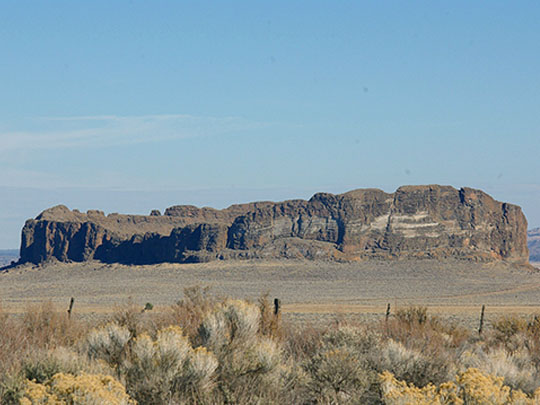
Fort Rock rises from the high desert of south-central Oregon, a ring of volcanic tuff formed when magma hit the wet bed of an ice-age lake, whose waves later breached its south wall and cut terraces into its sides.
Walk into the ring at Fort Rock State Natural Area, head to Fort Rock Cave, a National Historic Landmark about a mile away, and picture the homestead boom of 1905–15, when around 1,200 people took up claims here before drought, frost and jackrabbits drove them out.
In 1938 Luther Cressman dug up dozens of sagebrush-bark sandals at Fort Rock Cave sealed beneath ash from the Mount Mazama eruption that created Crater Lake, and radiocarbon dating later put them at over 9,000 years old, though the “world’s oldest shoes” tag oversimplifies, as the Guinness record is specifically for the oldest footwear dated directly.
15 – Jacksonville
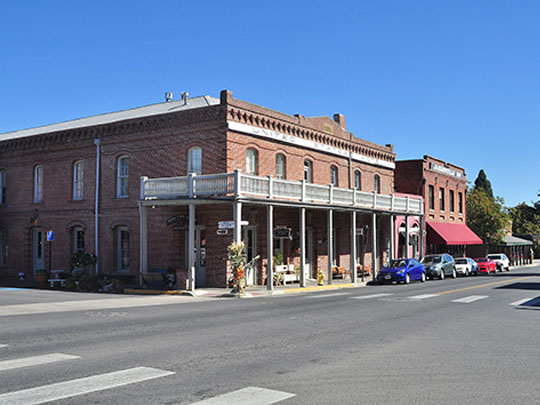
Jacksonville, in southern Oregon’s Rogue Valley, sprang up after gold was found at Rich Gulch in 1851–52 and was the Jackson County seat until 1927, long after the railroad bypassed it in 1884 for nearby Medford.
Jacksonville’s historic district of more than 100 buildings, including brick storefronts rebuilt after an 1873 fire and St Joseph’s Catholic Church of 1858, became a National Historic Landmark in the 1960s, and pioneer photographer Peter Britt’s hillside estate hosts the Britt Festival concerts.
Being bypassed by the railroad froze Jacksonville in the 19th century, and its own photographer has a famous first: Swiss-born Peter Britt took the earliest surviving photographs of Crater Lake in 1874.