

Wikimedia Commons / CC-BY-SA-3.0 / GFDL
Capital: Bucharest
Population: 19 million+
Language: Romanian

1 – Sighișoara (also above)

Sighișoara, on a hill above the Târnava Mare river in Transylvania, was founded by German-speaking Saxon settlers in the 12th century and listed by UNESCO in 1999 as a fortified medieval town, and in January 1945 Transylvania’s Saxons, more than 30,000 of them, were deported to the Soviet Union for forced labour.
Climb the medieval Clock Tower, home to the town museum, take the covered 17th-century Scholars’ Stairs up to the Church on the Hill, and walk past the guild towers named for the tinsmiths, butchers, tailors and ropemakers who defended them.
Vlad III, the Wallachian prince remembered as Dracula (“son of Dracul”), was probably born in Sighișoara around 1431, while his exiled father Vlad II Dracul lived and minted coins in the town, and a house in the citadel is traditionally pointed out as his birthplace.
2 – Bran Castle

Bran Castle was built by the Saxons of Brașov after King Louis I of Hungary gave them the right in 1377, guarding a customs post on the pass between Transylvania and Wallachia, and in 1920 the city gave it to Queen Marie of Romania.
Explore the rooms furnished by Queen Marie, whose heart was kept at Bran from 1940, and the courtyard and castle park, and in 1944 her daughter, Princess Ileana, set up a hospital in the village below, which she named the Hospital of the Queen’s Heart.
Bran is sold as Dracula’s Castle, but Dublin-born Bram Stoker, who wrote Dracula (1897) without ever visiting Romania, never mentioned it and placed his count’s castle near the Borgo Pass, and historians say Vlad III never lived at Bran.
3 – Bucharest


Bucharest, on the Dâmbovița river, first appears in a document issued by Vlad III in 1459, and in 1862 it became sole capital of the United Principalities of Moldavia and Wallachia, soon to be named Romania.
Take in the Palace of the Parliament, Ceaușescu’s House of the People, believed by Guinness to be the heaviest building in the world, the Romanian Athenaeum, the Arcul de Triumf, the Old Town around Lipscani and Curtea Veche, the Village Museum and Revolution Square, where Ceaușescu was booed from the balcony on 21 December 1989.
Under Ion Antonescu, Romania fought with the Axis, and the International Commission on the Holocaust in Romania found that 280,000–380,000 Jews were murdered or died in Romanian-controlled territories, until King Michael’s coup in Bucharest on 23 August 1944 switched the country to the Allied side.
4 – Sinaia

Sinaia, a mountain resort in the Prahova Valley beneath the Bucegi Mountains, takes its name from the monastery founded by Mihail Cantacuzino in 1695 after a pilgrimage to Mount Sinai, and King Carol I chose it for his summer palace.
Tour Peleș Castle, the neo-Renaissance palace begun for Carol I in 1873, Pelișor, the smaller palace of Queen Marie, and Sinaia Monastery, see the Eagles of Freedom memorial to the US airmen killed over Romania in WWII and ride the cable car up into the Bucegi.
Peleș is often described as the first castle in Europe fully powered by its own electricity plant, and King Michael, who switched Romania to the Allied side in 1944, was born on the estate at Sinaia in 1921.
5 – Timișoara

Timișoara, the main city of the Banat in western Romania, was taken from the Ottomans in 1716 by Prince Eugene of Savoy after 164 years of Ottoman rule, rebuilt as a Habsburg Baroque city, and on 20 December 1989 became the first city in Romania declared free of communism.
Wander Union Square with its Roman Catholic and Serbian Orthodox cathedrals and Baroque Palace art museum, then Victory Square, running from the National Theatre and Opera to the Orthodox Cathedral, and stroll along the Bega canal.
The Romanian Revolution began in Timișoara in December 1989, when parishioners formed a human chain to stop the eviction of Hungarian Reformed pastor László Tőkés, and back in 1884 it was one of the first cities in Europe to light its streets with electricity.
6 – Brașov

Brașov, beneath Mount Tâmpa in the Carpathians, was founded as Kronstadt by the Teutonic Knights, invited to the region in 1211 by King Andrew II of Hungary, grew into a rich Saxon trading town, was bombed by US aircraft in April 1944 and was renamed Orașul Stalin (Stalin City) from 1950 to 1960.
See the Black Church, traditionally said to have been blackened by the Great Fire of 1689 and often called Romania’s largest Gothic church, Council Square, Rope Street (Strada Sforii), one of the narrowest streets in Europe, the First Romanian School in the Schei district and the BRAȘOV letters on Tâmpa, reached by cable car.
On 15 November 1987 workers from the Red Flag (Steagul Roșu) truck plant in Brașov marched through the city chanting “Down with Ceaușescu!” in one of the first large revolts against his rule, and about 300 people were arrested.
7 – Sibiu

Sibiu, the Saxon Hermannstadt of southern Transylvania, was settled by Germans in the 12th century, became the chief town of the Transylvanian Saxons and capital of Habsburg Transylvania, and in 1940 it took in the Romanian University of Cluj after Northern Transylvania was ceded to Hungary.
Wander the Large and Small Squares, watched by the “eyes” in the roofs, which are really attic vents, cross the Bridge of Lies, the first cast-iron bridge in present-day Romania, and visit the Brukenthal Museum, opened in 1817 as the oldest museum in the country, and the ASTRA open-air museum.
Legend says the Bridge of Lies collapses if anyone tells a lie on it, Sibiu was European Capital of Culture in 2007, and rocketry pioneer Hermann Oberth, mentor to Wernher von Braun, was born in the city in 1894.
8 – Sihăstria Monastery

Sihăstria Monastery, in the forested hills of Neamț County in Moldavia, began as a 17th-century hermitage founded by monks from nearby Neamț Monastery, was burned in 1821 during fighting from the Greek War of Independence and became a full monastery in 1947.
See the stone Church of the Nativity of the Mother of God, the wooden cemetery church, the museum and the graves of Elders Cleopa and Paisie, then walk on through the forest to Sihla hermitage and the cave of St Teodora.
Elder Cleopa Ilie, abbot of Sihăstria from 1945, hid in the forests for years to escape communist persecution and was proclaimed a saint at the monastery in 2025, and Patriarch Daniel of the Romanian Orthodox Church became a monk here in 1987, with Cleopa as his spiritual godfather.
9 – Cluj-Napoca

Cluj-Napoca, the historic heart of Transylvania, grew from the Roman town of Napoca, was Klausenburg to its Germans and Kolozsvár to its Hungarians, and had “Napoca” added to its name in 1974 under Ceaușescu.
See St Michael’s Church, with one of the tallest church towers in Transylvania, the Matthias Corvinus Monument outside it, the house where Corvinus, the Renaissance king of Hungary, was born in 1443, the Baroque Bánffy Palace art museum and the Botanical Garden.
The Second Vienna Award gave Cluj to Hungary in 1940, and after Germany occupied Hungary in 1944 about 16,000 of its Jews, historians estimate, were deported from a brickyard ghetto to Auschwitz, while Cluj-born Rezső Kasztner negotiated the train that carried more than 1,600 Jews to Switzerland.
10 – Mamaia Beach

Mamaia, on a narrow sandbar between Lake Siutghiol and the Black Sea on the edge of Constanța, opened as a resort in 1906 with more than 45,000 visitors in its first season, and on 26 June 1941 Soviet warships raided nearby Constanța, losing the destroyer leader Moskva, most likely to a Romanian mine.
Spend the day on 8 km of sand, take a boat to Ovidiu Island in Lake Siutghiol and head into Constanța for the restored Art Nouveau Casino of 1910, the Carol I Mosque and the Roman mosaic building.
Constanța was ancient Tomis, where Augustus exiled the poet Ovid in AD 8 and where he wrote his Tristia before dying there around AD 17, though there’s no evidence he ever set foot on the island near Mamaia that bears his name.
11 – Painted Monasteries of Bucovina
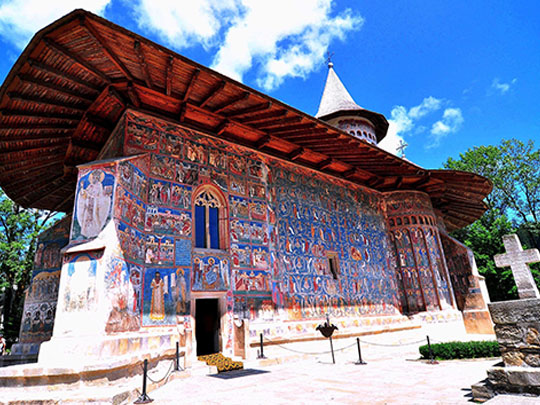
The painted monasteries of Bucovina, in Suceava County in north-eastern Romania, were founded by Stephen the Great, his son Petru Rareș and their nobles from the late 15th century, and eight of their churches are listed by UNESCO for the Bible stories painted across their outside walls.
See Voroneț, nicknamed the “Sistine Chapel of the East” for its Last Judgement and intense “Voroneț blue”, thought to be azurite-based, the Siege of Constantinople scenes at Moldovița, the reds of Humor, the greens of Arbore, and Sucevița with its Ladder of Virtues.
The Bucovina siege scenes show the Avar and Persian attack on Constantinople in 626 but paint the attackers as Ottoman Turks, a pointed message in the 1530s, and on 9 October 1941, the date Romania marks as its Holocaust remembrance day, deportations of Bucovina’s Jews to Transnistria began, among them the Jews of Gura Humorului, the town beside Voroneț.
12 – Sarmizegetusa Regia
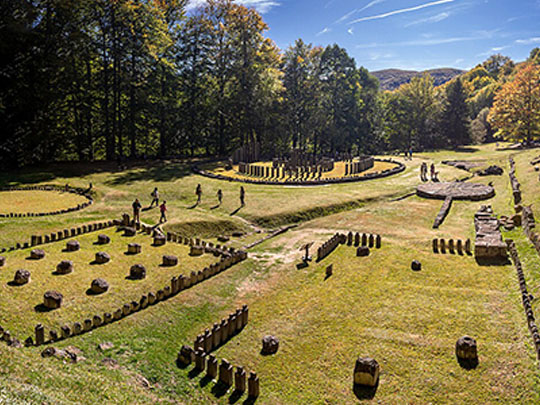
Sarmizegetusa Regia, at over 1,000 m in the Orăștie Mountains of Hunedoara County, was the capital of the Dacian kings from Burebista to Decebalus, until Trajan’s legions took it in 106 after two wars, Decebalus killed himself and Dacia became a Roman province.
Walk the terraces of the capital and its Dacian-built walls, then the sacred precinct with its circular and rectangular sanctuaries and the andesite “sun” disc, part of a UNESCO listing (1999) of six Dacian fortresses in these mountains.
Trajan’s Column in Rome tells the story of the Dacian Wars, down to Decebalus’s suicide, and from the 1990s looters dug about two dozen solid gold spiral bracelets from Sarmizegetusa, 13 of which have been recovered for the National History Museum in Bucharest.
13 – Alba Iulia
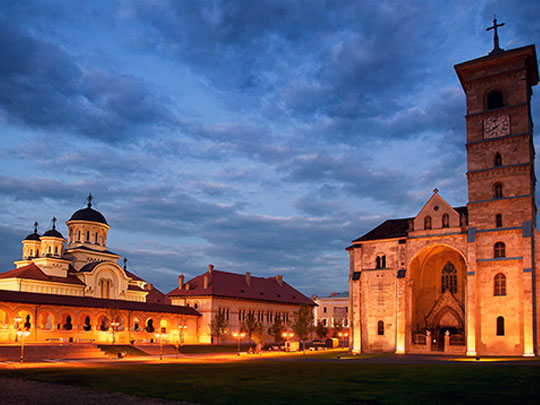
Alba Iulia, on the Mureș river, grew over the Roman legionary fortress of Apulum, was capital of the Principality of Transylvania from 1542 to 1690, and Michael the Brave entered it in 1599, ruling Wallachia, Moldavia and Transylvania together by 1600 in a brief union seen as a forerunner of modern Romania.
Walk the star-shaped Alba Carolina Citadel, built by the Habsburgs from 1715 to 1738, St Michael’s Cathedral, the oldest cathedral in Romania, with a tomb traditionally held to be that of John Hunyadi, the Coronation Cathedral and the Batthyaneum Library, home to half of the Carolingian Lorsch Gospels, the other half being in the Vatican.
On 1 December 1918 a great assembly at Alba Iulia proclaimed the union of Transylvania with Romania, the date the country celebrates as its National Day, and in 1922 King Ferdinand and Queen Marie were crowned here, in the town where the peasant leaders Horea and Cloșca had been broken on the wheel in 1785.
14 – Corvin Castle
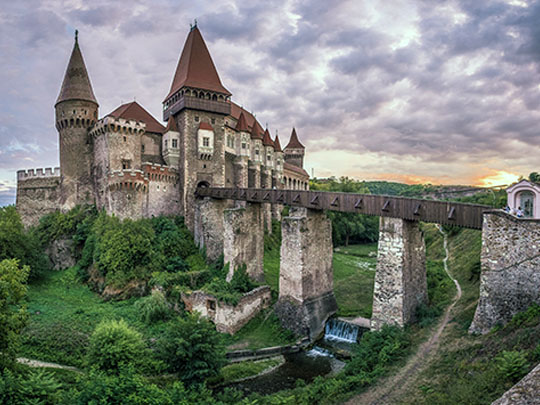
Corvin Castle, on a rock above the Zlaști river in Hunedoara, was rebuilt from the 1440s by the Hungarian commander John Hunyadi and extended by his son, King Matthias Corvinus, before restorers in the 19th century gave it its fairy-tale towers.
Cross the bridge to the Knights’ Hall, the Diet Hall with its medallion portraits, the Matthias Loggia, the Neboisa keep and the Capistrano Tower.
Legend says Turkish prisoners dug the well at Corvin Castle for 15 years and were never freed, carving “You have water, but no heart”, though a historian reads the real inscription as a prisoner named Hassan recording his name, and the castle starred in The Nun (2018) and Robert Eggers’s Nosferatu (2024).
15 – Saxon Fortified Churches
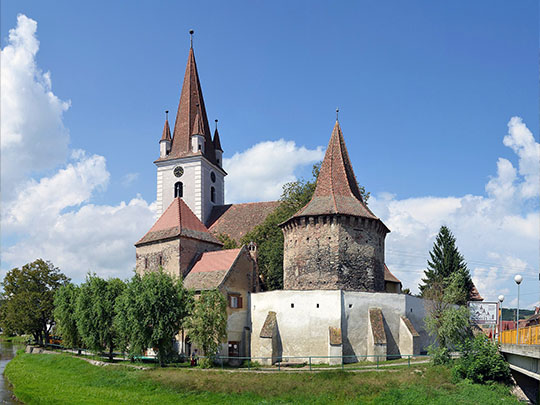
The Saxon fortified churches of Transylvania were built by German-speaking villagers between the 13th and 16th centuries and ringed with walls against Ottoman raids, and seven villages, led by Biertan, seat of the Saxon Lutheran bishops from 1572 to 1867, are listed by UNESCO.
See Biertan’s hilltop church with its 28-panel altarpiece and a sacristy lock that bolts in 13 places, Prejmer, begun by the Teutonic Knights in 1218, whose ring wall holds more than 270 rooms for some 1,600 villagers, and Viscri, where King Charles III’s foundation restored an 18th-century Saxon house.
Tradition says Biertan locked quarrelling couples together in a “marital prison” with one bed and one plate until they made up, and under a 1943 German–Romanian agreement many Saxon men served in the Waffen-SS, while after 1989 most Saxons left for Germany, leaving many of these churches with few or no worshippers.
16 – Poenari

Poenari Fortress, on a crag above the Argeș gorge at the southern end of the Transfăgărășan road, dates from the 13th century and was rebuilt in the 1450s by Vlad III, the prince remembered as Dracula, making it the castle most closely tied to him.
Climb the 1,480 steps to the ruined walls and towers for views down the gorge, then drive on past the Vidraru Dam onto the Transfăgărășan, built under Ceaușescu in the 1970s across the Făgăraș Mountains.
Tradition says Vlad forced the boyars of Târgoviște and their wives to rebuild Poenari until many died, legend says his first wife threw herself from the walls into the Argeș in 1462 rather than be captured by the Ottomans, and part of the fortress itself crashed into the river in a landslide in 1913.