

Wikimedia Commons / CC-BY-SA-3.0 / GFDL
Capital: City of San Marino
Population: 34,000+
Language: Italian

1 – Three Towers of San Marino (also above)
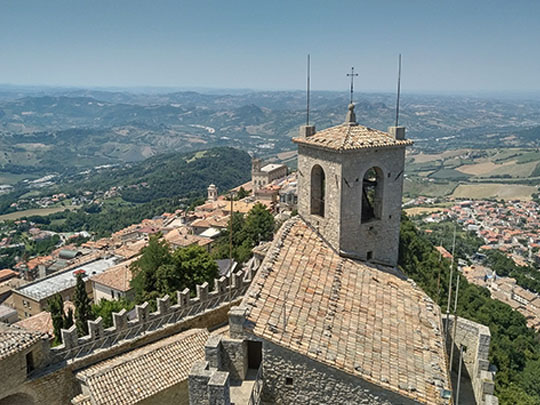
The Three Towers of San Marino crown the three peaks of Monte Titano (739 m), where tradition says a Christian stonemason called Marinus, from the Dalmatian island of Rab, founded a community in 301, and they stand at the heart of the UNESCO site “San Marino Historic Centre and Mount Titano” (2008).
Walk the ridge from Guaita, the oldest, built in the 11th century and used as a prison until 1970, to Cesta on the highest summit, with its Museum of Ancient Arms, and on to Montale, whose only door sits about 7 m above the ground.
All three towers appear on the flag and coat of arms of San Marino, which claims to be the world’s oldest surviving republic, and in 1797 it politely turned down Napoleon’s offer to enlarge its territory.
2 – Basilica di San Marino

The Basilica di San Marino, a neoclassical church built in 1826–38 to a design by Bolognese architect Antonio Serra on the site of a much older parish church, was made a basilica by Pope Pius XI in 1926 and is a co-cathedral of a diocese whose cathedral is at Pennabilli, over the border in Italy.
Inside, see the urn under the altar holding relics of Saint Marinus, found in 1586 and shared in part with Rab in 1595, then step next door into the little Church of San Pietro, where two niches cut into the rock are said to be the beds of Saints Marinus and Leo.
The Basilica di San Marino was consecrated on 5 February 1838, St Agatha’s Day, which the republic keeps as the anniversary of its liberation from Cardinal Alberoni’s occupation in 1740.
3 – Palazzo Pubblico

The Palazzo Pubblico, opened in 1894 on Piazza della Libertà to a design by Roman architect Francesco Azzurri, is where the Grand and General Council meets and the two Captains Regent, joint heads of state chosen every six months since 1243, are installed each 1 April and 1 October.
Stand in Piazza della Libertà before the Statue of Liberty, carved in Carrara marble by Stefano Galletti and given in 1876 by Countess Otilia Heyroth Wagener, then take in the crenellated facade of the palace, modelled loosely on the Palazzo Vecchio in Florence.
Abraham Lincoln, made an honorary citizen, wrote in 1861 that “although your dominion is small, your State is nevertheless one of the most honored, in all history”, and in 1944 neutral San Marino sheltered about 100,000 refugees, many in railway tunnels, while Allied raids that summer killed 63 people and the Battle of San Marino was fought that September.
4 – Borgo Maggiore and the Funivia
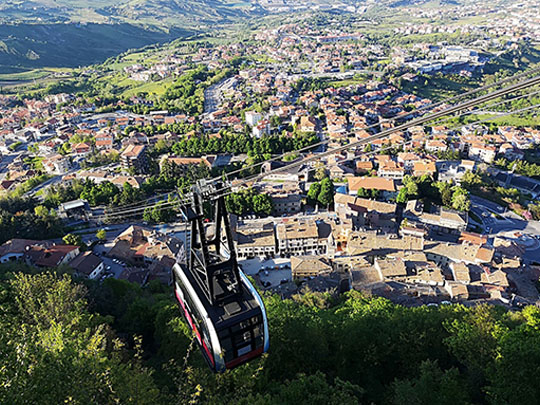
Borgo Maggiore, one of the nine castelli (districts) of San Marino, lies on the slopes at the foot of Monte Titano and grew up around the 12th century as Mercatale (“marketplace”), the republic’s main market town.
Ride the Funivia, the cable car opened in 1959, which climbs roughly 160 m along a 338 m line to the City of San Marino in about two minutes, and see the modernist Santuario della Beata Vergine della Consolazione by Giovanni Michelucci, consecrated in 1967 to replace a church badly damaged in WWII.
Before the cable car, Borgo Maggiore had a station on the Rimini–San Marino railway, put out of action by wartime bombing, and in the 1960s the town even had a helicopter service to Rimini.
5 – Rimini–San Marino Railway Tunnels
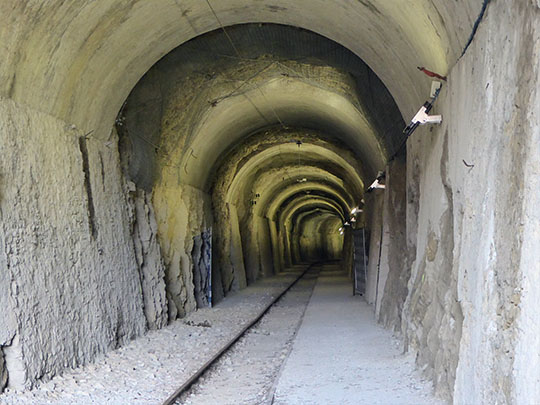
The Rimini–San Marino railway, an electric line of about 32 km climbing through more than a dozen tunnels from the Adriatic coast to the City of San Marino, was paid for by Mussolini’s government under a 1927 agreement and opened on 12 June 1932.
Walk into the Montale tunnel at the top of the line, where a restored 1931 railcar returned to the tracks in 2012, and picture the summer of 1944, when the railway tunnels sheltered many of the estimated 100,000 refugees who crowded into a republic of barely 15,000 people.
Allied air raids from 26 June 1944 cut the line and killed 63 people that summer, and in the Battle of San Marino (17–20 September 1944) the 4th Indian Division drove out the German 278th Infantry Division, with Gurkha Rifleman Sherbahadur Thapa winning a posthumous Victoria Cross for holding off German attacks alone for about two hours.