

Wikimedia Commons / CC-BY-SA-3.0 / GFDL
Capital: Nuku’alofa
Population: 100,000+
Language: Tongan/English
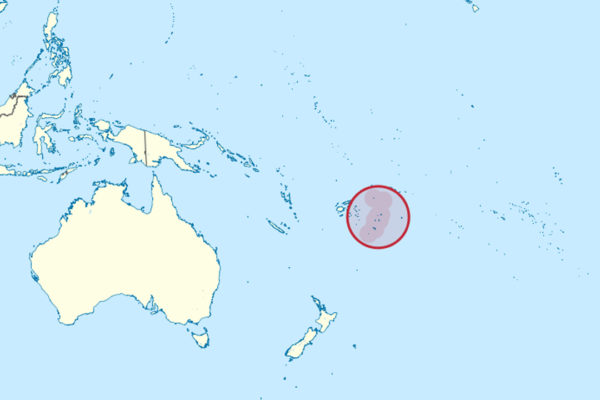
1 – Neiafu (also above)
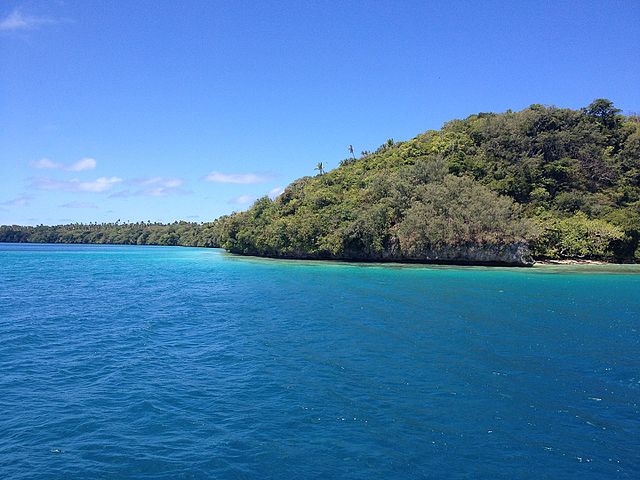
The main town of the Vava’u group, 250 km north of Tongatapu, sits at the head of a deep, fjord-like inlet that the Spanish navigator Francisco Mourelle sailed into in 1781 and named Puerto del Refugio, the Port of Refuge, having arrived short of water and looking for shelter — the name stuck, and it is still one of the great natural harbours of the Pacific.
Several hundred yachts put in here every sailing season, the walk up Mount Talau behind the town takes half an hour and lays out the whole archipelago, and boats run to Swallows Cave, a vaulted sea cavern on Kapa Island, and Mariner’s Cave, which can only be entered by diving through a submerged opening in the cliff.
Humpback whales come into these sheltered channels between about July and October to calve, and Tonga is one of the very few countries on earth that licenses swimming with them — four people to a whale, with a guide, in water where a mother and her calf may be resting a few metres below you.
2 – Mapu a Vaea Blowholes
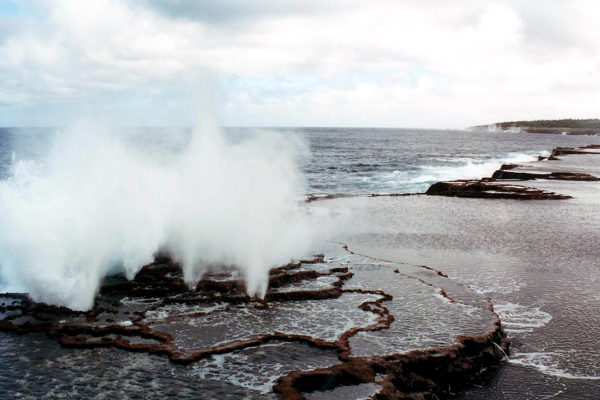
Along five kilometres of the south coast of Tongatapu near the village of Houma, the sea is driven up through hundreds of vents worn into a terrace of coral limestone, and on a day with a strong swell the jets go up thirty metres.
The whole stretch is walkable from a car park above the shore, there is no fee and no fence, and the sight to wait for is the chain reaction — when a big set comes in, a hundred blowholes go off along the coast one after another.
The name means the whistle of Vaea, after the chiefly family of Houma, and refers to the sound rather than the spray: the story goes that a chief used to sit out here listening, and decided the noise the coast made was the whistling of a nobleman.
3 – Nuku’alofa
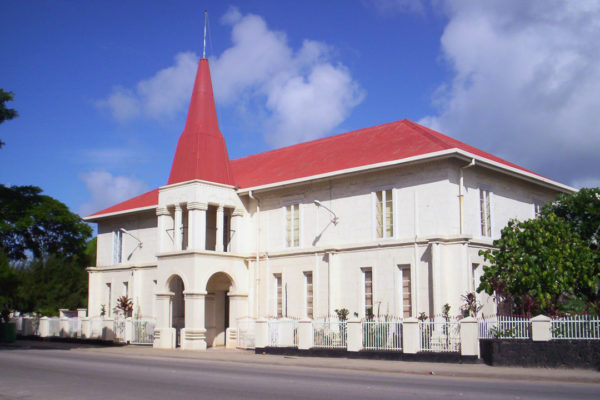
Tonga’s capital sits on the north coast of Tongatapu and is the seat of the only surviving Polynesian monarchy: George Tupou I united the islands under one crown in 1845 and gave the country a written constitution in 1875, and that early consolidation is the reason Tonga is the one Pacific nation never brought under colonial rule.
The white timber Royal Palace stands behind its lawns on the waterfront, the royal tombs at Mala’ekula hold the first five kings, Talamahu market is the best hour in town, and the coast road runs west past the flying fox colony at Kolovai.
The palace itself was never built here: it was cut and prefabricated from New Zealand kauri, shipped across in pieces and assembled on the shore in 1867 — and when rioting destroyed much of the central business district in 2006, the palace and its grounds came through untouched.
4 – Ha’amonga ‘a Maui
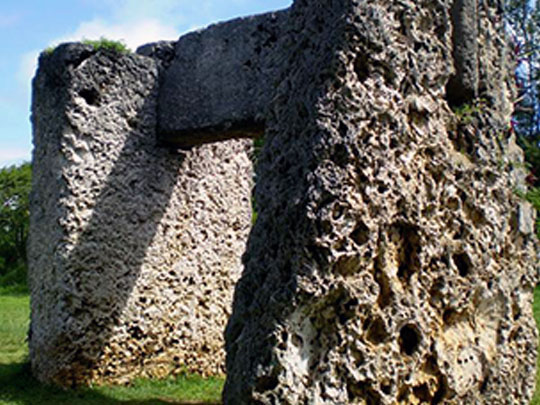
Thirty kilometres east of Nuku’alofa near the village of Niutōua stands a trilithon of three coral limestone slabs, over five metres high with uprights weighing thirty or forty tonnes apiece, raised around 1200 by Tu’itātui, the eleventh Tu’i Tonga — most likely as the gateway to his royal compound at Heketā.
The lintel sits in mortises cut into the tops of the uprights, and a short walk away is the ‘Esi Maka Fa’akinanga, a stone the king leaned against so that nobody could come at him from behind — his name is usually translated as the king who strikes the knee, from his habit of hitting anyone who sat too close.
Four years after Stonehenge was declared an astronomical instrument, King Tāufa’āhau Tupou IV visited in 1967 and proposed that the notch cut in the lintel marked the solstices; surveyors were sent, alignments were reported, and the theory has been repeated ever since — though the notch is only about ten centimetres long, and the evidence for it is thinner than the story suggests.