

Wikimedia Commons / CC-BY-SA-3.0 / GFDL
Capital: Tashkent
Population: 39 million+
Language: Uzbek and Karakalpak

1 – Ugam-Chatkal National Park (above)
Ugam-Chatkal National Park covers about 5,750 km² of the western Tien Shan in Tashkent region, set up in 1990 around the Chatkal reserve of 1947, and its mountains are part of the Western Tien-Shan World Heritage Site, listed in 2016 jointly with Kazakhstan and Kyrgyzstan.
Ugam-Chatkal National Park is the weekend mountains of Tashkent, a couple of hours from the city, with hiking and skiing around Chimgan, at 3,309 m, walnut and juniper forest, and the turquoise Charvak reservoir, held back by a dam 168 m high, completed in 1970.
Ugam-Chatkal is home to snow leopards and to Menzbier’s marmot, found only in the western Tien Shan, and the Chatkal reserve at its heart was set aside in 1947, more than four decades before the park, to protect the forests and wildlife of these valleys.
2 – Ark Fortress, Bukhara

The Ark Fortress is the citadel at the heart of Bukhara, a walled mound inhabited since at least the 4th century BC and the seat of the emirs until 1920, when the Red Army under Mikhail Frunze took the city with artillery and aircraft, leaving much of the Ark in ruins, before UNESCO listed old Bukhara in 1993.
Inside the Ark Fortress are the throne hall of the emirs, with a marble coronation throne of 1669, a mosque and museums, and from its walls you look across to the Kalyan minaret, built in 1127 and nearly 50 m tall, which legend says Genghis Khan spared, though no source from the time records it.
In June 1842, in the square in front of the Ark Fortress, Emir Nasrullah had two British officers, Charles Stoddart and Arthur Conolly, beheaded, and Conolly had coined the phrase “a great game” in a letter of 1840 for the Anglo-Russian rivalry over Central Asia, later made famous by Rudyard Kipling in his novel Kim.
3 – Kyzylkum Desert

The Kyzylkum Desert, the “red sand”, covers some 300,000 km² between the Amu Darya and Syr Darya rivers, mostly in Uzbekistan, and in the middle of it lies Muruntau, discovered in 1958, mined since 1967, one of the largest open-pit gold mines in the world, about 3.5 km across and around 600 m deep.
In the Kyzylkum, there are yurt camps by Aydar Lake, where visitors swim, fish and ride camels, while in a gorge of the Nurata hills the petroglyphs of Sarmishsay number about 10,000 rock carvings, most of them from the Bronze Age, on UNESCO’s tentative list for World Heritage.
Aydar Lake in the Kyzylkum should not exist, because in 1969–70 Soviet engineers, unable to pass a flood downstream, sent more than 20 km³ of Syr Darya floodwater into a dry depression, and with winter releases from upstream dams and drainage from the cotton fields it has grown to cover more than 3,000 km².
4 – Bibi Khanum Mosque

The Bibi Khanum Mosque in Samarkand was founded by Timur in 1399, on his return from sacking Delhi, as the great congregational mosque of his capital, popularly named for his chief wife, Saray Mulk Khanum, with more than 400 marble columns carved by masons brought from Azerbaijan, Persia and India.
The Bibi Khanum Mosque is a vast courtyard between a towering entrance portal and a blue-domed sanctuary, a short walk from the Registan, with a giant marble Quran stand of the Timurid era in the middle, under which, according to local lore, women who crawl will have many children.
The Bibi Khanum Mosque was too big for its own good, as Timur had the gateway pulled down and rebuilt higher while the Spanish envoy Clavijo watched in 1404, bricks were falling from the dome within years, the 1897 earthquake brought down the portal arch, and much of it was rebuilt from 1974, partly with modern materials.
5 – Shah-i-Zinda, Samarkand

Shah-i-Zinda, “the living king”, is a necropolis on the edge of Samarkand built around the shrine of Qusam ibn Abbas, a cousin of the Prophet Muhammad, who died in the 670s, and who, the legend goes, survived his beheading and walked down into a well, where he lives on.
Shah-i-Zinda is a narrow lane climbing past more than twenty mausoleums, most of them from the 14th and 15th centuries, many built for the family of Timur, among them the tomb of 1372 that his sister Turkan Aka built for her daughter Shadi Mulk, each covered in glazed blue tilework, and it is a place of pilgrimage.
Shah-i-Zinda was heavily restored in 2005, and the work was criticised by UNESCO, as new tiles replaced original Timurid tilework while new structures went up among the old ones, so the tradition that you count the steps going up, then again coming down, to be forgiven your sins if the numbers match, takes in more modern stonework than most visitors realise.
6 – Registan

The Registan, the “sandy place”, is the great square of Samarkand, framed by three madrasas, that of Ulugh Beg of 1417–20, the Sher-Dor of 1619–36 and the gilded Tilya-Kori of 1646–60, and Lord Curzon called it, even in its ruin, “the noblest public square in the world”.
On the Sher-Dor madrasa of the Registan, tiger-like lions prowl beneath suns with human faces, rare figurative imagery on an Islamic building, which gave the madrasa its name, Sher-Dor meaning “having tigers”, while the gilded prayer hall of the Tilya-Kori glows with gold leaf inside.
The first madrasa of the Registan was built by Ulugh Beg, grandson of Timur, a ruler who was also one of the finest astronomers of his age and compiled a catalogue of about a thousand stars before his own son had him killed in 1449, and in 1932 the Soviet engineer Vladimir Shukhov straightened one of its leaning minarets.
7 – Khiva (Itchan Kala)
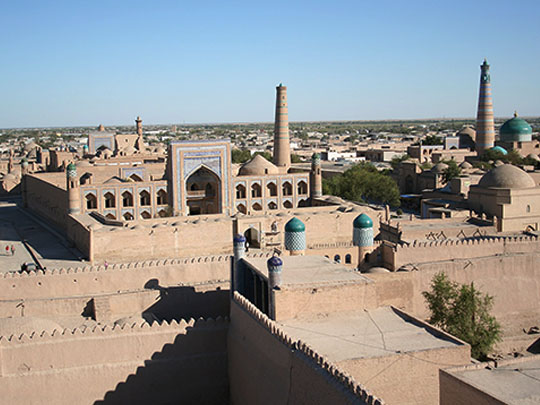

Khiva lies in the oasis of Khorezm on the lower Amu Darya in western Uzbekistan, and its walled inner town, Itchan Kala, was capital of the Khanate of Khiva from the early 17th century until the Russians conquered it in 1873, before UNESCO listed it in 1990, the first World Heritage Site in Uzbekistan.
Inside the mud-brick walls of Itchan Kala are dozens of monuments, among them the Juma Mosque, whose hall stands on more than 200 carved wooden columns, the oldest from the 10th century, the 56 m Islam Khoja minaret of 1910 and the Kalta Minor, a fat stump of turquoise tilework about 29 m high.
The Kalta Minor in Khiva was meant to be one of the tallest minarets in the Islamic world, but work stopped when the khan who ordered it was killed in battle in 1855, and in 1873, the Irish-American journalist Januarius MacGahan, son of Irish immigrants, defied a Russian ban to ride across the desert and witness the fall of the city.
8 – Moynaq
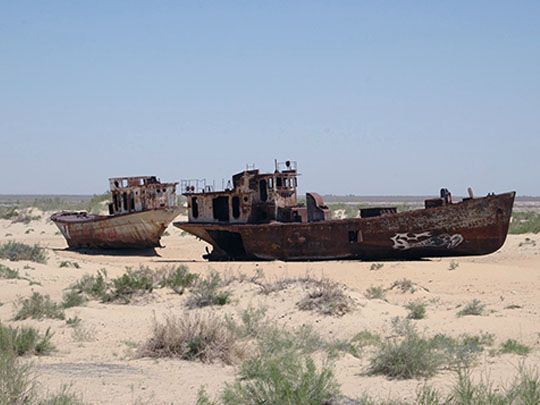

Moynaq, in Karakalpakstan in the far north-west of Uzbekistan, was a fishing port on the Aral Sea with a busy cannery, until Soviet irrigation drained the rivers that fed the sea, and by the mid-1980s the shoreline had retreated from the town, eventually by more than 100 km.
In Moynaq a cluster of rusting fishing boats stands on the old seabed below a memorial on the former cliff, a small museum shows photographs of the port in its prime, and in 2018 the town hosted the first Stihia, an electronic music festival held on the dry seabed.
The ship graveyard of Moynaq is not quite what it looks like, because the boats were gathered into one place for display and most of the fleet was sold for scrap, while the cannery, long after the sea had gone, kept running on fish shipped in from distant seas.