

Photo credit: WanderPast
Capital: Vatican City
Population: under 1,000
Language: Italian, Latin for the Holy See

1 – Vatican City (above)
Vatican City, at 44 ha the world’s smallest independent state, was created by the Lateran Treaty with Italy on 11 February 1929, ending the “Roman Question” left open since Italian troops took Rome in 1870, ten years after some 1,400 Irish volunteers of the Battalion of St Patrick fought to defend the Papal States.
Follow the Leonine Wall, built by Pope Leo IV after a Saracen raid in 846, see the little Vatican Railway Station, provided for in the Lateran Treaty and handed over in 1934, and remember that the whole of Vatican City has been a UNESCO World Heritage Site since 1984.
The Swiss Guard has protected the popes since 1506, and new recruits are sworn in every 6 May to mark the day in 1527 when 147 guards died covering Clement VII’s escape during the Sack of Rome, but their striped uniform, often credited to Michelangelo, was introduced in 1914.
2 – Via della Conciliazione

Via della Conciliazione runs from Castel Sant’Angelo to St Peter’s Square, on Italian soil just outside Vatican City, and takes its name from the 1929 “conciliation” between Italy and the papacy.
Walk between Marcello Piacentini’s obelisk-shaped lamp posts towards the dome of St Peter’s, then look back at Castel Sant’Angelo, Hadrian’s mausoleum turned papal fortress, where Clement VII took refuge in 1527.
Mussolini’s regime began clearing the medieval Spina di Borgo quarter in 1936 to build Via della Conciliazione, displacing thousands of residents, and the war delayed the work until the street was finished for the Holy Year of 1950.
3 – Vatican Museums

The Vatican Museums grew from Julius II’s statue collection in the Belvedere courtyard, which gained the Laocoön soon after it was dug up on the Esquiline Hill on 14 January 1506, and the Pio-Clementino opened as a public museum in the 1770s under Clement XIV and Pius VI.
See the Raphael Rooms, painted in 1508–24, where the School of Athens shows a Plato who resembles Leonardo and Michelangelo as Heraclitus, the 120 m Gallery of Maps of 1580–83, Raphael’s Transfiguration in the Pinacoteca, and Giuseppe Momo’s double-spiral staircase of 1932.
Napoleon’s France carried off many of the Vatican Museums’ masterpieces under the Treaty of Tolentino in 1797, including Raphael’s Transfiguration, and most returned after 1815, while the Vatican Library holds the chronicle of the Irish-born monk Marianus Scotus (1028–82), probably in his own hand.
4 – St Peter’s Square

St Peter’s Square was laid out by Gian Lorenzo Bernini in 1656–67 for Pope Alexander VII, with two curved colonnades of 284 columns, topped by 140 statues of saints, reaching out from the basilica like embracing arms.
At the centre stands an Egyptian obelisk, brought to Rome by Caligula in 37 AD for his circus and re-erected here by Domenico Fontana in 1586 with about 900 men and 75 horses.
During the German occupation of Rome in 1943–44, Mgr Hugh O’Flaherty, born in Kiskeam, Co. Cork, and raised in Killarney, stood on the steps of St Peter’s each evening while running an escape network that helped around 4,000 Allied POWs, and SS chief Herbert Kappler had a white line painted at the edge of St Peter’s Square, threatening to arrest him if he crossed it, while Delia Murphy of Claremorris, Co. Mayo, wife of the Irish Minister to the Holy See, T.J. Kiernan, drove escaped POWs through checkpoints in the legation car.
5 – St Peter’s Basilica

St Peter’s Basilica stands over the traditional tomb of St Peter, where Constantine built the first church in the 320s, and its replacement, begun by Julius II on 18 April 1506 and shaped by Bramante, Michelangelo and Maderno, was dedicated on 18 November 1626.
See Michelangelo’s Pietà, carved in 1498–99 when he was about 23 and traditionally his only signed work, Bernini’s bronze baldacchino of 1623–34, the worn foot of the bronze St Peter, and climb 537 steps to the top of Michelangelo’s dome, 133 m high.
Indulgences sold to help pay for St Peter’s Basilica provoked Martin Luther’s Ninety-five Theses in 1517, and the story that Bernini’s baldacchino was cast from bronze stripped from the Pantheon is largely legend, since most of that bronze went into cannon.
6 – Sistine Chapel

The Sistine Chapel, built in 1473–81 for Pope Sixtus IV and named after him, has hosted papal conclaves since 1492 and been their only venue since 1878, with black smoke from its chimney meaning no pope yet and white meaning one has been chosen.
Look up at Michelangelo’s ceiling of 1508–12, with nine scenes from Genesis including the Creation of Adam, then at his Last Judgement of 1536–41 on the altar wall, and the side walls painted in 1481–82 by Botticelli, Perugino, Ghirlandaio and Rosselli.
Michelangelo painted the Sistine Chapel ceiling standing on a scaffold he designed, not lying on his back, and he painted the papal official Biagio da Cesena, who objected to the nudes, as Minos, judge of the underworld, before Daniele da Volterra was paid to cover the nudes from 1565, earning the nickname “Il Braghettone”.
7 – Vatican Necropolis
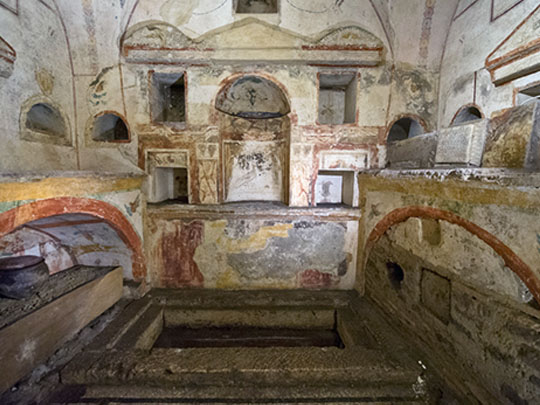
The Vatican Necropolis lies beneath St Peter’s Basilica, a Roman cemetery of 2nd- and 3rd-century tombs beside the circus begun by Caligula, where tradition places St Peter’s martyrdom, and Constantine’s builders took the roofs off the tombs and packed them with earth to raise the first basilica.
Book one of the small daily tours to walk the street of tombs, see the Tomb of the Julii, whose mosaic of a sun-god in a chariot is often read as Christ, and reach the red wall and the 2nd-century shrine known as the Trophy of Gaius.
Digging began in 1939, when the floor of the grottoes was lowered for Pius XI’s tomb, Pius XII announced in 1950 that Peter’s tomb had been found, and in 1968 Paul VI said bones from the necropolis had been identified as the apostle’s “in a way we can consider convincing”, a conclusion scholars continue to debate.
8 – Vatican Gardens
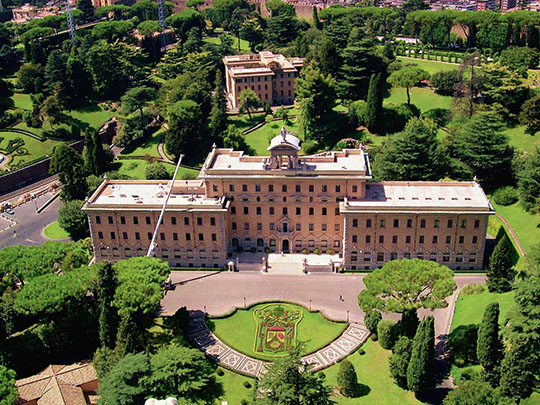
The Vatican Gardens, about 22 ha and roughly half of Vatican City, began in 1279 when Pope Nicholas III planted an orchard, lawn and garden inside new walls after moving the papal residence from the Lateran.
See the Casina of Pius IV, begun in 1558 by Pirro Ligorio and home of the Pontifical Academy of Sciences since 1922, the replica Lourdes grotto given to Leo XIII in 1902, and the Palazzina of Leo XIII, first home of Vatican Radio, set up by Guglielmo Marconi and opened in 1931.
After resigning in February 2013, Pope Benedict XVI moved into the Mater Ecclesiae monastery in the Vatican Gardens that May, arriving by helicopter at the gardens’ heliport, and lived there until his death on 31 December 2022.
9 – Castel Gandolfo
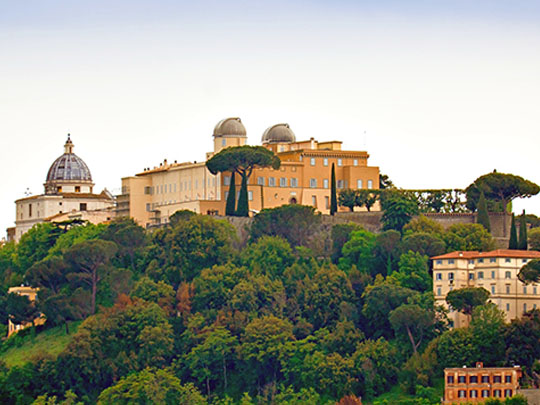
Castel Gandolfo, in the Alban Hills above the crater lake of Lake Albano about 25 km from Rome, has been a papal summer retreat since Urban VIII first stayed in 1626, its estate given extraterritorial status by the Lateran Treaty, and Pius XII and Paul VI both died there, in 1958 and 1978.
See the papal palace, a museum since 2016, the Barberini Gardens, opened to the public in 2014, with the ruins of Emperor Domitian’s villa, including a theatre and a covered gallery, and the old home of the Vatican Observatory, moved here from Rome’s city lights in the mid-1930s.
After the Allied landings at Anzio in January 1944 about 12,000 refugees sheltered on the papal estate at Castel Gandolfo and some 36 to 40 babies were born in the papal apartments, while Allied bombs on 10 February killed some 500 people at the nearby Propaganda Fide villa.