
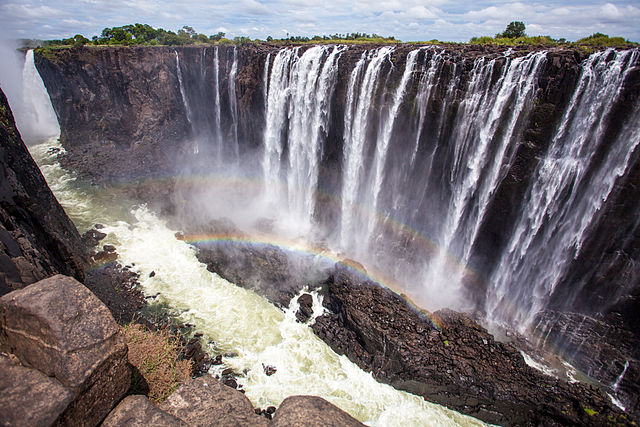
Wikimedia Commons / CC-BY-SA-3.0 / GFDL
Capital: Harare
Population: 16 million+
Language: Sixteen official languages — more than any other country on Earth, including Shona, Ndebele, English, Tonga, Kalanga, Venda, Xhosa, and Zimbabwean sign language.
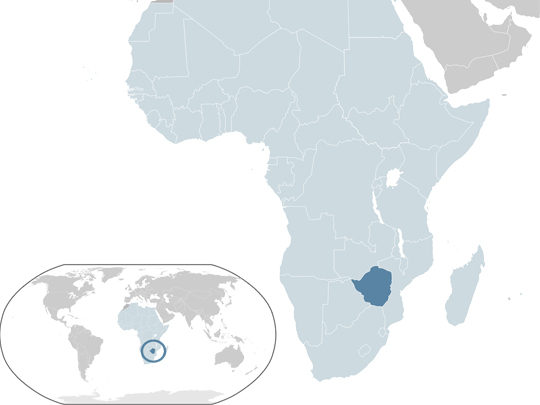
1 – Victoria Falls & Victoria Falls National Park (also above)
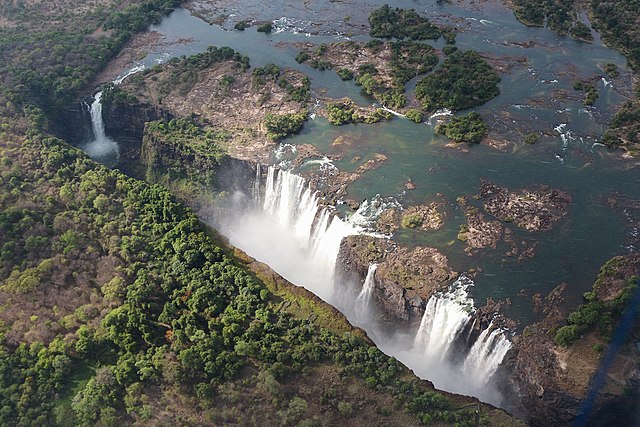
One of the Seven Natural Wonders of the World, Victoria Falls — Mosi-oa-Tunya, “the Smoke that Thunders” — is where the Zambezi plunges off a mile-wide cliff to form the largest sheet of falling water on Earth; and it’s from the Zimbabwean side that you get the grandest, most complete view, gazing head-on at the full width of the roaring curtain.
A paved trail leads through a dripping, emerald rainforest — a patch of jungle sustained entirely by the falls’ endless spray, where it “rains” every single day of the year — past a statue of the explorer David Livingstone, the first European to see the falls in 1855, to sixteen viewpoints facing cataracts with names like the Devil’s, the Main and the Rainbow.
On the nights around a full moon, the falls perform a rare piece of magic: a lunar rainbow, or “moonbow” — a ghostly, silver rainbow conjured by moonlight shining through the drifting spray, a sight you can witness in only a handful of places on the whole planet.
2 – Hwange National Park
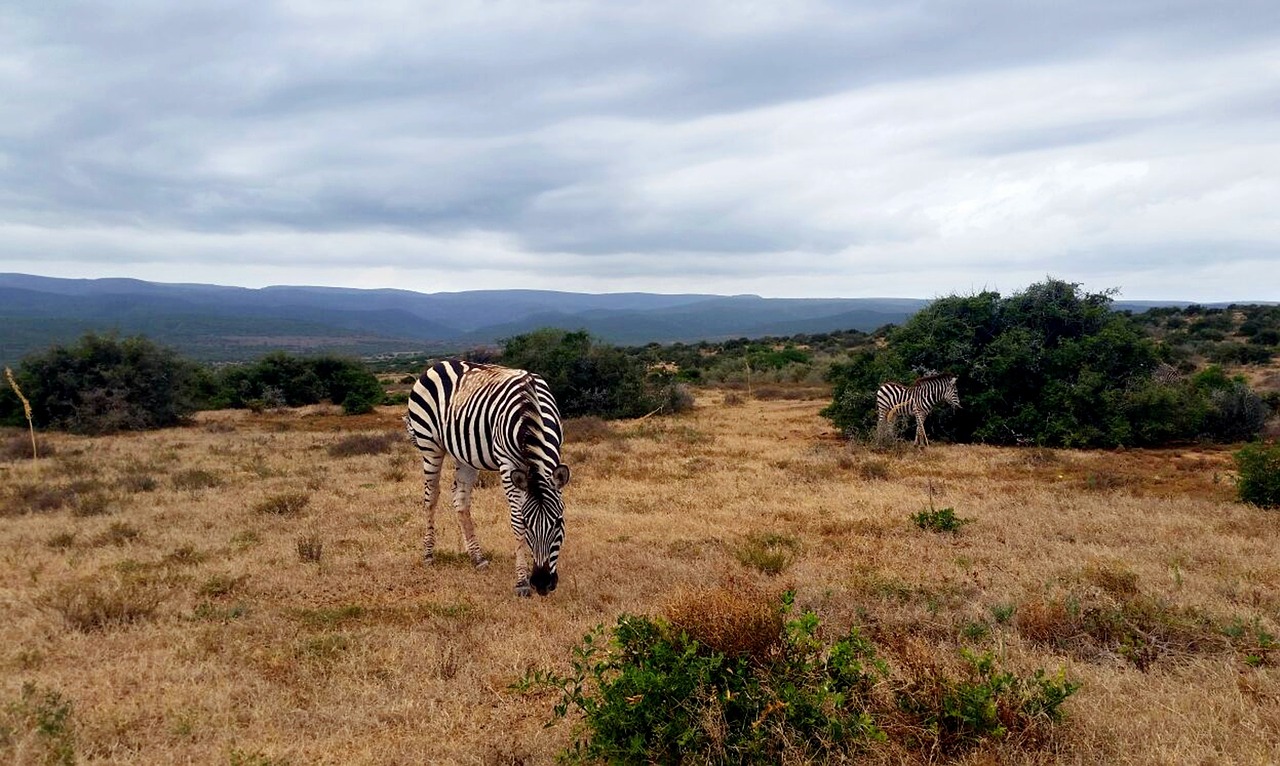
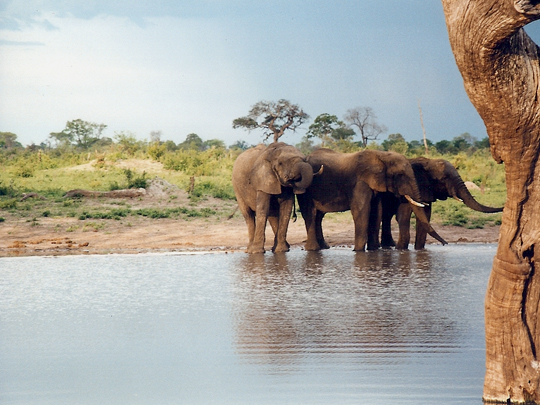
On the edge of the Kalahari in western Zimbabwe, Hwange is the country’s largest and oldest national park — a vast wilderness of golden grassland, teak forest and ancient sand, and one of the last great strongholds of the African elephant, home to one of the biggest populations anywhere on Earth.
In the dry season, tens of thousands of elephants, along with huge herds of buffalo, prides of lion and one of Africa’s largest populations of endangered wild dogs, gather at its waterholes in numbers that can take your breath away — a spectacle best watched simply by sitting quietly at the water’s edge as the herds file in at dusk.
There’s a secret behind all that life: Hwange has almost no natural water at all. Its rivers dried up thousands of years ago, and the herds survive only thanks to a network of man-made, pumped waterholes — so that one of Africa’s greatest wildlife gatherings is, quietly, kept alive by human hands.
3 – Matobo National Park
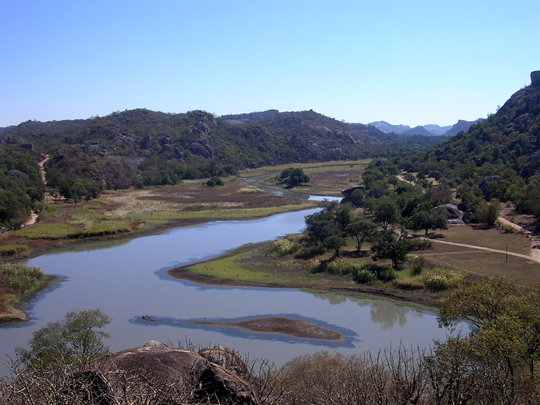
South of Bulawayo lies Matobo, Zimbabwe’s oldest national park — an otherworldly landscape of ancient granite, where two-billion-year-old rock has been weathered into a wonderland of whaleback domes, castle-like hills and giant balancing boulders that seem to defy gravity; the wider Matobo Hills are a UNESCO World Heritage Site and the spiritual heart of the nation.
The caves among the rocks hold the densest collection of ancient San paintings in southern Africa — some over 13,000 years old — while the park is one of the best places on the continent to track black and white rhino on foot, and to spot leopard and the soaring black eagles that nest on its cliffs.
High on a granite dome that the Ndebele hold sacred as Malindidzimu, “the place of the spirits,” lies the grave of Cecil Rhodes — the British empire-builder who gave his name to Rhodesia chose this very spot, which he called “World’s View,” to be buried, carved into the solid rock at the top of the hill.
4 – Balancing Rocks
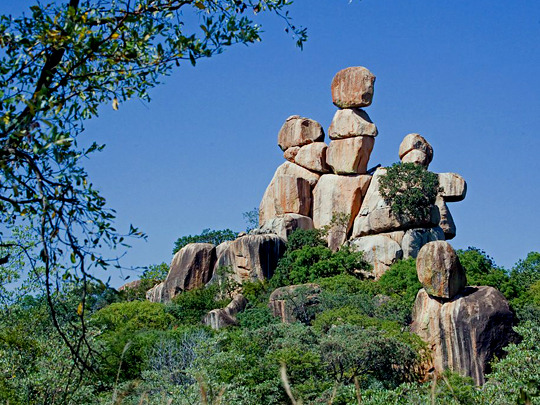
On the outskirts of the capital, Harare, stand the Chiremba Balancing Rocks — a cluster of enormous granite boulders stacked and perched impossibly on top of one another, like a giant child’s building blocks left teetering in the bush.
Though they look as if some titan piled them by hand, they are entirely natural: over billions of years hard granite formed deep underground, and as the softer surrounding rock eroded away and the granite cracked and peeled, it left these gravity-defying stacks behind — one of many such formations in a country whose very name, Zimbabwe, means “house of stone.”
These particular rocks are the most famous in the land, for they appear on every Zimbabwean banknote — chosen at independence as a symbol of balance and stability, a symbolism that turned bitterly ironic when the very same rocks ended up gazing out from the notorious 100-trillion-dollar note, printed during the country’s catastrophic hyperinflation.
5 – Nyanga National Park
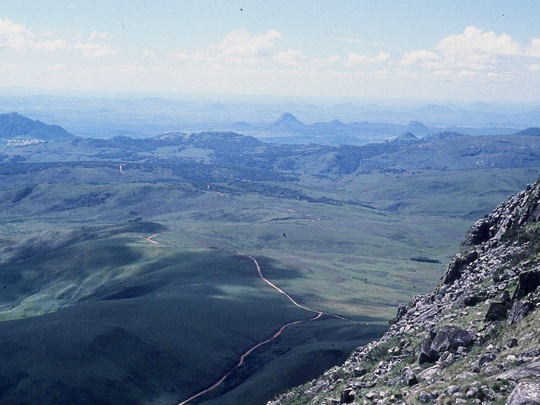
In the misty Eastern Highlands on the border with Mozambique, Nyanga is a cool, green mountain world utterly unlike the rest of hot, dry Zimbabwe — a landscape of rolling grassland, montane forest, trout streams and waterfalls, crowned by Mount Nyangani (2,592m), the highest peak in the country.
It’s a walker’s and angler’s paradise where rivers plunge over dramatic cascades — among them the Mtarazi Falls, the highest in Zimbabwe, tumbling some 760m into the valley below — and where the highlands are cool enough that frost, and even the occasional flurry of snow, can dust the peaks; the area was once the private mountain estate of the empire-builder Cecil Rhodes.
These hills hold a forgotten wonder: hundreds of kilometres of ancient dry-stone terraces climbing the mountainsides, along with mysterious stone-lined pits, all built by Shona-speaking farmers centuries ago — a sophisticated highland civilisation whose “pit structures,” long thought to be dungeons, are now understood to have been snug, predator-proof pens for their livestock.
6 – Great Zimbabwe
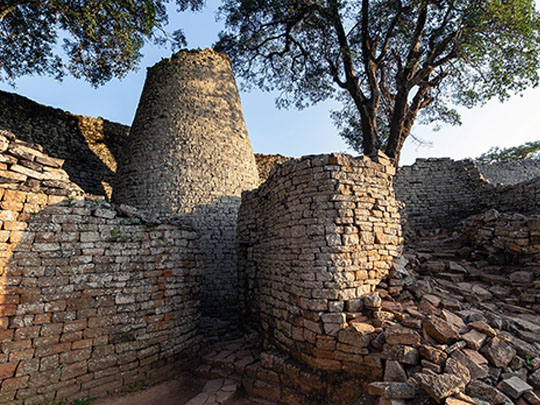
Near the town of Masvingo stand the majestic ruins of Great Zimbabwe — the largest ancient stone structure in all of sub-Saharan Africa, and the capital, six centuries ago, of a wealthy Shona kingdom that traded gold and ivory as far as China and Persia; so important that the modern nation took its very name from these ruins, “Zimbabwe” meaning “houses of stone.”
Its soaring granite walls were built entirely without mortar, each block precisely fitted to the next — most spectacularly in the Great Enclosure, a vast curving rampart up to 11m high wrapped around the enigmatic Conical Tower; from the hilltop acropolis above came the carved soapstone “Zimbabwe Birds,” one of which still flies on the national flag today.
For over a century, European colonisers simply refused to believe Africans could have built such a place, crediting it instead to Phoenicians or the biblical Queen of Sheba — and even after archaeologists proved beyond doubt that it was the work of the ancestral Shona, the white-minority Rhodesian government censored them and passed laws to suppress the truth, which was only fully reclaimed at independence in 1980.
7 – Bulawayo
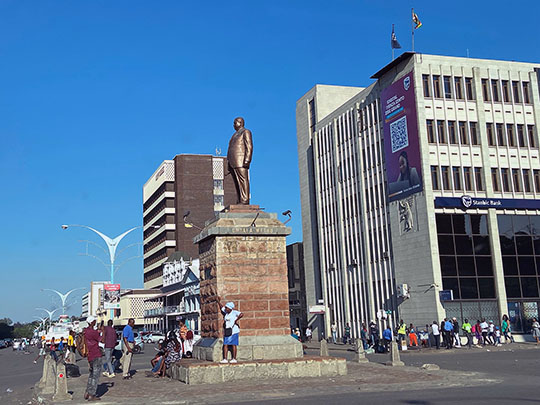
Mzilikazi led his followers north out of Zululand in the 1830s and founded a kingdom on these plains; his son Lobengula made Bulawayo his capital, and in 1888 put his mark to the Rudd Concession — a document he understood to grant mining rights, and which Cecil Rhodes used to claim an entire country. When the company’s columns came in 1893, Lobengula burned his own capital rather than surrender it and rode north to die; Rhodes built his town on the ashes and kept the name, usually translated as “the place of killing”.
The Natural History Museum is among the finest on the continent, the National Railway Museum recalls a city that was once the rail hub of southern Africa, and out in the Matobo hills lies Mzilikazi’s grave — a few miles from the one on the summit that everybody visits.
Rhodes laid out the streets to a peculiar specification: wide enough, it is said, for a full span of twelve oxen to turn a wagon in — which is why this city of half a million has boulevards you could land an aircraft on.
8 – Harare
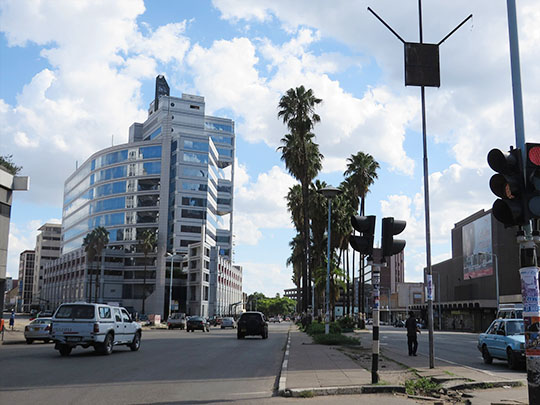

Zimbabwe’s capital began in 1890 as Fort Salisbury, thrown up by Rhodes’s Pioneer Column at the end of its march north, and it stayed Salisbury through the colony, the Federation and the fifteen years of white-minority Rhodesia — taking the name Harare in 1982, two years after independence, from a Shona chief who had held the ground long before.
Jacarandas turn the avenues purple every October; the National Gallery and the sculpture parks on the edge of town hold the country’s great collections, Mbare is the market everyone passes through, and Heroes’ Acre on the western hills is the national monument to the liberation war.
Harare is where Shona stone sculpture began: in the 1950s a handful of artists working around the gallery started carving serpentine and springstone entirely by hand, and within twenty years their work was being shown in Paris and New York — one of the few art movements of the twentieth century to emerge from Africa and be collected by the world on its own terms.
9 – Mana Pools
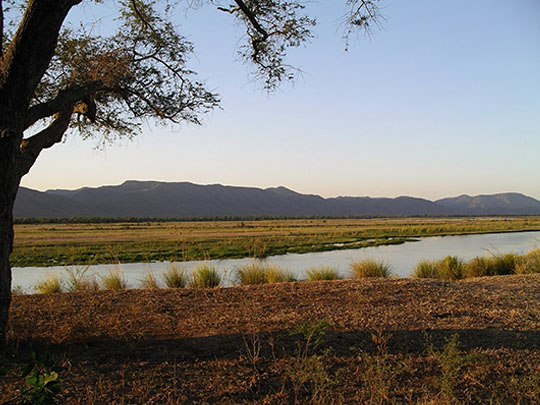

On the southern bank of the Zambezi below Kariba lies a floodplain of ancient river channels — mana means “four” in Shona, for the four pools the river left behind when it shifted course — backed by groves of towering winterthorn trees that stand in ranks like the pillars of a cathedral. UNESCO listed it in 1984.
It is one of the very few parks in Africa where visitors may get out and walk unaccompanied, which changes everything about being there: you go on foot among elephant, buffalo and eland, with lion and painted dogs in the woodland behind and the escarpment rising blue across the water.
The winterthorns drop a pod that elephants are prepared to work for — and a handful of Mana’s bulls have learned to rise up on their hind legs, balancing their whole weight on two feet to reach the high branches, a trick that appears to be passed on simply by younger animals watching the old ones do it.