
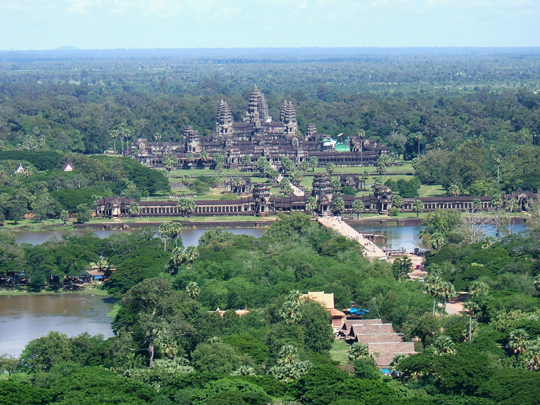
shankar s. / Wikimedia Commons / CC-BY-SA-3.0 / GFDL
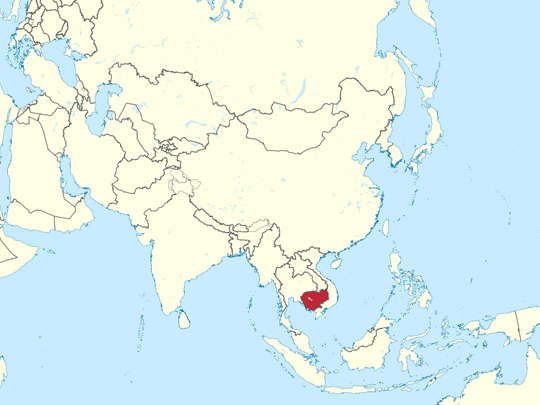
Capital: Phnom Penh
Population: 17 million+
Language: Khmer. Also Cham, Vietnamese, Chinese and English.
1 – Angkor Wat (also above)
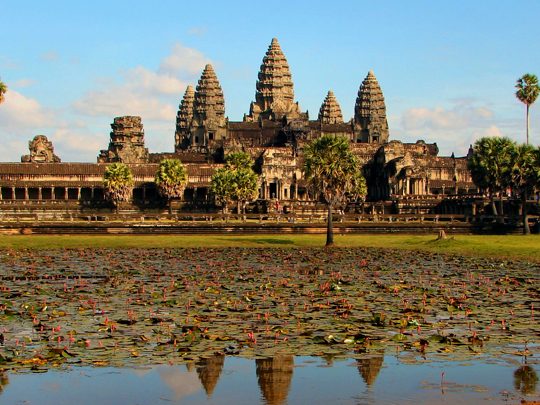
Angkor Wat was built in the first half of the 12th century for King Suryavarman II and dedicated to Vishnu, and Guinness World Records lists it as the largest religious structure ever built, at about 162.6 hectares, while it has appeared on almost every Cambodian flag since about the 1870s, including that of the Khmer Rouge.
A causeway crosses Angkor Wat’s moat, about 190 m wide, to five towers said to represent the peaks of Mount Meru, past more than half a kilometre of bas-reliefs, with the Churning of the Ocean of Milk on the east gallery and almost 1,800 carved devatas on the walls.
Angkor Wat faces west, the direction linked with death, which has led scholars to suggest it was also a funerary temple, and when a treaty of 9 May 1941, after the Franco-Thai War, handed Battambang and part of Siem Reap province to Thailand, Angkor remained Cambodian.
2 – Royal Palace, Phnom Penh
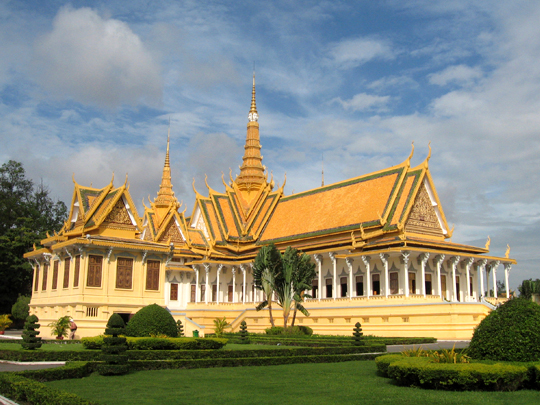
King Norodom moved the royal court from Oudong to Phnom Penh in 1866 and began the Royal Palace that year, though its Throne Hall, used for coronations and official audiences, dates from 1917–19.
Beside the Royal Palace the Silver Pagoda takes its name from more than 5,000 silver tiles of about a kilo each, and holds a small green Buddha, often said to be Baccarat crystal, as well as a life-size gold Buddha of about 90 kg set with 2,086 diamonds.
The Royal Palace’s iron pavilion was made in France and sent to King Norodom in the 1870s, and tradition says it was first built for Empress Eugénie at the opening of the Suez Canal, while in March 1945, after Japan removed the French administration, King Norodom Sihanouk declared an independent Kampuchea.
3 – Tuol Sleng
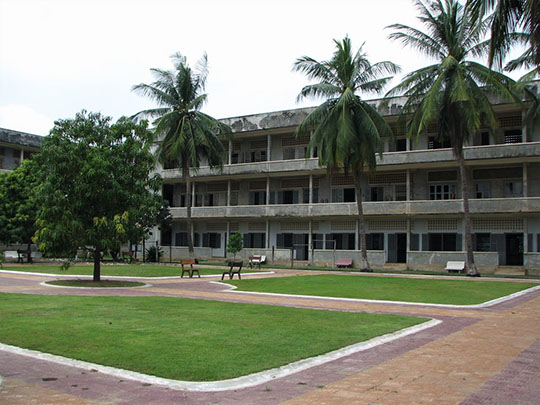
Tuol Sleng was built in 1962 as Ponhea Yat High School in Phnom Penh, and soon after the Khmer Rouge took the city in April 1975 it became Security Office 21, or S-21, the regime’s secret interrogation centre and prison.
Four school buildings stand around the courtyard at Tuol Sleng, with cells partitioned out of classrooms, the 14 white graves of the last victims found in 1979, and room after room of the photographs the regime took of its own prisoners.
Estimates of those held at Tuol Sleng run from about 12,000 to 20,000, and only a handful survived, among them the painter Vann Nath, kept alive to paint portraits of Pol Pot, whose later paintings of what he witnessed hang in the museum.
4 – Choeung Ek Mass Graves
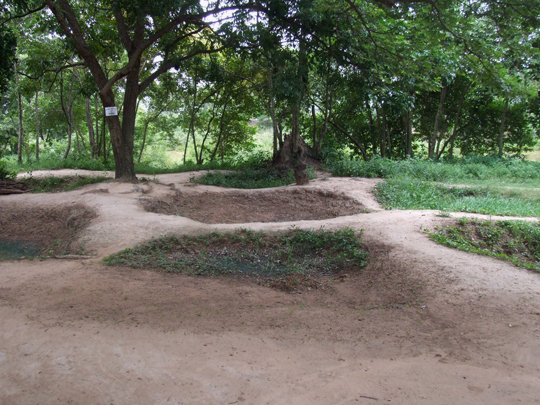
Choeung Ek, a former orchard and Chinese cemetery about 15–17 km south of central Phnom Penh, is where prisoners from S-21 were taken to be killed, and it is one of several hundred killing sites that researchers have mapped across Cambodia.
About 130 mass graves have been found at Choeung Ek, where nearly 9,000 bodies were exhumed in 1980, and a memorial stupa of the late 1980s holds thousands of skulls, while fragments of bone and cloth can surface after heavy rain.
An estimated 1.5 to 2 million people died under the Khmer Rouge, roughly a fifth to a quarter of the population, the UN-backed tribunal convicted three men, Kaing Guek Eav (Duch), Nuon Chea and Khieu Samphan, and in 2025 Choeung Ek and Tuol Sleng were inscribed together as World Heritage.
5 – Bayon
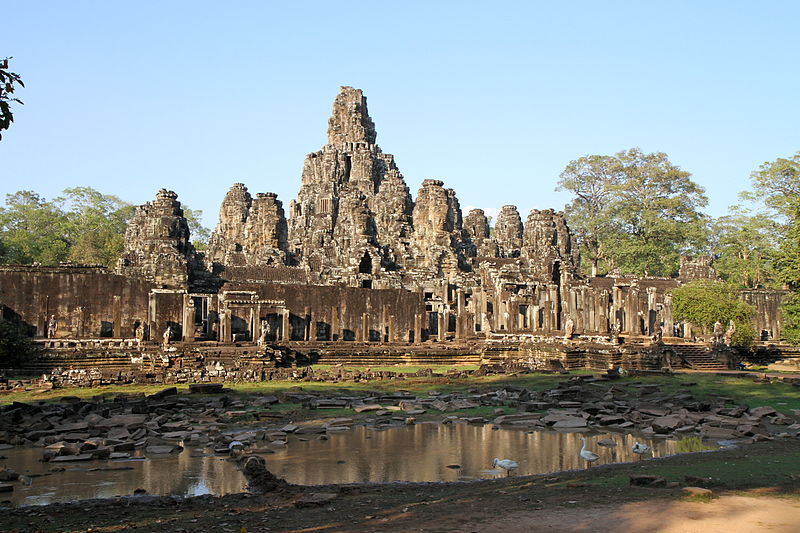
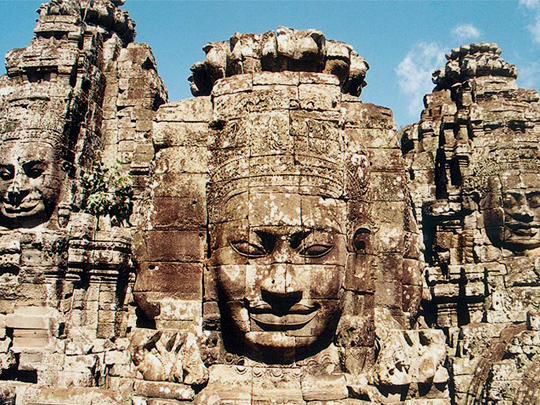
The Bayon stands at the exact centre of Angkor Thom, the walled city of about 9 km² built by Jayavarman VII after he drove out the Chams, who had sacked Angkor in 1177, and it was his Buddhist state temple.
Some 37 surviving towers of the Bayon carry around 200 serene stone faces, usually identified as the bodhisattva Lokeshvara, though some see the king’s own features in them.
More than a kilometre of the Bayon’s bas-reliefs show daily life in the 12th century, with markets, figures taken to be Chinese merchants, cooking, cockfights, childbirth and fishing, as well as a naval battle with the Chams on the Tonle Sap.
6 – Banteay Srei

Banteay Srei, about 25 km north-east of the main Angkor temples, was consecrated in 967, the only major Angkor temple not commissioned by a king, founded by the Brahmin courtier Yajnavaraha, an adviser under Rajendravarman II and tutor to Jayavarman V.
Banteay Srei’s three sanctuary towers and two libraries are carved from rose-pink sandstone so finely that the surfaces read more like woodwork than masonry, with scenes from the Ramayana and Mahabharata, as well as graceful devatas in their niches.
In 1923, the 22-year-old André Malraux, later France’s Minister of Cultural Affairs, cut away several devatas from Banteay Srei and was tried in Phnom Penh, and between 1931 and 1936 Henri Marchal restored the temple by anastylosis, a technique learned from Dutch archaeologists in Java.
7 – Neak Pean
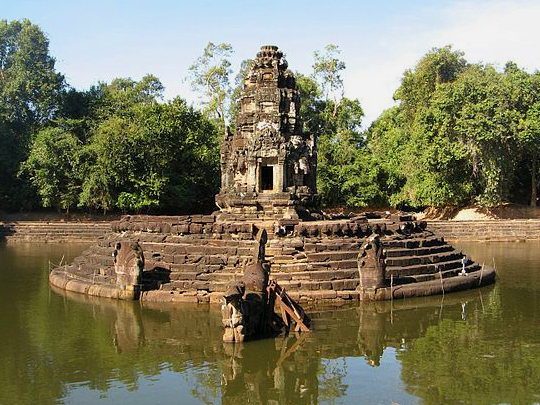
Neak Pean is an island temple in the Jayatataka baray east of Preah Khan, built by Jayavarman VII in the late 12th century and named “entwined serpents” after the two nagas coiled around its base.
A central pool at Neak Pean is ringed by four smaller pools, each fed from the centre through a spout carved as a head, human to the east, elephant to the north, horse to the west and lion to the south.
Neak Pean represents Anavatapta, the mythical Himalayan lake whose waters were believed to heal, and pilgrims bathed here hoping for cures, fitting for a king whose inscriptions record that he founded 102 hospitals.
8 – Koh Rong
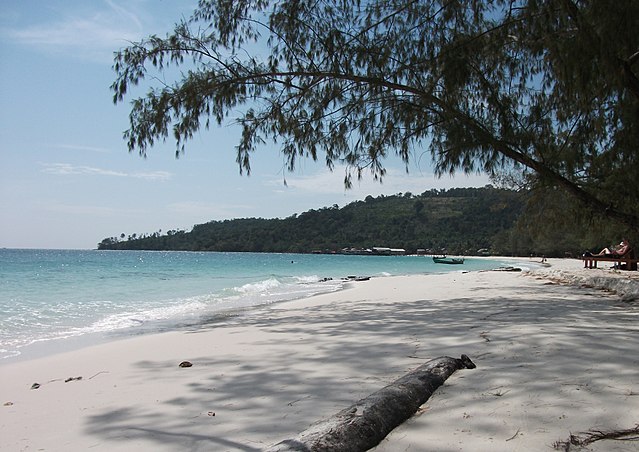
Koh Rong, Cambodia’s second-largest island at about 78 km², lies off the coast from Sihanoukville, a ridge of forested hills fringed with long white beaches.
Koh Rong’s beaches run from the village of Koh Touch to the long white sands of Sok San and quiet Long Set, nicknamed 4K Beach, while on dark nights the sea around the island glows with bioluminescent plankton.
Koh Rong has hosted the US version of Survivor, with two seasons filmed in 2015, as well as several editions of France’s Koh-Lanta.
9 – Koh Ker
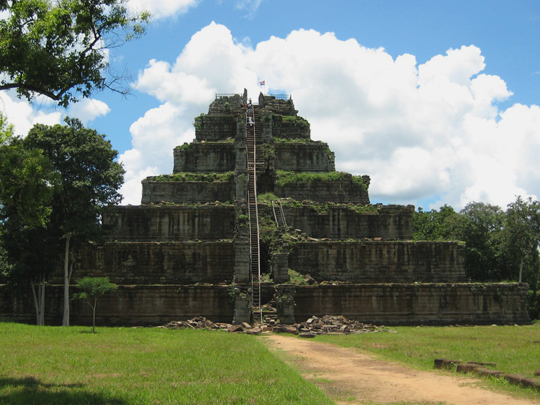
Koh Ker, about 110 km north-east of Angkor, was the capital of Jayavarman IV for about two decades in the 10th century, from around 921 or 928 to 944, and some 170 ancient sites survive there, including 76 temples.
Koh Ker’s great monument is Prasat Prang, the seven-tiered pyramid of the Prasat Thom complex, about 35 m high and often called the tallest in Cambodia, and the whole site was inscribed by UNESCO in 2023.
Koh Ker’s remote temples were heavily looted, and two statues taken from Prasat Chen around 1972, a Duryodhana and a Bhima, were returned in 2014, broken at the ankles, their feet found standing on the pedestals they were cut from.
10 – Tonle Sap
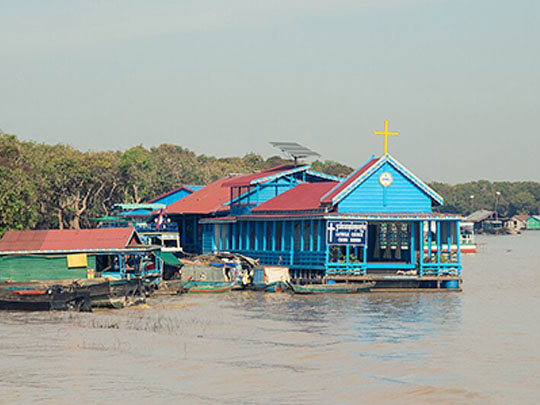
Tonle Sap, the great lake at the heart of Cambodia, grows from about 2,500–3,000 km² and less than 1 m deep in the dry season to more than 10,000 km² and up to about 9 m deep in the wet season, when the swollen Mekong forces the Tonle Sap River to run backwards.
Boats from Siem Reap reach the stilt village of Kampong Phluk, raised on piles up to about 10 m high, and Prek Toal, a core area of the Tonle Sap Biosphere Reserve with the largest remaining colonies of storks, pelicans and ibises in mainland Southeast Asia.
The Tonle Sap’s flood pulse sustains one of the world’s most productive freshwater fisheries, widely seen as the wealth behind Angkor, though upstream dams and climate change are linked to falling water levels and catches.