
Wikimedia Commons / CC-BY-SA-3.0 / GFDL
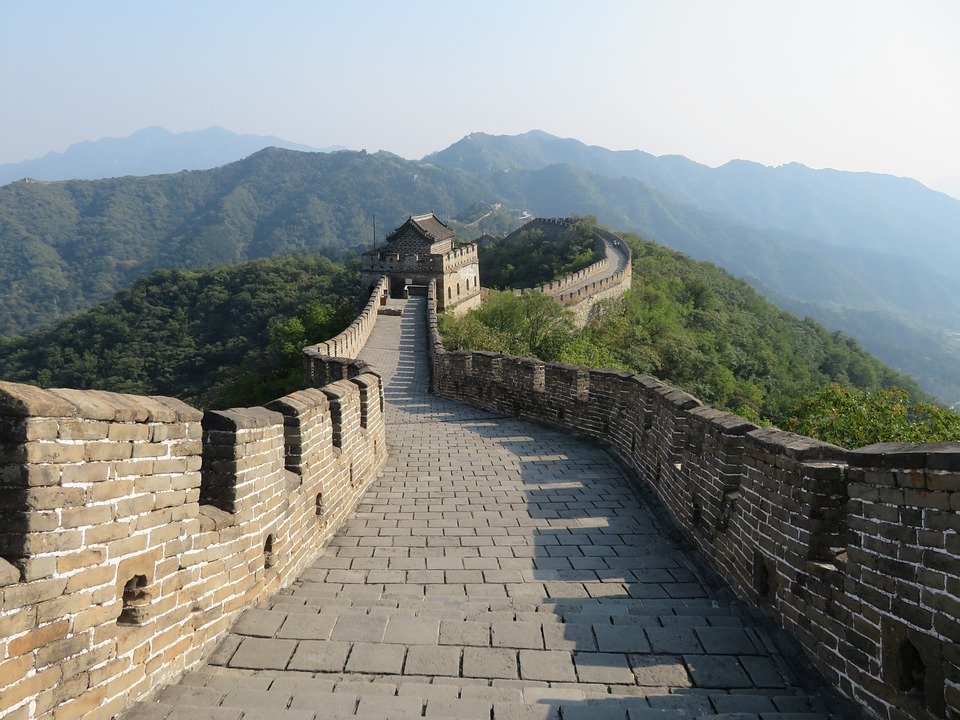
Capital: Beijing
Population: 1.4 billion+
Language: Putonghua, based on Mandarin is the official language. Cantonese, Wu, Hokkien and Hakka are major regional languages, and Tibetan, Uyghur, Mongolian and Zhuang are among the recognised minority languages
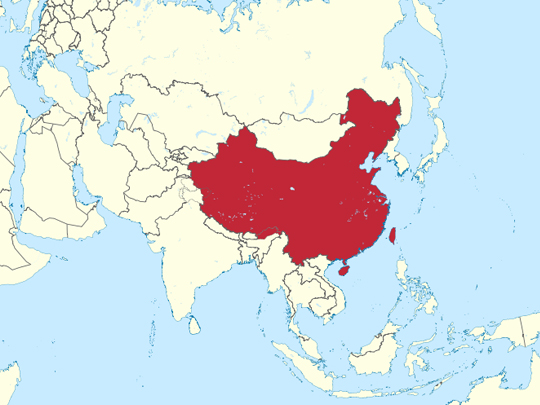
1 – Great Wall of China (also above)

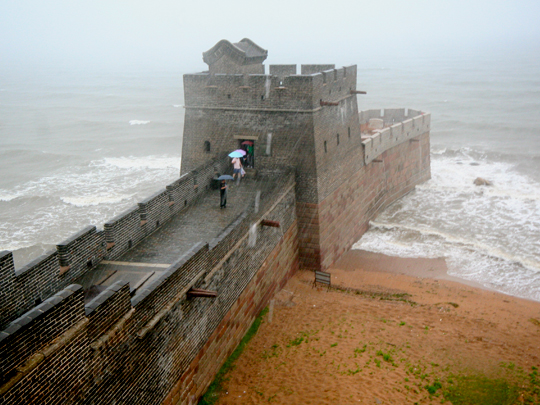
Shanhai Pass
Not one wall but a defensive system built, rebuilt and abandoned over two thousand years by a run of successive dynasties — a 2012 government survey put the total length of everything that counts as Great Wall, including trenches and natural barriers pressed into service, at 21,196 kilometres, of which the well-preserved Ming sections account for around 8,850.
Badaling near Beijing is the most restored and the most crowded; Mutianyu and Jinshanling give you ridgeline walking with room to breathe; and Shanhai Pass at the eastern end is where the wall comes down out of the hills and runs into the Bohai Sea at a fort called Laolongtou, the Old Dragon’s Head.
The gate at Shanhai Pass was known as the First Pass Under Heaven, and in May 1644 the Ming general holding it, Wu Sangui, opened it and let a Manchu army through to deal with a peasant rebellion — the wall did not fail, it was unlocked, and the Qing ruled China for the next 268 years.
2 – Forbidden City
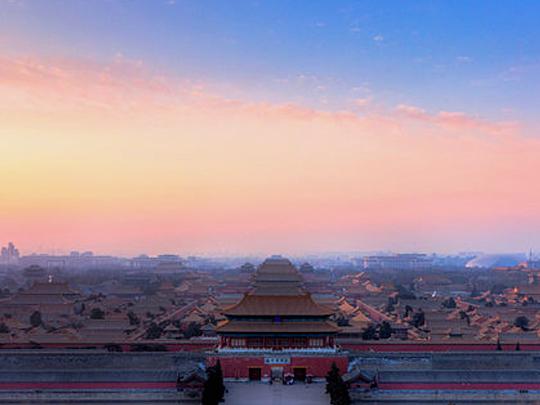
The Forbidden City was built between 1406 and 1420 when the Ming moved the capital north to Beijing, and home to twenty-four emperors across two dynasties until the last of them, Puyi, was evicted in 1924 — around 980 surviving buildings over 72 hectares, inside a moat and a ten-metre wall, laid out along the city’s north–south axis.
You come in from the south through the Meridian Gate, cross the Outer Court with its three great ceremonial halls, then pass into the Inner Court where the emperors actually lived and worked, finishing in the imperial garden; the Hall of Clocks and the Treasure Gallery are ticketed separately and are worth the extra.
It became the Palace Museum in 1925, and in the late 1940s the Nationalists shipped the best of the collection to Taiwan — which is why the finest imperial Chinese art is divided between two institutions both called the Palace Museum, one in Beijing and one in Taipei, each holding what the other hasn’t got.
3 – Summer Palace – Beijing
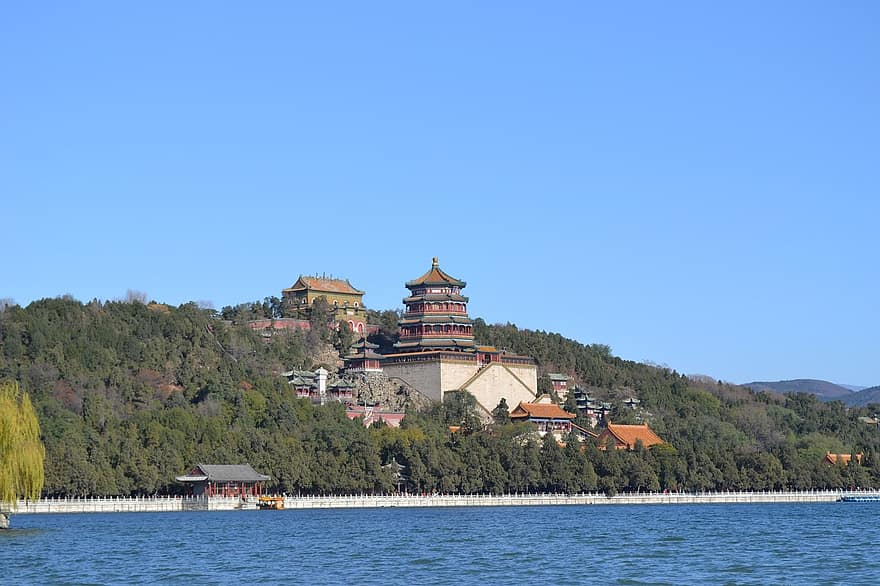
The Summer Palace is an imperial retreat of lake, hill and pavilions northwest of Beijing, rebuilt through the 1880s by the Empress Dowager Cixi after British and French troops burned the earlier version in 1860 — then burned again by the Eight-Nation Alliance in 1900, and rebuilt again.
Kunming Lake takes up three-quarters of the site with Longevity Hill rising behind it, the two joined by the Long Corridor, 728 metres of covered walkway painted end to end with thousands of scenes; a seventeen-arch bridge runs out to an island, and a two-storey marble boat sits at the shore that has never gone anywhere.
That boat is the most quoted object in modern Chinese history: Cixi is widely said to have paid for the restoration out of funds earmarked for the imperial navy, and when the Japanese destroyed that navy in 1894 the marble boat became the shorthand for what the money had bought instead — historians still argue about how much was really diverted.
4 – Heaven Lake
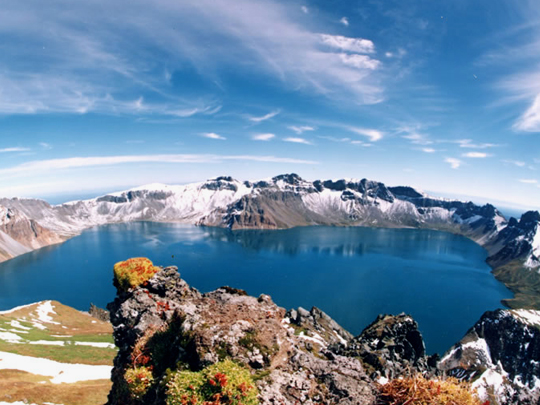
Heaven Lake is a crater lake at about 2,190 metres filling the caldera of Changbaishan, an active volcano on the North Korean border — the frontier runs straight through the water, so roughly half the lake is Chinese and half is not, and at close to 380 metres it is the deepest lake in China.
Three routes climb from the Chinese side through the Changbaishan nature reserve, the western and northern being the busiest; you are bussed most of the way, the summit is in cloud more often than not, and the reserve also takes in a waterfall, hot springs and a sunken valley of trees growing below ground level in an old collapse.
The caldera was made by the Millennium Eruption of 946, one of the largest volcanic events of the past two thousand years, which dropped ash as far as northern Japan — and the same mountain, called Paektu on the far side, is the sacred peak of Korean national myth.
5 – Terracotta Army
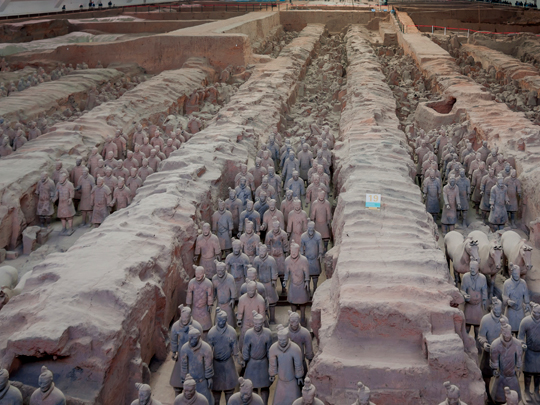
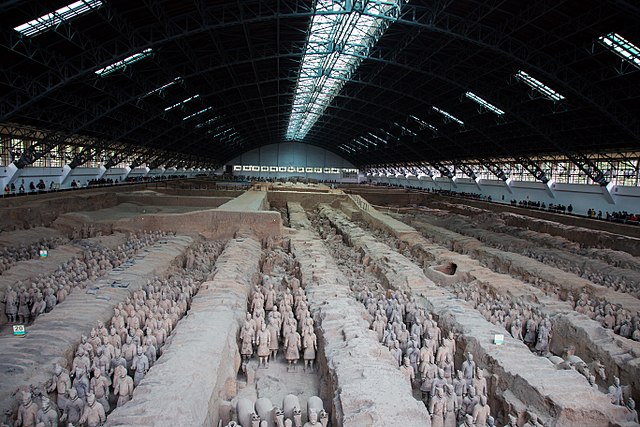
In March 1974 a group of farmers led by Yang Zhifa were sinking a well in Lintong County outside Xi’an and struck fired clay — what they had found was the outer guard of the mausoleum of Qin Shi Huang, the first emperor of a unified China, who died in 210 BC.
Three pits are open under hangars holding something over 8,000 figures with horses and chariots, known as the Terracotta Army, with every face individually finished; Pit 1 is the great parade formation, Pit 3 appears to be a command post, and the bronze weapons buried with them came out of the ground still sharp.
The emperor’s own tomb, a pyramid mound 76 metres high a short distance west, has never been opened — Sima Qian wrote a century afterwards that it held a map of the empire with rivers of mercury running through it, and soil surveys around the mound keep returning mercury readings far above anything in the fields around.
6 – Pingyao
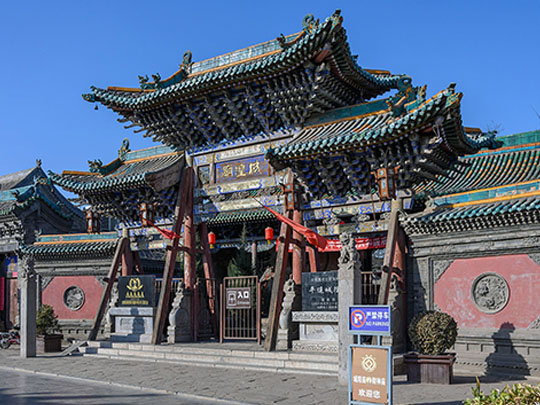
Pingyao is a walled Ming city on the Shanxi loess plateau, its six-kilometre rampart raised in 1370 and the street grid inside barely altered since — UNESCO listed it in 1997 as the most complete surviving example of a Han Chinese city of the imperial era, which it is largely because the place stopped mattering and nobody ever had a reason to knock it down.
You can walk the whole circuit of the walls and their seventy-odd watchtowers; inside are the old county government office with its courtrooms and cells, the City God temple, a long street of Ming and Qing shopfronts, and the courtyard houses of the merchant families, most of it on one combined ticket.
Pingyao invented modern Chinese banking: Shanxi merchants moving silver under armed escort needed something safer, and in 1823 a dye company on West Avenue reinvented itself as Rishengchang, the first draft bank — deposit silver in one city, present the paper in another, with ciphers and watermarks against forgery. Within decades the town held half the bank headquarters in China.
7 – Mogao Caves
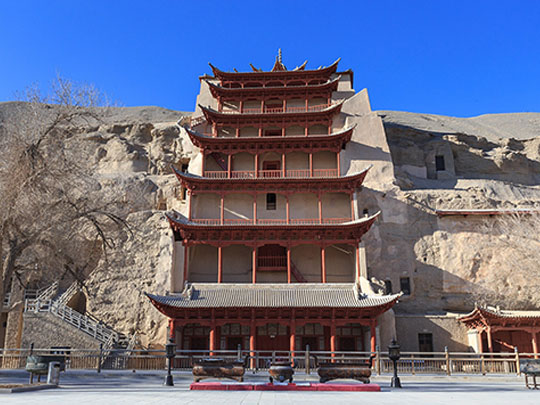
The Mogao Caves are four hundred and ninety-two decorated caves cut into a cliff outside Dunhuang in Gansu, on the edge of the Gobi at the point where the Silk Road divided to pass either side of the Taklamakan — carved, painted and repainted from the fourth century to the fourteenth, with some 45,000 square metres of wall painting and over two thousand painted sculptures.
Visits are tightly rationed: a timed ticket, a film at the visitor centre, then a guide and a fixed number of caves, which vary. The painting runs from early Indian and Central Asian styles through the confidence of the high Tang to late work under the Yuan, and no two caves look alike.
In 1900 a Daoist caretaker called Wang Yuanlu found a chamber walled up behind a mural holding perhaps fifty thousand manuscripts in seventeen languages, sealed around the year 1000 for reasons still argued over — Aurel Stein bought much of it in 1907 and Paul Pelliot more in 1908, and among what left was a Diamond Sutra printed in 868, the oldest dated printed book in the world.
8 – Kashgar
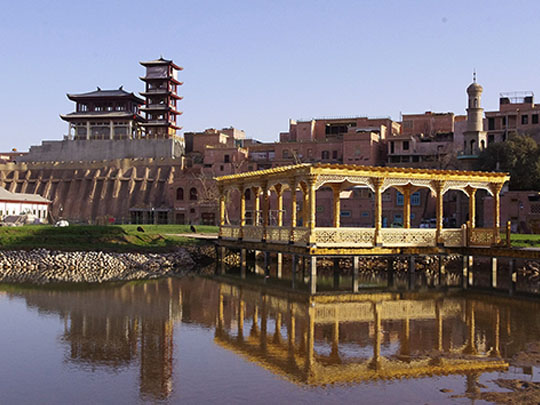

Kashgar is an oasis city at the western edge of the Taklamakan in Xinjiang, where the northern and southern Silk Road routes came back together before the crossing into the Pamirs — it is closer to Baghdad than to Beijing, and although all of China officially runs on Beijing time, Kashgar keeps an unofficial local clock two hours behind, so lunch falls at two and dinner at nine.
The population is around 85 per cent Uyghur; the Id Kah Mosque on the central square, founded in 1442 and much enlarged since, is the largest in China and takes up to twenty thousand worshippers; the old city is a grid of mud-brick lanes and craft workshops, and the Sunday livestock market is among the biggest in Central Asia.
From 2009 the authorities began demolishing and rebuilding that old city on a large scale, presenting it as earthquake-proofing after the 2008 Sichuan quake; critics outside China characterised it as the erasure of Uyghur urban fabric. Reported targets ran as high as 85 per cent of the quarter, and much of what a visitor walks through now is reconstruction.
9 – Potala Palace – Lhasa
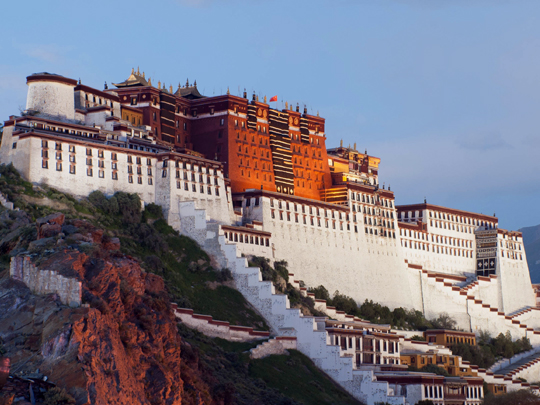
The Potala Palace is thirteen storeys of whitewashed and ox-blood stonework standing on Marpo Ri, the Red Hill, above Lhasa at around 3,700 metres — a palace was first raised here by King Songtsen Gampo in the seventh century, and the building you see was begun in 1645 by the fifth Dalai Lama. UNESCO listed it in 1994.
The White Palace held the government offices and the living quarters; the Red Palace behind it holds the chapels and the golden funeral stupas of eight Dalai Lamas, the fifth’s standing close to fifteen metres under more than three tonnes of gold. Tickets are booked a day ahead through an agency and time inside is limited.
The fifth Dalai Lama died in 1682 with the Red Palace unfinished, and his regent, Desi Sangye Gyatso, concealed the death for around fifteen years — maintaining that he was in extended retreat — so that the work could be completed and the succession managed. It was the winter residence of every Dalai Lama afterwards until the fourteenth left for India in 1959.
10 – Lake Namtso
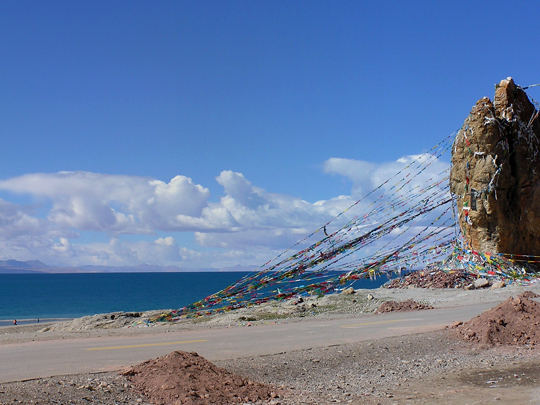
Lake Namtso, a salt lake of roughly 1,900 square kilometres lying at about 4,718 metres in the Nyenchen Tanglha range, a long day’s drive north of Lhasa, and one of the highest large lakes anywhere on earth — the name means heavenly lake, and it is one of the three great holy lakes of Tibet.
The road crosses the Laken pass at over 5,100 metres before dropping onto the Tashi Dor peninsula in the southeastern corner, where a small monastery sits among cave hermitages beneath two enormous boulders; the shore freezes from around November, the grassland behind is summer pasture, and the altitude is genuinely serious.
Pilgrims walk the circuit of the lake clockwise, a journey of several weeks on foot, and in the Tibetan Year of the Sheep — which comes round every twelve years — the numbers making the walk multiply, on the understanding that merit earned there in that year counts many times over.
11 – Huanglong
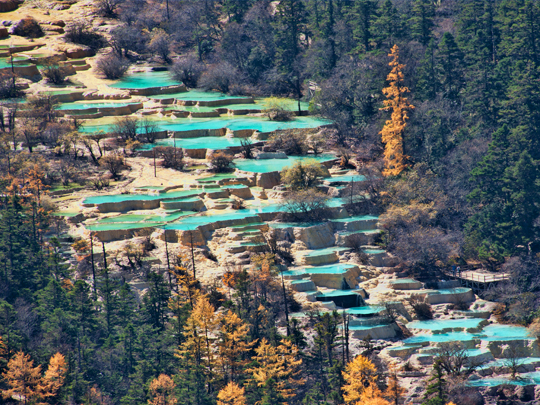
Huanglong, a valley above 3,000 metres in northern Sichuan where calcium-rich water runs down a limestone slope and drops its load as it goes, building terraces of travertine that hold several thousand shallow pools — the name means yellow dragon, which is what the ridge of gold-coloured rock looks like from above.
A boardwalk climbs about four kilometres up the valley past the pool systems to the Five-Colour Pond near the top, around 3,600 metres, where the water goes turquoise, green and gold depending on depth and mineral load; there is a cable car if you would rather not do the ascent at that altitude.
The pools are alive in the only sense that matters here — they are still being built, at a millimetre or two of fresh travertine a year — which is also why they are fragile, and why the boardwalk is not a crowd-control measure but the reason the terraces are still in one piece.
12 – Jiuzhaigou
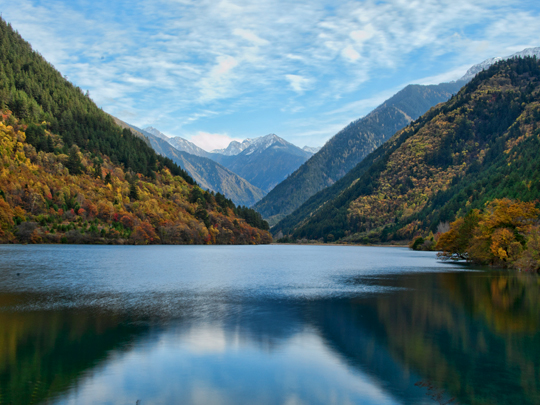
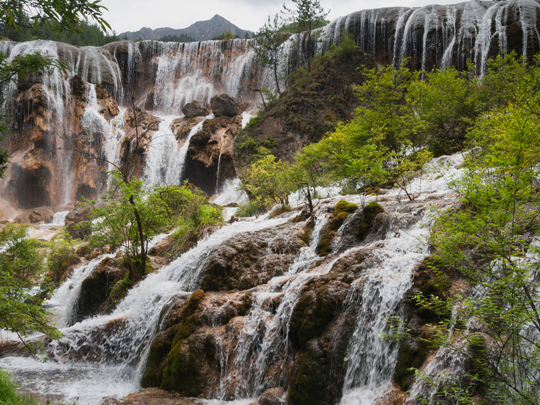
A Y-shaped system of valleys in the same corner of northern Sichuan as Huanglong, roughly a hundred kilometres away, with more than a hundred lakes, crystal clear, vibrantly coloured blues and greens, saturated enough to look retouched — Jiuzhaigou means nine-village valley, after the Tibetan settlements along it, several still lived in.
Buses run up the arms of the Y and you walk down between stops, past Five Flower Lake with a drowned forest lying visible on the bottom, the wide Pearl Shoal and the Nuorilang falls; the colour comes from dissolved calcium carbonate and algae, and October is the month, when the surrounding forest turns.
In August 2017 a magnitude-7 earthquake hit Jiuzhaigou, killed twenty-five people, damaged the falls and drained one of the lakes entirely when its natural dam gave out — the park reopened in stages, and the water simply carried on rebuilding, which is what made the place to begin with.
13 – Giant Buddha – Leshan

Seventy-one metres of Maitreya cut into a red sandstone cliff at Leshan in Sichuan, facing the confluence of three rivers — a monk named Hai Tong began it in 713 with an entirely practical aim, to calm water that was wrecking boats, on the reasoning that the spoil going into the river would slow the current.
You can look up at the Giant Buddha from a boat or take the staircase cut into the cliff alongside, which brings you level with an ear seven metres long; the surrounding rock carries thousands of smaller carvings, and a drainage system of hidden channels runs through the head and shoulders, which is why it is still here.
Hai Tong spent twenty years begging for the money, and when local officials came for it he is said to have offered them his eyes instead, and then gouged one out to settle the argument — he died with the carving at shoulder height, and his disciples took another seventy years to finish it.
14 – Guilin and the Li River
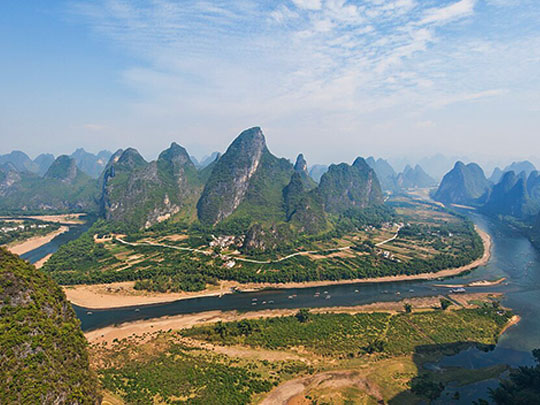
Limestone towers standing in the flat valley of the Li River in Guangxi, left behind as groundwater dissolved a plateau out from around them over tens of millions of years — a Song dynasty official wrote that the scenery at Guilin was the finest under heaven, and the line has been on every brochure printed since.
The standard way to see it is the 83-kilometre cruise down from Guilin to Yangshuo, four or five hours between the peaks; smaller bamboo rafts work the quieter Yulong river, there are caves at Reed Flute, and the rice terraces at Longji are a couple of hours north.
The stretch near Xingping is printed on the back of the twenty-yuan note, so a fair number of passengers spend the cruise holding a banknote up at arm’s length to line the real view up behind it — and the cormorant fishermen posing on the bamboo rafts are working a trade that stopped being economic decades ago.
15 – Huangguoshu Waterfall
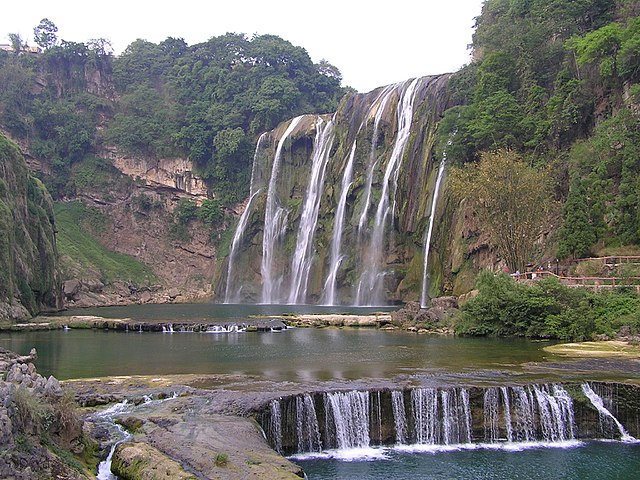
Huangguoshu Waterfall, the largest waterfall in China, on the Baishui river in Guizhou, roughly 78 metres high and a hundred wide when the river is up — it sits in deep karst country and is the biggest of a chain of eighteen falls strung along the same river system.
You can see it from above, below, in front and, unusually, from behind: a natural passage called the Water Curtain Cave runs 134 metres through the cliff behind the falling water, with openings along it that let you look out through the curtain itself.
That cave is Sun Wukong’s house — the 1986 television Journey to the West, one of the most-watched programmes ever made in China and still repeated every summer holiday, filmed the Monkey King’s Water Curtain Cave here, and for a great many Chinese visitors that, rather than the hydrology, is the reason to come.
16 – Zhangjiajie National Forest Park
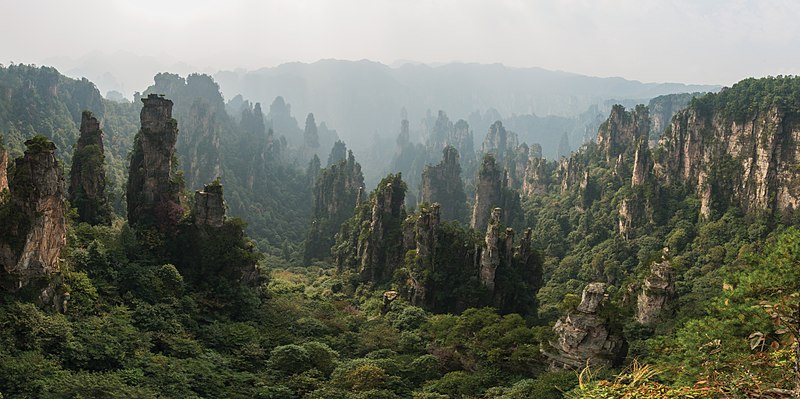
Three thousand quartz-sandstone pillars standing in the subtropical Zhangjiajie National Forest Park in northwestern Hunan, some over a thousand metres, cut out of a plateau by water and frost over an extremely long time — China made it the country’s first national park in 1982, and UNESCO listed the wider Wulingyuan area ten years later.
Cable cars and lifts do most of the vertical work, including a glass-sided elevator bolted to the outside of a cliff; over at neighbouring Tianmen Mountain there is a road with ninety-nine hairpins and a glass-floored walkway pinned to the rock face, for those who enjoy that sort of thing.
A location scout photographed these pillars in 2008 and they became the Hallelujah Mountains of Avatar; in 2010 the local government held a ceremony renaming the Southern Sky Column “Avatar Hallelujah Mountain”, then partly backed away from it after a domestic row about naming a Chinese peak for an American film — the new name stuck regardless.
17 – Huangshan

Huangshan, a granite massif in southern Anhui: seventy-odd peaks of bare rock with pines growing sideways out of the fissures and cloud filling the valleys below the summits — and no landscape in China has been painted more often, because this is where the shan shui tradition worked out what a mountain was supposed to look like.
Most people go up by cable car and walk the ridge paths between Bright Summit, Lotus Peak and the Greeting Pine; the sea of cloud is the thing worth timing for, which in practice means staying overnight on the mountain and being out before first light.
Xu Xiake, the seventeenth-century traveller whose diaries are the great record of the Chinese landscape, is supposed to have said that after Huangshan there is no point looking at other mountains — a line every guide will quote at you, and one that has been doing the local tourist board’s work for four hundred years.
18 – Suzhou
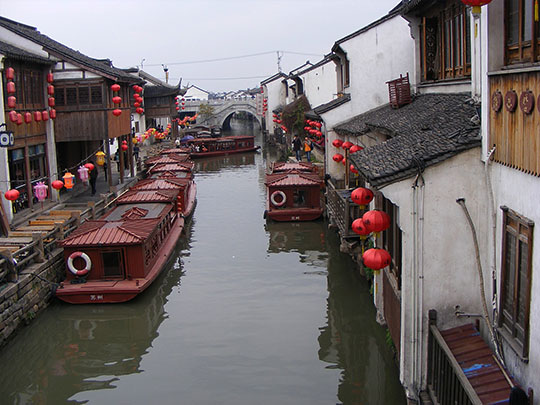
Suzhou is a canal city west of Shanghai, founded in the sixth century BC and made rich by silk and by the Grand Canal, and from the Song dynasty onwards the place where retired and dismissed officials built private gardens to prove a point about how a cultivated man withdraws from public life — nine of them are inscribed together by UNESCO, more than anywhere else in China.
The Humble Administrator’s Garden is the largest at around five hectares and is mostly water, laid out from 1509; the Lingering Garden is the most architecturally elaborate; the Master of the Nets is the smallest and, for a lot of people, the best — and the Suzhou Museum beside it was I. M. Pei’s last major building.
That first name is a joke, and a sour one: Wang Xianchen built the garden after being forced out of the censorate, and took the name from a line about gardening being the way an unsuccessful man goes about governing. He is said to have lost it almost immediately, when his son gambled it away in a single night.
19 – Yu Garden – Shanghai

Known as Yu Garden, two hectares of Ming scholar’s garden in the middle of Shanghai’s old city, begun in 1559 by an official called Pan Yunduan as a retirement garden for his father and close to twenty years in the making — by which point the cost had done serious damage to the family, and the garden passed out of their hands soon afterwards.
The design is the whole point: rockeries, ponds, zigzag bridges and dividing walls arranged so that no view is ever complete and two hectares feel like considerably more, with a tall pierced boulder called the Exquisite Jade Rock as the centrepiece and the Huxinting teahouse out on the pond beyond the wall.
It has been wrecked repeatedly by whatever was happening around it — occupied and shelled during the Small Swords rising of the 1850s, used as a barracks by foreign troops, bombed in the 1940s — and restored each time, so a garden designed to feel centuries old is in fact largely modern work.
20 – Hong Kong

A deep-water harbour on the Pearl River delta, Hong Kong was ceded to Britain in 1842 and enlarged by later cessions and a 99-year lease, returned to China in 1997 and run since as a Special Administrative Region with its own legal system, currency and immigration controls — about seven and a half million people on just over 1,100 square kilometres.
The Star Ferry across the harbour, the Peak tram up to the viewpoint, the double-decker trams along the north shore of Hong Kong Island, the Tian Tan Buddha out on Lantau, the incense smoke of Man Mo Temple and the street markets of Kowloon — under a skyline usually reckoned to hold more tall buildings than any other city on earth.
The surprise is how little of it is city. Roughly forty per cent of the territory is protected country park, and the great majority of the land is undeveloped — hills, reservoirs, beaches and long-distance trails, some of which start forty minutes from Central on public transport.
21 – Macau
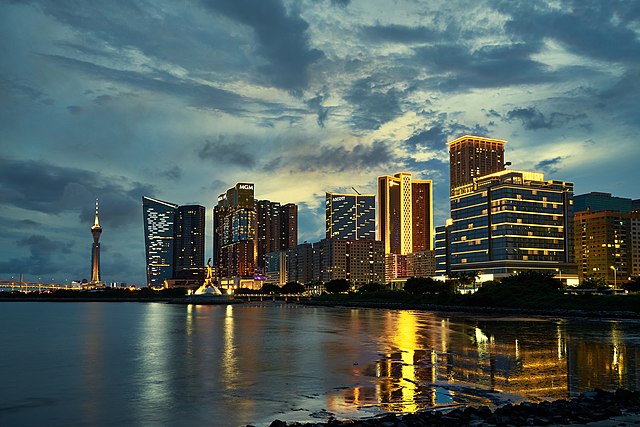
Forty square kilometres at the mouth of the Pearl River, Portuguese from the 1550s until the handover in 1999, which made Macau by a wide margin the longest-lived European settlement in Asia — and now a Special Administrative Region with its own laws, currency and immigration controls.
The old town is a World Heritage listing in its own right: the stone facade of St Paul’s standing alone at the top of its steps with nothing behind it, Senado Square in Portuguese black-and-white paving, the A-Ma Temple down by the water that probably gave the place its name, and the Guia lighthouse, the first on the China coast.
Macau’s casinos passed Las Vegas in revenue in 2006 and have taken several times the Strip’s receipts in good years since, on a territory a fraction of the size — and the resulting government surplus is handed back to permanent residents as an annual cash payment, which no other gambling economy has quite managed.