
shankar s. / Wikimedia Commons / CC-BY-SA-3.0 / GFDL
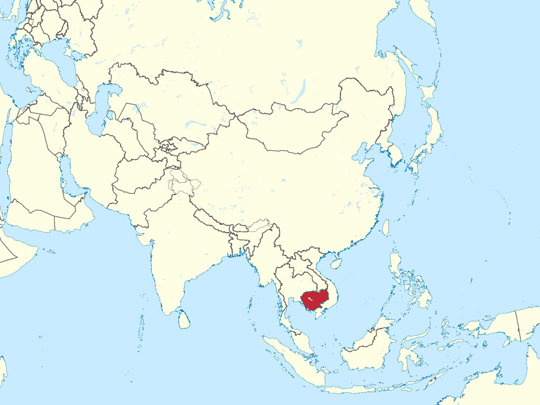
Capital: Phnom Penh
Population: 17 million+
Language: Khmer, Cham, Vietnamese, Chinese & English.
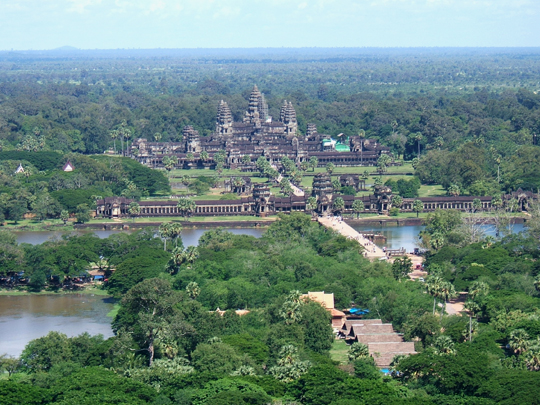
1 – Angkor Wat (also above)
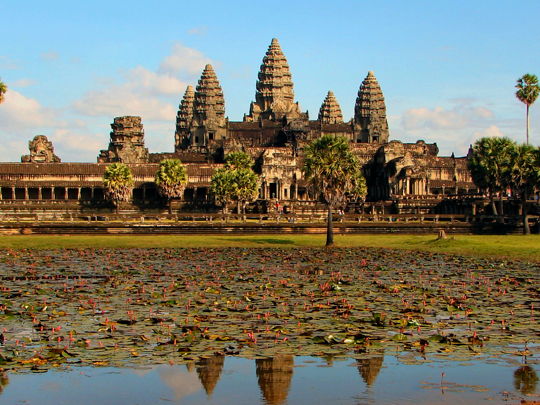
Built in the first half of the twelfth century for Suryavarman II as a Hindu temple to Vishnu, Angkor Wat covers around 160 hectares inside its moat and is generally described as the largest religious structure ever raised — and unlike most of Angkor it was never abandoned, sliding from Hindu to Theravada Buddhist use and working as a temple ever since.
The approach runs west along a causeway over a moat 190 metres wide to five towers arranged as Mount Meru, with close to six hundred metres of bas-relief gallery at ground level — the Churning of the Ocean of Milk on the east wall is the one to find — and something like 1,800 apsara figures carved into the walls above.
Almost every Khmer temple faces east; this one faces west, the direction of death, and that, with reliefs that read anticlockwise, has persuaded many scholars it was built as Suryavarman’s own funerary temple — it has also appeared on every Cambodian flag since the 1860s, including the Khmer Rouge’s.
2 – Royal Palace – Phnom Penh
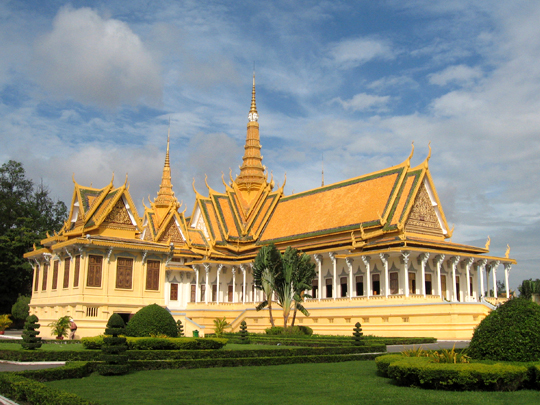
The Cambodian court moved down to Phnom Penh in the 1860s and King Norodom began the palace in 1866; most of what stands now was rebuilt in the 1910s, and the Royal Palace is still the king’s residence, which is why parts are closed to visitors and the rest has a dress code.
The Throne Hall is used for coronations and for receiving ambassadors, and beside it the Silver Pagoda takes its name from more than five thousand solid silver tiles laid across the floor, holding a seventeenth-century Emerald Buddha cut from Baccarat crystal and a life-size gold Maitreya set with several thousand diamonds.
In one corner stands a cast-iron pavilion with nothing to do with Cambodia at all: it was erected in Egypt for the Empress Eugénie to stay in at the opening of the Suez Canal, then dismantled and shipped out here in the 1870s — and it is the only building in the compound left from the original palace.
3 – Tuol Sleng
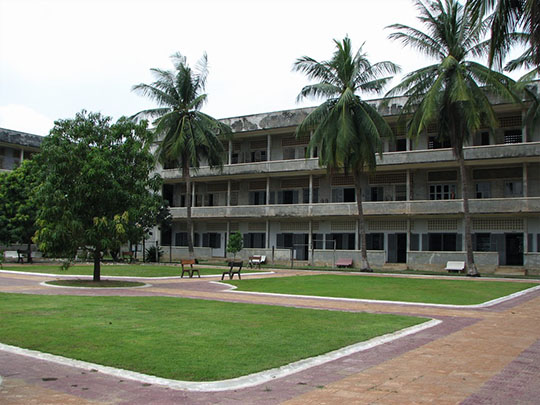
In the middle of Phnom Penh stands Chao Ponhea Yat High School, built in 1962 and taken over within weeks of the Khmer Rouge entering the city in April 1975 — the classrooms were emptied, the balconies wired over, and it became Security Prison 21, the interrogation centre of the regime’s internal security branch, and is now Tuol Sleng Genocide Museum.
Four blocks around a courtyard, left close to how they were found in 1979: cells partitioned out of classrooms in brick and rough plank, iron bedframes, the graves of the last fourteen prisoners by the gate, and room after room of the photographs taken of everyone who came through it — the regime documented its own prisoners obsessively, which is why the faces are all still here.
Somewhere between twelve and fifteen thousand people passed through and roughly a dozen came out alive, almost all because they had a skill the prison wanted — one was Vann Nath, kept back to paint portraits of Pol Pot, who returned after 1979 and painted instead what he had watched happen; those canvases hang in the museum now, beside the photographs.
4 – Choeung Ek Mass Graves
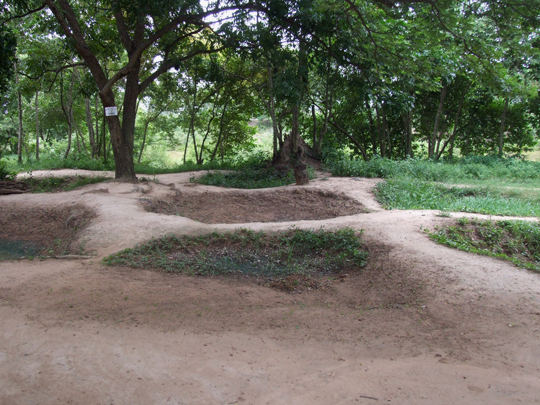
A former orchard and Chinese cemetery about fifteen kilometres south of Phnom Penh in Choeung Ek, this is where prisoners were driven at night once S-21 had finished with them — and it is the best known of more than three hundred such sites scattered across the country.
A hundred and twenty-nine mass graves have been identified here and eighty-six excavated, the remains of 8,985 people recovered from them; a memorial stupa built in 1988 holds several thousand skulls behind glass, arranged by age and sex, and bone and cloth still work their way up to the surface after heavy rain.
Estimates of how many people the regime killed run between one and a half and two million, close to a quarter of the country — and the tribunal that eventually sat, three decades later, convicted three men.
5 – Bayon
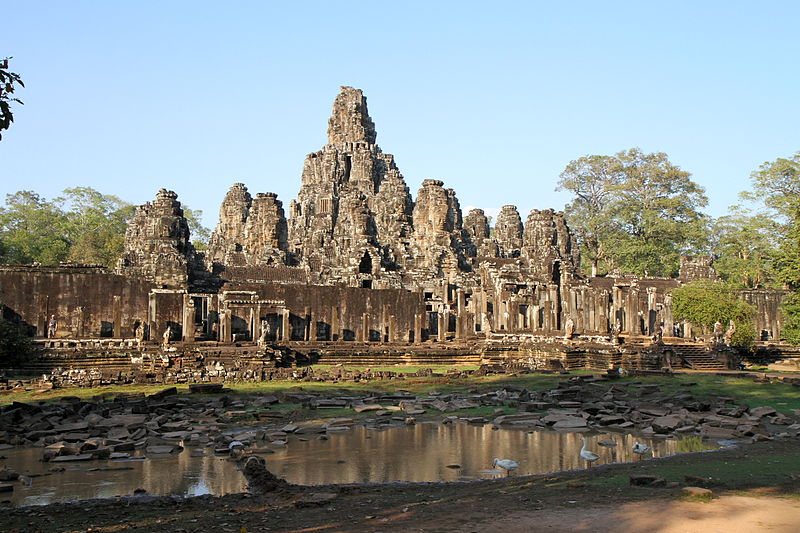
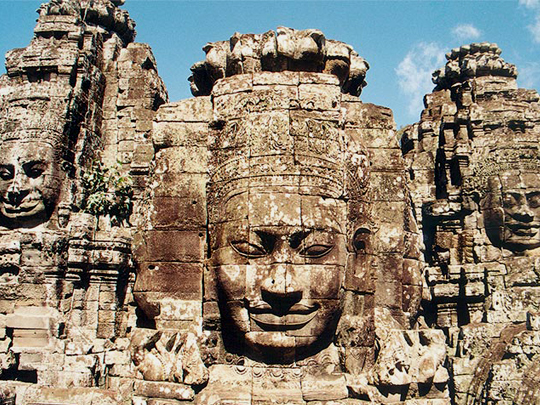
At the exact centre of Angkor Thom, the nine-square-kilometre walled city Jayavarman VII laid out after driving the Cham invaders back in 1181, the Bayon was his state temple — and where Angkor Wat is Hindu, ordered and symmetrical, this one is Buddhist, crowded and deliberately strange.
Fifty-four towers carry something like 216 huge stone faces, each around four metres high and turned to a cardinal point, all wearing the same closed-eyed smile; scholars have argued for a century over whether they represent the bodhisattva Lokeshvara, the king himself, or quite deliberately both at once.
The real find is at ground level: over a kilometre of bas-relief gallery showing not gods but ordinary twelfth-century life — a market with Chinese merchants identifiable by their clothes, cockfights, cooks at work, women giving birth, fishermen on the Tonle Sap, and the naval battle against the Chams that put Jayavarman on the throne in the first place.
6 – Banteay Srei

Thirty-odd kilometres northeast of the main Angkor group, Banteay Srei was consecrated in 967 and is the only major temple at Angkor not built for a king — it was founded by Yajnavaraha, a Brahmin scholar who advised one monarch and tutored the next.
It is small, and that is the point: three low towers and two libraries in rose-pink sandstone, carved so deeply and so finely across every lintel and pediment that the surfaces read more like woodwork than masonry, with Ramayana scenes above the doorways and devatas standing in niches along the walls.
In 1923 a twenty-two-year-old André Malraux — later France’s culture minister — cut four devatas off those walls and was arrested and tried in Phnom Penh, and the scandal is what finally pushed the French administration into protecting Angkor seriously; Banteay Srei became the first temple there rebuilt by anastylosis.
7 – Neak Pean
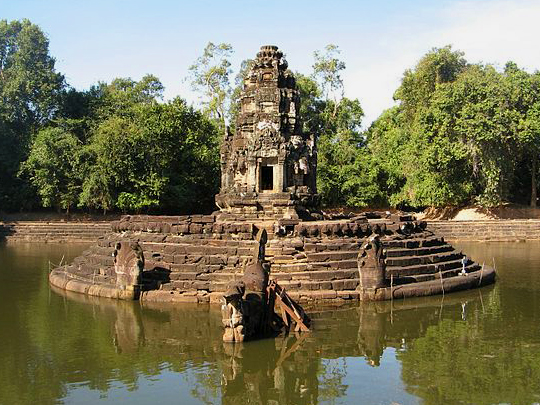
A small temple on a circular artificial island in the middle of a baray north of Angkor Thom, Neak Pean was built by Jayavarman VII in the late twelfth century and named for the pair of stone serpents coiled around its base.
A square central pool holds the island, with four smaller pools at the cardinal points, each linked to the centre by a stone spout carved as a head — human, lion, horse and elephant; it is at its best in the wet season when the pools are full, and you reach it along a boardwalk laid across the baray.
It was almost certainly a hospital, or at least a place of ritual healing: the layout copies Anavatapta, the lake in Buddhist cosmology whose water cures every illness, and pilgrims bathed in whichever pool matched their complaint — Jayavarman built more than a hundred hospitals across his empire, and this is what one looked like when it was also a temple.
8 – Koh Rong
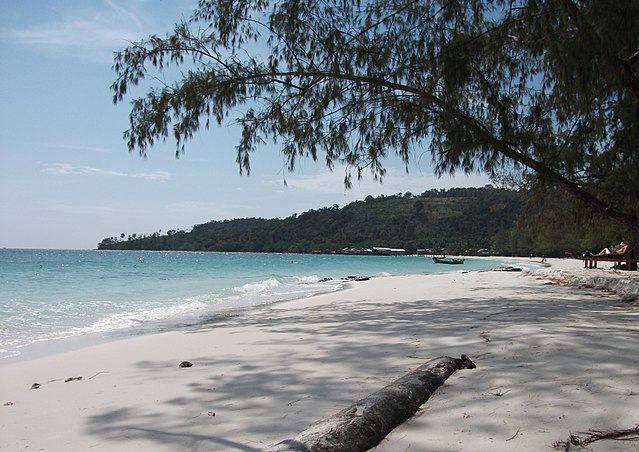
Koh Rong is Cambodia’s second-largest island, some 78 square kilometres of forested hills and long sand about 25 kilometres off Sihanoukville — and until roughly fifteen years ago it had almost no tourism at all, just a handful of fishing villages and no road worth the name.
The east side has the busy beaches around Koh Touch; Sok San on the west coast is a long quiet stretch with a village at one end; and Long Set, between them, is where the bioluminescent plankton turn up, lighting the water around you if you swim at night in the warmer months.
Several national editions of Survivor have been filmed here, which has done more for the island’s profile than any tourist board could — and Koh Rong is changing fast enough that the quiet version people came for in 2012 has largely relocated to its smaller neighbour, Koh Rong Sanloem.
9 – Koh Ker
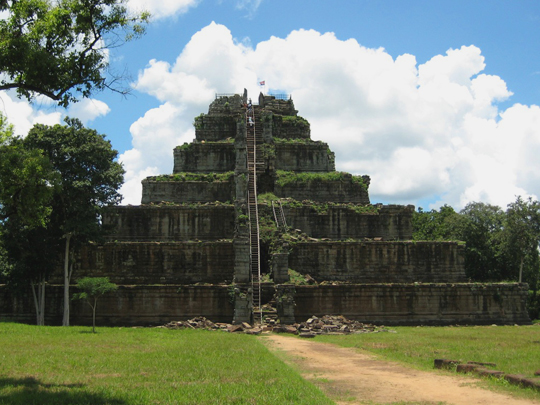
In 928 Jayavarman IV walked away from Angkor and founded his own capital 120 kilometres northeast in the forest, naming it Lingapura, the city of lingas; it lasted sixteen years before his successor moved the court back, and in that time something like 180 monuments went up.
The centrepiece is Prasat Thom, a seven-tiered sandstone pyramid rising around 35 metres straight out of flat forest, climbable by a staircase to a terrace with a view over unbroken canopy; a couple of dozen more temples are scattered through the trees, and the whole site was inscribed by UNESCO in 2023.
Being remote, Koh Ker was looted again and again, and its statues — monumental, oddly dynamic, unlike anything else in Khmer art — ended up in museums and private collections across the West; a restitution programme has been bringing them home, in several cases matched to their temple by the broken feet still standing on the pedestal.
10 – Tonle Sap
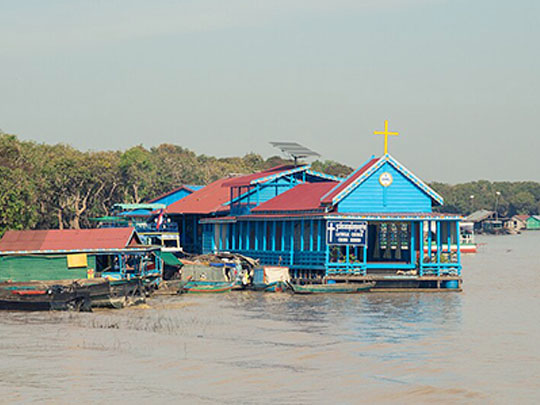
Tonle Sap is the largest freshwater lake in Southeast Asia sits in the middle of Cambodia and changes size every year on a scale nothing else quite matches: in the dry months it covers around 2,500 square kilometres at roughly a metre deep, and when the monsoon swells the Mekong, the river connecting the two is forced to run backwards, filling the lake to five or six times that area and nine or ten metres deep.
Boats go out from Siem Reap to villages built for the water — Kampong Phluk on stilts ten metres high, Kampong Khleang much larger and far less visited, Chong Kneas nearest and most commercialised — and to Prek Toal, a biosphere core zone holding one of the biggest waterbird colonies in Southeast Asia.
That flood is the reason Angkor is where it is, and the lake still runs one of the most productive inland fisheries on earth — though upstream dams and a weakening flood pulse are now measurably thinning both the flooded forest and the catch.