
Wikimedia Commons / CC-BY-SA-3.0 / GFDL
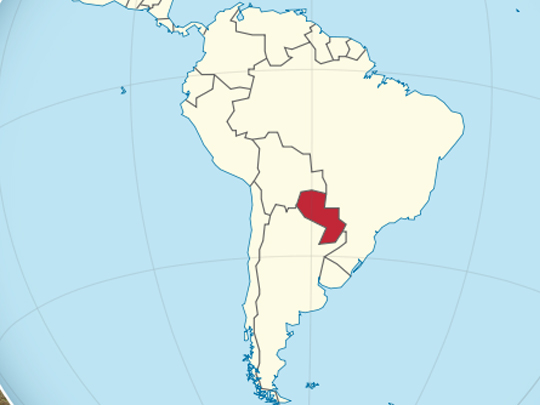
Capital: Asunción
Population: 6.4 million+
Language: Spanish and Guaraní
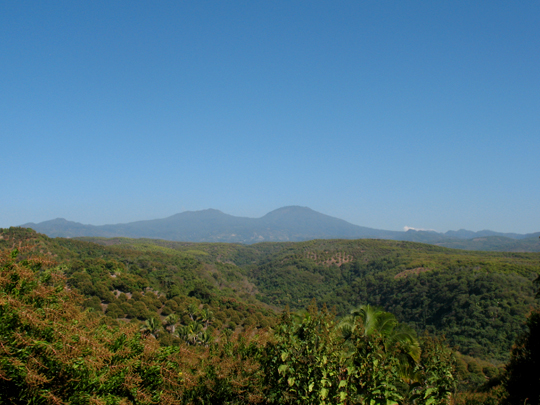
1 – Cerro Cora National Park (also above)
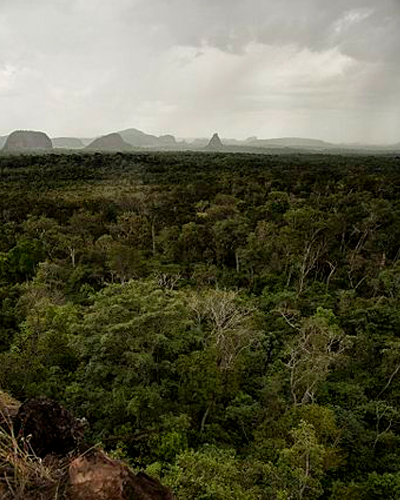
Paraguay’s largest protected area, some 5,500 hectares of wooded hills and rocky outcrops in Amambay near the Brazilian border, and the place where the War of the Triple Alliance ended on 1 March 1870, when Brazilian cavalry ran down the last Paraguayan camp beside the Aquidabán-Niguí stream and killed Marshal Francisco Solano López — a war that by most estimates had already killed more than half the country’s population.
The park works as both memorial and landscape: monuments and a small museum mark the spot where López died, while trails lead up the surrounding hills for wide views over the Cerrado, and the Aquidabán river has a shaded stretch that locals use for swimming.
Long before any of that, people were carving into the rock here — petroglyphs survive in shelters and caves across the park, and a research team dating them found some to be around 5,000 years old, which makes the famous battle a fairly recent event at Cerro Corá.
2 – Saltos del Monday
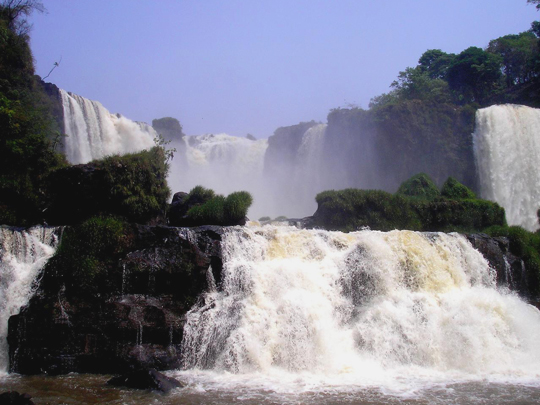
A wide curtain of falls roughly 40 to 45 m high near Presidente Franco in Alto Paraná, where the Monday River drops in three main cataracts just before it joins the Paraná, ringed by one of the last surviving pockets of Atlantic forest on this side of the river and long a gathering point on Guaraní routes through the region.
Walkways and viewing platforms bring you right up to the lip and down towards the spray, there’s zip-lining and abseiling on the cliffs for anyone who wants it, and the whole thing sits ten minutes from Ciudad del Este — close enough to add to an Iguazú trip, and blissfully empty by comparison.
Nothing to do with the day of the week: “Monday” is Guaraní, pronounced roughly mon-da-ugh, and is usually translated as the robbed river or river of thefts, though locals will offer you a few competing explanations of how it got the name.
3 – San José Beach – Encarnación
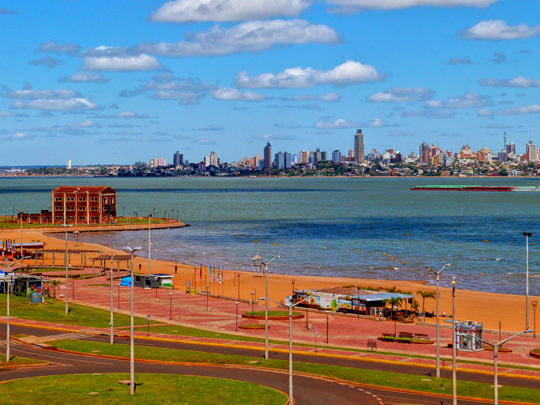
A broad sweep of sand on the Paraná in Paraguay’s southern border city, opposite Posadas in Argentina, and a fairly recent invention: when the Yacyretá dam downstream raised the river, the low-lying old town was cleared and its residents moved uphill, and the new waterfront built on the flooded ground came with beaches attached.
The Costanera promenade now runs several kilometres along the river with San José its busiest stretch — swimming, volleyball, food stalls, craft fairs and a sunset over Argentina — and the Jesuit ruins at Trinidad and Jesús are an easy day trip inland.
Encarnación throws the biggest carnival in Paraguay, a February run of floats, drums and feathered costumes down a purpose-built strip near the river, which is why a modest border city gets called the country’s answer to Rio.
4 – Itaipu Dam
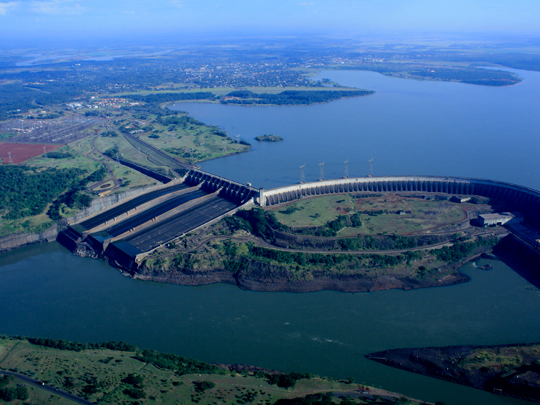
A colossal Brazilian-Paraguayan hydroelectric dam on the Paraná near Ciudad del Este, built between 1975 and 1991 and still one of the most productive power stations ever operated — it set a world record of 103 TWh in a single year and supplies the large majority of Paraguay’s electricity plus a substantial slice of Brazil’s.
Free and paid tours run daily to the crest, the turbine hall and viewpoints over the spillway, with an evening lighting show, and the surrounding land holds a biological reserve, a wildlife refuge and a museum on the project.
The reservoir drowned Guaíra Falls, a chain of eighteen cataracts on the Paraná that may have carried a greater volume of water than any waterfall on Earth; the gates closed in October 1982 and it vanished in a fortnight, after which the rock lip was dynamited for navigation, so it can never be brought back.
5 – La Santísima Trinidad de Paraná
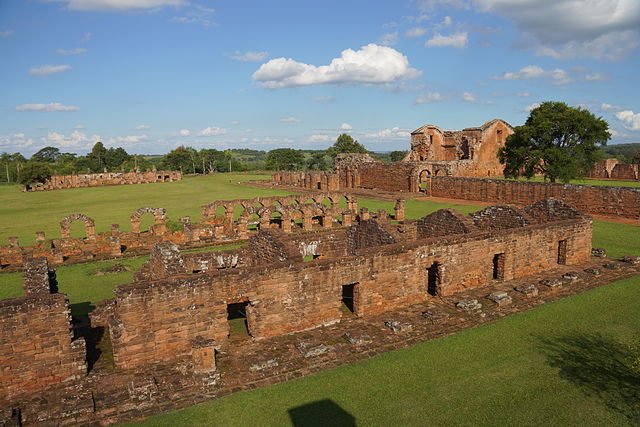
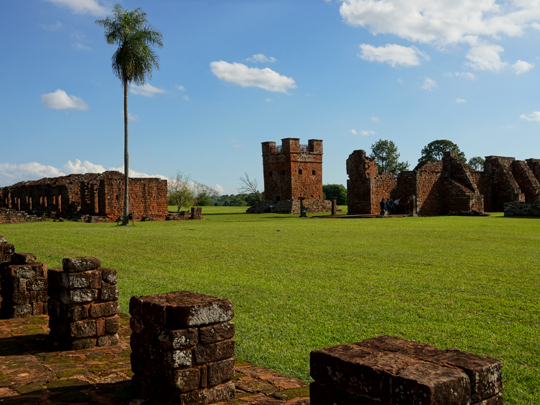
The best-preserved of the thirty Jesuit reductions built across what is now Paraguay, Argentina and Brazil, founded in 1706 on a terrace above the Paraná north of Encarnación, and by the 1720s home to several thousand Guaraní living in a self-governing town of workshops, schools and communal fields; UNESCO listed it in 1993.
Eight hectares of red sandstone ruins remain — the great church with its stone pulpit and carved doorways, the plaza, the bell tower, the indigenous housing blocks — and the frieze of angels playing maracas, harps and Guaraní instruments is the detail everyone photographs.
It all ended in 1767 when Spain expelled the Jesuits from its empire and the towns emptied within a generation, the same collapse dramatised in the 1986 film The Mission, which won the Palme d’Or and gave the reductions their afterlife in the popular imagination.
6 – Asunción
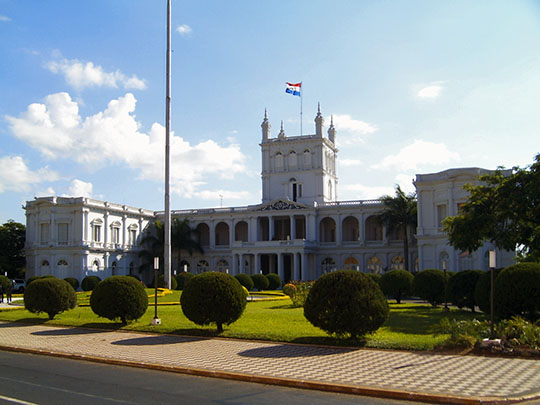

Founded on 15 August 1537 as a fortified post on the east bank of the Paraguay River, and by 1541 the base of Spanish power across the whole Río de la Plata basin after the settlers who had given up on Buenos Aires fled upriver to it; Paraguay declared its independence here in May 1811 and Asunción has been the capital ever since.
The old centre is worn and unpolished and rather better for it: the white Palacio de los López facing the water, the Panteón Nacional de los Héroes modelled on Les Invalides, the low colonial house where the 1811 conspirators met — now the Casa de la Independencia museum — and a crumbling railway station still holding its 19th-century locomotives.
Paraguayans call it the Mother of Cities and they mean it literally: expeditions sailing out from here founded Santa Fe, Corrientes and Santa Cruz de la Sierra, and in 1580 went back down the river to found Buenos Aires for a second time — which is to say the capital of Argentina was established from Paraguay.
7 – Fortin Boquerón
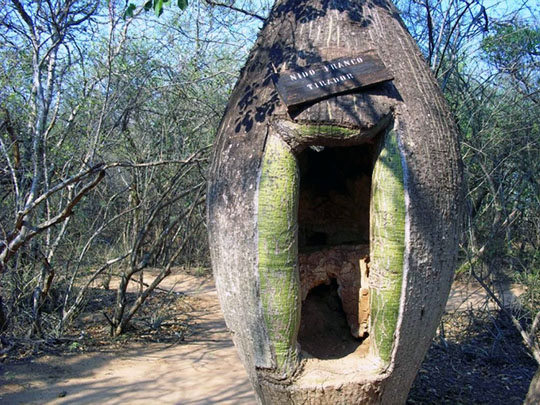
A remote outpost in the dry scrub of the Paraguayan Chaco where, between 9 and 29 September 1932, a Paraguayan force besieged and took a Bolivian garrison and opened the Chaco War — the first modern war fought in South America, over an all but waterless wilderness that both governments believed was sitting on oil.
The battlefield is preserved as a park off the Ruta Trans-Chaco, with original trenches, a reconstructed dressing station, a cemetery and a small but excellent museum of recovered weapons and photographs — and the hollowed-out palo borracho tree that served as a sniper’s post is still standing, and still alive.
The war killed something like 100,000 men in three years, a great many of them from thirst rather than gunfire, and it is remembered in Paraguay as the conflict that made the modern country.
8 – Yaguarón
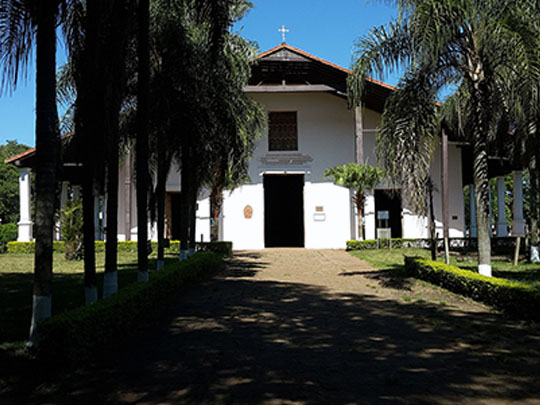
A small town 48 km from Asunción sitting beneath its own hill, which began as a Franciscan mission to the Guaraní and grew up around the church of San Buenaventura, built between 1755 and 1772 and now a protected national monument.
From outside it is a plain white barn with a separate bell tower; inside, every surface is carved, gilded and painted — retablo, pulpit, ceiling, columns — the work of Guaraní craftsmen under the Portuguese master José de Sousa Cavadas, and a block away the Museo Doctor Francia occupies the colonial house where Paraguay’s first ruler spent part of his childhood.
This is the same Hispano-Guaraní art you see lying in pieces at Trinidad, except that Yaguarón was never abandoned — it is still the parish church, still packed for the patronal feast, and so the one place in the country where you can stand inside a mission church rather than among its walls.