
Wikimedia Commons / CC-BY-SA-3.0 / GFDL
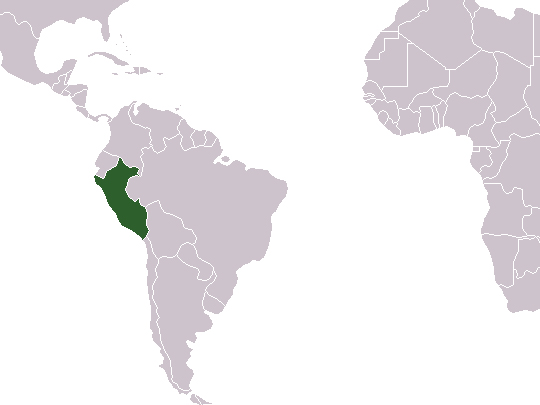
Capital: Lima
Population: 34 million+
Language: Spanish, Quechua and Aymara
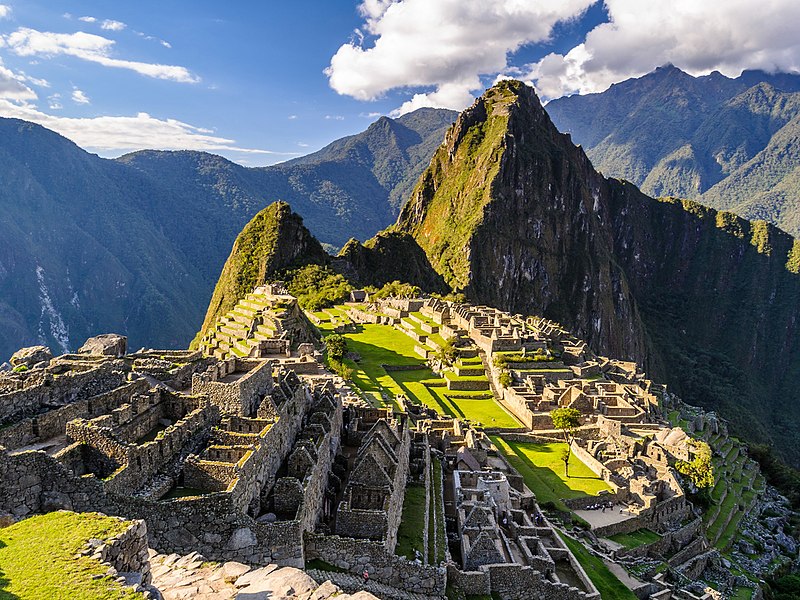
1 – Machu Picchu (also above)
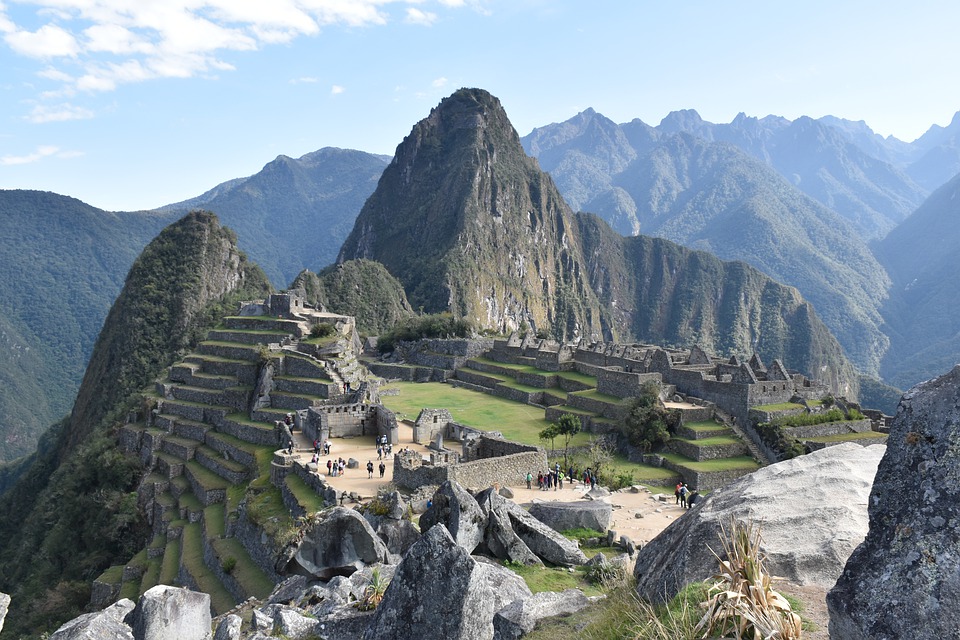
A royal estate built for the emperor Pachacuti around 1450, sitting on a saddle of granite at about 2,430 m with the Urubamba River looping far below, and emptied within a century of the Spanish conquest once the court that funded it collapsed.
The set pieces are the Temple of the Sun, the carved Intihuatana stone and the terraces stepping down the ridge, with steep add-on climbs up Huayna Picchu or Machu Picchu Mountain; entry is by timed ticket on fixed circuits, reached by train to Aguas Calientes or on foot along the Inca Trail.
The Spanish never found it, never recorded it and never smashed its shrines, which is why so much survives — and it was never really lost either, since Hiram Bingham was actually searching for the rebel stronghold of Vilcabamba in 1911 when a local farmer walked him up the ridge and he found families already farming the terraces.
2 – Plaza de Armas – Cusco
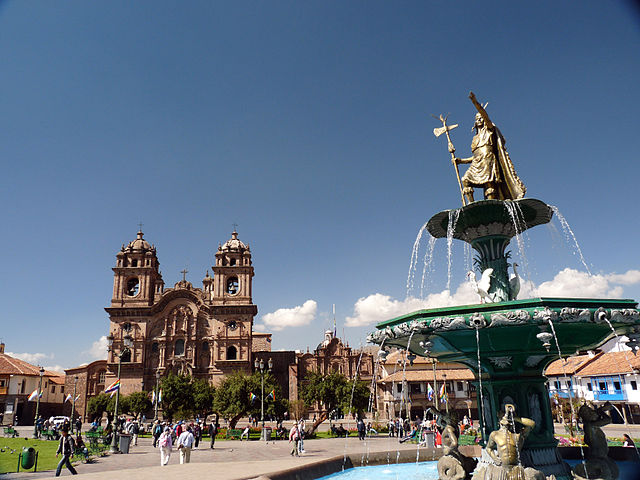
The ceremonial heart of the Inca empire at 3,400 m, known as Huacaypata, where the roads to the four quarters of the empire began and the great festivals were held, until the Spanish took the city in 1533 and built churches and mansions directly onto the demolished palaces.
The cathedral took roughly a century to finish and holds hundreds of Cusco School paintings plus the revered Lord of the Earthquakes crucifix; La Compañía faces it across the square, arcaded balconies run round three sides, and every 24 June the Inti Raymi procession fills the plaza.
Look for Marcos Zapata’s Last Supper inside the cathedral, in which Christ and the apostles sit down to a plump roasted guinea pig, with Andean chillies on the table and fermented corn chicha in the cups.
3 – Ollantaytambo – Sacred Valley

A Sacred Valley town about 60 km from Cusco laid out as a royal estate under Pachacuti, and the site of one of the very few Inca victories in open battle: in 1537 Manco Inca diverted the river to flood the plain, bogged down Hernando Pizarro’s cavalry and drove the Spanish back from the terraces above.
Temple Hill rises in enormous stepped terraces to an unfinished Temple of the Sun built from six pink granite monoliths of around 50 tonnes each, hauled from a quarry across the valley; the storehouses of Pinkuylluna sit on the opposite slope, and the town is also the railhead for Machu Picchu.
The town below the ruins is the real surprise — people still live inside the original Inca street grid, in houses on Inca foundations, with Inca water channels running down the middle of the lanes, which is why it gets called the oldest continuously inhabited town in the Americas.
4 – Saksaywaman
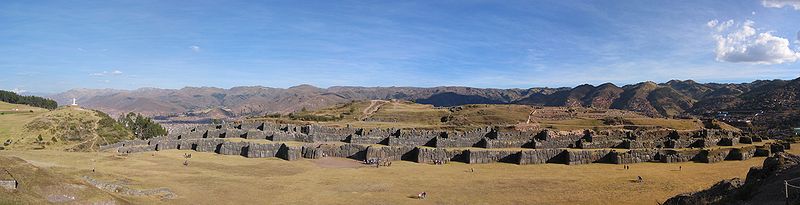
A vast ceremonial and defensive complex on the ridge just above Cusco, its three tiers of zigzag walls running some 400 m and built from andesite blocks quarried up to 35 km away, the largest weighing well over 100 tonnes and fitted without mortar so tightly you cannot slide paper between them.
It’s a twenty-minute walk uphill from the plaza to the walls, the smooth rock slides of the Rodadero, the underground passages and a huge grass parade ground where Inti Raymi is staged every 24 June.
What you see is a fraction of what stood here: after the bloody siege of 1536 the Spanish treated the site as a stone quarry for colonial Cusco, and the only reason the famous blocks survive is that they were too heavy to carry down the hill.
5 – Huaca del Sol & Huaca de la Luna
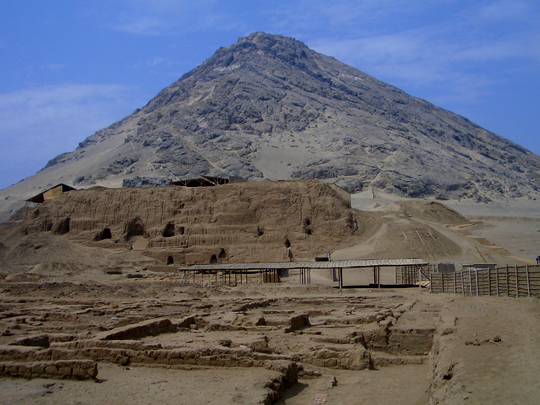
Two adobe pyramids in the desert a few kilometres outside Trujillo, the ceremonial and administrative core of the Moche state from roughly 100 to 800 AD, with the Huaca del Sol built from tens of millions of mud bricks and still the largest adobe structure in the Americas.
The Moon temple is the one you go inside: six temples stacked one on top of another across six centuries, with painted friezes still red, blue and yellow after 1,500 years showing warriors, bound prisoners and the fanged face of Ai Apaec, the decapitator god, plus an excellent site museum.
In 1602 Spanish treasure hunters diverted the Moche River straight into the Huaca del Sol to wash it open and get at whatever gold was inside; they found very little, but destroyed a large part of the pyramid, and the gouge they cut is still obvious today.
6 – Pikillaqta
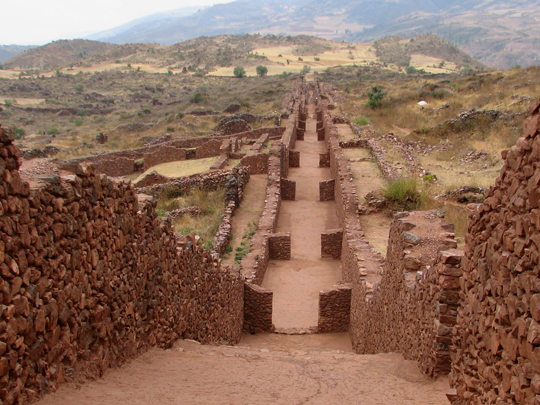
A planned city south-east of Cusco above Lake Huacarpay, built not by the Incas but by the Wari between roughly 600 and 1000 AD — centuries before Cusco’s more famous empire — with around 700 buildings on a rigid grid behind walls that reached twelve metres.
Walking it means long straight corridors between high, blank, windowless walls, an experience closer to a ruined barracks than a temple, and it pairs naturally with the Rumicolca gateway next door, the water terraces at Tipón and the painted church at Andahuaylillas.
Nobody knows why it was abandoned, half-finished, with no sign of any attack — and nobody knows what its builders called it either, since the name is a much later Quechua nickname usually translated as something like “flea town”.
7 – Paracas National Reserve
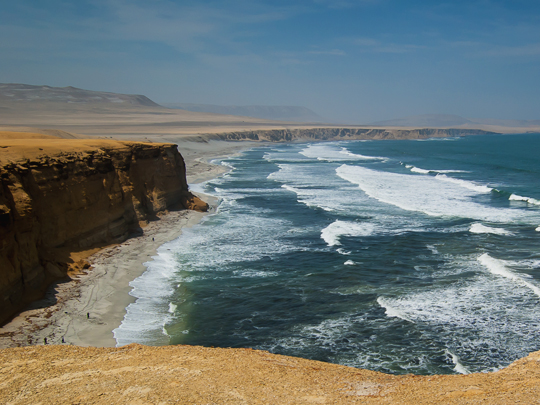
A huge coastal reserve south of Lima where one of the driest deserts on Earth runs straight into one of its richest seas, the cold Humboldt Current feeding the whole system, and the home ground of the Paracas culture, whose embroidered textiles are among the finest anything in the ancient Americas produced.
The peninsula circuit takes in the maroon sand of Playa Roja, sheer cliffs and the viewpoint where the sea arch of La Catedral stood before the 2007 earthquake, with flamingos in the bay and boat trips out to the Ballestas Islands for sea lions and Humboldt penguins.
Cut into a slope facing the sea is the Candelabra, a three-pronged figure about 180 m tall and visible some 20 km out to water — and despite a century of theories, nobody has established who made it, when, or what it was for. Guano from the islands off Paracas was once Peru’s largest export.
8 – Huanchaco – Trujillo
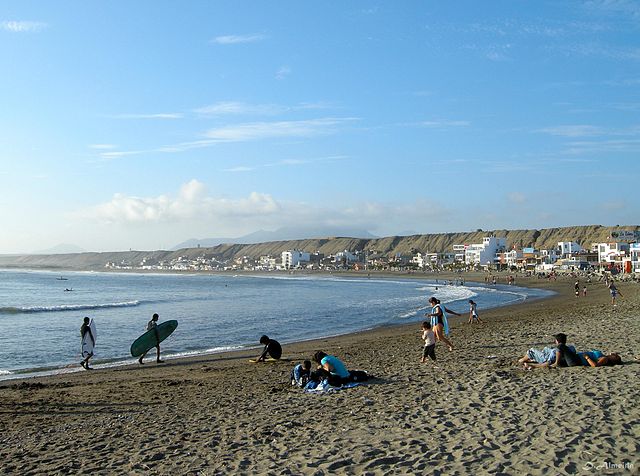
A fishing town turned beach resort just north of Trujillo, which served as the port of Chan Chan, the vast mud-brick capital of the Chimú, and has been worked by the same fishing families for far longer than that.
The long pier, the ceviche and the steady, forgiving waves are the draw — this is one of the best places in South America to learn to surf — and Chan Chan and the Moche pyramids are both a short ride away.
Fishermen here still build caballitos de totora, cigar-shaped reed craft they straddle like a horse and ride back through the breakers, a practice shown on pottery around 3,000 years old, which is the basis of Huanchaco’s claim to be where wave-riding began and why it was made a World Surfing Reserve.
9 – Archbishop’s Palace – Lima
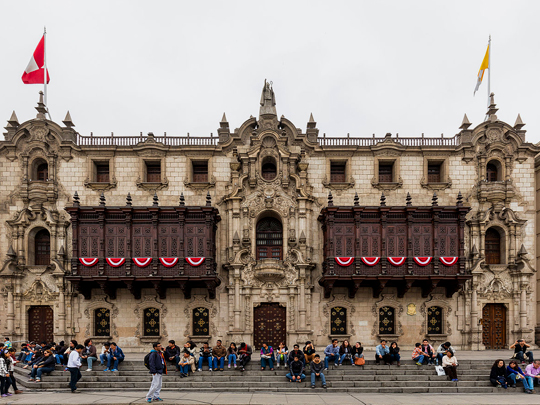
The archdiocese has occupied this plot beside the cathedral on Lima’s Plaza Mayor since Pizarro set the land aside for the city’s head priest in 1535, making it one of the oldest continuously used addresses in the capital.
The façade is worked stone under a granite figure of Saint Turibius, and the ticket for the cathedral also gets you into the palace, where marble staircases, gilded chapels, tiled patios and a good collection of Cusco School religious painting are open to visitors.
Those magnificent carved cedar balconies are not colonial at all: the present building only opened in 1924, designed by a Polish-born architect who copied the 18th-century Torre Tagle Palace across town, and it’s usually reckoned Lima’s first great neo-colonial building.
10 – Caral
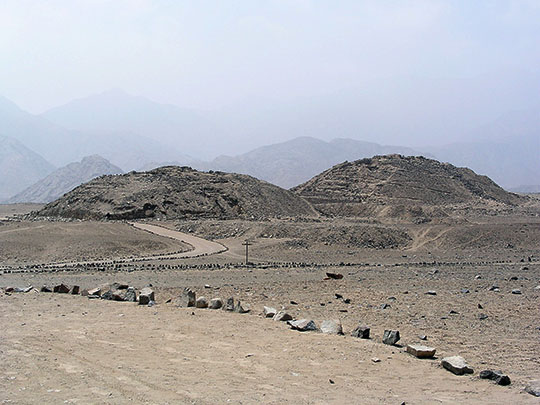
A city of stepped pyramids, sunken circular plazas and residential quarters spread across a desert terrace in the Supe valley some 200 km north of Lima, raised around 2600 BC — at roughly the moment the first Egyptian pyramids were going up, some 1,500 years before the Olmecs, and about four thousand years before the Inca — which makes it the oldest known city in the Americas.
Six pyramids survive, the largest around 28 m high on a base the size of several football pitches, along with the circular amphitheatre plaza and the remains of the ordinary houses, and the whole site was UNESCO-listed in 2009 on the strength of Ruth Shady’s excavations from the mid-1990s.
What archaeologists have not found here is the striking part: across something like a thousand years of occupation there are no fortifications, no weapons and no burned or sacked buildings, and there is no pottery either — the complete absence of ceramics was the first clue that the place was far older than anyone had assumed.
11 – The Nazca Lines
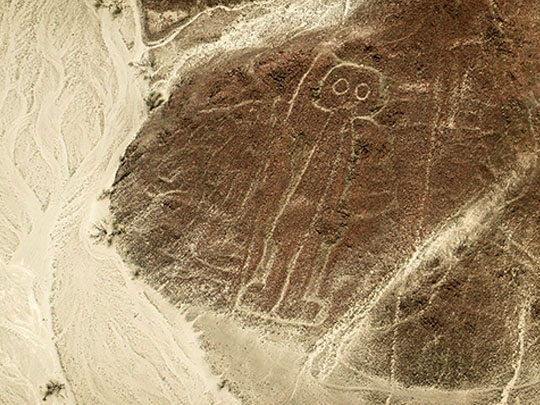
Hundreds of straight lines, geometric shapes and vast animal figures — a hummingbird, a monkey, a spider, a condor — scored across roughly 750 square kilometres of stony desert south of Ica, made between about 500 BC and 500 AD by scraping away the dark oxidised surface stones to expose the pale ground beneath, and preserved ever since by a climate with almost no rain and almost no wind.
They are effectively invisible from the ground, so most people take a light aircraft from Nazca or Pisco; there is also a viewing tower on the Pan-American Highway, which itself was driven straight through one of the figures before anyone thought to stop it.
The lines survive largely because of one person: Maria Reiche, a German mathematician who arrived in Peru in 1932, first saw them in 1941 and spent the next fifty-odd years living beside them, mapping them, paying for guards out of her own pocket and sweeping the figures clean with a broom — so persistently that locals joked she must be a witch.
12 – Chan Chan
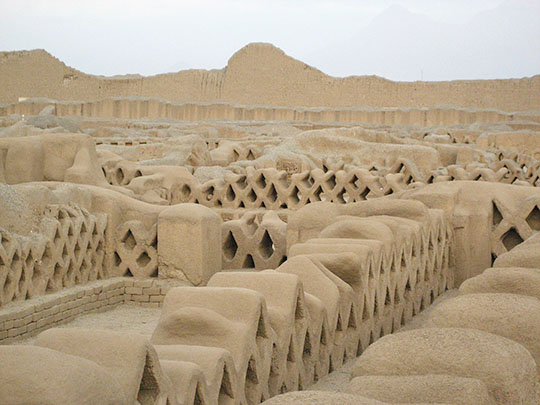

The capital of the Chimú, founded around 850 AD in the Moche valley just outside Trujillo and grown into the largest city in pre-Columbian South America — some 20 square kilometres of adobe housing perhaps 60,000 people, until the Inca took it in about 1470 and the Spanish looted what was left.
One compound, Nik An, is restored and open: high mud walls carrying friezes of fish, seabirds and fishing nets, ceremonial courtyards, a huge stepped reservoir and a maze of corridors, with the rest of the site stretching away unexcavated towards the sea.
At the centre stand nine vast walled palaces, and the reason there are nine is that each Chimú ruler built his own — living in it during his reign, and having it sealed as his tomb when he died, which obliged his successor to start again from scratch somewhere else in the city.
13 – Arequipa
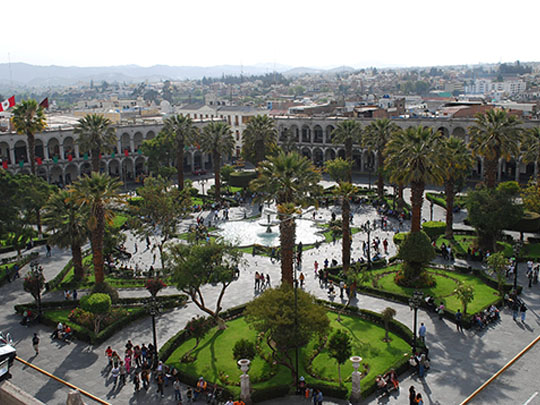
Peru’s second city sits at 2,300 m in a valley beneath three volcanoes, refounded by the Spanish in 1540 on the road from Cusco to the coast, and built almost entirely from sillar — a pale volcanic stone quarried nearby, which is why it is called the White City and why UNESCO listed the historic centre in 2000.
The arcaded Plaza de Armas and its twin-towered cathedral anchor a centre of sillar mansions, cloisters and baroque façades, with the Yanahuara viewpoint framing El Misti through carved stone arches and the Colca Canyon, condors and all, a few hours north.
The Santa Catalina monastery, founded in 1579, is a walled city inside the city — its own streets, squares and painted lanes, where the daughters of wealthy families lived with their own servants and porcelain — and it stayed shut behind that wall for nearly four hundred years, opening to outsiders only in 1970.