

David Stanley / Wikimedia Commons / CC-BY-SA-3.0 / GFDL
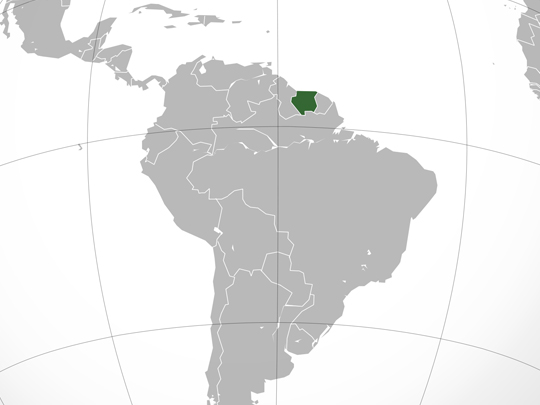
Capital: Paramaribo
Population: 620,000+
Language: Dutch (Sranan Tongo, Hindustani, Javanese and Maroon)
1 – Saint Peter and Paul Cathedral (also above)
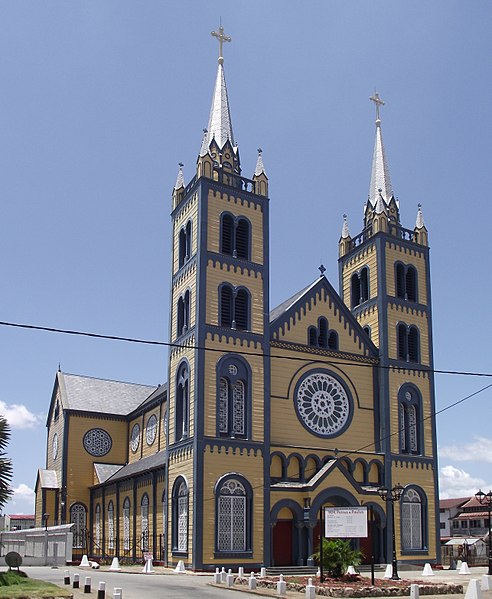
The Catholic cathedral of Paramaribo, begun in 1883 on the site of a former Dutch Jewish theatre that the congregation had been using as a church since 1826, consecrated in 1885 with the twin towers added by 1901, and raised to the rank of minor basilica in 2014.
The pale blue-grey and yellow façade gives no hint of the interior, which is unpainted Surinamese cedar from floor to vaulting, wrapped around pillars of near-indestructible greenheart, with carved arches, Stations of the Cross and room for around 900 people.
The whole building, inside and out, is timber — it is regularly claimed as the largest wooden building in the Western Hemisphere — and being made of wood in the tropics nearly finished it, since termites and rot left the cathedral tilting and shut for roughly two decades before a long restoration reopened it in 2010.
2 – Fort Zeelandia
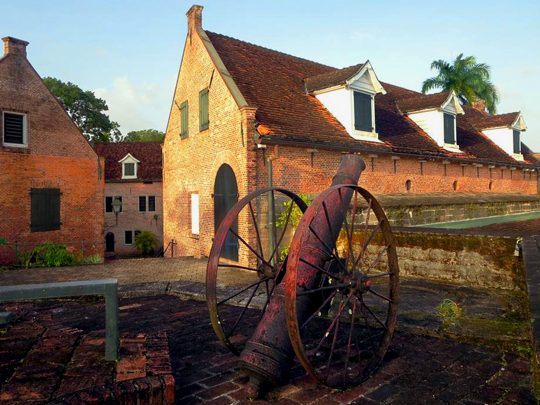
A small pentagonal fort on a bend of the Suriname River, and the spot where the colony effectively began: the English fortified it as Fort Willoughby in 1651, and in February 1667 a Zeeland squadron under Abraham Crijnssen took it after a bombardment lasting about three hours and renamed it Fort Zeelandia.
Later that same year (1667), the Treaty of Breda let each side keep what it had taken, so the Dutch held on to Suriname and its sugar while the English kept a small northern settlement called New Amsterdam, which they had already started calling New York.
It now holds the Suriname Museum, with colonial furniture, ethnographic collections, an old apothecary and cells, cannon on the ramparts and the Palm Garden alongside; on one bastion a memorial stone names the fifteen government opponents who were held, tortured and shot here on 8 December 1982 during the military dictatorship, and the bullet holes are still in the wall.
The fort was designed to hold off attackers but the Dutch eventually built Fort Nieuw Amsterdam downriver instead, and Zeelandia spent nearly a century as a prison.
3 – Waterkant
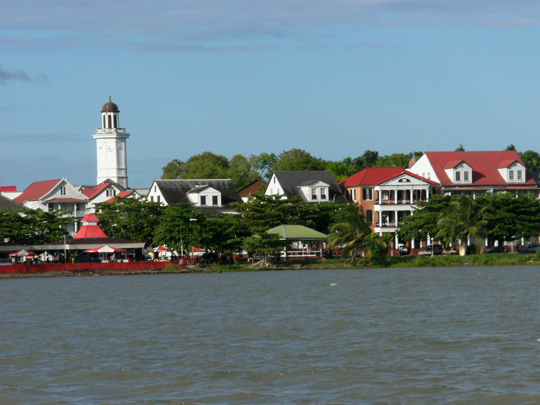
The riverside street at the heart of Paramaribo, lined with white timber merchant houses facing the Suriname River, the commercial front of a Dutch colony built on sugar and the labour of enslaved Africans, and the centrepiece of a historic inner city that UNESCO listed in 2002.
The old houses now hold bars, cafés and guesthouses, the vast Centrale Markt sits at one end selling fish, herbs and tropical fruit, and food stalls set up along the water in the evening — this is where the whole city comes to watch the sun go down over the river.
Walk a few streets back to Keizerstraat and you find a mosque and a synagogue standing directly beside one another, sharing a car park, in a capital where Hindu temples, churches, mosques and synagogues all sit within a few blocks of each other.
4 – Central Suriname Nature Reserve
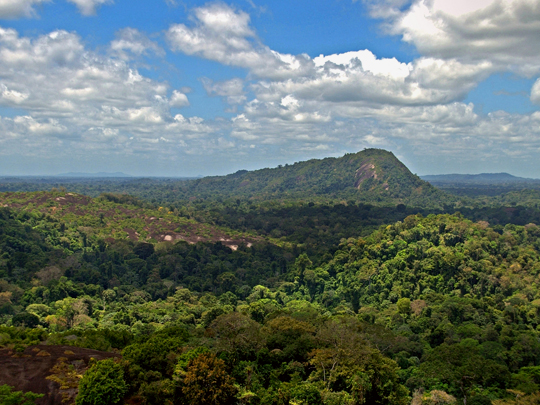
An immense block of untouched rainforest covering roughly 1.6 million hectares — about a tenth of the whole country — created in 1998 by joining three older reserves and listed by UNESCO in 2000, protecting the upper Coppename watershed in a country that remains among the most heavily forested on Earth.
Access is by boat and small plane to the Raleighvallen base on the river, from where the classic trip is the sweaty climb up the Voltzberg granite dome for a view of unbroken canopy in every direction, with jaguar, tapir, giant river otter, eight species of monkey and the flame-orange Guiana cock-of-the-rock in the forest below.
What makes it unusual among the world’s great forests is not just that nobody lives here, but that nobody hunts here either — it is one of the largest stretches of primary tropical forest anywhere that is uninhabited, undisturbed and unhunted, which is why the animals behave as though people are a novelty.
5 – Maroon Villages of the Upper Suriname River
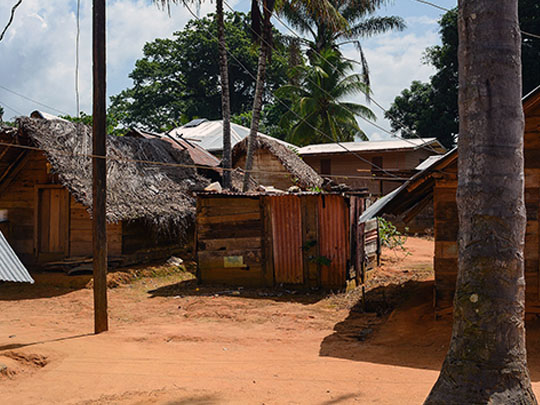
A string of Saramaka villages along the Boven Suriname in the forested interior, reached by road to Atjoni and then by dugout canoe, settled by Africans who escaped the Dutch sugar plantations and fought the colony for decades until the Dutch gave in and signed treaties recognising their freedom and their territory — the Ndyuka in 1760, the Saramaka in 1762 — a full century before slavery was abolished in Suriname at all.
Lodges at Botopasi, Goejaba and Palumeu put you in the villages rather than beside them: timber houses above the river, children swimming off the rocks, drumming after dark, and at Pikin Slee a museum of Maroon woodcarving, the dense geometric style that is among the clearest surviving strands of West African art anywhere in the Americas.
Suriname holds the largest Maroon population in the hemisphere, better than a fifth of the country, and these are among the very few communities in the Americas that took their freedom by force and then had it written down — on the same rivers where their descendants still live, and still speak Saramaccan rather than Dutch.
6 – Jodensavanne
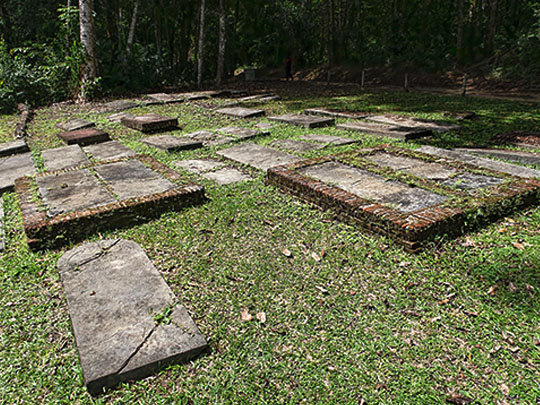
A ruined settlement on a bluff above the Suriname River some 50 km south of Paramaribo, founded in the 1680s by Sephardic Jews who had fled the Inquisition and had been granted something granted nowhere else on earth — territorial and religious self-rule — and listed by UNESCO in 2023 together with the older cemetery at Cassipora Creek.
What stands is the brick shell of Beraha VeSalom, the synagogue inaugurated in 1685 and the first of any architectural ambition in the Americas, in a clearing in the forest beside a Jewish cemetery of carved stone slabs and a separate African-Creole cemetery with wooden grave markers.
The community that built it ran more than forty sugar plantations worked by thousands of enslaved Africans, so the only place in the world where Jews governed themselves before the founding of Israel was also a slave society — and when the sugar economy failed and fire took the village in 1832, the whole settlement was left to the forest.
7 – Commewijne


The plantation district directly across the water from Paramaribo, where the Commewijne and Suriname rivers meet, once the engine of the colony’s sugar and coffee wealth and then, after slavery was abolished in 1863, the place where tens of thousands of indentured labourers from India and Java were landed to replace the people who had just been freed.
It is flat and best taken by bicycle off the ferry: the old estates at Peperpot and Frederiksdorp, the ruined Marienburg sugar factory with its rusting machinery, Javanese villages where the food and the mosques would not look out of place in central Java, and Fort Nieuw Amsterdam standing at the confluence as an open-air museum.
Something like 34,000 Indians and 33,000 Javanese came through under contract, and their descendants are now the two largest population groups in the country — which is why a Dutch-speaking South American republic keeps Holi and Eid as national holidays.