
Christine Rondeau / Wikimedia Commons / CC-BY-SA-3.0 / GFDL
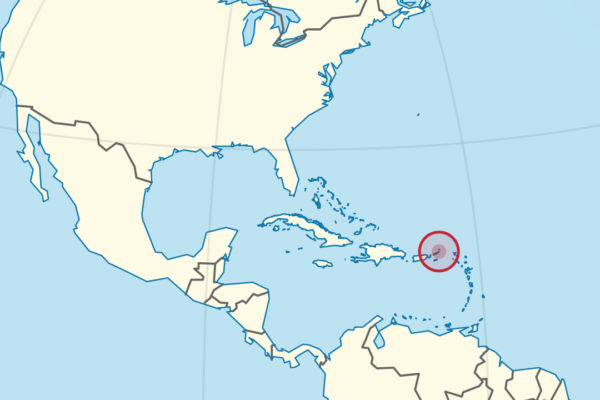
Capital: Road Town
Population: 40,000+
Language: English/Virgin Islands Creole
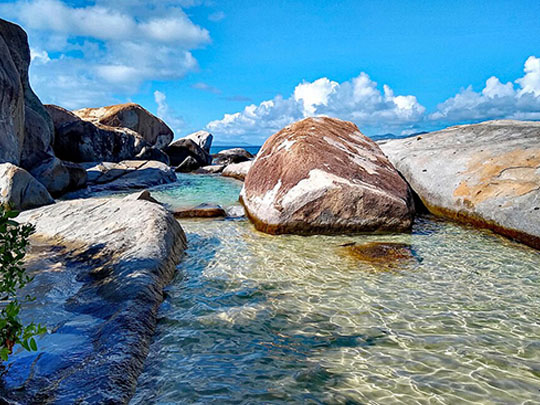
1 – The Baths (above)
At the southern tip of Virgin Gorda, granite boulders the size of houses lie tumbled along a white-sand beach — strange in a volcanic chain, because this is granite that cooled deep underground and only reached the surface after ages of erosion stripped everything above it.
A marked trail with ropes and ladders threads between and under the boulders, through seawater grottoes and tidal pools, and comes out at Devil’s Bay; it’s been a national park since 1990, and it gets busy, so go early.
The biggest of the boulders run to about 40 feet across — and a few miles east, the same geology gave Virgin Gorda a copper mine, worked by Cornish miners from the late 1830s, whose chimney and engine house still stand on the cliffs.
2 – Road Town
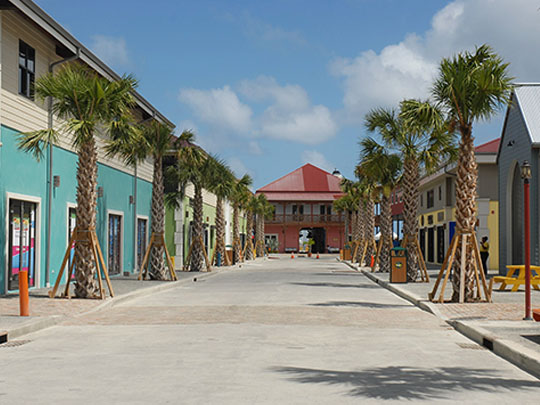
Tortola’s capital wraps around a deep, sheltered harbour on the south coast, and the name is plain sailors’ English: “the roads” is an anchorage where ships can safely lie offshore.
Walk Main Street past the 1840s prison and the old post office, take in Fort Burt on the hill above, and stop at the Sunday Morning Well, traditionally the spot where emancipation was proclaimed in 1834 — though locals will tell you it was read elsewhere first.
On 24 November 1949, around 1,500 people marched through these streets to the Commissioner’s Office demanding a say in their own government, at a time when the whole territory held under 7,000 — the Legislative Council was restored the following year, and the march is now a public holiday.
3 – Jost Van Dyke
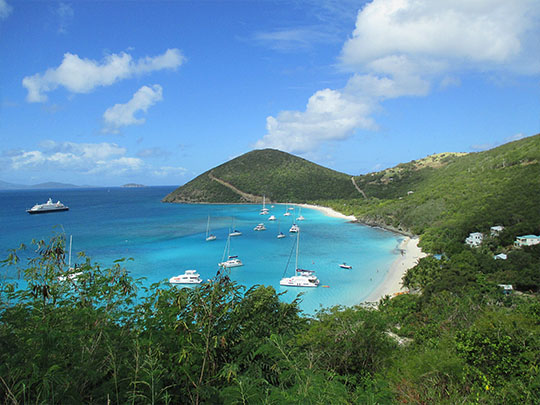
Four miles west of Tortola, this green, mountainous speck of about eight square kilometres is named after a 17th-century Dutch privateer, and was later settled by Quakers who preached against slavery while running sugar plantations with enslaved labour.
There’s one road and a few hundred residents: Great Harbour, where Main Street is the beach, and White Bay round the headland, with the Bubbly Pool and Sandy Cay a short hop away.
For a place this small it has a long reach — Foxy’s, opened in 1968, effectively launched BVI yachting tourism and throws one of the Caribbean’s great New Year’s parties; the Soggy Dollar Bar, named for sailors swimming ashore with wet cash, claims to have invented the Painkiller; and William Thornton, who designed the United States Capitol, was born here in 1759.