
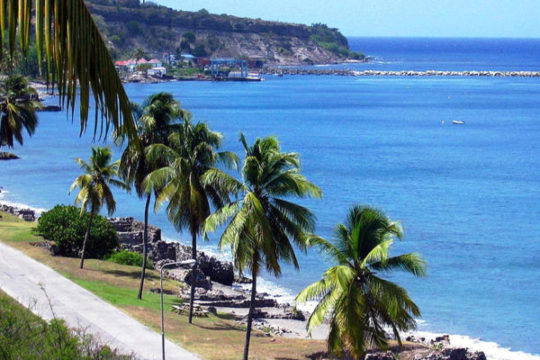
Walter Hellebrand / CC-BY-SA-3.0 / GFDL

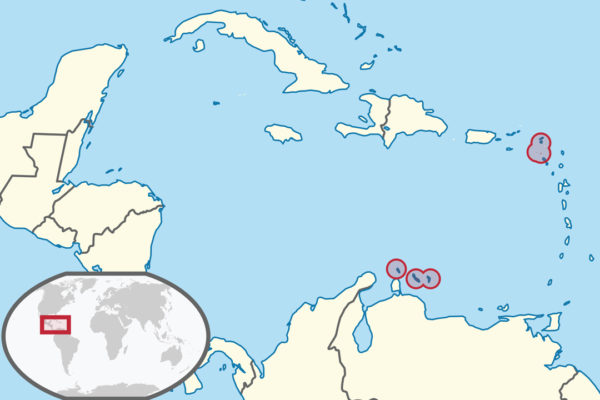
Special Municipalities: Bonaire/Saba/ Sint Eustatius
Population: 32,000+
Language: Dutch/English/Papiamentu
1 – Oranjestad, Sint Eustatius (also above)
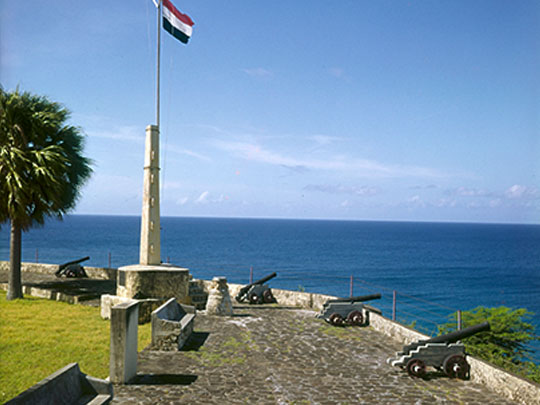
Statia’s capital climbs from a ruined waterfront up a cliff to a fort, and in the 1770s this was one of the busiest free ports on earth — thousands of ships a year, no duties, no questions, which is how a rock of eight square miles came to be called the Golden Rock.
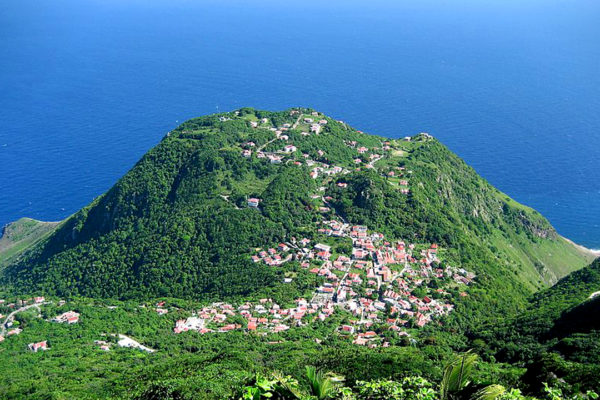
Wander the warehouse ruins of Lower Town, half of them in the sea, then climb to Fort Oranje above, where the cannon still point out over the bay and the Quill’s green cone rises behind the town.
On 16 November 1776 those guns returned a salute to the American brig Andrew Doria, widely taken as the first foreign recognition of the United States — Britain took its revenge in 1781, when Admiral Rodney arrived with 15 warships and 3,000 troops against a garrison of 45, sacked the place and left it never to recover.
2 – Windwardside, Saba
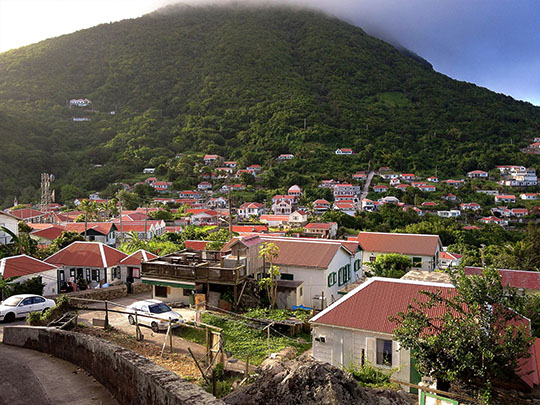
Saba is the tip of a volcano with almost no flat land, and Windwardside is its largest village, perched on a shoulder of the mountain at around 500 metres — the island had no harbour, no road and no airstrip, so for centuries everything came ashore at the rocks and went up eight hundred steps cut into the cliff, known simply as The Ladder.
Every house is white with a red roof and green shutters, and the village holds the shops, the dive operators, a small museum and the foot of the Mount Scenery trail.
Dutch engineers told the Sabans a road was impossible, so a local man, Josephus “Lambee” Hassell, took a correspondence course in civil engineering and built one by hand with his neighbours, starting in 1938 — and the airstrip that followed has the shortest commercial runway in the world, about 400 metres with cliffs at both ends.
3 – Mount Scenery
The volcano that is Saba rises to 887 metres, which makes this wet, cloud-wrapped summit the highest point not just on the island but in the entire Kingdom of the Netherlands.
A stone stairway of 1,064 steps, built by hand by Sabans in the late 1960s, climbs from Windwardside through banana groves into elfin cloud forest, where mountain mahogany trees stand smothered in orchids and bromeliads; go in the morning, and don’t bother in the rain.
It’s a dormant volcano rather than a dead one — the last eruption was around 1640, and it’s reckoned the northernmost active volcano in the Caribbean, now wired with seismometers by the Dutch meteorological service.