
Wikimedia Commons / CC-BY-SA-3.0 / GFDL
Capital: Manama
Population: 1.55 milion+
Language: Arabic/English
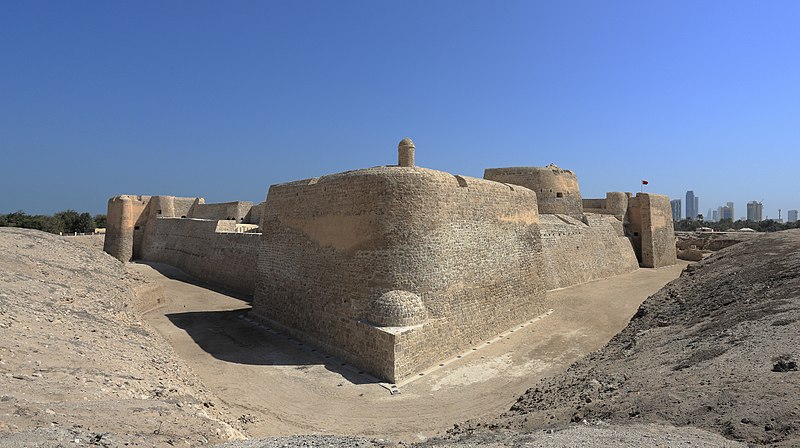
1 – Bahrain Fort (also above)
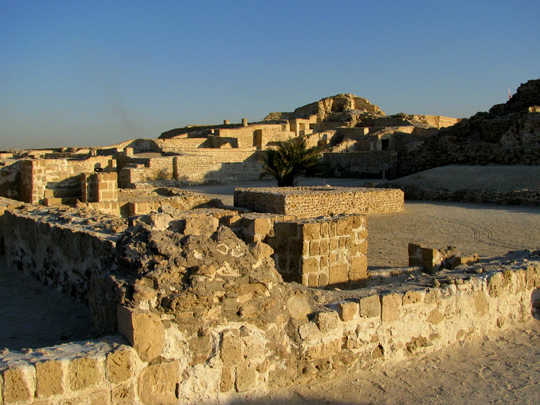
Bahrain Fort is a 300-by-600-metre artificial mound on the north coast about six kilometres from Manama, built up over four and a half thousand years of people living on top of each other — seven layers running from around 2300 BC to the eighteenth century, and the reason the site matters is that this was the capital of Dilmun, the trading civilisation Sumerian texts had been describing long before anyone found physical proof it existed.
A sixteenth-century Portuguese fort sits on top and gives the whole site its name; below and around it are excavated Dilmun streets and houses, a colossal central building, a copper-casting workshop, the remains of a lighthouse and the channel that ran in from the sea, with a site museum at the entrance and a café facing the water.
Only about a quarter of the site has been dug, and the work only began in 1954, when a Danish team under Geoffrey Bibby came looking for Dilmun and found it — turning a civilisation known solely from other people’s writing into a place with an address.
2 – Riffa Fort
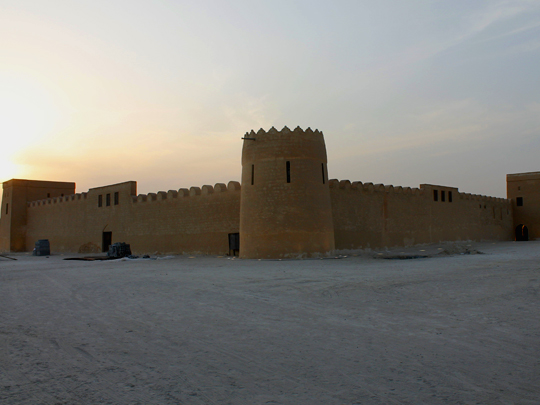
Properly the Shaikh Salman bin Ahmed Al Fateh Fort, Riffa Fort stands on a cliff above Wadi Al-Hunainiya between East and West Riffa, raised in 1812 on the foundations of an earlier fort that had fallen into ruin — and built not as a garrison but as a home, which is what separates it from every other fort in Bahrain.
Rooms, a kitchen, a storeroom and a prayer hall run around the courtyard, with a restored mosque near the northern corner and a museum tracing the ruling family’s line through swords, daggers, jewellery, hunting gear and falconry equipment, plus a café on a glass terrace hanging over the valley.
Shaikh Isa bin Ali Al Khalifa, who went on to rule Bahrain for sixty-three years from 1869 to 1932, was born in a room in the northeastern tower in 1848 — and the valley below was the district’s water supply, drawn from its wells by a saqqa and carried up by donkey.
3 – Tree of Life
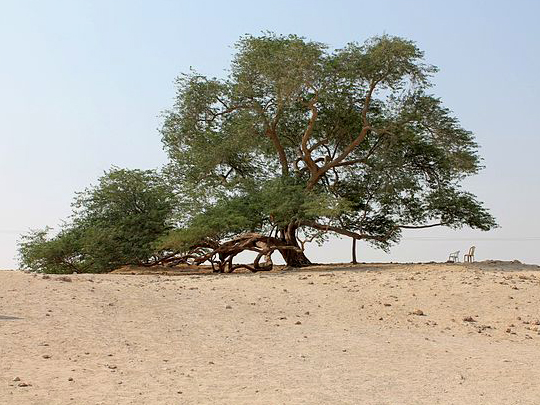
The Tree of Life is a single mesquite about ten metres tall stands on a low rise in the desert some forty kilometres south of Manama, near Jebel Dukhan, with nothing much growing around it for the best part of a kilometre — local accounts put the planting at 1583, which would make it well over four hundred years old.
The trunk now sits inside an iron fence, because visitors spent decades carving their names into the bark, and there’s a small visitor centre; go in winter and either early or at dusk, since the only shade for miles is the tree itself and summer temperatures here run comfortably past forty degrees.
Bahrain has long been identified with Dilmun, the paradise of the Sumerian texts where Gilgamesh went looking for immortality, which is how the tree came to be called the last survivor of the Garden of Eden — the duller answer is that mesquite roots reach fifty metres down, the water table here is not far below the surface, and there are other trees a kilometre up the road.
4 – Al Fateh Grand Mosque
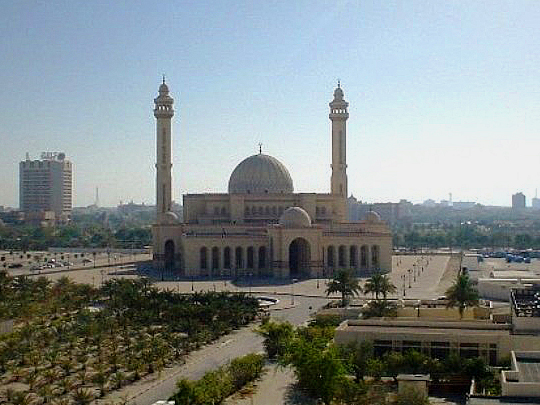
Built at Juffair in 1987 under Shaikh Isa bin Salman Al Khalifa and named for Ahmed Al Fateh — Ahmed the Conqueror, who took Bahrain in 1783 and founded the dynasty that still rules, and whose son built the fort at Riffa — Al Fateh Grand Mosque covers 6,500 square metres and holds around seven thousand worshippers, making it the largest place of worship in the country.
Italian marble on the floors, teak doors from India carved locally and standing six metres high, Austrian glass in the lamps, Kufic calligraphy running round the walls, and since 2006 the National Library of Bahrain occupying part of the building; non-Muslims are welcome, the guided tours are free and run in several languages, and abayas are lent at the door.
The dome is fibreglass — around fifty-four tonnes of it, and usually described as the largest fibreglass dome anywhere — which sounds like an odd material for a country’s grandest building until you work out that it weighs a fraction of what stone would, which is the only reason a dome that size could go up at all.
5 – Muharraq
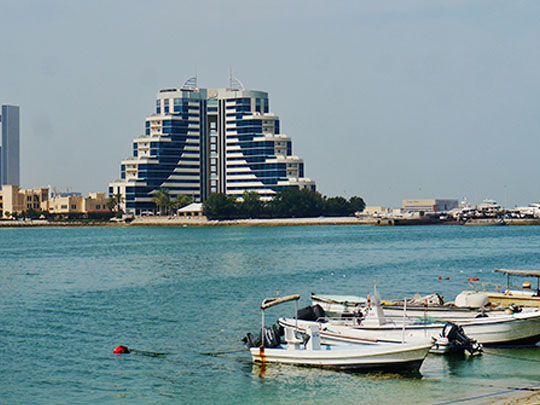
Muharraq sits on its own island across the water from Manama and was Bahrain’s capital before the government moved across in the early twentieth century, and for something close to four thousand years the entire place ran on one thing: pearls, dived for by hand from oyster beds in the Gulf, which is why UNESCO listed it in 2012 as the last complete surviving example of a pearling economy anywhere in the world.
A 3.5-kilometre path threads seventeen listed buildings through the old town — merchants’ houses, shops, warehouses and a mosque, with the Siyadi complex the grandest — and runs down to Bu Maher fort at the southern tip, the shore the dhows sailed from, while the Qaisariya souq in the middle still sells coffee, spices and cloth.
As Japanese cultured pearls began flooding the market, Bahrain banned their import and sale outright in 1928, and the ban still stands: it is the only country on earth that forbids them, and pearls sold here pass through a state laboratory that X-rays them for the internal growth lines a cultured one can’t hide.