
Wikimedia Commons / CC-BY-SA-3.0 / GFDL
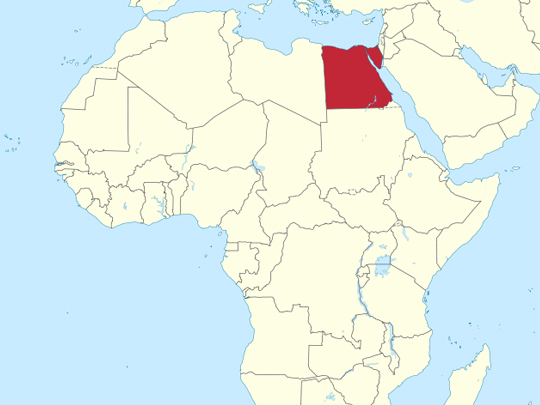
Capital: Cairo
Population: 109 million+
Language: Egyptian Arabic
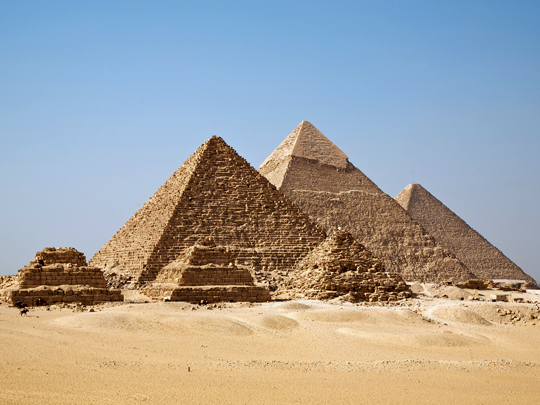
1 – Pyramids at Giza (above)
On a desert plateau at the edge of Cairo stand the three great pyramids of Giza, raised around 4,500 years ago as tombs for the pharaohs Khufu, Khafre and Menkaure — the oldest, and only surviving, of the Seven Wonders of the Ancient World.
The largest, Khufu’s Great Pyramid, was built from some 2.3 million blocks — hauled into place by paid workers, not slaves — and once gleamed under a smooth casing of polished white limestone; you can still climb into its cramped inner passages to the burial chamber.
The Great Pyramid was the tallest structure on Earth for nearly 3,800 years — a record unbroken until the spire of an English cathedral in Lincoln finally edged past it in the 14th century.
2 – Sphinx
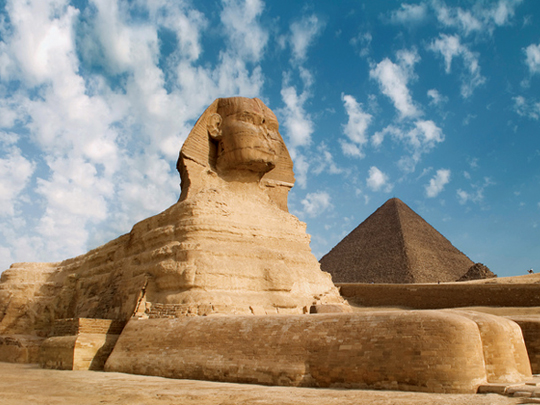
Crouching beside the pyramids, the Great Sphinx — a lion’s body with a pharaoh’s head, most likely that of Khafre — was carved from a single outcrop of bedrock around 4,500 years ago, and remains the largest statue ever cut from one piece of stone.
At 73m long and 20m tall, it has gazed east toward the rising sun for millennia, though for much of that time it lay buried up to its neck in sand; one pharaoh, Thutmose IV, left a tablet between its paws claiming the Sphinx had promised him the throne if he dug it out.
Contrary to the popular tale, Napoleon’s soldiers did not shoot off its nose — sketches drawn decades before Napoleon reached Egypt already show it noseless; a medieval account blames a Sufi cleric who took a chisel to it in 1378, enraged at locals worshipping the statue.
3 – Luxor – Valley of the Kings
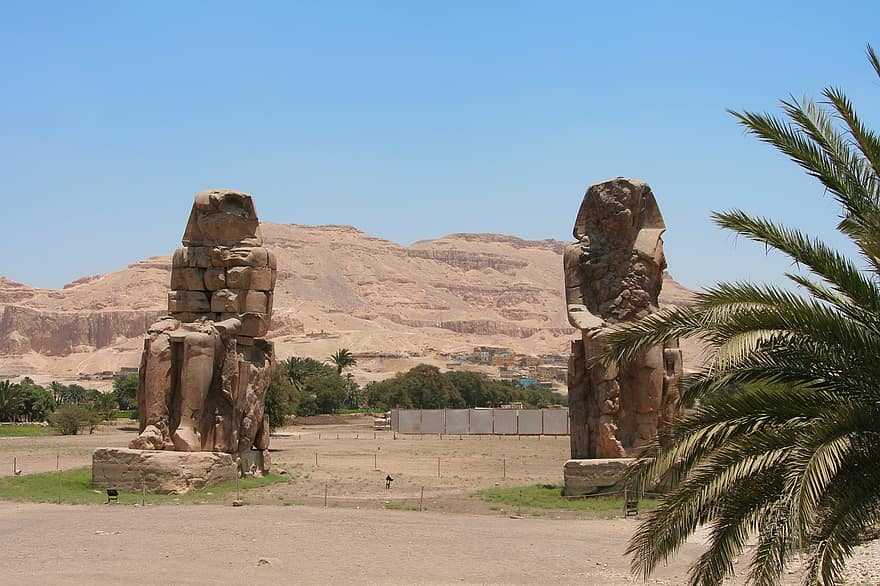
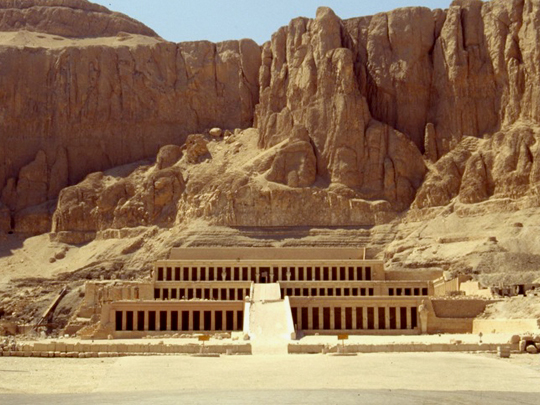
Hidden in the desert hills on the west bank of the Nile across from Luxor — ancient Thebes — the Valley of the Kings was the secret burial ground of Egypt’s New Kingdom pharaohs, who cut more than sixty tombs deep into the rock over some 500 years.
Their walls still blaze with painted scenes of gods and the afterlife more than 3,000 years on; the most famous tomb is that of the boy-king Tutankhamun, found by Howard Carter in 1922 crammed with over 5,000 treasures — the only royal tomb ever discovered nearly intact, now displayed together at the Grand Egyptian Museum.
When Carter’s patron Lord Carnarvon died soon after the tomb was opened, the world seized on the idea of a “curse of the pharaohs” — a legend that has haunted mummy films and stories ever since.
4 – Abu Simbel
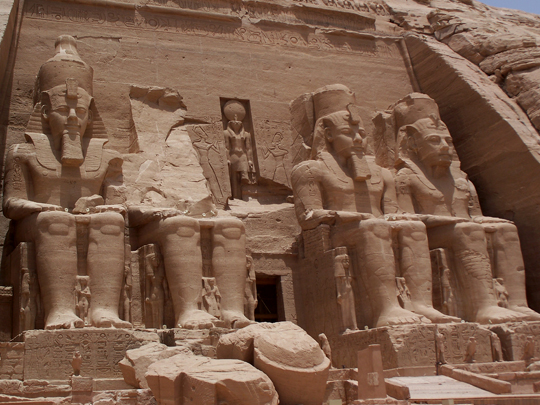
Carved into a Nubian cliff by Ramesses II around 3,300 years ago, near what is now the Sudanese border, the two temples of Abu Simbel — the greater one fronted by four seated colossi of the pharaoh, each some 20m high — were built to awe travellers and overawe Egypt’s southern neighbours.
In the 1960s, when the rising waters of Lake Nasser behind the new Aswan High Dam threatened to drown them, the entire complex was sawn into more than a thousand blocks and rebuilt, piece by piece, on higher ground — one of the greatest rescue operations in archaeological history.
The ancient builders aligned the Great Temple so precisely that, twice a year, the dawn sun still spears some 60m into the mountain to light up the gods in its innermost sanctuary — while deliberately leaving Ptah, lord of the underworld, in shadow.
5 – Karnak

On the east bank at Luxor sprawls Karnak, the largest religious complex ever built — a sacred city of temples, towering gateways and obelisks dedicated above all to Amun-Ra, king of the gods, and the spiritual heart of ancient Egypt for some 2,000 years.
Its showpiece is the Great Hypostyle Hall, a forest of 134 colossal stone columns — the tallest as high as a six-storey building — that once held up a painted roof; elsewhere stand soaring obelisks, a sacred lake, and the avenue of ram-headed sphinxes running to Luxor Temple.
Karnak wasn’t the work of one king but of roughly thirty, who kept adding to it across two millennia — so its stones read like an open-air history book of ancient Egypt, each pharaoh building alongside the last rather than tearing it down.
6 – Philae
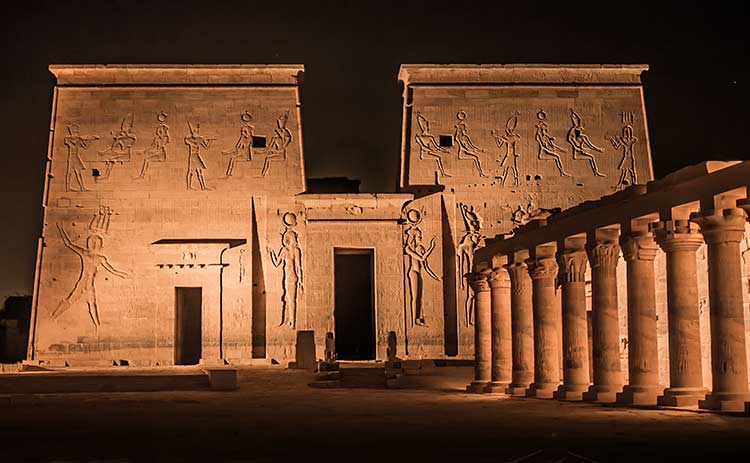
On an island in the Nile near Aswan stands the graceful temple of Philae, sacred to Isis — goddess of magic and healing — and for centuries one of the ancient world’s great pilgrimage sites, drawing worshippers from across the Mediterranean.
Wander its pylons, colonnades and the elegant riverside Kiosk of Trajan; the whole complex was famously lifted from its original, flood-prone island and rebuilt stone by stone on higher Agilkia Island in the 1970s to save it from the Aswan dams.
Philae was the last bastion of the old Egyptian religion, still worshipping Isis long after Egypt turned Christian — and it was here, in 394 AD, that a priest carved the very last hieroglyphic inscription ever written, closing a tradition more than 3,000 years old.
7 – Saqqara
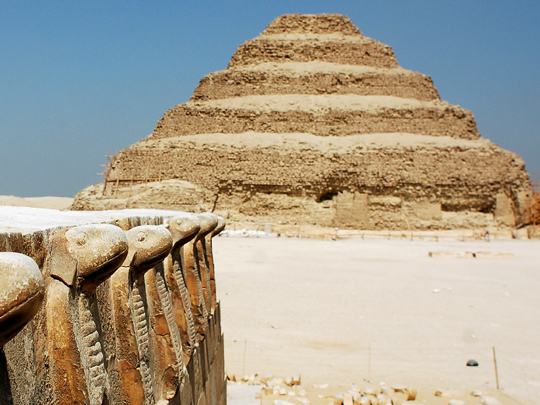
South of Cairo lies Saqqara, the sprawling city of the dead that served ancient Memphis for over 3,000 years — and the site of the Step Pyramid of Djoser, the world’s oldest great stone building, raised around 4,700 years ago.
Rising in six giant tiers, this was Egypt’s very first pyramid — the prototype for Giza — and around it spreads a vast necropolis of lesser pyramids, richly painted noble tombs and the eerie Serapeum, where sacred Apis bulls were laid to rest in colossal stone coffins.
The pyramid’s architect, Imhotep, became one of the most celebrated figures in Egyptian history — so revered that, more than a thousand years later, this commoner was worshipped as a god of wisdom and medicine, an honour otherwise reserved for kings.
8 – River Nile
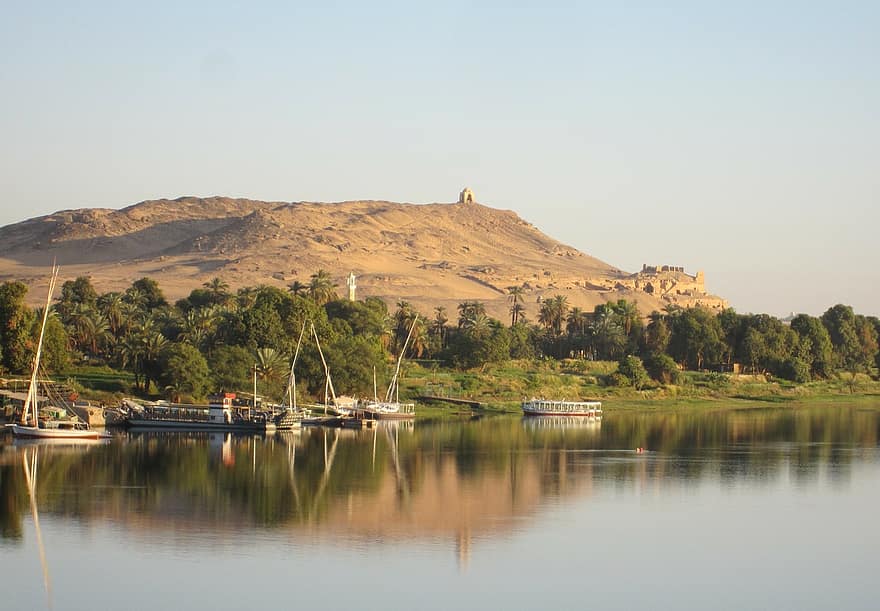
The longest river on Earth, the Nile winds some 6,650km from the heart of Africa north to the Mediterranean — and without it there would be no Egypt, for it was the river’s yearly flood that turned a strip of desert into the cradle of one of history’s greatest civilisations.
Every summer it once spread rich black silt across its banks, and the Egyptians built their calendar, gods and cities around the miracle; today you can trace that same lifeline by felucca sailboat or cruise ship, gliding past temples and palm groves between Luxor and Aswan.
Egypt is often called “the gift of the Nile” for good reason — even now almost the entire population is crammed onto the narrow green ribbon of the valley and delta, barely a twentieth of the country, with empty desert stretching away on either side.
9 – Mount Sinai
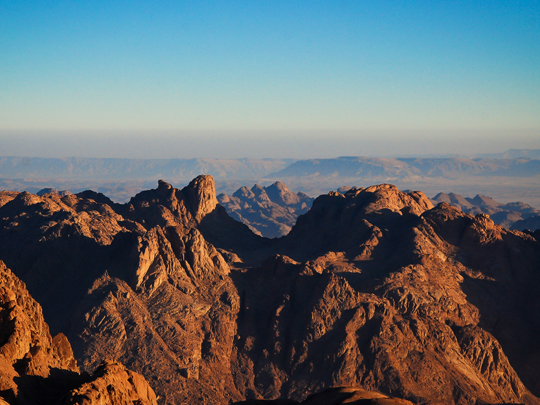
Rising from the red desert of the Sinai Peninsula, this 2,285m peak — Jabal Musa, the “Mountain of Moses” — is revered by Jews, Christians and Muslims alike as the place where Moses received the Ten Commandments from God.
At its foot huddles St Catherine’s Monastery, built around 1,500 years ago on the supposed site of the Burning Bush and one of the oldest working Christian monasteries on Earth, its library second only to the Vatican’s in ancient manuscripts; most visitors climb through the night to greet the sunrise from the summit.
One of the two paths to the top is the punishing “Steps of Repentance” — some 3,750 stone steps said to have been cut, one by one, by a single penitent monk.
10 – Alexandria


Founded by Alexander the Great in 331 BC on the Mediterranean coast, Alexandria became the dazzling capital of Greek and Roman Egypt — the city of Cleopatra and, for centuries, the greatest seat of learning in the ancient world, where Greek, Egyptian and Jewish cultures met on the shore of the sea; while Montazah, a lavish royal Ottoman palace was built as a summer retreat for Egypt’s kings.
Guarding the harbour once rose the Pharos — the Lighthouse of Alexandria, one of the Seven Wonders of the Ancient World — which stood over 100m tall and beamed its fire out to sea for some 1,500 years, until earthquakes finally toppled it; the medieval Qaitbay fort now occupies its exact spot, and divers still recover its fallen stones from the seabed.
The city was also home to the Great Library, the most celebrated of antiquity, whose keepers set out to collect every book in the world — so zealously that ships putting into port were searched and their scrolls seized to be copied; among the scholars who worked here were Euclid, the father of geometry, Eratosthenes, who measured the circumference of the Earth, and Archimedes.
11 – Islamic Cairo
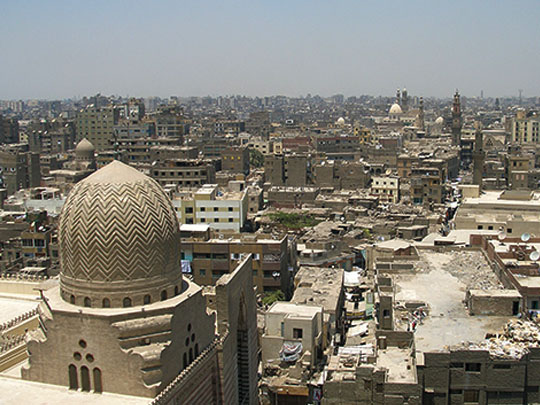
Between Saladin’s Citadel and the surviving medieval gates lies the city that Egypt’s Arab, Fatimid, Ayyubid, Mamluk and Ottoman rulers spent a thousand years building — UNESCO-listed since 1979, and one of the densest concentrations of Islamic architecture anywhere on Earth.
The Mosque of Ibn Tulun of 879 is the oldest in Cairo still standing in its original form, with an outer staircase spiralling up its minaret; Al-Azhar, founded in 970, runs a school that is among the oldest continuously operating universities in the world and remains the leading seat of Sunni learning; the Citadel carries the alabaster Mosque of Muhammad Ali on its skyline; and Khan el-Khalili has been trading since the 14th century.
On 1 March 1811, Muhammad Ali invited the Mamluk beys — the warrior caste that had ruled Egypt for the better part of six centuries — to a banquet at the Citadel, then had them cut down in a narrow lane as they rode out; six hundred years of Mamluk power ended in a single afternoon.
12 – Siwa Oasis
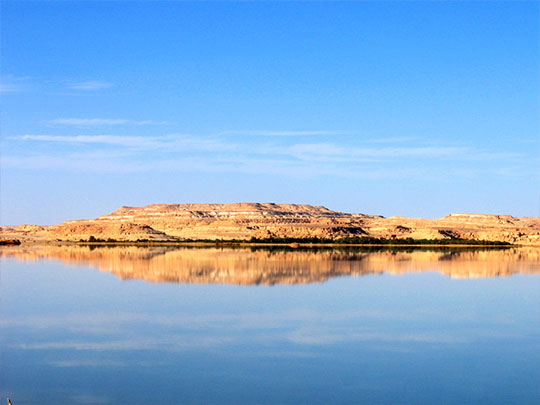
Six hundred kilometres west of the Nile and barely 50 from the Libyan border, Siwa is a deep green bowl of date palms and salt lakes lying below sea level — the easternmost Berber-speaking community in the Sahara, and home to an oracle of Amun whose fame carried across the whole Mediterranean.
The oracle’s temple still stands in ruins on the rock at Aghurmi; below it lie the Mountain of the Dead, honeycombed with painted tombs, freshwater springs shaded by palms, salt pools so dense that sinking is impossible, and the slumped mud towers of Shali in the middle of town.
Shali was raised in the 13th century from kershef — chunks of salt cut from the lakes and bound with clay — and no raider ever breached it in seven hundred years; then three days of rain in 1926 dissolved the roofs and walls like sugar, and the townspeople came down off the rock for good.
13 – Suez Canal
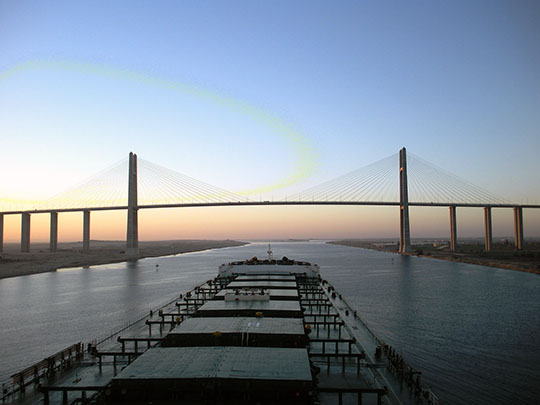
Running 193km from Port Said on the Mediterranean to Suez on the Red Sea, the canal opened in 1869 after a decade of digging under Ferdinand de Lesseps, cutting thousands of miles off the voyage from Europe to Asia — and leaving Egypt so deep in debt that Britain bought into the company in 1875 and occupied the country outright in 1882.
The best of it is the sight from the Ismailia road, where ships appear to be sailing through open desert; Port Said keeps its balconied colonial waterfront at the northern mouth, and free ferries still shuttle across a waterway that a single container ship, wedged sideways in 2021, managed to block for six days.
On 26 July 1956 Nasser nationalised the canal, and Britain, France and Israel invaded — only to be forced into humiliating withdrawal under American and Soviet pressure, in a crisis that is usually reckoned the moment Britain and France stopped being first-rank world powers.
14 – The Grand Egyptian Museum

Two kilometres from the pyramids on the edge of the Giza plateau, the Grand Egyptian Museum opened on 1 November 2025 after more than two decades of construction and roughly a billion dollars — the largest museum in the world devoted to a single civilisation.
More than 100,000 objects fill twelve galleries; an 83-tonne statue of Ramesses II stands in a six-storey hall; a vast staircase climbs past colossi to a glass wall that frames the pyramids themselves; and the complete contents of Tutankhamun’s tomb are shown together for the first time since Howard Carter opened it in 1922.
The building was designed by Heneghan Peng, a Dublin practice, who won an international competition that drew more than 1,500 entries from 82 countries — which means the newest monument at Giza, standing in sight of the oldest, was drawn up in an office in Ireland.