
Wikimedia Commons / CC-BY-SA-3.0 / GFDL
Capital: St Peter Port
Population: 64,000+
Language: English
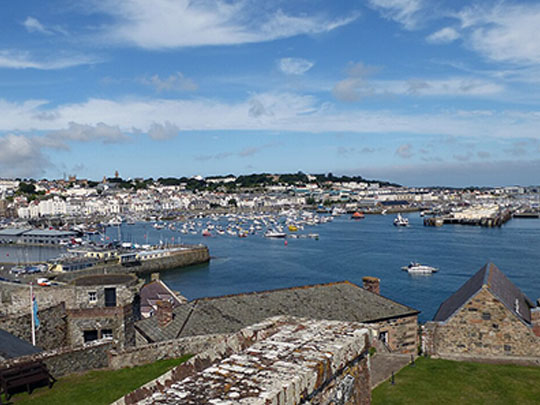
1 – St Peter Port (above)
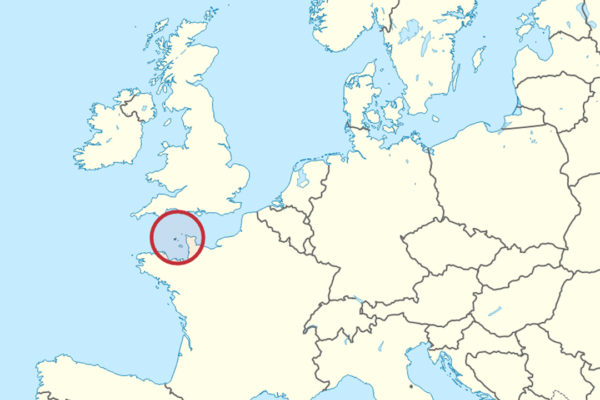
St Peter Port is the harbour capital of Guernsey, a Crown Dependency rather than part of the UK, whose islands joined the Duchy of Normandy in 933 and stayed loyal to the English Crown when King John lost mainland Normandy in 1204.
In St Peter Port, wander the harbour front and the Town Church, browse the old Market, and climb up to Candie Gardens and the Guernsey Museum.
During the German occupation of 1940–45, the only part of the British Isles occupied by German forces, three Jewish women were deported from Guernsey and murdered at Auschwitz, and St Peter Port’s harbour welcomed the Red Cross ship Vega with food in December 1944 and British liberators on 9 May 1945, celebrated as Liberation Day.
2 – Castle Cornet

Castle Cornet guards St Peter Port’s harbour from a rocky islet, built soon after 1204 when Guernsey sided with the English Crown, and King George VI gave it to the islanders in 1947 in thanks for their loyalty through two world wars.
At Castle Cornet, explore the castle’s museums, including the Maritime Museum, and catch the firing of the noonday gun.
During the English Civil War Castle Cornet held out for the King while the island backed Parliament, firing on the town until it surrendered in 1651, the last Royalist stronghold to fall, and in 1672 lightning blew up its powder magazine, killing the governor’s mother and wife.
3 – Hauteville House
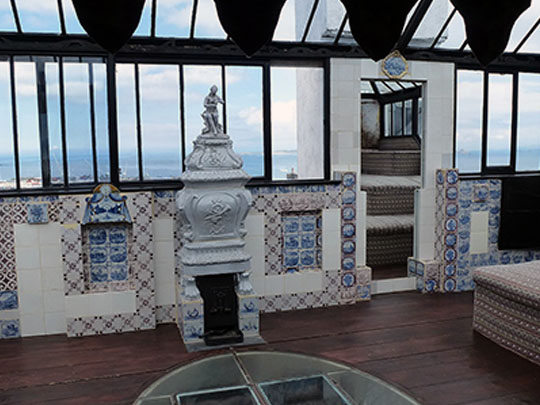
Hauteville House in St Peter Port was Victor Hugo’s home in exile, after he opposed Napoleon III’s 1851 coup and was expelled from Jersey, and he bought it in 1856 and lived there until he returned to France in 1870.
At Hauteville House, tour the house and garden, which Hugo’s descendants gave to the City of Paris in 1927.
At Hauteville House, Hugo finished Les Misérables and wrote Toilers of the Sea, a novel set on Guernsey and dedicated to the island, and in 1859 he turned down Napoleon III’s offer of amnesty.
4 – Forest and the South Cliffs

Forest is a parish on Guernsey’s high southern plateau, home to the island’s airport, and its cliffs drop to small bays such as Le Gouffre and Petit Bot.
In Forest, walk the cliff paths down to Le Gouffre and Petit Bot, and visit the parish church of Ste Marguerite de la Forêt.
Along the south-coast cliffs just east of Forest, the painter Pierre-Auguste Renoir spent several weeks in 1883 and painted about 15 views, most of them of Moulin Huet bay.
5 – German Military Underground Hospital
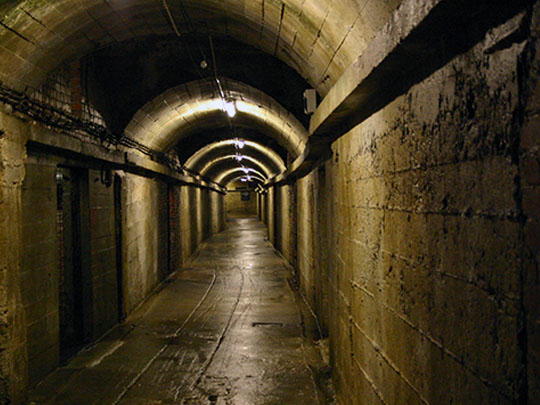
The German Military Underground Hospital lies beneath a low hill at La Vassalerie in St Andrew, Guernsey, dug into the rock by forced labourers during the German occupation and never fully completed.
At the German Military Underground Hospital, walk through about 7,000 square metres of bare concrete corridors and wards, with original hospital beds and medical equipment.
The Underground Hospital is the largest structural reminder of the German occupation in the Channel Islands, yet it was barely used as a hospital: wounded Germans were brought here after D-Day in 1944, but the damp tunnels were no place to recover, and much of it served as an ammunition store.
6 – Sark
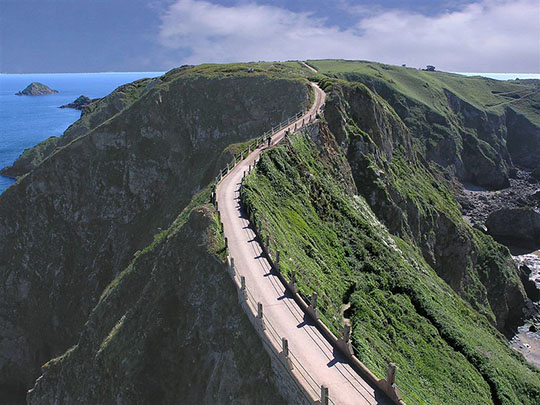
Sark is a tiny island in the Bailiwick of Guernsey, about 11 km east of Guernsey, settled in 1565 when Elizabeth I granted it to Helier de Carteret on condition he kept 40 men there, and its 40 tenements made it widely known as Europe’s last feudal state until reforms in 2008.
On Sark, where cars are banned and you get around by bike, tractor or horse and cart, cross the narrow ridge of La Coupée to Little Sark and its old silver-mine ruins, and stay after dark on the world’s first Dark Sky Island, which inspired the Irish singer Enya’s album Dark Sky Island.
During the German occupation the Dame of Sark, Sibyl Hathaway, faced down the occupiers, a British commando raid on Sark in October 1942 is believed to have contributed to Hitler’s Commando Order, and German prisoners of war built La Coupée’s concrete road in 1945.