
Wikimedia Commons / CC-BY-SA-3.0 / GFDL
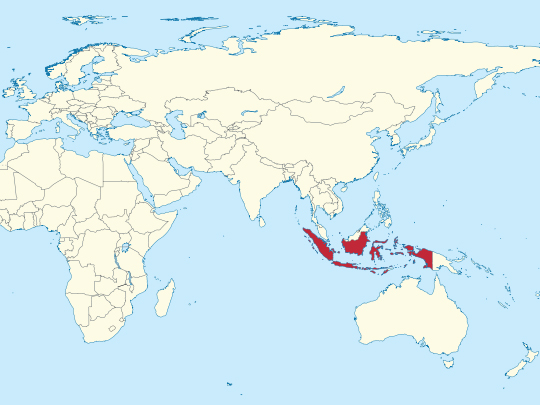
Capital: Jakarta
Population: 285 million+
Language: Bahasa Indonesia (over 700 living languages are spoken across the country).
1 – Lake Toba
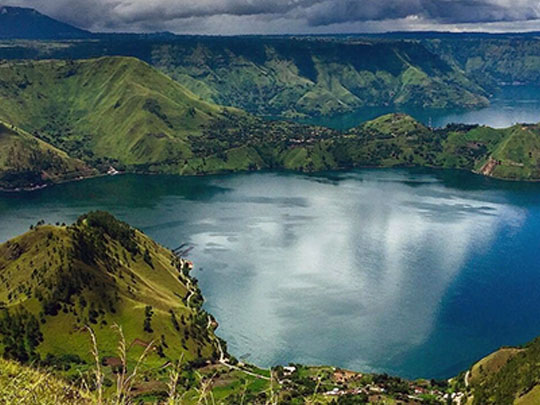

Lake Toba is the largest volcanic lake in the world, filling a caldera in the highlands of North Sumatra — roughly a hundred kilometres long, thirty across and over five hundred metres deep, sitting at about 900 metres, with an island in the middle, Samosir, about the size of Singapore.
Samosir is the reason to come, reached by ferry from Parapat: Batak villages with high saddle-roofed houses, the carved stone chairs and execution ground at Ambarita, hot springs on the far shore, and a lake you can swim in with no salt, no current and nothing in it that bites.
The caldera was made by the largest explosive eruption on earth in the last twenty-five million years, around 74,000 years ago — and for two decades a widely repeated theory held that it nearly finished the human species, cutting the global population to a few thousand and leaving a genetic bottleneck. More recent work has found little evidence for that. The eruption remains colossal; its effect on us remains argued over.
2 – Jakarta
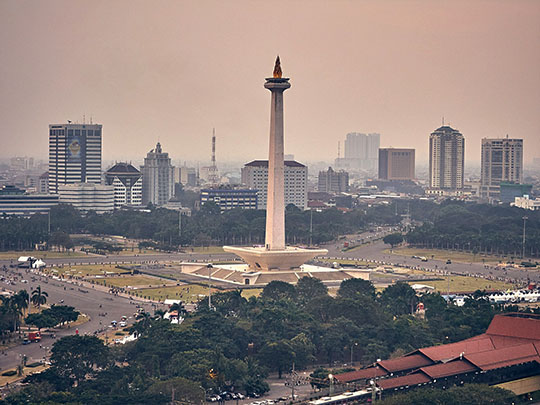
Jakarta is a city of over ten million on the northwest coast of Java, inside a metropolitan area of roughly thirty million that is among the largest on earth — founded as the port of Sunda Kelapa, taken by the Dutch in 1619 and rebuilt as Batavia, headquarters of the VOC and the seat of three centuries of Dutch rule in the archipelago.
Kota Tua, the old Batavia core around Fatahillah Square with the colonial town hall now a museum; the pinisi schooners still loaded by hand at Sunda Kelapa; the Monas obelisk; and the Istiqlal Mosque, the largest in Southeast Asia, which faces the Catholic cathedral across the road — the two are now linked by a pedestrian tunnel.
Jakarta is sinking, in places by more than twenty centimetres a year, largely because the city has pumped out the groundwater beneath itself; much of the north already sits below sea level behind walls. That is a large part of why Indonesia is building a new capital, Nusantara, in the forests of East Kalimantan — legislated in 2022 and still under way.
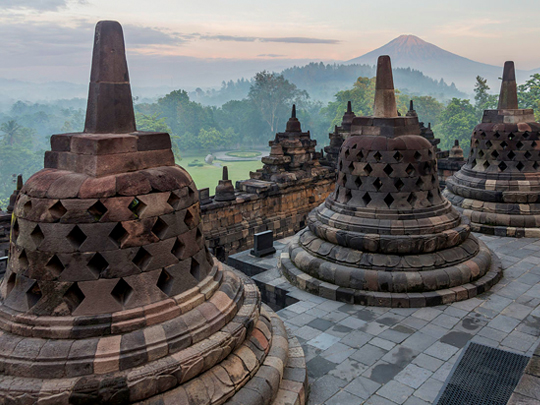
3 – Borobudur Temple (also main pic)
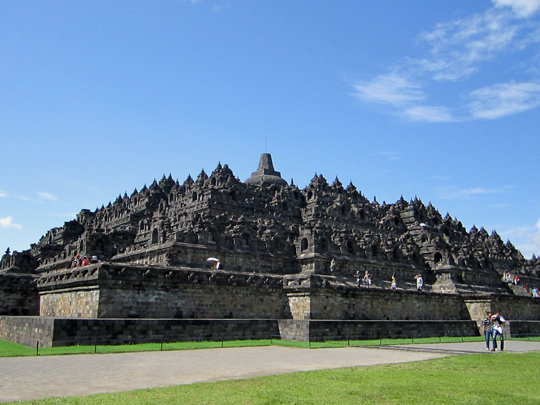
Borobudur is the largest Buddhist monument in the world, raised in central Java between roughly 780 and 830 under the Sailendra dynasty — nine stacked platforms, six square and three circular, carrying 2,672 relief panels and 504 Buddha figures, seventy-two of them seated inside perforated stone stupas on the upper terraces.
It was abandoned within a couple of centuries as Java turned to Islam and the court moved east, and lay under ash and jungle until Raffles had it cleared in 1814; a UNESCO-backed restoration between 1975 and 1982 took the lower terraces apart stone by stone, cleaned them, and put in the drainage the builders never had.
The building is meant to be walked rather than looked at — five kilometres of clockwise circuit climbing through the levels, reading the reliefs as you go from the world of desire to the world of form and finally to formlessness. And there is a level nobody sees: the base was encased early on, hiding 160 panels on the law of cause and effect, uncovered and photographed in 1890, then sealed up again.
4 – Prambanan Complex
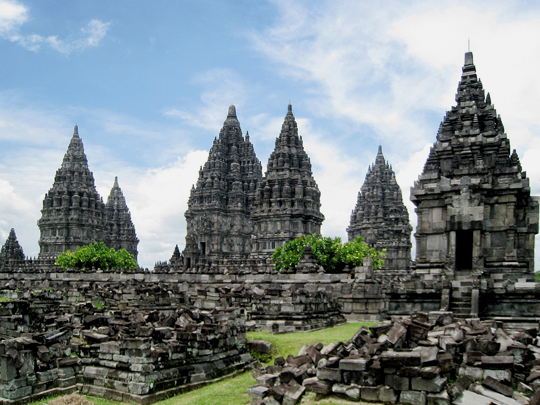
Prambanan Complex is the largest Hindu temple complex in Indonesia, completed around 856 on the same plain as Borobudur and barely twenty kilometres from it — dedicated to the Trimurti, with the central Shiva temple rising 47 metres and the site originally holding something like 240 shrines.
Three main temples face three smaller ones housing the gods’ mounts, Shiva’s bull Nandi among them, and the inner gallery walls of the Shiva and Brahma temples carry the Ramayana in relief — which is also staged as a ballet on an open-air stage beside the temples through the dry season, with the towers lit behind the dancers.
Prambanan collapsed in a sixteenth-century earthquake and reconstruction only began in 1918. The rule the archaeologists work to is that a temple is rebuilt only if enough of its original stone survives — which is why two great towers stand and a couple of hundred smaller shrines are still lying around them in sorted, numbered heaps, waiting for blocks that are never going to turn up.
5 – Sewu Temple Compound

Sewu Temple Compound is a Buddhist complex of 249 temples laid out as a mandala, 800 metres north of Prambanan and inside the same UNESCO listing — and older than either famous neighbour, begun in the late eighth century under the Sailendras, some seventy years before Prambanan.
Inscriptions give its real name as Manjusrigrha, the house of Manjusri. A large central sanctuary is ringed by concentric rows of smaller shrines, most of them still collapsed, with huge armed guardian figures seated at the entrances. It is a ten-minute walk from Prambanan and takes a fraction of the visitors, which is most of the appeal.
Sewu means a thousand in Javanese, after the legend of Rara Jonggrang: a prince ordered to build a thousand temples in one night to win a princess, tricked into stopping at 999, who turned her to stone for it — she is said to be the statue in Prambanan’s Shiva temple. The quieter fact is the one the legend covers: a Buddhist complex and a Hindu one built within decades of each other, 800 metres apart.
6 – Bromo Tengger Semeru National Park
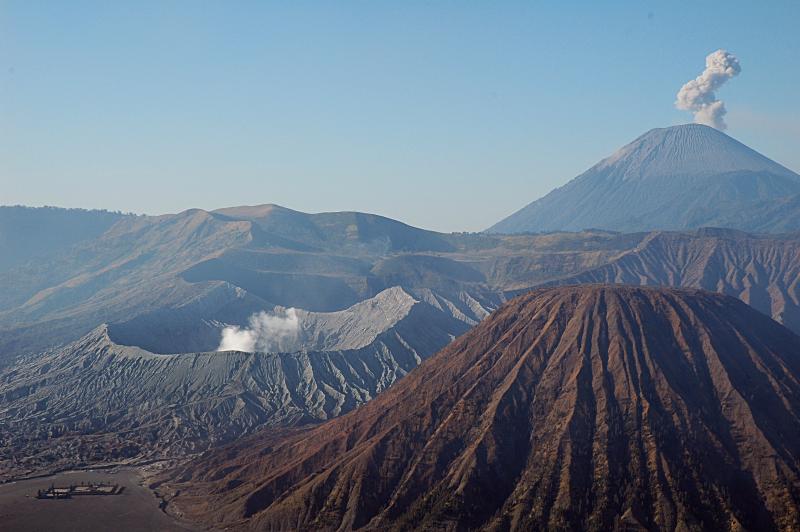
Bromo Tengger Semeru National Park is a park in East Java built around the Tengger caldera, a ten-kilometre bowl of volcanic sand from which several cones rise — Bromo, active and steaming at 2,329 metres, and behind it Semeru at 3,676 metres, the highest mountain in Java and among the most continuously active volcanoes anywhere.
The standard trip is a pre-dawn jeep to a viewpoint on the caldera rim for sunrise over the sand sea, then down across the sand on foot or horseback and up a staircase to the lip of Bromo’s crater. Semeru is a serious multi-day climb and closes whenever it is throwing ash, which is often.
The Tenggerese living on these slopes are Hindu, descended from people who fled the collapse of the Majapahit empire, and each year at Yadnya Kasada they climb Bromo before dawn and throw offerings into the crater — fruit, vegetables, money, live chickens and goats — while other villagers wait down inside it holding nets, to catch them.
7 – Bali
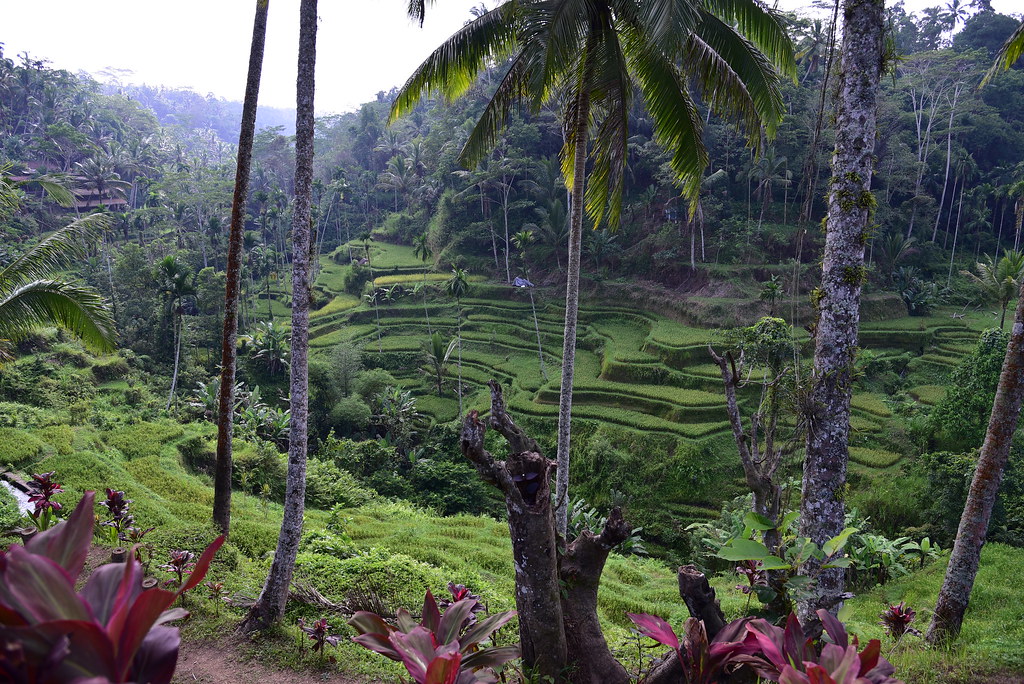
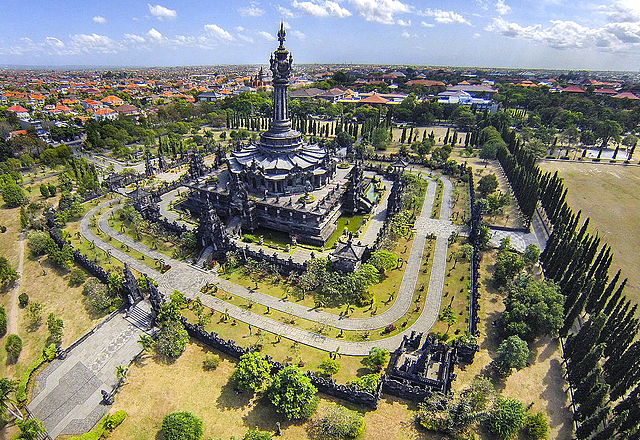
Bali is an island of about 5,700 square kilometres and four and a half million people, and the one part of Indonesia that stayed Hindu when Java turned to Islam — roughly 87 per cent of Balinese follow a form of Hinduism brought over by the Majapahit court in the fifteenth century, inside a country that is itself roughly 87 per cent Muslim.
Ubud and the hill country for temples, terraces and galleries; the south coast for surf and crowds; the east for Besakih, the mother temple on the flank of Mount Agung; the north and west for quieter water and fewer people. Denpasar is the working city most visitors pass through without registering. Those rice terraces are a thousand-year-old piece of civil engineering.
The subak system moves irrigation water through canals and weirs, and who gets water and when is settled not by any authority but by the farmers themselves, meeting in water temples — UNESCO listed the whole arrangement in 2012 as a landscape produced by a philosophy rather than by an economy.
8 – Uluwatu Temple

Uluwatu Temple is a small temple on the edge of a seventy-metre limestone cliff at the southwestern tip of Bali, founded in the eleventh century and extended in the sixteenth by the priest Dang Hyang Nirartha, who is said to have achieved release from the world here — one of the sad kahyangan, the six temples the Balinese treat as the island’s spiritual pillars.
Non-Balinese cannot go into the inner courtyards, so the reason to come is the setting: a walled path along the clifftop with the Indian Ocean directly below and surf breaks famous in their own right. A kecak dance is performed in an open amphitheatre on the cliff at sunset. The long-tailed macaques here run a trade.
They take sunglasses, phones and hats, carry them out of reach and hand them back for food — and primatologists working at this temple have found that the monkeys hold out for better payment when what they have taken is worth more, a bartering habit that appears to be learned and passed on.
9 – Komodo National Park
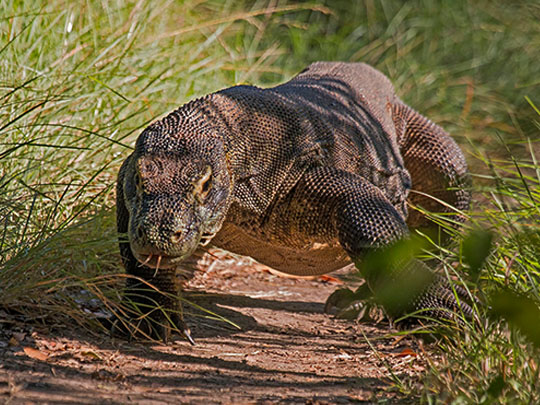
Three main islands — Komodo, Rinca and Padar — with dozens of smaller ones scattered between Sumbawa and Flores, made Komodo National Park in 1980 and UNESCO-listed in 1991, specifically to protect the largest lizard on earth, of which a few thousand survive and which lives nowhere else in the world.
You walk with a ranger and a forked stick on Komodo or Rinca to find them; Padar has the ridge viewpoint over three differently coloured bays that every photograph of the park is taken from; and the water is as good as the land, with manta rays at the cleaning stations and some of the fiercest currents in Indonesia.
For thirty years it was taught as settled fact that the dragon kills by infection — a mouth so septic that a bitten buffalo dies days later. In 2009 a team at the University of Queensland put a dragon through an MRI scanner and found venom glands in the lower jaw, delivering anticoagulants and compounds that collapse blood pressure. It is simply venomous, and the bacteria story is finished.
10 – Tanjung Puting
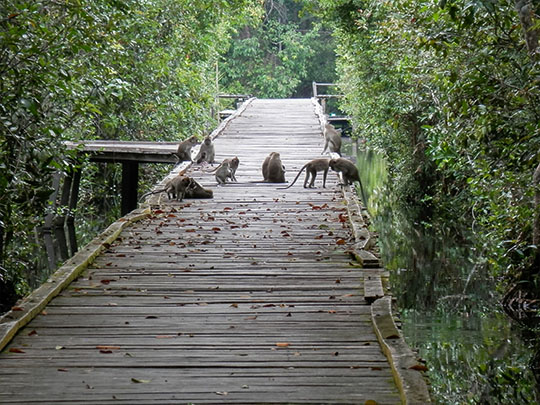

Tanjung Puting is four thousand square kilometres of peat swamp, heath forest and mangrove on the southern coast of Central Kalimantan, declared a national park in 1982 — and one of only two places on earth where orangutans live in the wild, the other being Sumatra.
You travel by klotok, a wooden houseboat that chugs up the Sekonyer river at walking pace while you sleep on the roof under a net; the route ends at Camp Leakey, with feeding platforms at points along the way where orangutans come in, and proboscis monkeys, gibbons and hornbills in the trees between them.
Camp Leakey was set up in 1971 by Biruté Galdikas, the third of the three young women Louis Leakey sent into the field — Jane Goodall to the chimpanzees, Dian Fossey to the gorillas, Galdikas to the orangutans, then the least understood of the great apes. She stayed more than fifty years, until her death in 2026, and most of what is known about wild orangutans was learned here.
11 – Tana Toraja
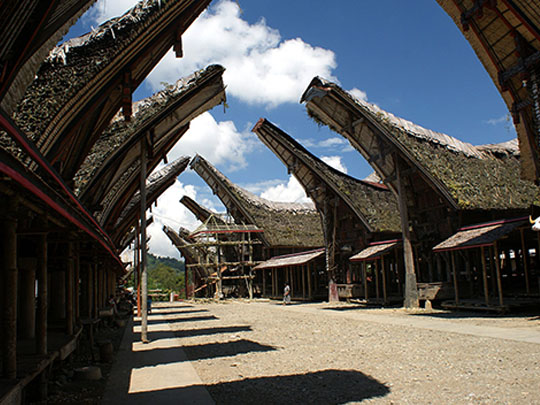
A highland region in South Sulawesi, a long road up from Makassar, where the Toraja were left largely to themselves by the coastal sultanates and reached by the Dutch only in the twentieth century — which is a large part of why a set of practices around death that exists nowhere else survived intact into the present.
Villages of tongkonan, ancestral houses with vast saddle-shaped roofs sweeping up at both ends and buffalo horns stacked down the front post; and cliff faces at Lemo and Londa cut with galleries of graves, lined with tau-tau — carved wooden effigies of the dead, standing on balconies looking out over the valley.
A Toraja funeral is a process rather than an event, and an expensive one. Between the death and the ceremony, which may be months or years away depending on what the family can raise, the deceased stays in the house, is spoken of as sick rather than dead, and is brought food. The funeral runs for days, and the number of buffalo sacrificed marks the standing of the family.
12 – Raja Ampat


Raja Ampat is an archipelago of roughly 1,500 islands, cays and shoals off the northwestern tip of West Papua, at the dead centre of the Coral Triangle — the name means four kings, after four of the larger islands, and the population across all of them is small enough that the great majority are uninhabited.
Wayag in the far north is the postcard: a maze of mushroom-shaped limestone islets, seen properly only after a hard scramble up a ridge. Misool in the south has the lagoons and the rock art. In between are manta rays, wobbegong sharks, and on Waigeo, birds of paradise displaying at dawn in forest directly above the reef.
More species of coral have been recorded here than anywhere else on earth — something like three-quarters of every known species, inside one small archipelago — and a great deal of what protects them is local rather than national: village-managed no-take zones run under customary marine tenure, opened and closed by agreement between communities.