

Wikimedia Commons / CC-BY-SA-3.0 / GFDL
Capital: Des Moines
Population: 3.2 million+
Language: English

1 – Des Moines (also above)

Des Moines, in central Iowa where the Des Moines and Raccoon rivers meet, grew from an army fort of 1843, becoming the state capital in 1857, and at a later Fort Des Moines the army commissioned 639 Black officers in 1917, then opened its first training centre for women officers in 1942.
Des Moines has the State Capitol, finished in 1886, the only US capitol with five domes, its main one covered in 23-carat gold leaf, the Pappajohn Sculpture Park and, every August, the Iowa State Fair, home of the butter cow since 1911, which draws more than a million visitors.
The story that Des Moines means “river of the monks” is folklore, and one leading theory, from the linguist Michael McCafferty, traces it to a name Father Marquette recorded in 1673 from an Illinois-language insult meaning roughly “excrement face”, while Bill Bryson, who grew up here, opened The Lost Continent by saying he came from Des Moines, adding “Somebody had to”.
2 – Field of Dreams, Dyersville

The Field of Dreams is a ballfield cut into the cornfields of two family farms near Dyersville, in northeast Iowa, built in 1988 for the film Field of Dreams (1989), with Kevin Costner, based on Shoeless Joe (1982), a novel by the Canadian writer William Patrick Kinsella.
At the Field of Dreams, visitors can run the bases, walk out of the corn like the ghost ballplayers and see the white farmhouse, and Major League Baseball has staged games here since 2021, when the White Sox beat the Yankees in the first major-league game played in Iowa.
For 18 years the field had two owners, as the Lansings had the house and infield while the Ameskamp family had left and centre field, each with a rival souvenir stand, until 2007, while the famous line is “If you build it, he will come”, not “they”, and the novel’s reclusive writer, Salinger, became Terence Mann in the film after Salinger’s lawyers objected.
3 – Dubuque

Dubuque stands on the bluffs of the Mississippi, where Iowa, Illinois and Wisconsin meet, named after Julien Dubuque, a French-Canadian lead miner who gained the Meskwaki’s permission to mine in 1788 and is often called the first European to settle permanently in what became Iowa, and it is Iowa’s oldest city, settled in 1833.
Dubuque has the Fenelon Place Elevator, 90 m of track climbing 58 m up the bluff, built in 1882 by a banker who wanted to get home for lunch and a nap, the Shot Tower of 1856 and Julien Dubuque’s monument on the bluff above the river.
Iowa’s first recorded murder trial was held in Dubuque in 1834, when Patrick O’Connor, from County Cork, was tried under a tree and hanged for shooting a fellow Irishman, and in 1843 the Dublin-born Mary Frances Clarke brought her Sisters of Charity of the Blessed Virgin Mary here, the first Catholic nuns in Iowa.
4 – Amana Colonies

The Amana Colonies are seven villages in east-central Iowa near Cedar Rapids, founded in 1855 by the Community of True Inspiration, German Pietists whose faith dates from 1714, who lived communally, sharing work, kitchens and land, until members voted in 1932 to split into a church and a company.
The Amana Colonies have more than 450 buildings from the communal era, a woollen mill begun in 1859, wineries known for rhubarb wine and family-style German restaurants, and the Amana Society owns some 10,500 ha.
Amana’s appliance company began in 1934 with a drinks cooler built by Amana craftsmen, and in 1967 its Radarange became the first popular countertop microwave for the home, though not the first, as Tappan had introduced one in 1955, while Raytheon, which developed the microwave oven, had bought Amana in 1965.
5 – Maquoketa Caves State Park

Maquoketa Caves State Park lies in the limestone bluffs along Raccoon Creek in eastern Iowa, its name coming from a Native American name meaning “Bear River”, and it is one of Iowa’s earliest state parks, after the Maquoketa Women’s Club bought the first land in 1921.
Maquoketa Caves State Park has about 13 caves, more than any other Iowa state park, including the 335 m Dancehall Cave, with a walkway first laid out in the 1930s, the Natural Bridge, about 15 m above the creek, and the 15-tonne Balanced Rock.
Maquoketa Caves were closed from 2010 to 2012 to protect bats from white-nose syndrome, and they shut every year from mid-November to April while the bats hibernate, and the Dancehall name recalls the dances held there in the 1800s, with a dance floor built near the Natural Bridge in 1868.
6 – Grotto of the Redemption

The Grotto of the Redemption, in the farming town of West Bend in northwest Iowa, was begun in 1912 by Father Paul Dobberstein, a German-born priest who had vowed to build a shrine to the Virgin Mary if he survived pneumonia as a seminarian, and he worked on it until his death in 1954.
The Grotto of the Redemption has nine grottos telling the life of Christ, encrusted with shells, crystals, Venetian mosaics, 59 tonnes of petrified wood and a stalagmite of more than 900 kg from Carlsbad Caverns, while a 136 kg Brazilian amethyst sits in the church’s Christmas Chapel.
The Grotto is billed as the largest man-made grotto in the world, and every stone was lifted by hand until Father Louis Greving, who took over the work, brought in an electric hoist, while nearby Emmetsburg, founded by Irish settlers in 1856, is named after Robert Emmet and has a cast of the Emmet statue that stands on St Stephen’s Green in Dublin.
7 – Davenport
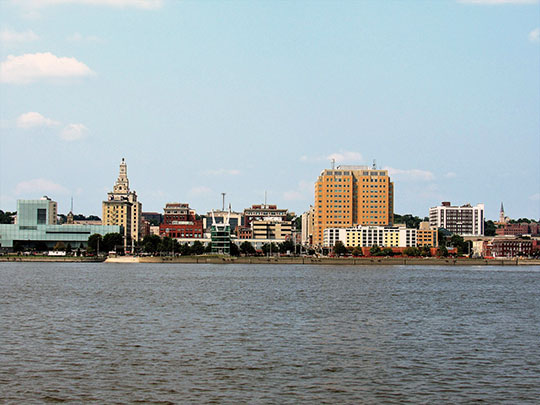
Davenport, on the Mississippi in the Quad Cities of eastern Iowa, was laid out in 1836 by a group of investors, including the interpreter Antoine LeClaire and named after his friend George Davenport, an English-born trader killed by robbers in 1845, while in 1856 the first railroad bridge across the Mississippi reached it from Rock Island, Illinois.
Davenport has its riverfront, Modern Woodmen Park, with a Ferris wheel beyond the outfield, the Figge Art Museum and, every summer, the Bix Beiderbecke jazz festival, honouring the cornet player born here in 1903, and it is often described as the largest Mississippi city without a permanent flood wall.
Two weeks after the bridge opened, the steamboat Effie Afton hit it and its owners sued, and Abraham Lincoln defended the bridge company in 1857, ending in a hung jury, while Davenport’s St Patrick’s Day parade starts in Rock Island and crosses the river into Iowa, billed as the only bi-state St Patrick’s parade.
8 – Effigy Mounds

Effigy Mounds National Monument, on the Mississippi bluffs of northeast Iowa, protects 206 burial and ceremonial mounds, built over some 2,000 years, among them 31 shaped like bears and birds, raised mostly in the late first millennium AD by Late Woodland peoples, and it has been a national monument since 1949.
Effigy Mounds has trails through the woods to the Marching Bear Group, ten bear-shaped mounds in a line, and overlooks above the river, a few miles upriver from the mouth of the Wisconsin River, where Marquette and Jolliet entered the Mississippi in 1673.
In 1990 the monument’s superintendent, Thomas Munson, removed the remains of 41 Native American people from its museum collection and kept them at his home for more than 20 years, pleading guilty in 2016, and a review found the park had built 78 unauthorised projects among the mounds between 1999 and 2010.
9 – Herbert Hoover National Historic Site

The Herbert Hoover National Historic Site, in the small town of West Branch in eastern Iowa, keeps the two-room cottage, 4.3 m by 6.1 m, where Herbert Hoover was born on 10 August 1874 to Quaker parents, and he was orphaned by the age of nine before becoming the 31st president, from 1929 to 1933.
The Herbert Hoover National Historic Site has the birthplace cottage, a reconstruction of his father’s blacksmith shop, the Quaker meetinghouse, 33 ha of tallgrass prairie, the graves of Hoover and his wife Lou and the Presidential Library and Museum.
Herbert Hoover is remembered for the Depression, but before that his Commission for Relief in Belgium, set up in 1914, fed millions in Belgium and northern France during the First World War, and Harry Truman came to the library’s dedication on Hoover’s 88th birthday in 1962, calling himself “one of his closest friends”.
10 – Surf Ballroom, Clear Lake
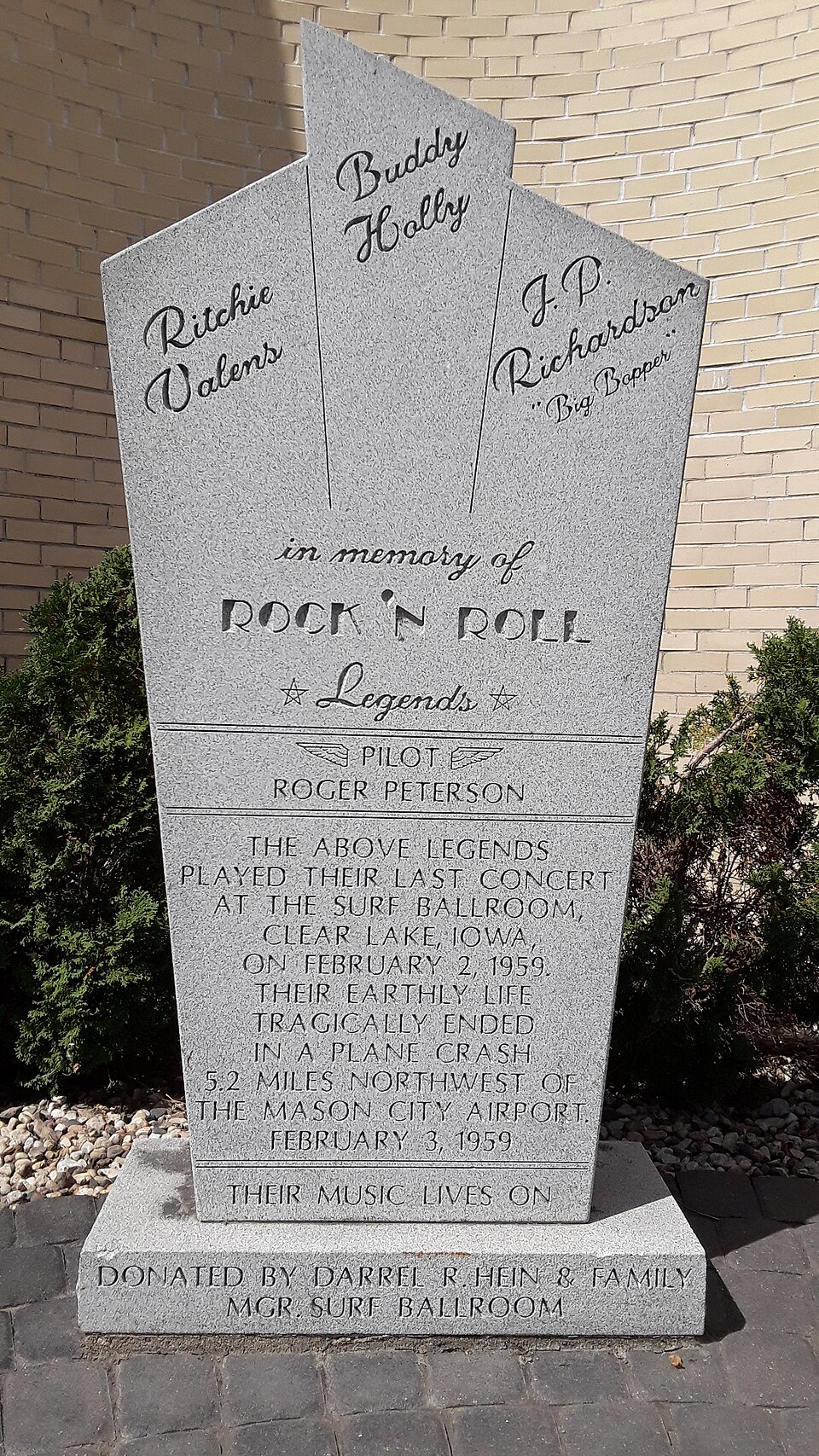
The Surf Ballroom stands by the lake in Clear Lake, north Iowa, opened in 1933, rebuilt in 1948 after a fire, and on 2 February 1959 Buddy Holly, Ritchie Valens and the Big Bopper, Jiles Richardson, played their last show here, before their chartered plane crashed into a cornfield minutes after taking off from nearby Mason City, killing them and the 21-year-old pilot, Roger Peterson.
The Surf Ballroom, a National Historic Landmark since 2021, hosts concerts, its green-room walls covered in musicians’ signatures, and a Winter Dance Party tribute every year around the anniversary, while some 8 km north a path through the fields leads to the crash site, marked by a steel guitar and records.
According to his guitarist, Tommy Allsup, Ritchie Valens won his seat on the plane in a coin toss, though accounts differ, and Waylon Jennings gave his up to the Big Bopper, who was ill, while in 1971 Don McLean’s “American Pie” called it “the day the music died”.
11 – American Gothic House

The American Gothic House is a small white farmhouse in the town of Eldon, in southeast Iowa, built in 1881–82 for the Dibble family, with a pointed Gothic window in its gable, and Grant Wood painted it in 1930 behind the two figures of American Gothic, which won a $300 prize and a bronze medal at the Art Institute of Chicago.
The American Gothic House isn’t open to the public inside, but the visitor centre next door lends out costumes for posing in front of it like the painting, and the Gothic window, which Wood thought pretentious for so small a house, is hinged so that furniture could be moved upstairs.
The models for American Gothic were Wood’s sister, Nan, about 30, and his dentist, Byron McKeeby, 62, while Wood later said she was the farmer’s grown-up daughter, though newspapers called them a married couple, prompting complaints from Iowa farm wives, and he made the roof steeper and the window longer than they really are.
12 – Sergeant Floyd Monument, Sioux City
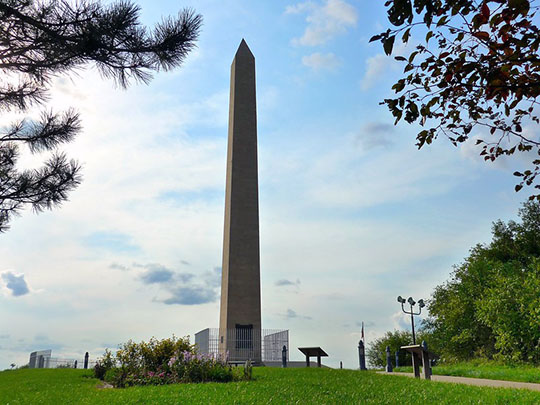
The Sergeant Floyd Monument stands on a bluff above the Missouri River in Sioux City, northwest Iowa, over the grave of Sergeant Charles Floyd, who died on 20 August 1804, probably of a burst appendix, the only member of Lewis and Clark’s expedition to die on the journey.
The Sergeant Floyd Monument is a 30 m sandstone obelisk dedicated in 1901, with views over the river, and down by the water the Sergeant Floyd River Museum is housed in a Corps of Engineers towboat built in 1932.
Sergeant Floyd was buried four times, after the river wore away the bluff and his grave was exposed in 1857, and his monument was the first site designated a National Historic Landmark, on 30 June 1960, while the towboat named after him became one too in 1989.
13 – Winterset
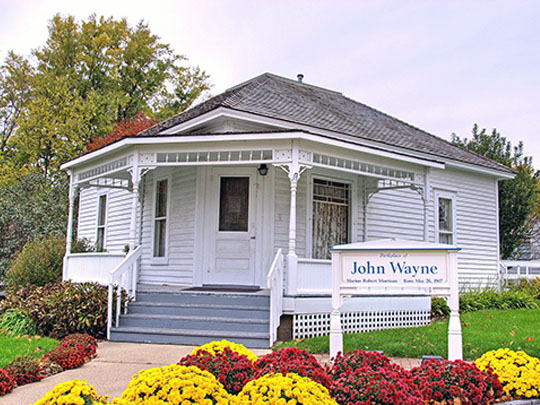
Winterset, the county seat of Madison County in south-central Iowa, is where John Wayne was born Marion Robert Morrison on 26 May 1907, and where the young George Washington Carver lived around 1888–90, until a local woman, Helen Milholland, heard him sing in church and urged him to go to college.
Winterset has the John Wayne Birthplace and Museum, the courthouse of 1876–78 and the six surviving covered bridges of Madison County, including the Roseman and Holliwell bridges from the 1995 film The Bridges of Madison County, celebrated each October at the Covered Bridge Festival.
John Wayne’s ancestor Robert Morrison came from the parish of Drummaul in County Antrim, emigrating around 1800, and Wayne described himself as Scotch-Irish, while the Delicious apple began as a chance seedling on Jesse Hiatt’s farm near Peru, in Madison County, winning a nursery contest in 1894 as the “Hawkeye”.
14 – Old Capitol, Iowa City
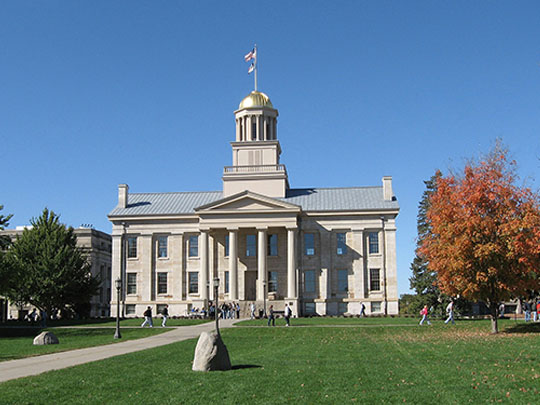
The Old Capitol, in Iowa City in eastern Iowa, is a Greek Revival building begun on 4 July 1840, where the territorial legislature met from 1842 and the new state’s government sat from 1846 until the capital moved to Des Moines in 1857, when it became the first permanent building of the University of Iowa.
The Old Capitol is a museum with its restored legislative chambers, at the heart of the university, and Iowa City, home of the Iowa Writers’ Workshop since 1936, became a UNESCO City of Literature in 2008, the third in the world after Edinburgh and Melbourne.
On 20 November 2001, a fire accidentally started by contractors working on the Old Capitol destroyed its cupola, dome and bell, and it reopened in 2006, while the Dublin poet Eavan Boland took part in the university’s International Writing Program in 1979.