

Wikimedia Commons / CC-BY-SA-3.0 / GFDL
Capital: Tokyo
Population: 124 million+
Language: Japanese (Ryukyuan languages of the southern islands and Ainu in the north are recognised as endangered).
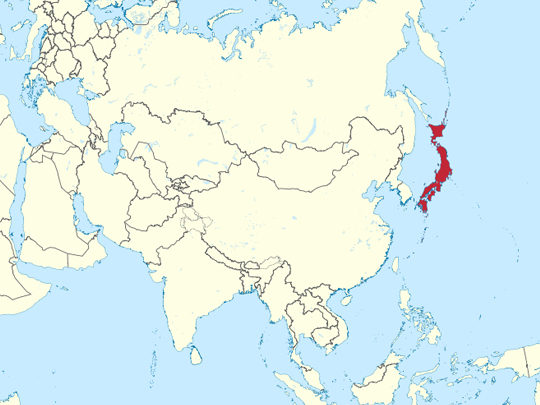
1 – Tokyo (also above)
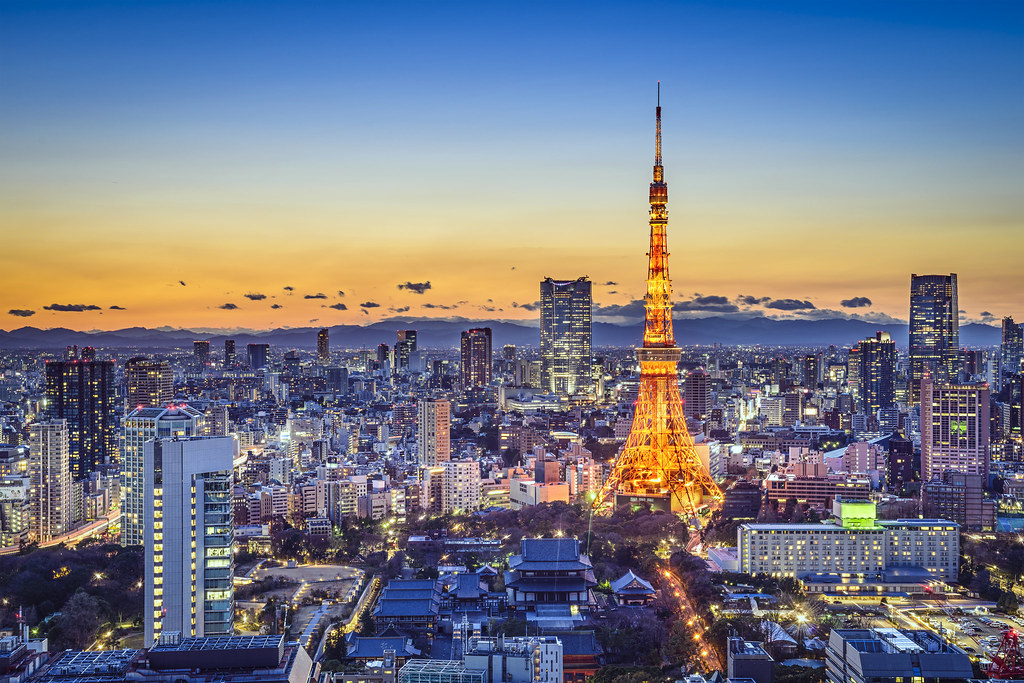
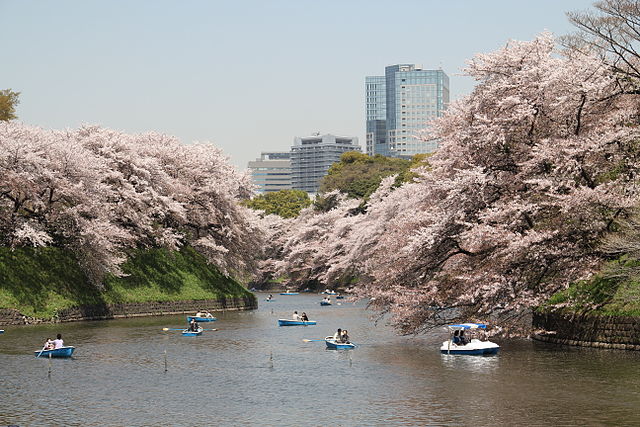
Tokyo was Edo, a fishing village that became the shogun’s capital in 1603 and by about 1700 was probably the largest city in the world, with a million people. It was renamed Tokyo — eastern capital — when the emperor moved here in 1868, and it has been destroyed twice since: by the Kantō earthquake of 1923 and by firebombing in March 1945.
Tokyo is really a set of towns that grew into each other: Asakusa for Sensō-ji, the oldest temple in the city; Shibuya and Shinjuku for the crowds and the neon; Ueno for the museums; the Imperial Palace gardens in the middle on the site of Edo Castle; and Toyosu for the fish market.
Almost no street in Tokyo has a name. Addresses run district, then block, then building — and building numbers were historically given out in the order the buildings went up rather than by position, so two doors side by side can be number 3 and number 17. The city has always run on landmarks and maps, and now on phones.
2 – Kyoto
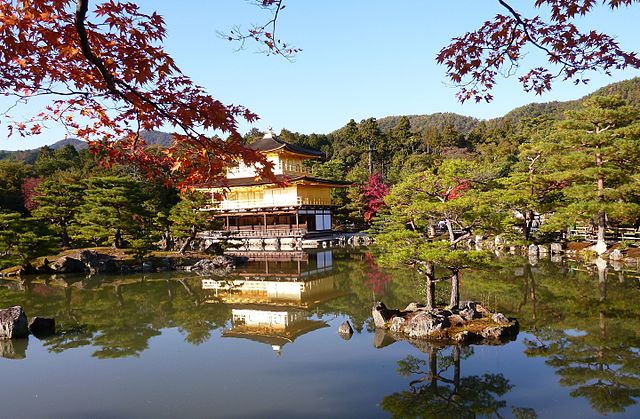
Kyoto was the capital of Japan from 794 until 1868 — well over a thousand years — and it is where most of what the world now thinks of as traditional Japanese culture was actually made: the tea ceremony, noh, the dry garden, kaiseki cooking. It holds something like 1,600 Buddhist temples and 400 Shinto shrines.
Kyoto’s obvious stops are Kinkaku-ji, the golden pavilion; Fushimi Inari and its tunnel of vermilion gates up the hillside; the rock garden at Ryōan-ji; Kiyomizu-dera on its wooden stilts; and the Gion district. The less obvious pleasure is the Philosopher’s Path and the small temples strung along it. Kyoto is still standing because one man crossed it off a list.
In May 1945 it sat at the top of the American atomic target list, and the Secretary of War, Henry Stimson, struck it out and kept it out through repeated arguments with General Groves and two conversations with Truman. The popular story that he had honeymooned there is false — and the film Oppenheimer repeated it anyway.
3 – Nikkō
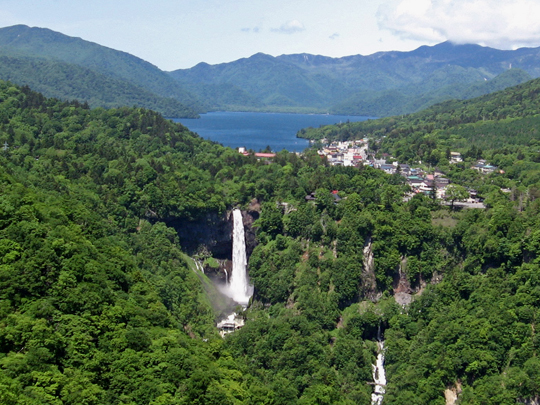
Nikkō is a mountain town about two hours north of Tokyo, and it holds two separate things: a national park of volcanoes, lakes and waterfalls, and — just outside the park boundary — the Tōshō-gū, the mausoleum of Tokugawa Ieyasu, who ended a century of civil war and founded the shogunate that ran Japan for 250 years.
The Tōshō-gū at Nikkō is the most ornate building in the country, a mass of gold leaf and carving that includes the three wise monkeys and the sleeping cat, and is nothing whatever like the restraint of Kyoto. In the park itself are Lake Chūzenji, the 97-metre Kegon Falls, the Senjōgahara marsh and hot springs at Yumoto.
The roads into Nikkō run under cedars. From 1625 a retainer called Matsudaira Masatsuna spent two decades planting them along three highways into the town — tens of thousands of trees — and gave the whole avenue to the shrine on the 33rd anniversary of Ieyasu’s death. About twelve thousand survive along 35 kilometres, and Guinness lists it as the longest tree-lined avenue in the world.
4 – Hiroshima

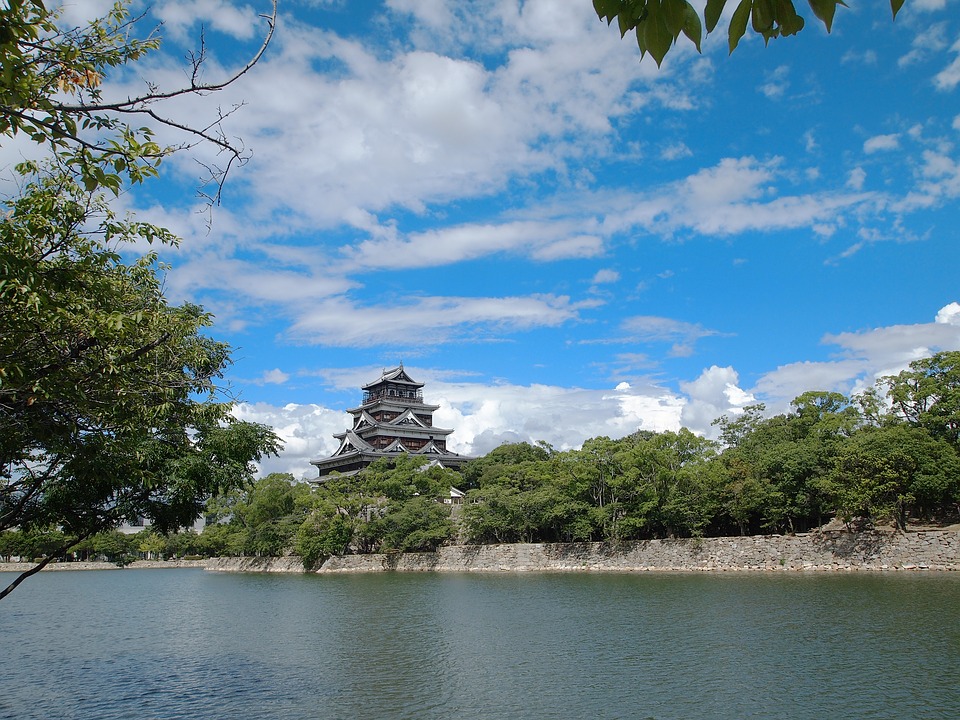
At a quarter past eight on the morning of 6 August 1945, an atomic bomb was detonated about six hundred metres above the centre of Hiroshima. Somewhere between seventy and eighty thousand people were killed immediately, and roughly as many again died before the end of the year from injuries and radiation.
The city was rebuilt and now holds well over a million people. The Genbaku Dome in Hiroshima was the Prefectural Industrial Promotion Hall, designed by a Czech architect in 1915. It stood almost directly beneath the detonation, its frame survived, and it has been left exactly as it was found. Across the river are the Peace Memorial Park and Museum, the Children’s Peace Monument, and a flame lit in 1964 that is to be put out when the last nuclear weapon is gone.
Around a hundred and seventy trees within two kilometres of the hypocentre lived. They are catalogued one by one as hibakujumoku, survivor trees — camphors, ginkgos, a weeping willow — and several still lean permanently away from the blast. Seeds and saplings taken from them have been sent to more than thirty countries.
5 – Ishigaki Island
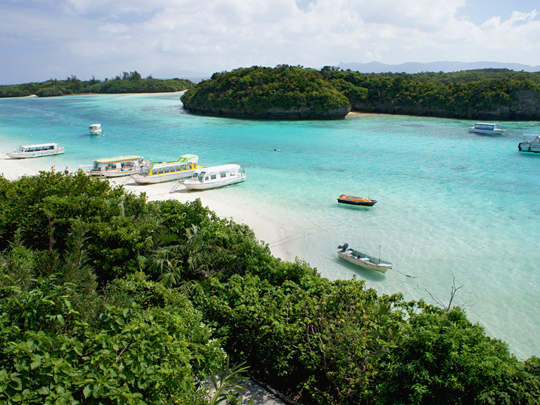
Ishigaki lies in the Yaeyama Islands at the far southwestern end of Japan, about 400 kilometres from Okinawa’s main island and only around 250 from Taiwan — which puts it closer to Taipei than to Naha. These islands belonged to the Ryukyu Kingdom, an independent state until Japan annexed it in 1879, and they still have their own languages.
Kabira Bay on Ishigaki has the postcard water and the black pearl farms, though swimming there is not allowed; manta rays gather at a cleaning station off the north coast; and the island is the jumping-off point for Taketomi, with its coral-walled lanes and sand streets, and for Iriomote, which is almost entirely jungle. Ishigaki has the darkest skies in Japan.
All eighty-eight of the modern constellations can be seen from here across the course of a year, which is not true anywhere else in the country, and the Southern Cross clears the horizon in spring. In 2018 the Iriomote-Ishigaki National Park became Japan’s first certified International Dark Sky Place.
6 – Kanazawa
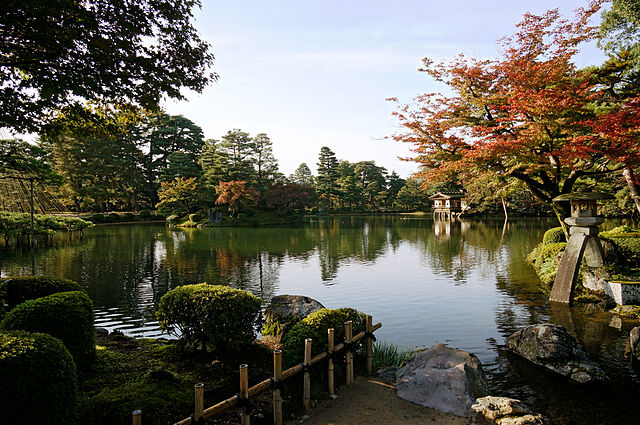
Kanazawa sits on the Sea of Japan coast and was, under the Maeda lords, the richest domain in the country after the shogun’s own. It was never bombed during the Second World War — there was no industry in it worth the fuel — so its Edo-period districts survive largely intact, which almost no other Japanese city can say.
Kanazawa has Kenroku-en, counted among the three great gardens of Japan; the Higashi Chaya teahouse district behind wooden lattice fronts; the Nagamachi samurai quarter with its earthen walls; the rebuilt castle; the Ōmichō market; and the 21st Century Museum of Contemporary Art, which is a glass circle you walk into from any side.
The name Kanazawa means marsh of gold, and the city makes essentially all of Japan’s gold leaf — something like ninety-nine per cent of it. It is beaten down to roughly a ten-thousandth of a millimetre, thin enough to see light through, and it ends up on temples, lacquerware, ice cream, and on the Tōshō-gū at Nikkō.
7 – Kamakura
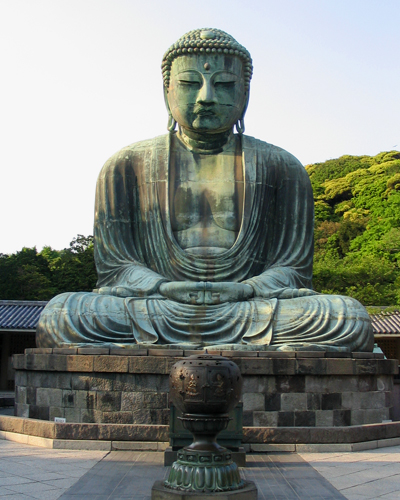
Kamakura is a coastal town an hour south of Tokyo which was, from 1185 to 1333, the seat of the first warrior government in Japan — the shogun ruled from Kamakura while the emperor stayed on in Kyoto, an arrangement that lasted in one form or another for nearly seven hundred years.
Kamakura has around sixty-five temples and twenty shrines packed into a small space: Tsurugaoka Hachimangū at the head of the main avenue, the Zen monasteries of Kenchō-ji and Engaku-ji, Hase-dera on its terrace above the sea, and walking trails over the wooded ridges between them. The beach is ten minutes from the station.
The Great Buddha at Kōtoku-in was cast in bronze in 1252 and originally stood inside a wooden hall. The hall was wrecked and rebuilt more than once, and in 1498 a tsunami carried it off for good. The Buddha has sat in the open ever since — more than five centuries of weather, and the reason it is always photographed against sky rather than ceiling.
8 – Mount Fuji
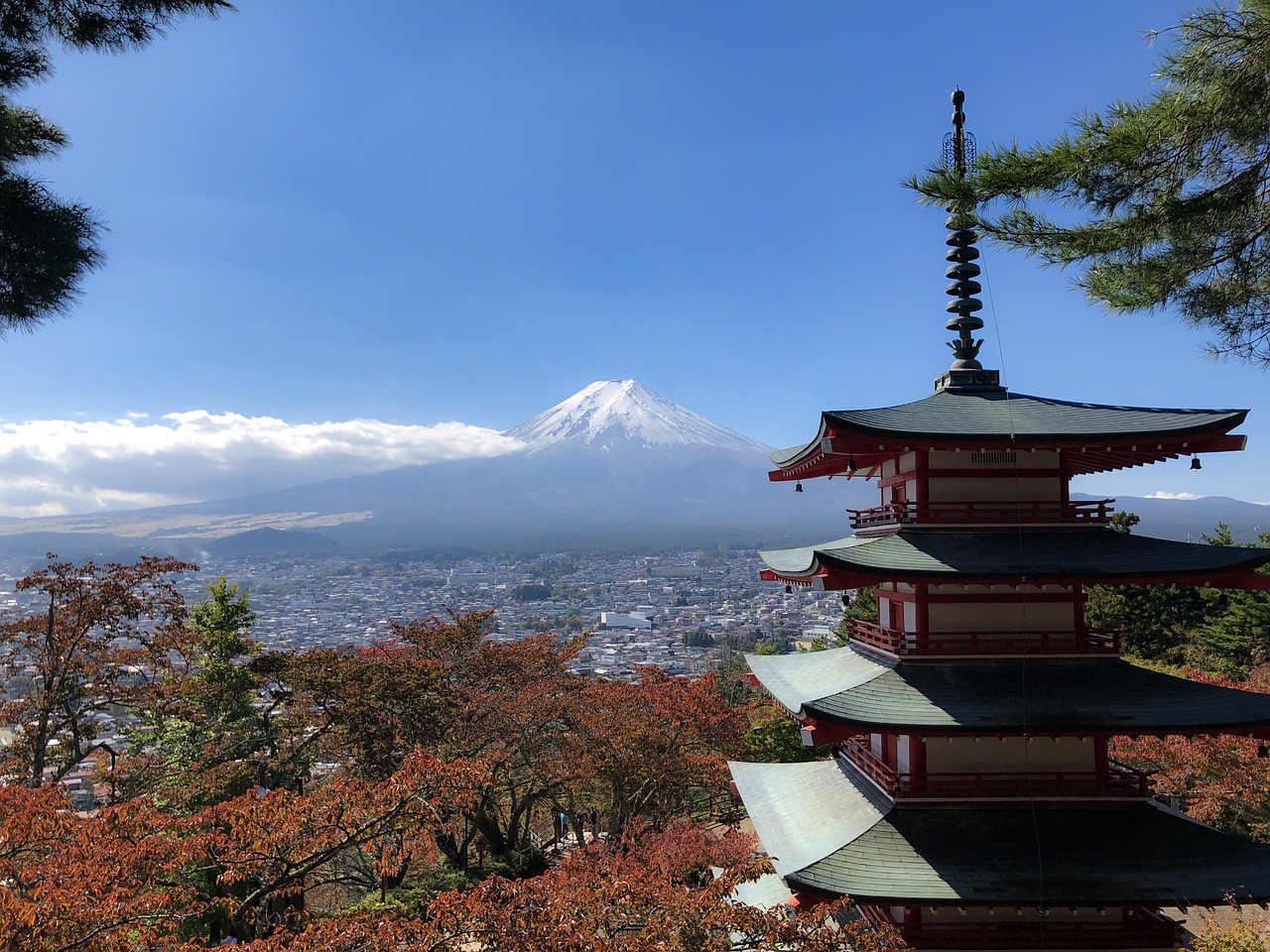
Mount Fuji is an active volcano of 3,776 metres, the highest mountain in Japan, standing almost perfectly symmetrical about a hundred kilometres southwest of Tokyo. It last erupted in 1707, dropping ash on the capital, and has been quiet since — though it is still classified as active rather than dormant.
The climbing season on Mount Fuji runs from early July to early September, with four routes and huts along the way; most people start in the afternoon, sleep partway up and walk the last stretch in the dark for sunrise. Out of season, the classic views are from the Fuji Five Lakes — or from the right-hand side of a Shinkansen.
UNESCO listed Mount Fuji in 2013, and not as a mountain. It is inscribed as a cultural site — a sacred place and a source of artistic inspiration — for its pilgrimage routes, the shrines around its base and what Hokusai and Hiroshige made of its outline. The listing is for the idea of Fuji rather than for the rock.
9 – Himeji Castle
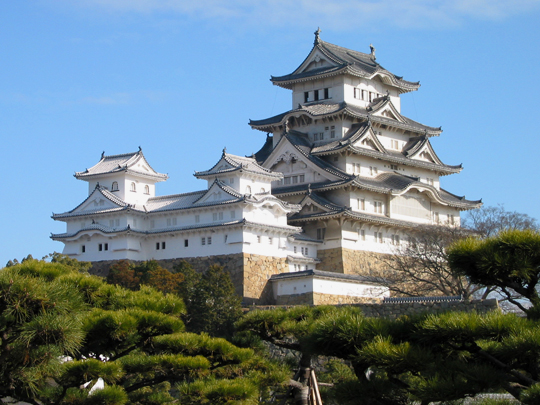
Himeji Castle in its present form was finished in 1609 by Ikeda Terumasa, and it is the largest and best-preserved castle in Japan — one of only twelve that still have their original wooden keep, and one of the country’s first two UNESCO listings, in 1993. The keep at Himeji Castle is six storeys of white plaster over a stone base, with three smaller keeps linked to it by corridors.
The approach spirals and doubles back through a sequence of gates built to confuse and slow an attacker, and the white lime plaster over the timber — which gives it the name White Heron Castle — was fireproofing as much as decoration. Himeji Castle has never been damaged by war, fire or earthquake in four hundred years.
The city around it was firebombed in 1945 and largely burned; the castle did not. Local accounts have it that an incendiary came through the roof of the keep and failed to go off. It also came through the 1995 Kobe earthquake, close enough to be shaken hard, without structural harm.
10 – Nara
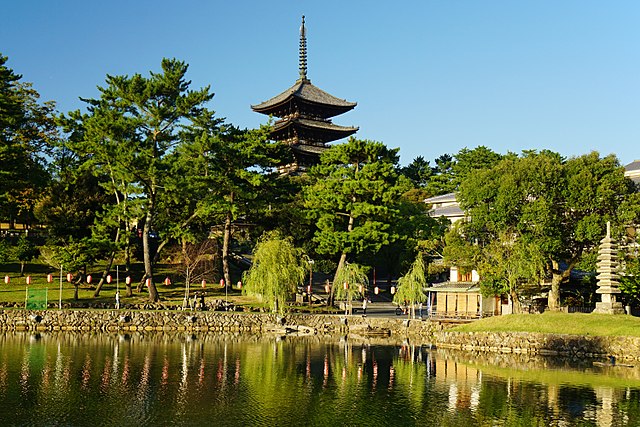
Nara was Japan’s first permanent capital, from 710 to 784, laid out on a grid copied from Chang’an, the Tang capital in China. It lost the capital to Kyoto after seventy-four years and has been a quiet provincial town ever since, which is precisely why so much of the eighth century is still standing in it.
Tōdai-ji in Nara holds the Great Buddha, sixteen metres of bronze cast in the 750s, inside a hall that was for centuries the largest wooden building in the world. The lantern-lined approach to Kasuga Taisha, the pagoda at Kōfuku-ji and the deer park are all within a walk; some 1,200 sika deer roam the park, protected as messengers of the gods. Behind Tōdai-ji stands the Shōsō-in, a raised wooden storehouse sealed in 756 with the possessions of a dead emperor.
It holds over nine thousand objects — Persian cut glass, a Central Asian lute, Tang mirrors, Indian dyes — and unlike every other Silk Road collection anywhere, it was never buried and never excavated. It has simply sat in that shed for twelve hundred years.
11 – Hokkaido
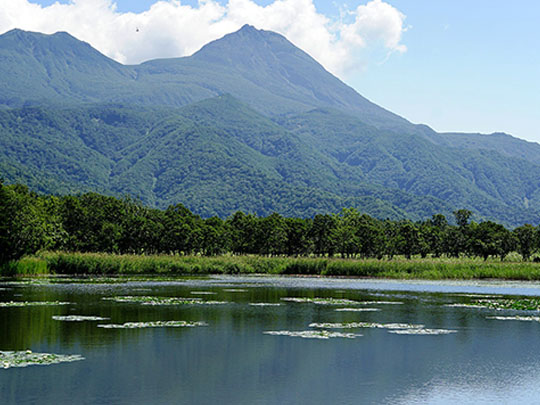
Hokkaido is Japan’s northernmost island: a fifth of the country’s land area carrying about four per cent of its people, and it was not fully incorporated into Japan until 1869. It is the homeland of the Ainu, whose language is unrelated to Japanese, and who were formally recognised as an indigenous people of Japan only in 2008.
Sapporo is Hokkaido’s only large city, laid out on an American-style grid in the 1870s and known for its February snow festival and its beer. Beyond it are the lavender fields at Furano, the volcanoes and hot springs of Daisetsuzan, the crater lake at Mashū, and the Shiretoko peninsula out in the far northeast.
Shiretoko — “the end of the earth” in Ainu — was UNESCO-listed in 2005 for one reason: drift ice. Sea ice comes down the Sea of Okhotsk from the Amur and reaches this coast in late January, the lowest latitude at which seasonal sea ice forms anywhere in the northern hemisphere. Algae on its underside bloom as it melts, and that bloom feeds the plankton, the salmon, and eventually the brown bears standing in the rivers.
12 – Miyajima
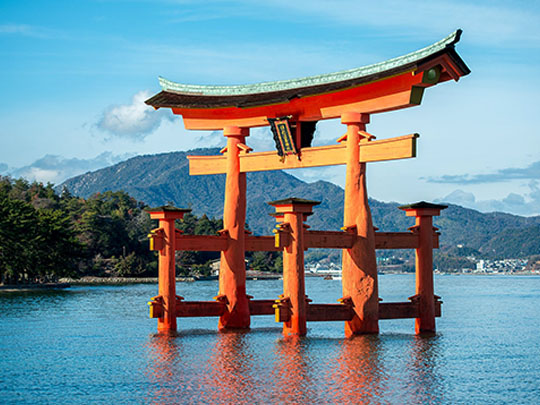
Miyajima — properly Itsukushima — is an island in the Inland Sea about forty minutes from Hiroshima by train and ferry. Its shrine was founded in the sixth century and given its present form in 1168 by Taira no Kiyomori, and it is built on piers out over the water because the island itself was understood to be a god, rather than merely the home of one.
The great torii of Miyajima stands sixteen metres high in the shallows and is anchored to nothing: six camphor pillars simply rest on the seabed, held down by around sixty tonnes of weight, with four tonnes of stones packed into the top beams as ballast. At low tide you walk out to it; at high tide the shrine appears to float. Mount Misen and its old forest rise behind, and deer wander the village.
Because Miyajima was the god, it had to stay ritually clean. No births, no deaths and no burials were permitted on the island — pregnant women and the dying were taken to the mainland. The rule has stood formally since 1878 and is still observed in principle: among roughly two thousand residents, there is no cemetery.
13 – Osaka
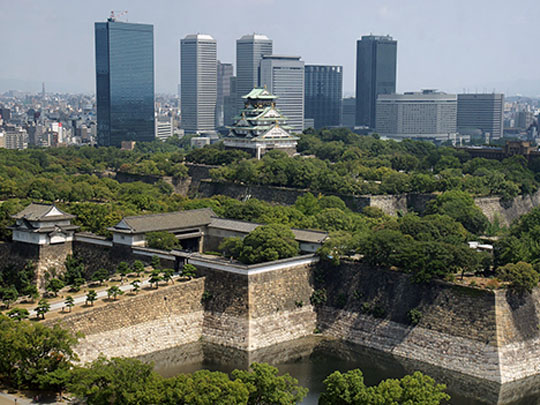
Osaka is Japan’s third-largest city and its most commercially minded, built on a delta and cut through with canals. Under the Tokugawa it was the country’s warehouse: the rice tax from every domain in Japan was shipped here, stored here and sold here, which earned Osaka the name tenka no daidokoro — the nation’s kitchen.
Osaka has Dōtonbori with its canal-side neon and the Glico running man; the reconstructed castle that Hideyoshi first built in the 1580s; Shinsekai under the Tsūtenkaku tower; the Umeda Sky Building; and the food the city is actually known for — takoyaki, okonomiyaki, kushikatsu — under the local motto kuidaore, roughly “eat yourself broke”. Because all that rice passed through one place, Osaka worked out how to trade it before it existed.
Merchants at Dōjima were dealing in rice bills from the 1690s, and the exchange was formally sanctioned by the shogunate in 1730, with standardised contracts, set settlement dates and a clearing house. It is generally reckoned the world’s first organised futures market, well over a century before Chicago.
14 – Shirakawa-gō
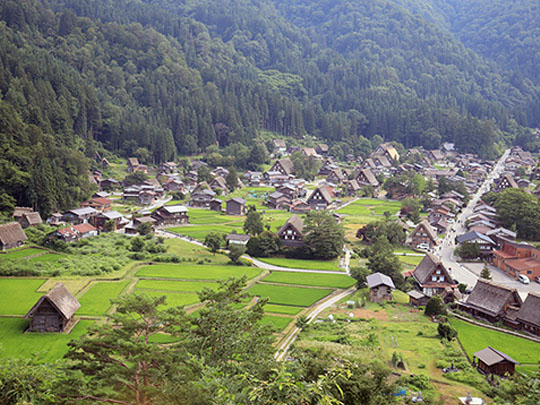
hirakawa-gō is a valley in the mountains of Gifu prefecture, far enough in and buried under snow long enough each winter that it was effectively cut off for months at a time. UNESCO listed Shirakawa-gō in 1995, together with neighbouring Gokayama, and it listed them for the farmhouses.
The houses at Shirakawa-gō are gasshō-zukuri — “hands in prayer” — thatched roofs pitched at around sixty degrees to shed several metres of snow, framed without nails and lashed together with rope and straw. Those attics were working floors: silkworms were raised in the roof space, and beneath the ground floor the villagers made saltpetre for gunpowder.
A gasshō roof has to be rethatched every thirty or forty years, and no one family could ever manage it. So the village did it together, under a system called yui: everyone turns out, two hundred people or more strip and rethatch a single house in a day, and the obligation comes round to each household in turn. The architecture survived because the mutual debt did.