
Photo credit: academyliberia.weebly.com
Capital: Monrovia
Population: 5.2 million+
Language: English (Over 20 indigenous languages)
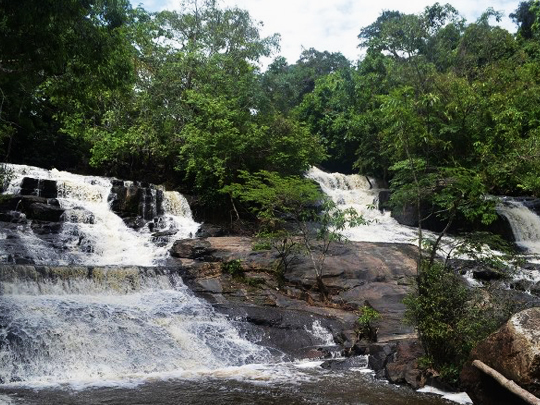
1 – Kpatawee Waterfalls (above)
In the lush rainforest of central Liberia’s Bong County, a few hours’ drive up-country from Monrovia, the Kpatawee Waterfall tumbles in tiers over dark basalt into a deep, cool pool — Liberia’s best-loved swimming and picnic spot, yet still blissfully uncrowded.
Reaching the upper falls means a short hike through the trees and a clamber over black boulders, rewarded by a dip in the tea-coloured water; a rustic community eco-lodge of thatched huts sits nearby, and the road in winds through villages of rice paddies, banana groves and palm-wine tappers.
The surrounding forest hides one of Africa’s stranger animals — the water chevrotain, a shy, ancient little creature that looks like a spotted mouse-deer and, when danger threatens, escapes by diving into a stream and walking along the bottom underwater.
2 – Sapo National Park
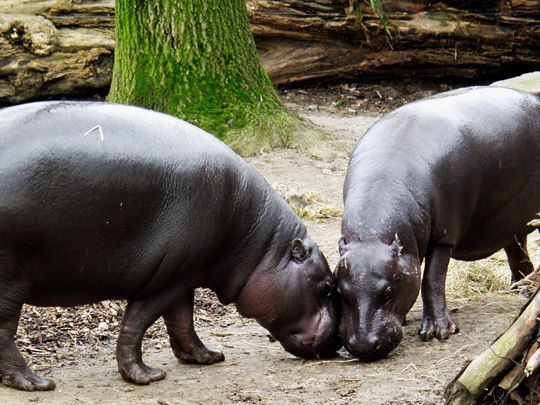
Deep in the southeast of Liberia lies Sapo, the country’s only national park and its largest tract of untouched rainforest — the second-biggest block of primary jungle left in West Africa, and part of an Upper Guinean forest so rich it has been called the most mammal-diverse region on Earth.
Reaching it is an adventure in itself, ending in guided treks and dugout-canoe trips through a wilderness of towering trees, swamps and rivers alive with forest elephants, zebra duikers, giant forest hogs, leopards and — the star of the show — the shy, nocturnal pygmy hippopotamus, best glimpsed by torchlight after dark.
The park very nearly didn’t survive: through Liberia’s civil wars it was overrun by hunters and by thousands of illegal gold miners who cut camps into the forest, and it took a government operation in 2005 to clear them out — since when the elephants have slowly come back, and Sapo has become the quiet proof that a wrecked country can put a wilderness together again.
3 – Monrovia
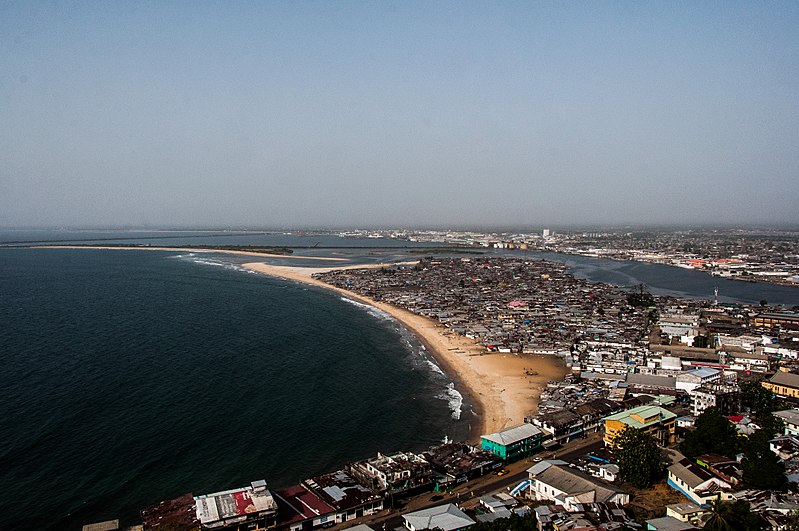
Liberia’s capital and largest city, strung along the Atlantic at the mouth of the Mesurado River, Monrovia was founded in 1822 as a home for freed American slaves resettled in Africa by the American Colonization Society — and named after the sitting US president, James Monroe.
History clings to little Providence Island, where the first settlers stepped ashore, and to landmarks like the domed Capitol and the ghostly, war-scarred shell of the once-glamorous Ducor Palace Hotel on the hill above; down at sea level, the vast Waterside Market throngs with colour and noise.
Liberia was built in America’s own image — the settlers gave it a flag modelled on the Stars and Stripes, a US-style constitution and the English language, and named their capital for a US president, making Monrovia the only capital city outside the United States named after an American head of state.
4 – Mount Nimba Nature Reserve
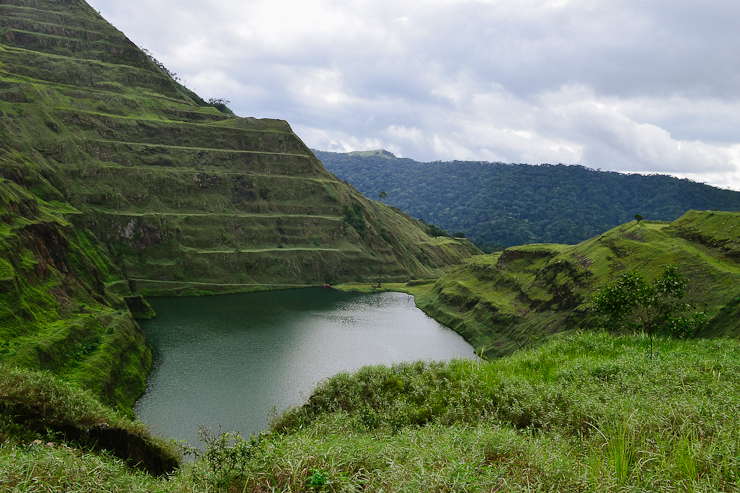
On Liberia’s northeastern border, where the country meets Guinea and Côte d’Ivoire, Mount Nimba rises abruptly from the forest to 1,752m — a chain of grass-topped peaks holding some of the richest, most endemic-packed wildlife in West Africa, protected on the Liberian side as the East Nimba Nature Reserve.
The mountain hides a double story: montane forests alive with tool-using chimpanzees and creatures found nowhere else, and the scars of mining, for Nimba holds some of the world’s highest-grade iron ore — the old workings near the company town of Yekepa have left behind the strangely beautiful, turquoise Blue Lake, a flooded pit now ringed by returning forest.
Among Nimba’s endemic oddities is the tiny Nimba toad — one of the only amphibians on Earth that gives birth to live young instead of laying eggs, an evolutionary rarity clinging to these misty mountain grasslands.
5 – Harper
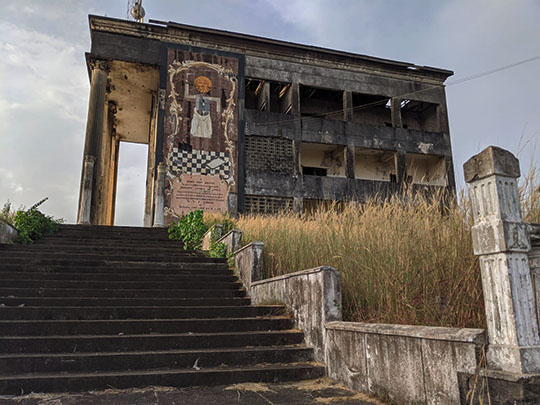

Out on Cape Palmas in Liberia’s far southeastern corner, Harper was the capital of the Republic of Maryland — a separate settler colony founded in 1834, which declared its own independence in 1854 and existed as a sovereign state with its own flag until Liberia annexed it in 1857 — and it went on to become the heartland of the Americo-Liberian elite and the birthplace of William Tubman, president for 27 years from 1944.
What remains is a town of magnificent ruins: Tubman’s clifftop mansion with rain coming through the roof and squatters in the rooms, the gutted shell of the Masonic lodge he built, plantation-style houses in the style of the American South, a lighthouse on the cape and settler churches from the 1800s.
The men who built those houses were freed slaves and their descendants — and they governed the indigenous majority as an underclass, excluded from citizenship for a century, until the resentment that produced helped tip the country into the wars that left these mansions standing open to the sky.