
Wikimedia Commons / CC-BY-SA-3.0 / GFDL
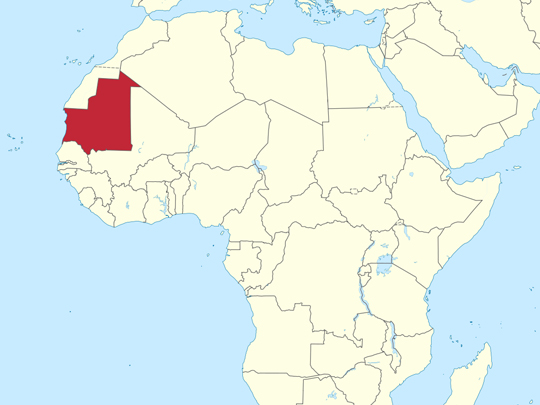
Capital: Nouakchott
Population: 5 million+
Language: Arabic – also Pulaar, Soninke and Wolof.
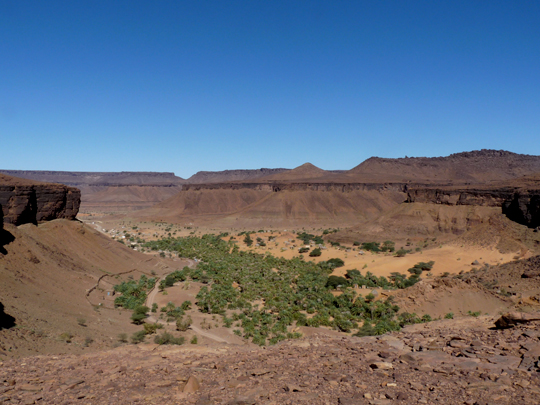
1 – Terjit (above)
Hidden in a narrow gorge on the western edge of the Adrar, Terjit is the best-loved of Mauritania’s oases — a ribbon of date palms and running water between towering red rock walls, and for centuries a life-saving halt for the camel caravans crossing the desert.
Lie in the shade with a glass of mint tea and float in the spring-fed pools, among the few places in the country where bathing is cool and safe; in high summer whole families move into the palm groves for the guetna, the date harvest, and the gorge fills with tents and visiting relatives.
The oasis is fed by two springs at once, one hot and one cold, which meet in a natural rock basin — so the water you wade into has been warmed and chilled by the same desert stone.
2 – Chinguetti Mosque
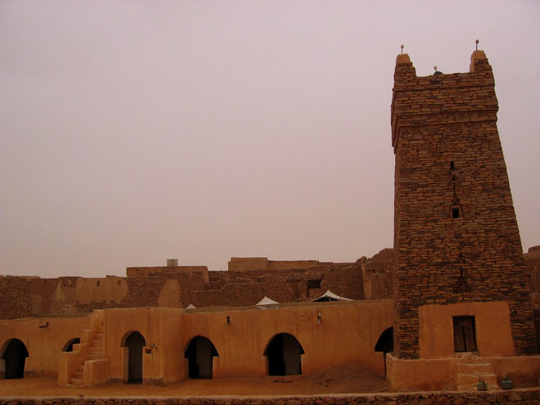
Deep in the Saharan Adrar stands Chinguetti, founded in the 13th century as a caravan city and grown into a centre of Islamic learning so revered that it came to be counted among the holy cities of Islam — and so dominant that the whole country was once known simply as the Land of Chinguetti.
The Great Mosque’s square minaret, built of unmortared stone and crowned with ostrich eggs, is a national emblem; around it huddle ochre houses and a handful of family libraries still guarding thousands of medieval manuscripts on the Koran, law, astronomy, and medicine — kept, in some cases, by the descendants of the men who copied them.
A city of perhaps 20,000 souls in its prime, Chinguetti is now being swallowed by the Sahara: the dunes come down the streets, whole quarters of the old town lie buried, and its guardians know the sand may one day take the lot.
3 – Nouakchott
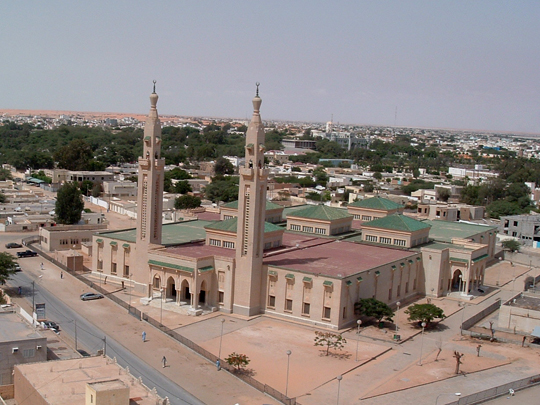
One of the youngest capitals on Earth: barely a village when it was picked to lead newly independent Mauritania, chosen partly because it stood between the country’s Arab north and African south, and laid out from 1958 for a planned 15,000 people — it now holds close to a third of the entire nation.
The Grand Mosque’s minarets are almost the only things rising above a low, sand-coloured sprawl of markets and drifting dunes; but the sight to stay for is the Port de Pêche, where every afternoon hundreds of brightly painted pirogues come in through the Atlantic surf and the catch is hauled up the open beach by hand.
What filled this city was catastrophe: at independence something like four-fifths of Mauritanians were nomads moving with their herds, and the great Sahel droughts of the 1970s and 80s killed the animals and ended that life — barely one in twenty lives it now, and a great many of the rest ended up here.
4 – Adrar Plateau
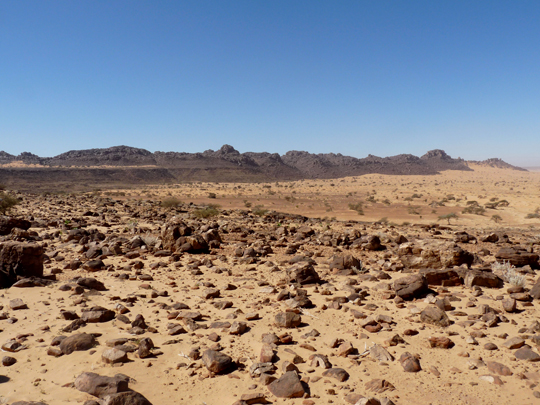
The Adrar is the heart of Saharan Mauritania — a high, arid plateau of sandstone escarpments, deep canyons, stony plains and dune seas that has been a crossroads of desert life for thousands of years, from Neolithic hunters to the great trans-Saharan caravans.
Its finest ruin is Ouadane, a stone town climbing a hillside above its palm grove, abandoned quarter by quarter over centuries and now a maze of roofless walls; out on the plateau, prehistoric engravings of giraffe, cattle and hunters record a Sahara that was once green, and the dunes are best crossed slowly, by 4×4 and camel.
The plateau’s most astonishing feature can really only be seen from above — the Richat Structure, or “Eye of the Sahara”, a vast bull’s-eye of concentric rock rings some 40km across, so enormous and near-perfectly circular that astronauts use it as a landmark from orbit.
5 – Banc d’Arguin
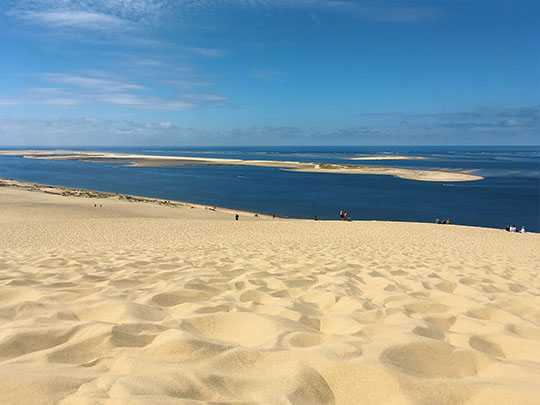
Where the Sahara runs straight into the Atlantic, a vast expanse of shallow water, sandbank and shore was made a national park in 1976 and UNESCO-listed in 1989 — and it is one of the most important wintering grounds on Earth for migratory birds, with millions of waders arriving each year from northern Europe and Siberia.
There are no roads and almost no buildings: a few Imraguen fishing villages, their lateen-sailed boats drawn up on the sand, flamingos and pelicans standing on the flats — and a tradition of calling in wild dolphins by beating the water with sticks, letting them drive the mullet into the shallows, and each side taking a share.
On 2 July 1816 the French frigate Méduse ran aground on these banks; the officers took the boats and left some 147 people on a raft, of whom fifteen were alive thirteen days later — Géricault painted them, and The Raft of the Medusa has hung in the Louvre ever since.
6 – The Iron Ore Train
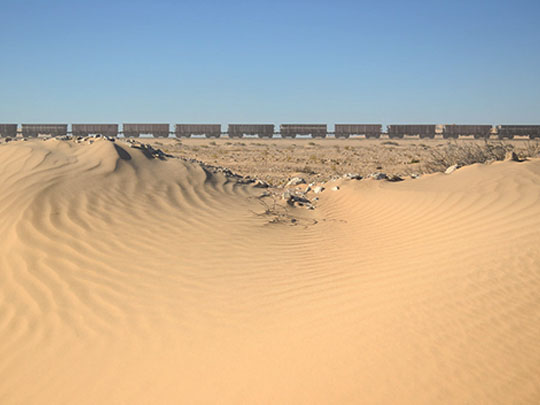
A single railway line crosses Mauritania: 704km of track opened in 1963, running from the iron mines at Zouérat through the emptiest quarter of the Sahara to the ore terminal at Nouadhibou on the coast — built to move the one commodity the country had, and still the backbone of its economy.
The trains run to more than 200 wagons and up to three kilometres in length, among the longest and heaviest anywhere on Earth; a passenger carriage is sometimes coupled on the end, but most travellers simply climb up and ride on top of the ore, through a night that turns bitterly cold under an enormous sky.
The line had to stay inside French territory, so rather than accept Spain’s terms for crossing a few kilometres of Western Sahara, the engineers bored two kilometres through solid granite at Choum — and in 1991 the route was diverted through that very territory after all, leaving the tunnel standing empty in the desert.
7 – Oualata
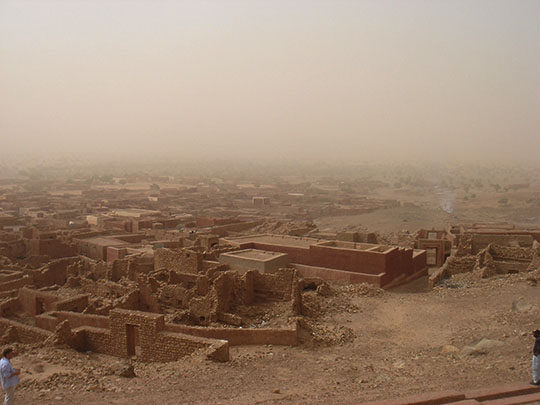
Far out in the southeast near the Malian border, Oualata stood at the end of the caravan road from Timbuktu and grew rich as a terminus of the trans-Saharan trade — one of the four ancient ksour, with Chinguetti, Ouadane and Tichitt, inscribed together by UNESCO in 1996.
What makes it unlike anywhere else is the painting: the women of the town decorate the houses inside and out with sweeping red and white designs, looping around doorways, window frames and interior niches, renewed by hand and passed from mother to daughter down the generations.
The traveller Ibn Battuta reached Oualata in 1352 after two months in the desert and was thoroughly scandalised — the women went unveiled, kept male friends their husbands raised no objection to, and were treated with more deference than the men; his complaints about it are among the earliest written descriptions of life anywhere in this corner of Africa.