
Wikimedia Commons / CC-BY-SA-3.0 / GFDL
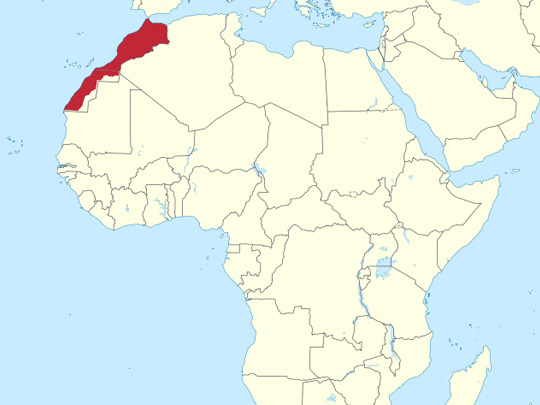
Capital: Rabat
Population: 37 million+
Language: Arabic/Tamazight/Darija
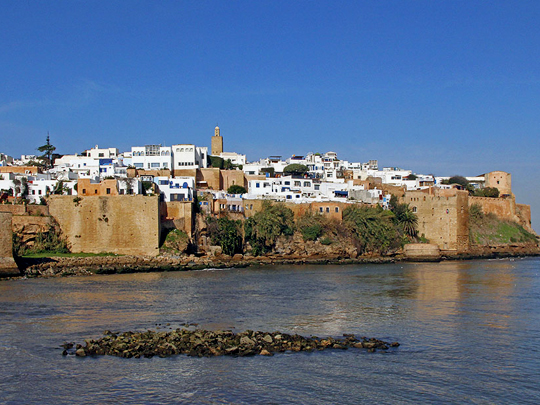
1 – Kasbah of the Udayas (above)
Perched on a rocky bluff where the Bou Regreg river meets the Atlantic, the Kasbah of the Udayas is the oldest and most beguiling corner of Rabat — a 12th-century fortress founded by the Almohads, entered through the magnificent carved gateway of Bab Oudaia, and today a UNESCO World Heritage Site.
Behind its honey-coloured walls twists a maze of narrow lanes painted in dazzling blue and white — a style brought by Muslim refugees expelled from Spain — leading to a serene Andalusian garden and a clifftop café with sweeping views over the estuary and the ocean.
Those tranquil lanes hide a fierce past: in the 17th century this was a stronghold of the Salé Rovers, feared Barbary corsairs who raided shipping and coastal towns as far away as Iceland and Ireland — the very pirates who, in Daniel Defoe’s novel, capture and enslave Robinson Crusoe.
2 – Atlas Mountains

Sweeping across Morocco in a great snow-capped wall, the Atlas Mountains rise to Mount Toubkal (4,167m), the highest peak in North Africa — a mighty barrier dividing the fertile coast from the endless Sahara beyond, and the ancestral homeland of the Berber, or Amazigh, people.
Their valleys are dotted with mud-brick villages, terraced fields and fortified kasbahs, where a warm welcome and a glass of mint tea are never far away; trekkers climb to the roof of Toubkal, and in winter you can even ski at Oukaïmeden, the highest ski resort on the continent.
The range takes its name from Greek mythology — from Atlas, the Titan condemned by Zeus to bear the weight of the heavens on his shoulders forever, whom the ancient Greeks imagined standing here at the very edge of their known world; the “atlas” of maps is named for him too.
3 – El-Badi Palace
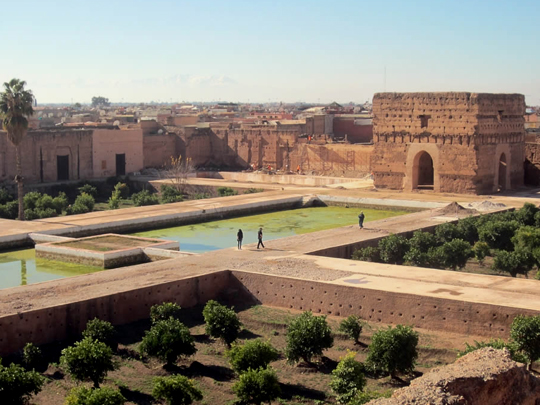
In the heart of Marrakech stand the vast, roofless ruins of El Badi — “the Incomparable” — the palace built by the Saadian sultan Ahmad al-Mansur to celebrate his crushing victory over the Portuguese in 1578, and paid for with ransom gold and the riches of the trans-Saharan trade.
In its 16th-century heyday it was hailed as one of the wonders of the age — some 360 rooms clad in Italian marble, gold and onyx around a huge courtyard with sunken orange gardens and a great reflecting pool; today only the towering earthen walls remain, crowned by the untidy nests of a famous colony of white storks.
Its glory was short-lived, just as one man foresaw: when al-Mansur proudly asked his court jester’s opinion of the finished masterpiece, the jester replied only that “it will make a beautiful ruin” — and sure enough, a century later a later sultan stripped it bare to build his own capital at Meknes.
4 – Chellah
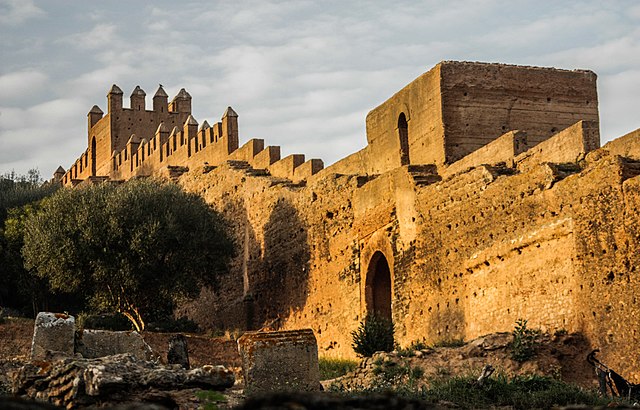
On a hillside just outside Rabat lies Chellah, an atmospheric walled ruin that stacks a thousand years of history into a single garden — the remains of Sala Colonia, once the southernmost city of the Roman Empire in Africa, later reused by Morocco’s Marinid sultans as a royal burial ground.
Wander from the tumbled columns and forum of the Roman town up to the medieval necropolis — a monumental gateway, the beautifully tiled minaret of a ruined mosque, and the tombs of sultans — all overgrown with orange trees, wildflowers and jasmine, and topped by the great nests of storks.
At the heart of it lies a sacred spring pool full of eels, where for centuries women hoping for children have come to feed the eels boiled eggs — a folk ritual for luck and fertility that still quietly carries on among the ancient stones.
5 – Hassan Tower
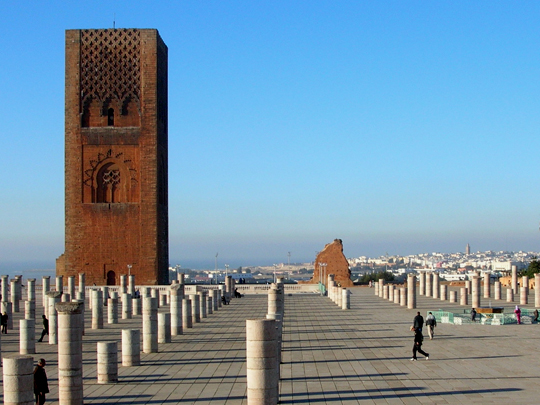
Rising above Rabat on the bank of the Bou Regreg, the Hassan Tower is the great unfinished minaret of a mosque that was meant to be the largest in the western Muslim world — begun in 1195 by the mighty Almohad sultan Yaqub al-Mansur, who dreamed of making Rabat his imperial capital.
When the sultan died in 1199 the project was abandoned, and the tower still stands at just 44m — half its intended height — presiding over a vast field of stone columns that mark the floor of the mosque that never was; beside it now rests the exquisite modern mausoleum of King Mohammed V, guarded day and night.
Unusually, the tower has no staircase inside but a series of gentle ramps — built wide enough that the muezzin could ride a horse all the way to the top to give the call to prayer.
6 – Majorelle Garden, Marrakech
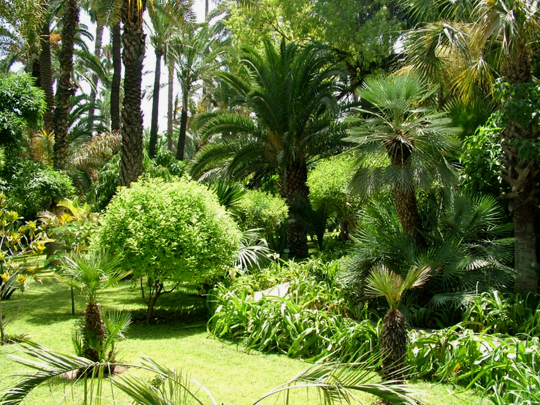
A dreamlike oasis of calm in the bustle of Marrakech, the Majorelle Garden was the life’s work of the French painter Jacques Majorelle, who spent some forty years from the 1920s filling it with cacti, bamboo, towering palms and lily ponds — and painting everything in one unforgettable colour.
That colour is “Majorelle Blue,” an electric cobalt so vivid the artist trademarked it, splashed across the villa, fountains, pots and pergolas in dazzling contrast to the greenery and the Moroccan sun; today the villa’s old studio also houses a fine museum of Berber art.
After the garden fell derelict and was slated for demolition, it was rescued in 1980 by none other than the fashion designer Yves Saint Laurent and his partner Pierre Bergé — who so adored the place that when Saint Laurent died, his ashes were scattered here, in the garden he had saved.
7 – Fez
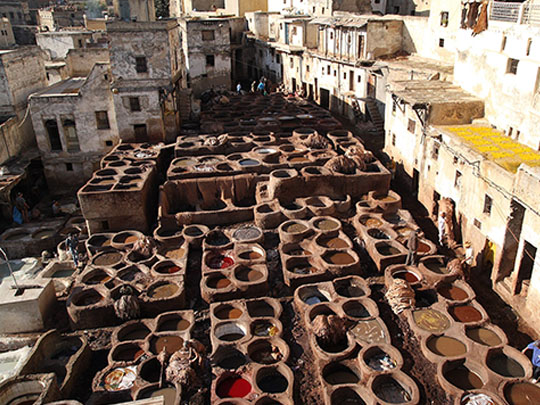
The spiritual and intellectual heart of Morocco, Fez is the oldest of the country’s imperial cities — founded some 1,200 years ago — and its walled old town, Fes el-Bali, is one of the largest and best-preserved medieval cities anywhere, a UNESCO World Heritage Site.
Plunge into its dizzying maze of some 9,000 alleyways — one of the largest car-free areas on Earth, where donkeys still do the hauling — to find the famous Chouara tannery, a honeycomb of stone dye-pits where leather has been worked by hand, in vats of saffron, poppy and mint, since medieval times.
Tucked in the heart of the medina stands the University of al-Qarawiyyin — founded in the year 859 by a woman, Fatima al-Fihri — recognised as the oldest continuously operating university in the world, a seat of learning already ancient when Oxford and the Sorbonne first opened their doors.
8 – Casablanca
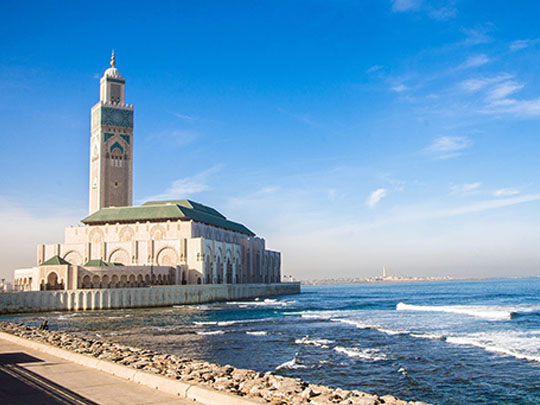
Morocco’s largest city and economic powerhouse, Casablanca sprawls along the Atlantic coast — a fast, modern metropolis of business and boulevards that grew up under French rule, leaving it with one of the greatest collections of Art Deco architecture anywhere in the world.
Its crowning glory is the Hassan II Mosque, one of the largest on Earth, built partly out over the sea with a soaring 210m minaret that for years ranked as the tallest in the world; inside, up to 25,000 worshippers can pray beneath a retractable roof — and on a section of glass floor, directly above the crashing Atlantic waves.
For all its fame from the classic 1942 film, “Casablanca” was never actually shot here — Humphrey Bogart’s movie was filmed almost entirely in Hollywood — so decades later the city gamely opened its own “Rick’s Café,” a lovingly recreated version of the film’s bar, for the tourists who came looking for it.
9 – Aït Benhaddou
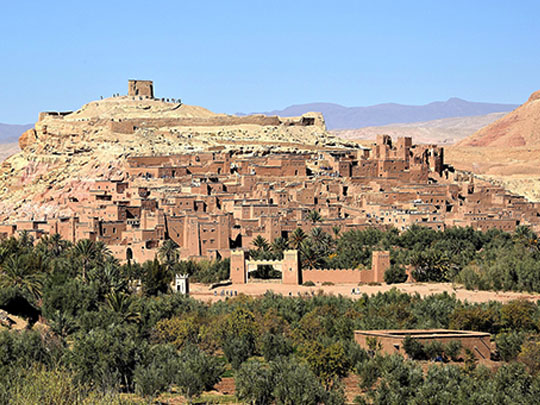
On the old caravan road between the Sahara and Marrakech, this ksar — a fortified village of packed red earth — climbs a hillside above the Ounila river, its kasbah towers tapering upward under geometric decoration, everything built from mud, straw and the ground it stands on; UNESCO listed it in 1987 as the finest survivor of southern Morocco’s earthen architecture.
A few families still live inside the walls while most of the village has moved across the river; you cross by stepping stones and climb through lanes and granaries to the agadir at the summit, with the Atlas behind and the desert road running away south.
Hollywood worked out long ago that this place looks like the past: Lawrence of Arabia filmed here in 1962, and Jesus of Nazareth, The Last Temptation of Christ, The Mummy, Gladiator and Game of Thrones all followed — so many productions that nearby Ouarzazate, with two vast studio complexes, is known as the Hollywood of Africa.
10 – Erg Chebbi, Merzouga
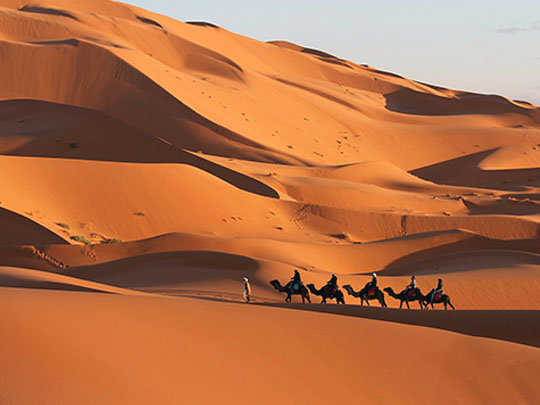

Out on the Algerian border, an isolated sea of orange dunes rises some 150m out of flat stony desert and runs about 28km from end to end — one of only two great ergs in Morocco, and, local legend has it, sand sent to bury a town whose people once turned away a woman and her child at the door.
Camel trains leave the village of Merzouga in the late afternoon for camps out among the dunes, where the sand goes from gold to blood-red at either end of the day; after winter rains the seasonal lake of Dayet Srji appears at the dunes’ edge and fills with flamingos.
In the height of summer, when the surface heat is fierce, people come here to be buried up to the neck in the hot sand for a few minutes at a time — a treatment for rheumatism and joint pain practised for generations, and still enough of a going concern that clinics and guesthouses in Merzouga organise the season around it.
11 – Essaouira
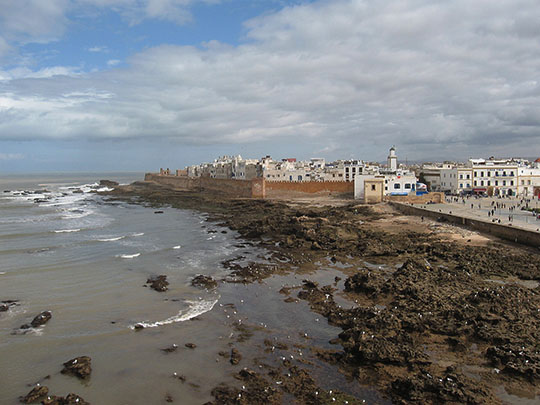

This windswept Atlantic port was a Phoenician landing and then, under the client king Juba II, a centre for making the purple dye that coloured Roman emperors’ robes; the town you see was built from the 1760s by Sultan Sidi Mohammed ben Abdallah, who had a French military engineer lay it out — which is why a Moroccan medina inside Vauban-style ramparts is arranged on a grid.
Walk the sea walls and their bronze cannon, the fish market where the day’s catch is grilled on the quay, the old mellah of a once-large Jewish community, and a harbour full of small wooden boats painted the same brilliant blue.
Jimi Hendrix spent a few days here in 1969, and the town has been living off it ever since — he is said to have written “Castles Made of Sand” about a ruined palace in the dunes nearby, and to have tried to buy a village; neither is true, and the song came out two years before he ever set foot in Morocco.
12 – Chefchaouen
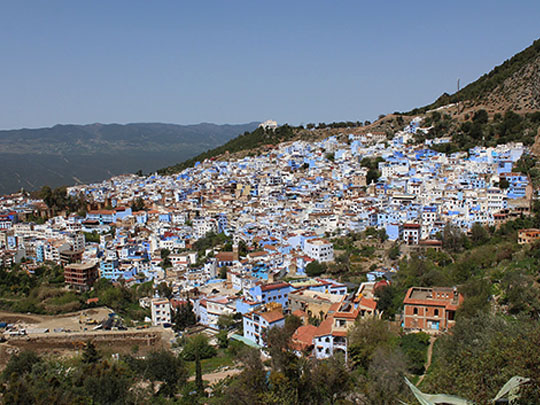
High in the Rif mountains, Chefchaouen was founded in 1471 as a fortress against Portuguese raids and then filled by Muslims and Jews driven out of Spain, who built it in the style of the Andalusia they had lost — and for centuries it was closed to outsiders altogether, with barely a handful of Europeans reaching it before Spanish troops arrived in 1920.
Today every wall, step and doorway in the old town is washed in blue, from powder to deep indigo, running up the hillside beneath the twin peaks that give the town its name; below sits the red-walled kasbah on Uta el-Hammam square, and a short climb above leads to the Spanish mosque and the whole blue bowl laid out at your feet.
Nobody agrees why it is blue. One account credits Jewish refugees painting the colour of heaven in the 1930s; another says the wash keeps mosquitoes off; a third, less romantic, notes how well it photographs.
13 – Volubilis
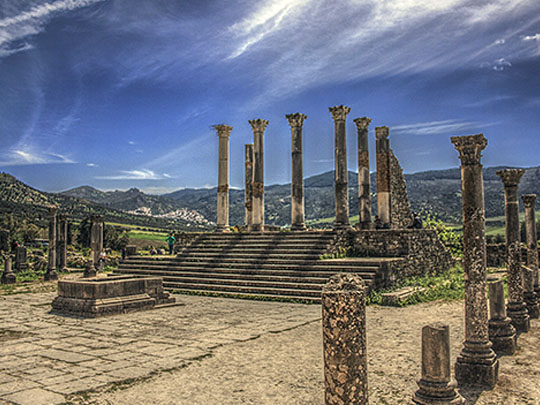

Set on a slope below the Zerhoun hills near Meknes, Volubilis was the capital of the Berber king Juba II before Rome annexed his kingdom, and grew into the westernmost city of the Roman Empire in Africa — some twenty thousand people made rich by olive oil, holding on until the legions pulled back at the end of the third century; UNESCO listed it in 1997.
It is the finest Roman site in Morocco and still reads as a town: the Arch of Caracalla of 217, the basilica and capitol, colonnaded streets, stone olive presses standing where they were used — and, best of all, mosaics left in the floors of the merchants’ houses where they were laid, Orpheus charming the animals, Hercules at his labours, Diana surprised at her bath. Much of its cut stone went to build Meknes for Moulay Ismail.
When Rome left, the city didn’t die. In 788 a refugee great-great-grandson of the Prophet was given shelter here and proclaimed ruler — and from a Roman town came the dynasty that made Morocco a Muslim kingdom.