
Wikimedia Commons / CC-BY-SA-3.0 / GFDL
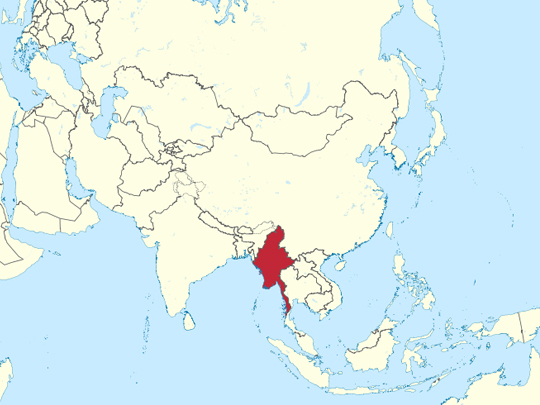
Capital: Nay Pyi Taw
Population: 55 million+
Language: Burmese (more than a hundred languages are spoken).
1 – Bagan (also above)
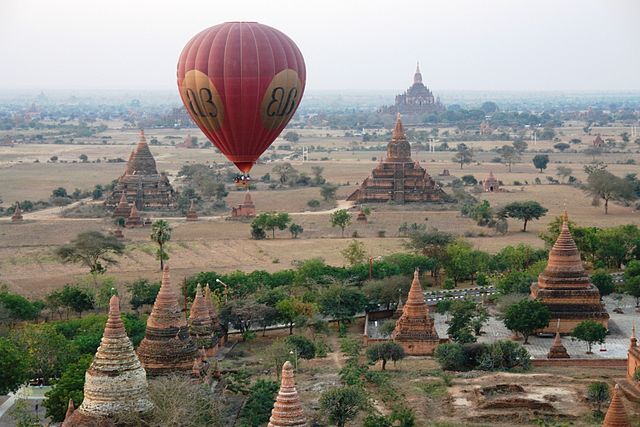
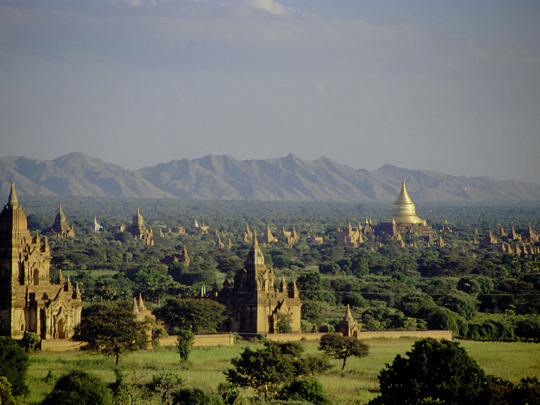
Bagan stands on a bend of the Irrawaddy in central Myanmar, and it was the capital of the kingdom that first unified the country. Between the eleventh and thirteenth centuries something like ten thousand temples, stupas and monasteries went up on the plain; around three and a half thousand survive across some forty square kilometres. UNESCO inscribed Bagan in 2019.
You cover Bagan by e-bike, horse cart or balloon. Ananda, Thatbyinnyu, Dhammayangyi and Shwesandaw are the ones everybody goes to, but the pleasure is the hundreds in between, standing in the scrub with nobody in them. Climbing the temples was banned in 2018 after a series of falls. It took Myanmar twenty-three years to get Bagan listed.
The first bid went in around 1996 and UNESCO refused it, because the junta had spent the decade “restoring” hundreds of temples with the wrong bricks, invented spires and a golf course — work that assessors compared to a theme-park version of a religious site. When an earthquake shook Bagan in 2016, the cracks exposed the modern concrete underneath.
2 – Taung Kalat Monastery

The monastery sits on Taung Kalat, a volcanic plug 225 metres high — the hardened throat of an old vent, left standing when the softer ground around it wore away. Mount Popa itself is the extinct volcano about four kilometres off, and it is a good deal higher.
Seven hundred and seventy-seven steps climb Taung Kalat, barefoot, past a large and confident population of macaques. At the bottom is a shrine to the thirty-seven nats — the spirits of Burmese folk religion, most of them people who died badly, each with a story. Visitors are asked not to wear red, green or black, and not to carry pork.
The nats are older than Buddhism in Burma and were never displaced by it. When King Anawrahta of Bagan made Theravada Buddhism the state religion in the eleventh century he tried to stamp nat worship out, failed, and instead had the thirty-seven of them formally installed at his own pagoda — placed beneath the Buddha. They have been part of the arrangement ever since.
3 – Shwedagon Pagoda

Shwedagon stands on Singuttara Hill above Yangon, ninety-nine metres of gilded stupa, and it is the most sacred Buddhist site in Myanmar. Tradition holds that it is 2,600 years old and contains eight hairs of the Buddha; the chronicles first mention it in the 1360s, and archaeologists date the original structure to somewhere between the sixth and tenth centuries.
The platform at Shwedagon is a small town of shrines, bells and image houses, and it is busiest at dusk. Visitors wash the Buddha image that corresponds to the day of the week they were born on. The upper terraces are open to men only — which is also true of the boulder at entry 7.
The gold on Shwedagon is real gold plate, riveted on, and it was donated: by kings, and by ordinary people buying a square at a time, continuously for centuries. The crown at the top carries 5,448 diamonds and 2,317 rubies, and the very tip is a single 76-carat diamond that almost nobody standing on the platform can see.
4 – Mandalay Temple & Palace

Mandalay was built from nothing as a royal capital by King Mindon in 1857, on a site chosen to fulfil a prophecy about the 2,400th anniversary of Buddhism. It lasted twenty-eight years: the British deposed King Thibaw in 1885, shipped him to India, and ended the Burmese monarchy. The palace at Mandalay is a two-kilometre square inside a moat.
The British used it as Fort Dufferin, it was burned out in 1945 during the fighting for the city, and what stands today is a 1990s reconstruction, much of it concrete. The one original building is the Shwenandaw monastery, teak-carved throughout, which survives because Mindon’s son had it moved outside the walls.
At the foot of Mandalay Hill is Kuthodaw, where 729 marble slabs stand in individual shrines, each carved on both faces with the text of the Buddhist canon. Mindon commissioned it because palm-leaf manuscripts rot. It is usually called the world’s largest book, and reading the whole of it aloud is said to take the better part of a year.
5 – Mrauk U

Mrauk U in Rakhine State was the capital of the Arakan kingdom from 1430 to 1785 — an independent state on the Bay of Bengal that faced India rather than Burma, and grew rich on the trade running between the two.
What survives at Mrauk U is a landscape of temples on low hills, built in dark sandstone rather than brick: Shittaung of 1535, whose name means the shrine of eighty thousand images and which has a spiral inner corridor carved with them; Koe-thaung, larger and half-collapsed; and Htukkanthein, which looks more like a bunker than a temple.
Mrauk U was one of the most cosmopolitan places in Asia. Portuguese and Dutch traders kept factories there, the kings employed Japanese samurai as bodyguards, Bengali Muslim poets wrote at the court, and European visitors compared the city to Amsterdam or to London. The Burmese took it in 1785, and it has been quiet ever since.
6 – Kandawgyi Lake
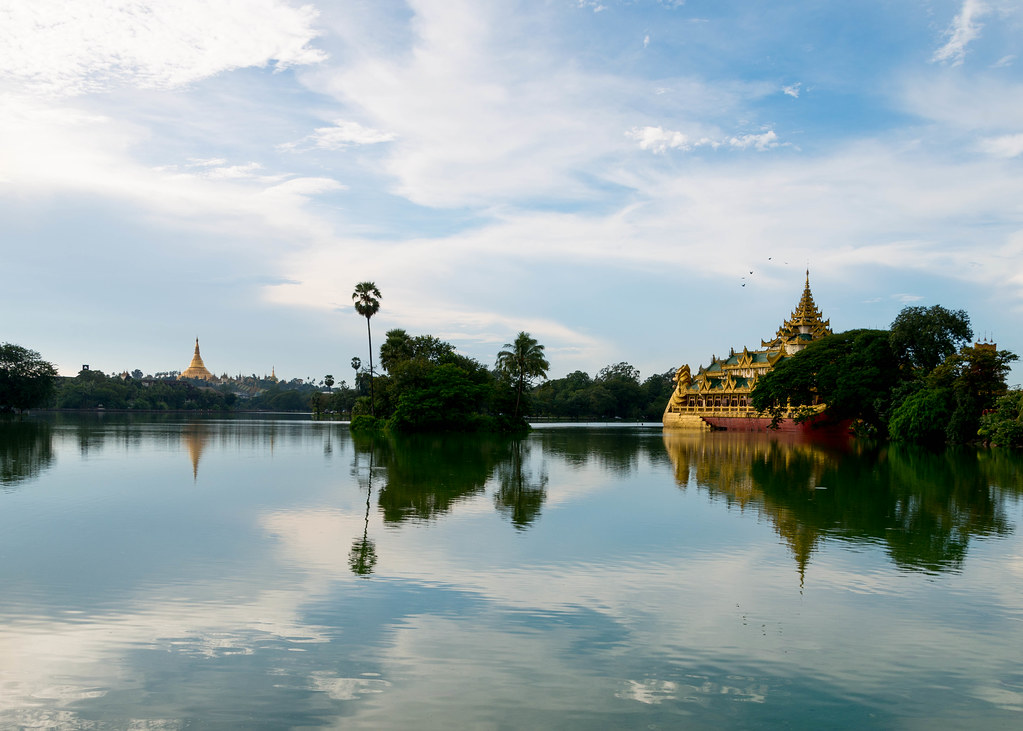
Kandawgyi lies in central Yangon just east of Shwedagon, and its name means great royal lake — which is generous, because it is a Victorian waterworks. The British dug Kandawgyi in the 1880s as a reservoir for the city, fed by pipe from Inya Lake further north.
A boardwalk on stilts runs round part of the shore through Kandawgyi Nature Park, and the reflection of Shwedagon in the water at dusk is why most people come. Yangon’s zoo is on the northern side, and the park is one of the few large green spaces in the city. The Karaweik on the eastern shore looks like a royal barge and is not one.
It is a concrete building finished in 1972, modelled on the ceremonial barges of the Burmese kings and on the karaweik, a mythical bird, with a restaurant inside. Almost nothing at Kandawgyi Lake is old — which is worth knowing before you go looking for antiquity in it.
7 – Golden Rock
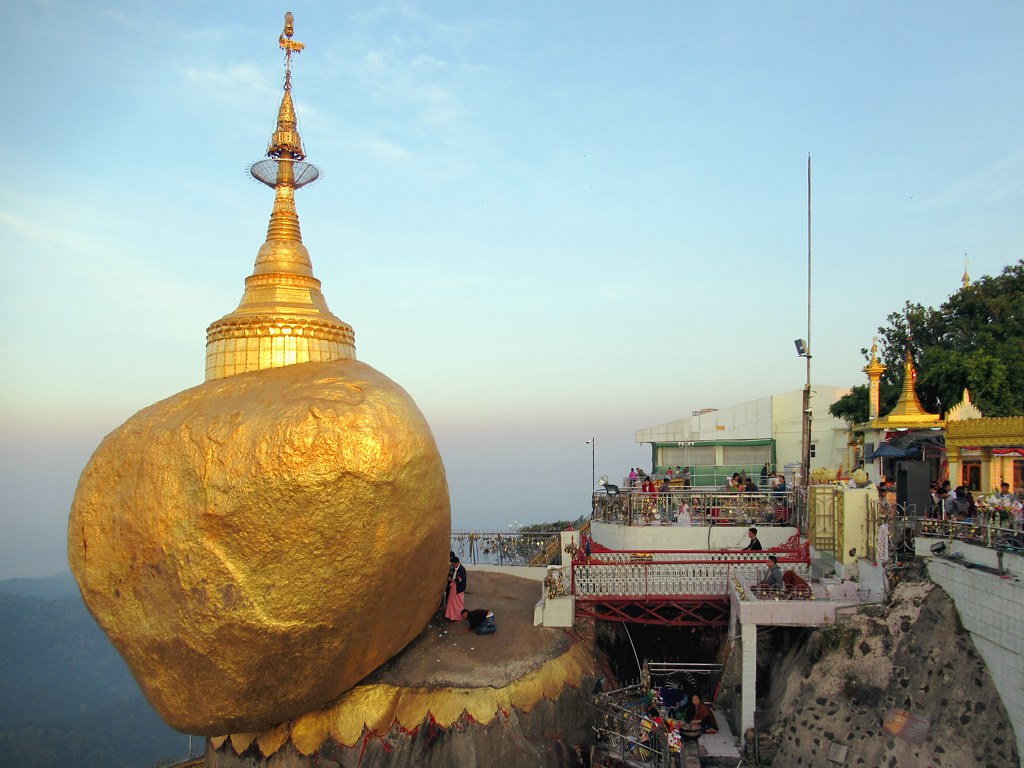
Kyaiktiyo, the Golden Rock, is a granite boulder about seven metres high sitting on the lip of a cliff at around 1,100 metres in Mon State, with a small stupa built on top of it. It ranks with Shwedagon among the most important Buddhist sites in the country.
You reach the Golden Rock by open truck, packed onto plank benches for the last steep stretch of road, and then on foot. Pilgrims stay overnight and the platform is at its fullest before dawn. The boulder really is balanced: there is a visible gap beneath part of it, and people pass a thread underneath to prove the point.
The gold on the Golden Rock is applied by hand, leaf by leaf, and only men may approach the boulder to do it — women may look from the platform but not touch. Tradition holds that the whole thing is held in place by a single hair of the Buddha, enshrined in the stupa on top of it.
8 – Pindaya Caves
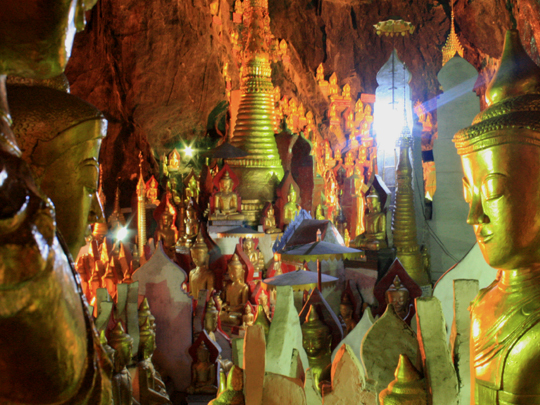
The Shwe U Min cave at Pindaya is a limestone chamber in the hills of Shan State, running a couple of hundred metres back into the rock, and it is filled with Buddha images — more than eight thousand of them, in alabaster, teak, marble, brick and lacquer.
The images at Pindaya are stacked along the walls, wedged into niches and jammed into passages until in places you have to turn sideways to get past. Some are the height of a person and some a few centimetres. The oldest carry dates from the 1700s, and the cave keeps going back into the hill beyond where the lighting stops.
Pindaya is not a finished collection but an accumulating one. Pilgrims have been leaving images here for centuries and still are; each new one is inscribed with the name of whoever donated it, and the total goes up every year. The cave will carry on filling for as long as people keep coming to it.
9 – Inle Lake
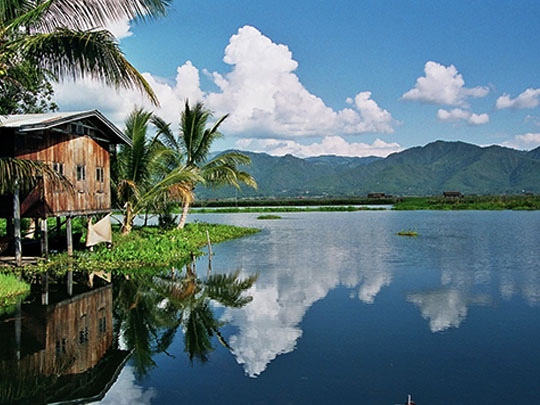
Inle is a shallow freshwater lake some twenty-two kilometres long in the Shan hills at around 880 metres, and the people who live on it — the Intha, the sons of the lake — row standing up, with one leg wrapped around the oar. It looks like a trick and is not: it leaves both hands free for the net and lets you see over the reeds.
The villages on Inle Lake stand on stilts and are connected by water rather than road. The gardens float — beds of matted weed and mud staked down with bamboo poles, growing tomatoes on open water. There are silversmiths, cheroot rollers, and weavers who draw thread out of lotus stems to make a cloth produced almost nowhere else.
Phaung Daw Oo pagoda holds five small Buddha images, none more than half a metre high, so thickly gold-leafed that they have lost their shape altogether. Four are taken round the lake on a barge each autumn. The fifth stays behind: in 1965 the barge capsized, only four were recovered — and when the search party got back to the pagoda, the missing one was sitting on its pedestal.
10 – Colonial Yangon
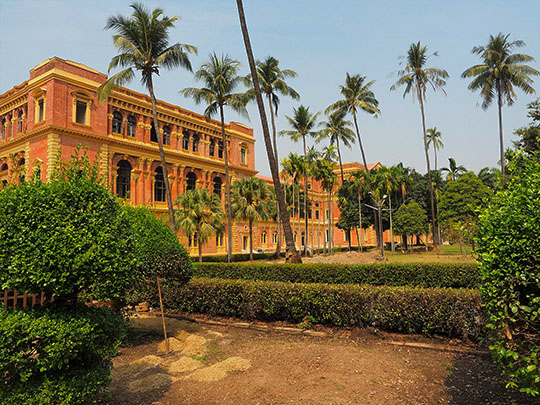

The British made Rangoon their capital in 1852 and laid out a grid downtown along the river. What went up over the following eighty years — banks, trading houses, ministries, shophouses — is now the largest surviving collection of colonial-era buildings anywhere in Southeast Asia, and the core of it is remarkably intact.
Pansodan Street is where to walk in Colonial Yangon, past the High Court, the Sofaer building and rows of secondhand bookstalls. The Strand Hotel opened in 1901; the red-brick Secretariat, finished in 1905, is where Aung San and six colleagues were shot dead on 19 July 1947, months before independence. Yangon also holds the grave of the last Mughal emperor, exiled here in 1858.
Those buildings survive because nothing replaced them. Yangon spent fifty years under socialism and sanctions with no money and no development pressure, so the city simply stopped — and then in 2005 the government moved out to Nay Pyi Taw and emptied the ministries. Poverty and abandonment did the conserving. Since the country reopened, the property market has been the greater threat.
11 – Nay Pyi Taw
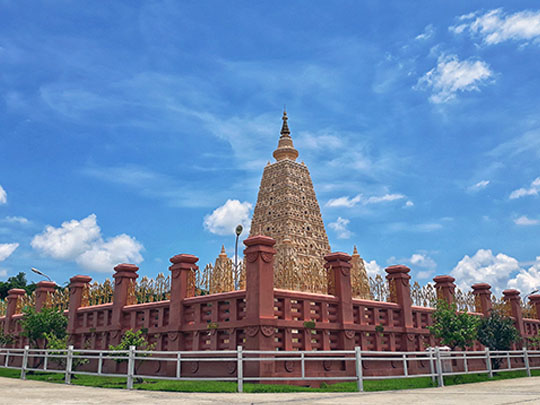

Nay Pyi Taw is the capital of Myanmar, and almost nobody had heard of it before 2005. It was built in secret in scrubland near Pyinmana from around 2002, and on 6 November 2005 the ministries were ordered to pack and leave Yangon, with a second convoy departing days later at an hour reportedly set by astrologers.
The name means abode of kings. Nay Pyi Taw covers something like seven thousand square kilometres, divided into zones sitting kilometres apart — ministries here, hotels there, military quarters somewhere else again. Yaza Htarni Road runs twenty lanes wide through the middle of it and is usually close to empty. Uppatasanti Pagoda is a copy of Shwedagon, built deliberately a foot shorter than the original.
Near that pagoda the government keeps white elephants. Pale elephants have signified the legitimacy of Burmese kings for centuries — a righteous ruler is supposed to attract them — and successive governments have gone to considerable trouble to acquire them and house them where they can be seen. It is the clearest statement Nay Pyi Taw makes about what it is for.