
Wikimedia Commons / CC-BY-SA-3.0 / GFDL
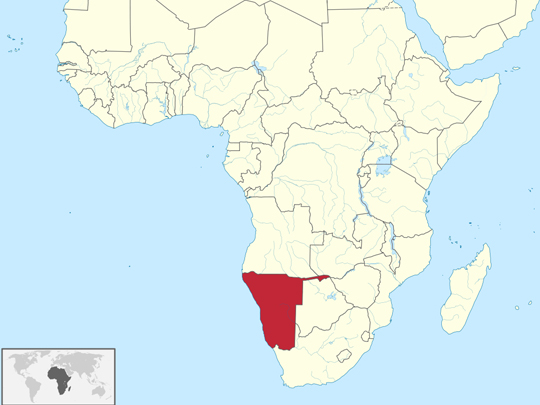
Capital: Windhoek
Population: 3 million+
Language: English (also Oshiwambo, Khoekhoegowab & others)
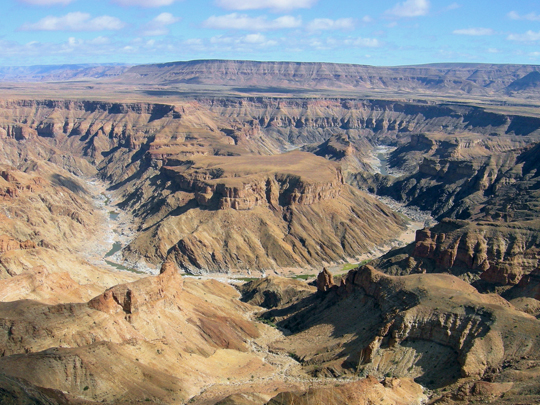
1 – Fish River Canyon (above)
Slicing a colossal gash across the desert of southern Namibia, the Fish River Canyon is the largest canyon in Africa — and, by many reckonings, the second-largest on Earth after Arizona’s Grand Canyon — a 160km chasm of layered rock plunging up to 550m to a winding riverbed far below.
Carved over hundreds of millions of years through rock nearly two billion years old, it’s a place of jaw-dropping viewpoints and one of the continent’s great challenges: a gruelling five-day, 85km trek along the canyon floor, rewarded at the far end by a soak in the hot springs of Ai-Ais.
The San people have their own explanation for its wild, twisting shape — they tell of a giant serpent who, chased into the desert by hunters, thrashed and burrowed his way through the rock, gouging out the canyon’s endless bends as he fled.
2 – Etosha National Park
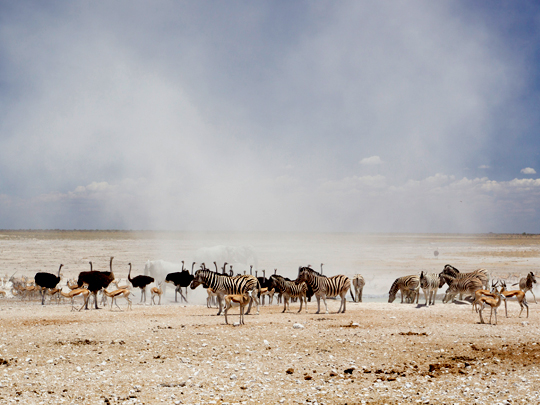
One of the oldest and largest game parks in Africa, Etosha spreads across the north of Namibia around its namesake: the Etosha Pan, a vast, blinding-white salt flat so enormous it can be seen from space; its name means “Great White Place,” and it’s the ghost of an ancient lake that dried to bare clay when its river changed course.
For most of the year the pan is a shimmering desert, so the wildlife gathers instead at the waterholes fringing it — the classic Etosha safari is simply to sit and wait as elephants, lions, giraffes, zebra and one of Africa’s great strongholds of the endangered black rhino file in to drink, best of all at the floodlit waterholes after dark.
Etosha’s elephants are among the biggest in Africa, yet often the palest — caked head to toe in the white dust and clay of the pan, they roam the plains like giant grey ghosts, and, curiously, tend to grow much smaller tusks than their cousins elsewhere on the continent.
3 – Sossusvlei sand dunes
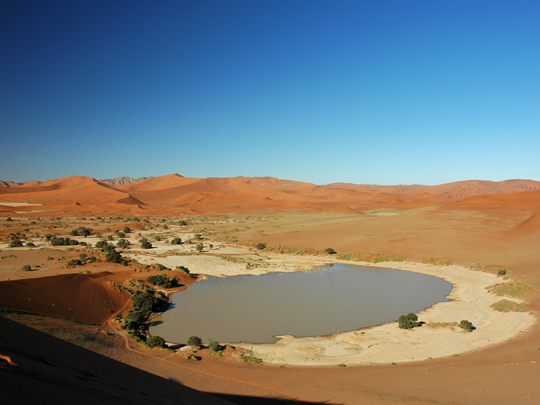
Deep in the Namib — the oldest desert on Earth — Sossusvlei is a sea of colossal, apricot-red sand dunes rolling to every horizon, among the tallest on the planet; the giant known as “Big Daddy” rises some 325m, and the sands glow from gold to burning red, coloured by iron in their ancient grains.
The dunes ring a cracked white clay pan at the end of a river that almost never reaches it; climbing a dune at dawn — Dune 45 or Big Daddy — to watch the rising sun set the desert ablaze in ridges of fire and shadow is one of the great experiences of African travel.
Hidden among the dunes lies Deadvlei — a blinding-white pan studded with the black, twisted skeletons of camel-thorn trees that died around 900 years ago yet still stand: the air here is so bone-dry that they never rotted away, simply scorched by the sun into one of the most surreal, haunting scenes on Earth.
4 – Skeleton Coast
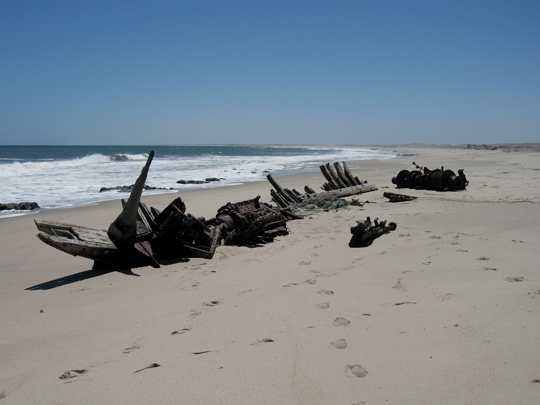
Where the world’s oldest desert crashes into the cold Atlantic lies the Skeleton Coast — a bleak, fog-shrouded 500km of Namibian shoreline so treacherous that Portuguese sailors called it “the Gates of Hell,” and the San, “the Land God Made in Anger.”
It’s a haunting graveyard of the sea: the rusting hulks of hundreds of wrecked ships lie scattered along the sand and half-buried in the dunes, run aground in the blinding fog thrown up where the icy Benguela Current meets the desert heat, while black-backed jackals, brown hyenas and even desert-adapted lions and elephants patrol the shore.
The coast takes its grim name from the bones — of the whales and seals that once littered the beaches, and of the sailors who died here: for those who survived a shipwreck and struggled ashore faced a crueller fate still, trapped in a waterless desert with no fresh water and no settlement for hundreds of miles in any direction.
5 – Cape Cross Seal Reserve
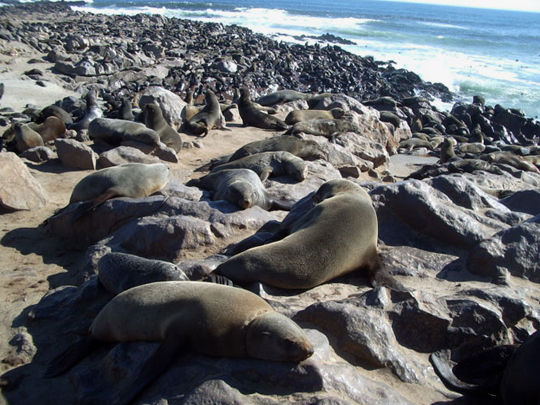
On a bleak, wind-scoured headland of the Skeleton Coast, Cape Cross is home to one of the largest colonies of Cape fur seals on Earth — a heaving, barking, pungent mass of animals, up to a quarter of a million strong at the breeding peak, sustained by the fish-rich waters of the cold Benguela Current.
From a boardwalk you can stand almost among them as they loll on the rocks, surf in the waves and nurse their pups, while jackals and hyenas prowl the fringes; the noise and the smell are overwhelming, and the sheer spectacle unforgettable.
The cape got its name centuries before the seals drew visitors — for it was here, in 1486, that the Portuguese explorer Diogo Cão became the first European to set foot on Namibian soil, planting a stone cross to claim it; that original cross was later carried off to Germany, and only came home to Namibia in 2019.
6 – Twyfelfontein

Among the red sandstone mountains of Namibia’s remote Damaraland lies Twyfelfontein — an open-air gallery holding one of the largest collections of ancient rock engravings in all of Africa, and the country’s first UNESCO World Heritage Site; its curious Afrikaans name means “Doubtful Spring,” after a farmer who doubted his own waterhole would last.
Chipped into the rock around a life-giving spring by San hunter-gatherers over thousands of years, more than 2,000 engravings crowd the boulders — giraffes, rhinos, elephants, lions and ostriches, along with human and animal footprints, thought to mark the meeting-point of this world and the spirit world.
The most famous of all is the “Lion Man” — an engraving of a lion whose long tail ends in a paw print, and whose feet each bear five toes instead of four; scholars read it as a shaman caught mid-transformation, a human turning into a lion in the depths of a trance.
7 – Kolmanskop and Lüderitz


Lüderitz began in 1883, when a merchant from Bremen bought the bay and gave Germany its first foothold in Africa — the seed of the colony of German South West Africa; then in 1908 a railway worker picked a diamond out of the sand a few kilometres inland, the authorities sealed off the whole region as the Sperrgebiet, the Forbidden Zone, and a town called Kolmanskop rose straight out of the dunes.
At its height it had a ballroom, a theatre, a skittle alley, an ice factory delivering a block to every door and the first X-ray machine in southern Africa — installed as much to check workers for swallowed diamonds as to treat them; richer fields were found further south, the last resident left in 1956, and the dunes came in through the windows, filling grand rooms to the sills.
On a peninsula at the edge of Lüderitz lies Shark Island, where between 1905 and 1907 German forces held Herero and Nama prisoners in a camp thousands never left. It is a campsite today, and what should be done with it has been argued over in Namibia for years.
8 – Windhoek
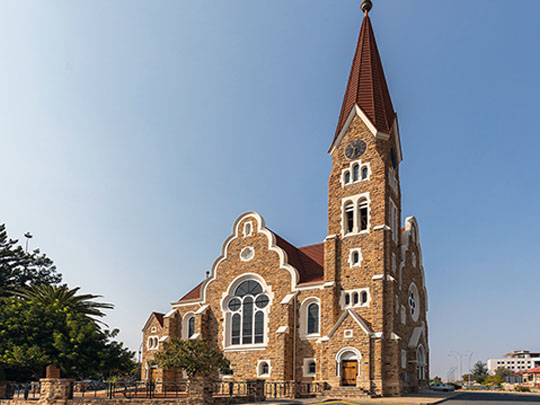
Namibia’s capital sits in a highland basin at 1,700m around hot springs that Nama and Herero communities used long before the Germans made the place their colonial headquarters in the 1890s; South Africa seized the territory in 1915 and held it for the next 75 years, until independence came on 21 March 1990.
The whitewashed Christuskirche of 1907 still presides over the centre, with the old German fortress of the Alte Feste below it and the Independence Memorial Museum alongside; the street names are German, the shop signs Afrikaans and the conversation Oshiwambo, which is as neat a summary of the country as you will find.
One small patch of ground tells the whole story: an equestrian statue raised in 1912 to the German soldiers who fell in the war against the Herero and Nama stood here for a century, until it was taken down in 2013 — and in its place now stands a memorial to that war’s victims, a man and a woman rising with their chains broken.