
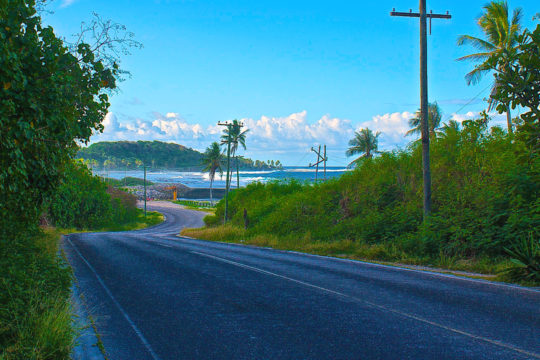
Wikimedia Commons / CC-BY-SA-3.0 / GFDL
Republic of Naoero (formerly Nauru)
Capital: Yaren – Naoero is the only country in the world with no official capital in law.
Population: 12,000+
Language: Nauruan/English

1 – Topside
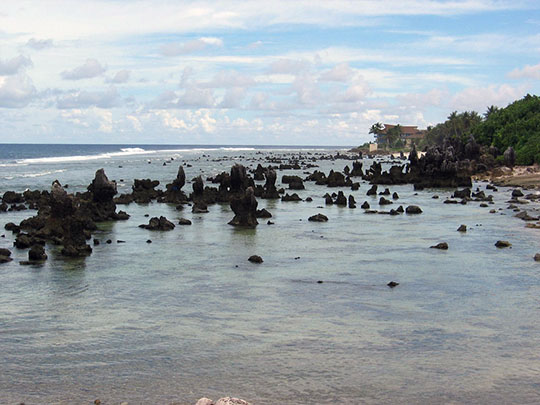
The raised limestone plateau covering the interior of Naoero — the island known internationally as Nauru until 2026 — held one of the richest phosphate deposits on earth, laid down over millennia by seabirds, and the whole modern history of the country turns on it: a lump of rock brought back to a company office in Sydney in 1896 was taken for petrified wood, and only three years later identified as almost pure phosphate.
Mining began in 1907 and ran for most of a century, and what it left is one of the strangest landscapes anywhere: a forest of jagged coral pinnacles standing several metres high across roughly four-fifths of the island, with rusting cantilever loading gear still reaching out over the sea at Aiwo.
The royalties briefly made this one of the richest places on the planet per head, and the money went spectacularly astray — into property, an airline that could carry a tenth of the population at once, and, most famously, a West End musical about the life of Leonardo da Vinci that opened in London in 1993 and closed inside a month.
2 – Command Ridge
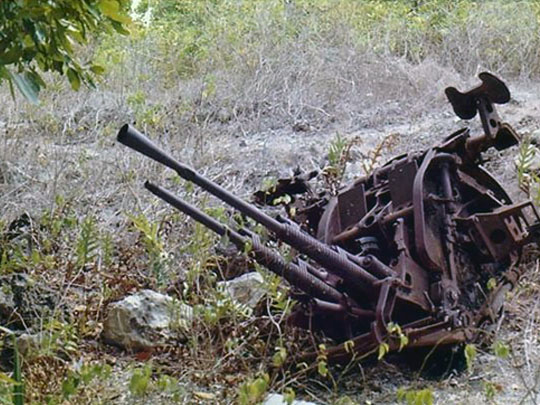

At 65 metres, the highest point on the island is a low limestone rise above Aiwo, and it was the Japanese command and communications post during the occupation that began in August 1942, when the garrison fortified the whole island and built two airstrips.
Rusted anti-aircraft guns still sit on their mountings among the scrub, along with the concrete communications bunker and lookout, and the view takes in the airstrip, the coast road and the pinnacle fields of Topside in a single turn of the head.
In 1943 the Japanese deported around 1,200 islanders — about two-thirds of the population — to forced labour on Truk, where more than 460 died, and fewer than 750 came home in 1946; the day the Nauruan population climbed back to 1,500, the number long held to be the minimum for the people’s survival, is still marked every 26 October as Angam Day, the most important date in the national calendar.
3 – Yaren
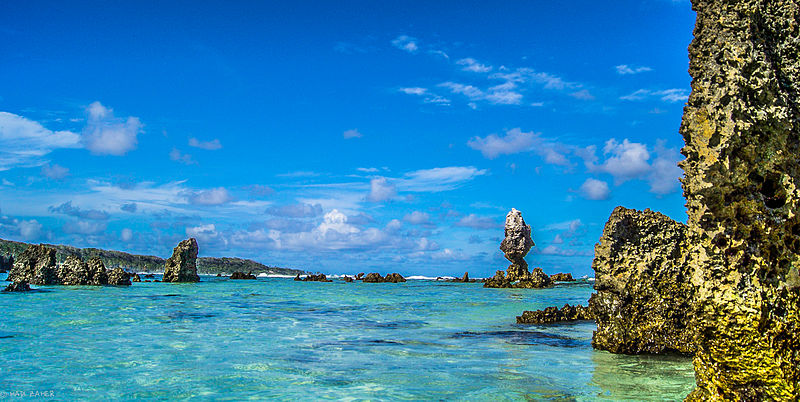
The district on the south coast is where the government sits, and has been since independence on 31 January 1968 made this the smallest sovereign republic in the world; its older name, Makwa or Moqua, comes from Moqua Well, the underground lake that supplied the island’s drinking water.
Parliament House and the ministries are clustered here beside the runway of the island’s only airport, the Moqua Caves and their freshwater pool are a short walk away, and the 19 km ring road that circles the whole country passes the door.
Naoero is the only country on earth with no official capital: nothing in the constitution or in law names one, and Yaren is simply the district where the offices happen to be — which is how it ends up on every map and in every almanac as a capital city that technically isn’t.