
Wikimedia Commons / CC-BY-SA-3.0 / GFDL
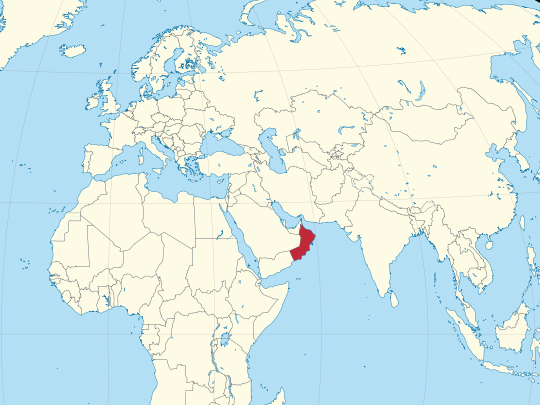
Capital: Muscat
Population: 5.2 million+
Language: Arabic/Swahili
1 – Jebel Akhdar (also above)
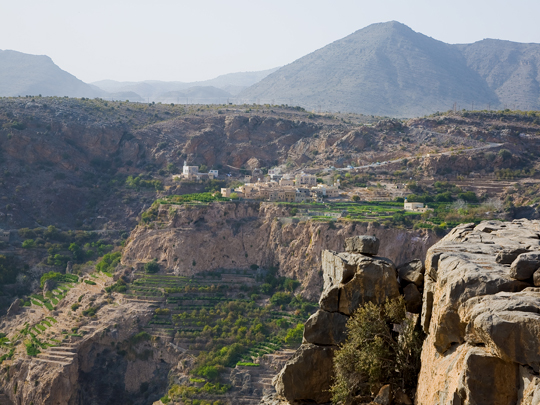
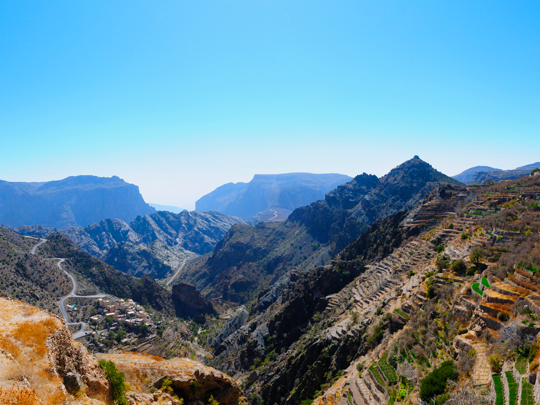
Jebel Akhdar — the Green Mountain — is a plateau at around two thousand metres in the Hajar range, a couple of hours inland from Muscat. It is green by Omani standards rather than anyone else’s: high enough to run ten or fifteen degrees cooler than the coast, with enough winter rain to grow things that will grow nowhere else in the country.
The villages on Jebel Akhdar sit along the rim of a canyon with their terraces below them, fed by falaj channels — stone and earth watercourses run off springs and maintained for centuries. Pomegranates, apricots, walnuts and damask roses grow on the terraces, and in April the roses are picked before dawn and distilled into rosewater.
In 1954 the Imam of Oman rebelled against the Sultan and withdrew onto Jebel Akhdar, which was held to be unassailable: one guarded road, and cliffs everywhere else. The war dragged on for five years. In January 1959 two SAS squadrons climbed the escarpment overnight carrying their own equipment and were on the plateau by morning. The rebellion collapsed within days.
2 – Nakhal Fort
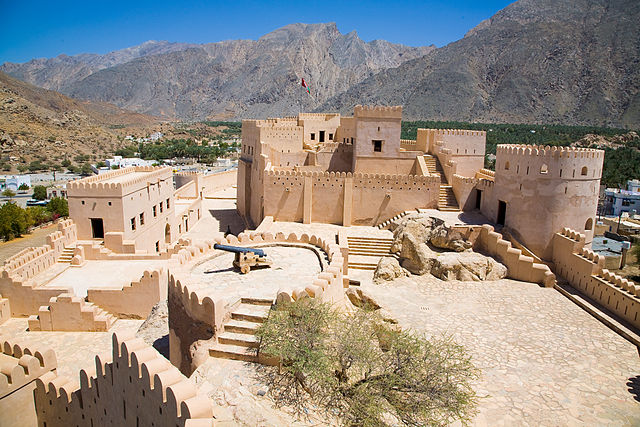
Nakhal Fort stands on a rock outcrop at the foot of the Hajar mountains, about ninety minutes west of Muscat and above a plain of date palms. Parts of its foundations are pre-Islamic; the fort as it stands is largely seventeenth-century Ya’ruba work with later additions, and it was restored in 1990. What makes Nakhal Fort worth the detour is how it was built.
The walls do not sit on the rock so much as follow it — the outcrop comes up through the floors, the towers are shaped around the stone, and in places the bedrock simply is the wall. Below the fort are the hot springs at Ain A’Thowarah, running at around forty-five degrees.
Oman has something in the region of five hundred forts, towers and castles, which for a country of five million people is an extraordinary density. They were not built against one enemy. The interior was tribal, the coast was fought over by the Portuguese and the Persians, and the Imams and the Sultans spent centuries in conflict with each other. Almost every oasis has one.
3 – Royal Opera House – Muscat
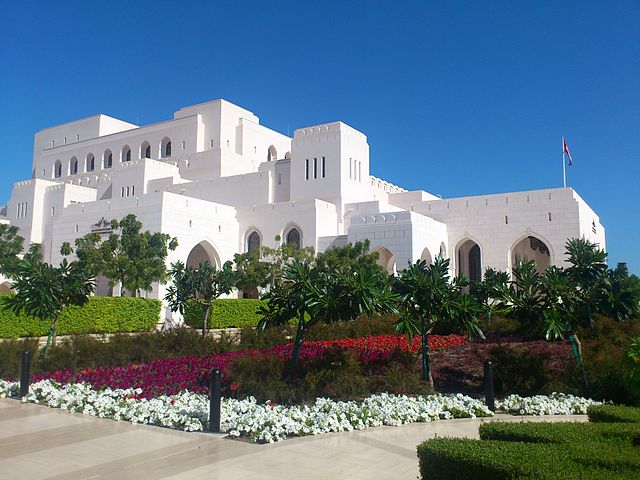
The Royal Opera House opened in Muscat in October 2011, the first purpose-built opera house in the Arab Gulf. Sultan Qaboos commissioned it, and the building is Omani in idiom rather than an imported concert hall — carved limestone, teak, arcades and gardens — seating around eleven hundred.
The auditorium of the Royal Opera House has retractable seating and a movable proscenium, so it can take opera, ballet, orchestral concerts and Arabic music in turn, and every seat carries a small screen with surtitles in Arabic and English. It opened with Turandot, conducted by Plácido Domingo.
The building came second. In 1985 Qaboos decided Oman should have a symphony orchestra and, rather than hire one, had around a hundred Omani schoolchildren selected — most of whom had never seen the instruments — and taught from scratch. The Royal Oman Symphony Orchestra gave its first public concert in 1987, and it remains the only orchestra of its kind in the Arab world made up entirely of nationals.
4 – Bahla Fort
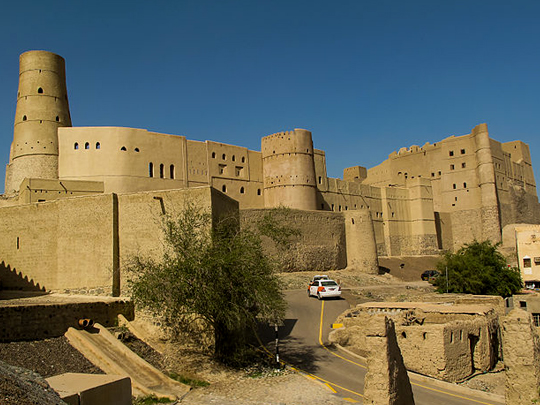
Bahla Fort stands above an oasis at the foot of Jebel Akhdar, and it is enormous: a mud-brick citadel on a stone base, inside a walled oasis whose defences run for kilometres. Most of what survives is thirteenth and fourteenth century, from the Banu Nabhan period, though parts go back considerably further.
In 1987 Bahla became Oman’s first UNESCO World Heritage Site. The town of Bahla is as old as its fort and has a reputation across Oman for magic — it is where the jinn are said to come from, and Omanis will tell you so with varying degrees of seriousness. The souq beside the fort still sells the pottery Bahla has been making for centuries.
A year after Bahla Fort was listed, it went onto the World Heritage in Danger list — and Oman put it there itself, submitting the nomination in February 1988, because the unfired mud brick was collapsing every rainy season and the country could not hold it alone. It stayed on that list for sixteen years, and the fort only reopened in 2012.
5 – Wadi Shab
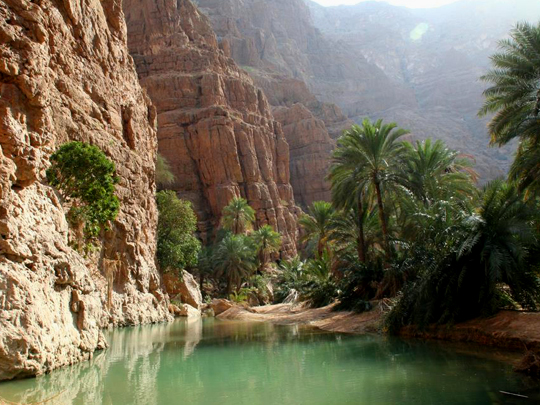
Wadi Shab cuts inland from the coast road between Muscat and Sur, about two hours from the capital. A wadi is a valley that is dry until it isn’t; this one carries water all year from springs, which is why there are date palms and banana trees growing in the bottom of a gorge in the middle of a desert.
You cross the inlet at the mouth of Wadi Shab by boat — somebody will row you over for a small fee — then walk about forty-five minutes up the canyon, over boulders and along falaj channels, past terraces and an abandoned village. Three pools lie at the top, deep and green, and you swim between them. The last pool is not the end of it.
On the far side there is a crack in the rock about half a metre wide, and if you swim through it on your side you come out into a chamber inside the mountain, with a waterfall dropping into it and daylight coming through a hole in the roof. There is no way to see any of that from outside.
6 – Nizwa Fort
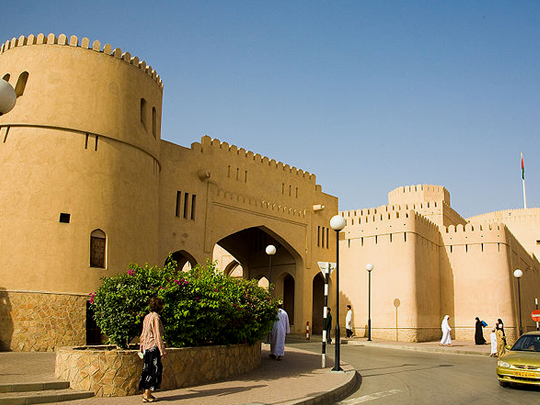
Nizwa was the capital of Oman’s interior and the seat of the Ibadi imamate, and its fort is the most visited monument in the country. The rectangular castle beneath is far older, but the great round tower was built between 1656 and 1668 by Imam Sultan bin Saif, who had recently finished driving the Portuguese out of Muscat.
The tower at Nizwa Fort is thirty-four metres high and forty-five across, and the bottom fifteen metres of it are solid — packed stone and rubble, so cannon fire went into the mass and stopped. Twenty-four guns on the roof covered every direction, and the whole thing was built above a well so it could not be cut off from water. The souq next door still trades livestock on Friday mornings.
Getting up the tower means one twisting staircase through seven doors, each set at a turn, each with shafts opening directly above it. Defenders poured boiling water and oil down them — and when those ran short, date syrup, drawn off the bags of dates stored in the cellars below. It sticks, it holds its heat, and there was always plenty of it.
7 – Sultan Qaboos Grand Mosque
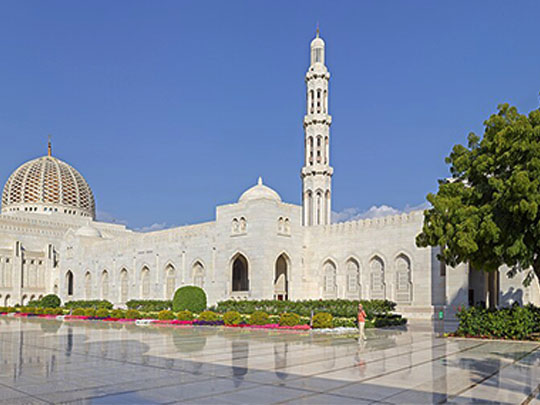
Sultan Qaboos called for a grand mosque in 1992, held a design competition the following year, and opened the result on 4 May 2001 — thirty years to the month after he took power. The Sultan Qaboos Grand Mosque is built from some three hundred thousand tonnes of Indian sandstone, has five minarets, and takes around twenty thousand people across its halls and courtyards.
The carpet in the main prayer hall is a single piece: 1.7 million knots, twenty-one tonnes, made by six hundred women in Khorasan over four years, woven in eighty-five sections and stitched together on site. Above it hangs a Swarovski chandelier fourteen metres tall and eight tonnes heavy, with a staircase inside it so somebody can get at the bulbs.
Oman is the only country in the world with an Ibadi majority — a school of Islam that separated in the seventh century, before the Sunni and Shia division hardened, and which survives in strength almost nowhere else. The Grand Mosque takes its decoration from across the Islamic world rather than from any one tradition, and it is the only mosque in Oman that admits non-Muslims.
8 – Ras al Jinz
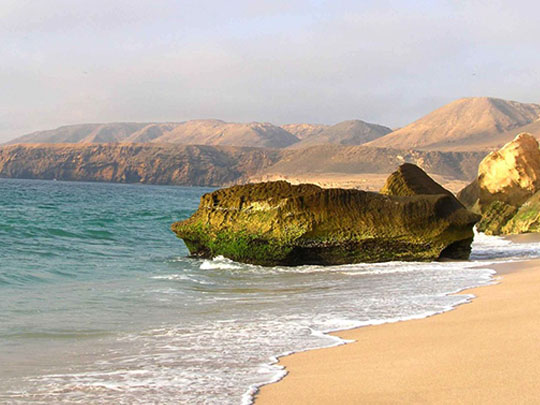
Ras al Jinz is the easternmost point of the Arabian peninsula, a headland beyond Sur where the Gulf of Oman meets the Arabian Sea. It has been a protected turtle reserve since the 1990s, and it is one of the most important green turtle nesting beaches in the Indian Ocean — thousands of females come ashore here each year, in every month of the year.
You see them at Ras al Jinz on a guided walk before dawn or after dark, without torches and without flash: the females haul up the sand, dig, lay upwards of a hundred eggs, cover the nest and go back down. Each is returning to the beach where she hatched decades earlier, having found her way back to it across an ocean. People have been launching boats off this beach for a very long time.
Excavations at Ras al Jinz have turned up slabs of bitumen from around 2500 BC with barnacles on one face and the impressions of reeds and rope on the other — waterproofing stripped from the hulls of reed vessels. It is among the earliest physical evidence anywhere of seagoing boats, and Indus Valley pottery was found alongside it.
9 – Dhofar and the Land of Frankincense
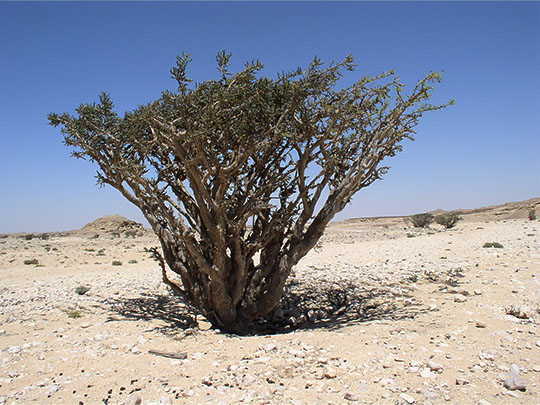

Dhofar is Oman’s southern province, eight hundred kilometres from Muscat, and it is the only part of Arabia that catches the Indian Ocean monsoon. From late June to early September the khareef wraps the hills in fog and drizzle and turns them green, and Gulf families drive for days to sit in it. UNESCO listed four sites in Dhofar in 2000 as the Land of Frankincense.
Those four are Wadi Dawkah, a grove of frankincense trees on the dry inland side of the hills; the port of Sumhuram at Khor Rori, fortified two thousand years ago to control the trade; Al-Baleed, the medieval city of Zafar on the Salalah shore; and the caravan oasis at Shisr, out towards the Empty Quarter. Shisr is the one with the story.
In 1992 a team using NASA radar traced old caravan tracks converging on a point in the desert, dug there, and found a fortress around a collapsed sinkhole — and the press announced the discovery of Ubar, the lost city of the Quran and of Lawrence’s “Atlantis of the Sands”. The archaeologist on the team was more careful: the satellites narrowed the search, he said, and digging found it. Most scholars now doubt the Ubar identification altogether.