
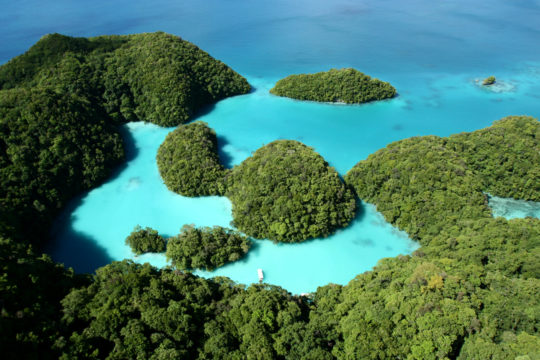
Wikimedia Commons / CC-BY-SA-3.0 / GFDL
Capital: Ngerulmud
Population: 17,000+
Language: English/Palauan (Japanese is an official language in the state of Angaur – the only place in the world where Japanese holds official status)

1 – Milky Way (also above)
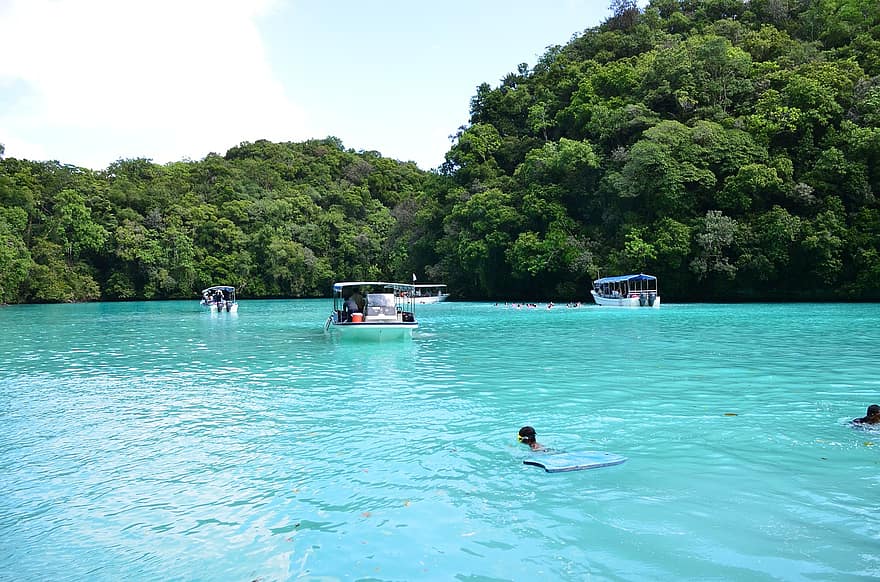
A sheltered cove among the Rock Islands south of Koror, known locally as Kangun, where the water turns an opaque milky turquoise — not from minerals bubbling up or algae blooming, but from a bed of fine white silt on the floor, the limestone islands themselves worn down over millennia by rain, tide and weathering into calcium carbonate powder.
Boats anchor in the middle of the cove and guides free-dive to the bottom to bring up bucketfuls of the mud, which everyone smears on head to foot, lets bake for a few minutes in the sun, and then rinses off by jumping back into the lagoon.
Palauans have used the mud as a skin treatment for generations, and the standing local claim is that it takes ten years off you — the cosmetic promise is untested, but the geology behind it is real enough, because what you are rubbing into your skin is the pulverised remains of the islands you are anchored between.
2 – Peleliu
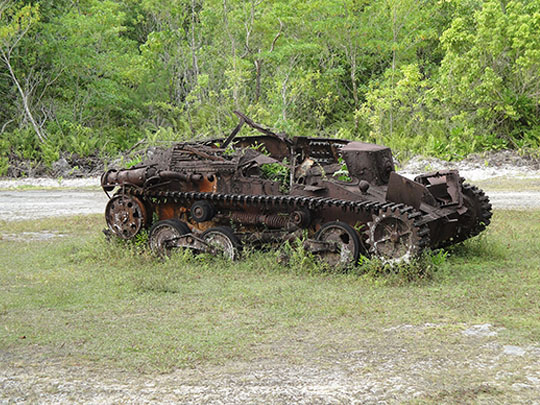
A low coral island at the southern end of the Palauan chain, Peleliu was held in 1944 by around 11,000 Japanese troops who had given up defending the beaches in favour of more than five hundred linked caves and tunnels dug into the coral ridges — and the American landing on 15 September opened what became, for the numbers engaged, the costliest battle of the Pacific war.
The island is effectively one open-air memorial: rusting tanks and field guns standing in the scrub, the shell of the Japanese headquarters building, caves that still hold equipment, the airstrip the whole thing was fought for, and the shattered coral ridges of the Umurbrogol that the Marines named Bloody Nose Ridge.
The commanding general told his Marines it would be over in four days, five at the most; it took two and a half months. In the aftermath of the war, the battle has been questioned in the United States, with people feeling too many lives had been lost for an island that had little strategic value.
3 – Rock Islands
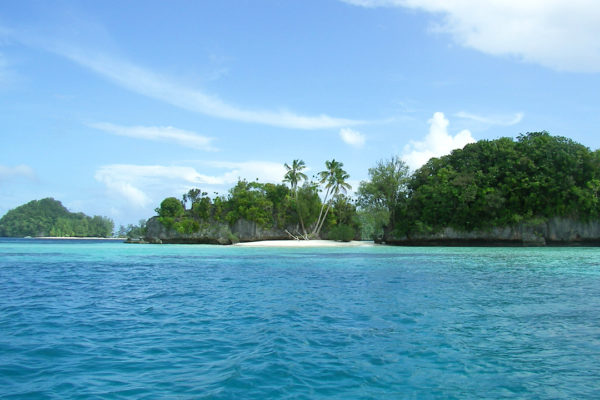
Four hundred and forty-five uninhabited limestone islands scattered across a lagoon south of Koror, ancient coral reefs pushed up out of the sea and then undercut by the waves into their mushroom shapes; people used these islands for three thousand years and built permanent stone villages on a few of them, which were abandoned in the 17th and 18th centuries when the land could no longer support the numbers living on it.
The lagoon holds 52 marine lakes, the greatest concentration anywhere on earth, along with burial caves and panels of red rock art, and the diving at Blue Corner and German Channel is routinely rated among the best in the world; UNESCO listed the whole area in 2012 for its nature and its human history together.
Palau has an old custom called bul, a moratorium declared by chiefs to let a stretch of reef recover, and in 2017 the country wrote it into immigration law — every arriving visitor now signs a pledge stamped in their passport, drafted with the help of Palauan schoolchildren, promising to tread lightly and take nothing home.
4 – Jellyfish Lake
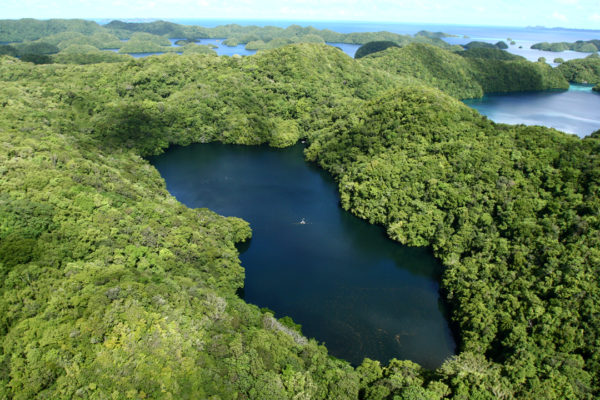
Known in Palauan as Ongeim’l Tketau, this is one of seven marine lakes in the Rock Islands holding jellyfish, cut off from the open sea roughly twelve thousand years ago as the ice age ended and the limestone closed around it, leaving everything inside to evolve on its own terms.
Getting there means a short steep climb over the ridge on Eil Malk and down to a jetty on the far side; snorkelling is allowed and diving is not, because below about fifteen metres the lake holds no oxygen at all and enough hydrogen sulphide to be lethal.
The golden jellyfish here follow the sun, gathering at the western end overnight, swimming east at first light and turning back by mid-afternoon for a round trip of about a kilometre — and they stop dead at the line where lakeside trees throw a shadow on the water, because the anemones that eat them live in the shade. Sadly, in recent years the jellyfish population has dipped well below its peak.